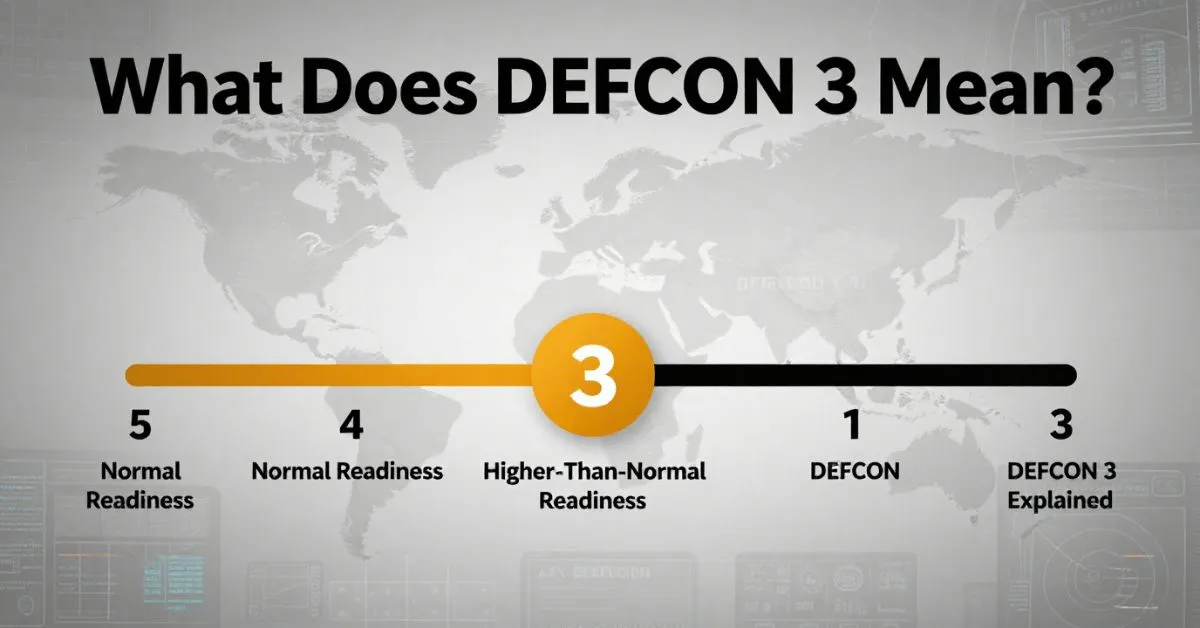
DEFCON 3 means the U.S. military is at a higher-than-normal state of readiness. It signals serious tension and faster military preparedness, but it does not automatically mean war has started or that a nuclear attack is imminent.
If you want the simplest possible explanation, think of DEFCON 3 as a warning that the situation is serious enough for the military to prepare more quickly than usual.
It is an elevated alert level, not the highest one. That difference matters because many people hear “DEFCON 3” and assume it means immediate war. In reality, DEFCON 3 sits in the middle of the DEFCON scale and reflects heightened readiness, not maximum emergency status.
This guide explains what DEFCON 3 means in plain English, where it sits on the DEFCON scale, how it compares with other levels, and what real historical examples can teach us about the term. It is written to help readers who saw the phrase in news, military history, or online discussion and want a clear answer without jargon.
What does DEFCON mean?
DEFCON stands for Defense Readiness Condition. Merriam-Webster defines it as one of five levels of U.S. military defense readiness ranked from 5 to 1, with 1 representing the highest level of perceived threat. In other words, the lower the number, the more serious the alert.
That point is important because many people assume the numbers work the opposite way. They do not. DEFCON 5 is normal peacetime readiness.
DEFCON 1 is the most severe level. DEFCON 3 is above normal and signals that the military is preparing for a situation that could become more dangerous.
What DEFCON 3 means in simple terms
In plain English, DEFCON 3 means the U.S. military has raised its readiness level above normal because of a serious threat or unstable situation.
The Federation of American Scientists summarizes DEFCON 3 as an increase in force readiness above normal readiness. Historical State Department records also describe DEFCON III as a high stage of preparedness used when attack is not yet imminent.
So the practical meaning is this: the danger is serious enough that the military wants to react faster, position forces more carefully, and be better prepared in case events escalate. That is why DEFCON 3 sounds intense. It is intense. But it is still not the same as saying war has already begun.
Does DEFCON 3 mean war?
No. This is the most common misunderstanding, and it is the first confusion a strong article should clear up.
DEFCON 3 does not automatically mean war has started. It also does not automatically mean nuclear missiles are about to be launched.
It means readiness has been raised because the military sees a serious enough threat to prepare more aggressively than usual. That is different from saying attack is immediate or unavoidable.
A simple way to remember it is:
- DEFCON 3 = serious readiness
- Not = instant war
- Not = maximum alert
That distinction is what many searchers are actually looking for when they type this keyword into Google.
Where DEFCON 3 sits on the DEFCON scale
The easiest way to understand DEFCON 3 is to compare it with the full scale.
| DEFCON Level | General meaning | Plain-English takeaway |
|---|---|---|
| DEFCON 5 | Normal peacetime readiness | Routine readiness |
| DEFCON 4 | Increased intelligence watch and security measures | More caution than normal |
| DEFCON 3 | Force readiness above normal | Serious tension, faster preparation |
| DEFCON 2 | Further increase in readiness, below maximum | Very high alert |
| DEFCON 1 | Maximum readiness | Most severe level |
This table shows why DEFCON 3 matters. It is a meaningful step above routine conditions, but two more levels still exist above it. That is why it is more accurate to describe DEFCON 3 as a major readiness alert rather than a declaration that the worst-case scenario is already happening.
DEFCON 3 vs DEFCON 4 vs DEFCON 2
DEFCON 4
DEFCON 4 is a lower alert level than DEFCON 3. FAS describes it as normal readiness with increased intelligence and strengthened security measures. That makes DEFCON 4 more about caution and monitoring than rapid force posture changes.
DEFCON 3
DEFCON 3 is the point where readiness rises above normal in a more serious way. It signals that the military sees real risk and wants a faster, stronger response posture. It is no longer simple caution. It is active preparation.
DEFCON 2
DEFCON 2 is one level higher than DEFCON 3 and much more severe. FAS describes it as a further increase in force readiness, below maximum readiness. Historically, DEFCON 2 is most associated with the Cuban Missile Crisis, which helps show how much more serious it is than DEFCON 3.
Quick comparison
If you want a simple memory trick:
- DEFCON 4: stay more alert
- DEFCON 3: prepare faster
- DEFCON 2: prepare for possible immediate conflict
- DEFCON 1: maximum readiness
That comparison makes the meaning much easier to understand than a vague definition alone.
Real examples of DEFCON 3 in history
Historical examples help show that DEFCON 3 is serious, but not automatically the final step before war.
1. Cuban Missile Crisis
The State Department’s history of the Cuban Missile Crisis says the Joint Chiefs of Staff announced a military readiness status of DEFCON 3 as U.S. naval forces began the quarantine of Cuba and military planning accelerated.
This is a classic example of DEFCON 3 being used during an extremely tense crisis when the United States needed stronger readiness without yet being at the maximum alert level.
2. 1973 Arab-Israeli War
State Department historical records say President Nixon ordered U.S. forces to DEFCON III during the October 1973 Arab-Israeli War. The same record describes it as the highest stage of preparedness when attack was not imminent.
This example is especially useful because it directly supports the plain-English idea behind DEFCON 3: the danger was serious enough for elevated readiness, but it was not the same as declaring that immediate attack had begun.
3. Korean crisis in 1976
After the August 18, 1976 incident in Korea, State Department records show the United States took a number of measures including DEFCON 3, aircraft deployments, and other visible military moves. Again, the pattern is the same: increased readiness, stronger signaling, and preparation for possible escalation.
4. September 11, 2001
National Archives records show that NORAD declared DEFCON 3 at 10:46 a.m. EDT on September 11, 2001.
This example matters because it shows DEFCON 3 is not only a Cold War term. It can also appear in fast-moving national security emergencies that require immediate military readiness and response.
What people often get wrong about DEFCON 3
Mistake 1: Thinking DEFCON 3 means nuclear war has started
That is false. DEFCON 3 means higher readiness, not automatic nuclear exchange. The history and reference material do not support the idea that DEFCON 3 by itself equals war.
Mistake 2: Thinking DEFCON 3 is the highest level
It is not. DEFCON 2 and DEFCON 1 are both more severe. The scale runs downward, not upward.
Mistake 3: Treating DEFCON 3 and DEFCON 2 as basically the same
They are not the same. DEFCON 2 is one level below maximum readiness and carries a much more severe meaning than DEFCON 3. If an article blurs those two levels together, it usually confuses the reader instead of helping them.
Mistake 4: Using the term without context
DEFCON is a military readiness system. The meaning becomes clearer when it is explained alongside the full scale, the historical situation, and what the level does not mean. That context is what turns a scary phrase into an understandable one.
How to understand DEFCON 3 in news or online discussion
When you see “DEFCON 3” in a headline, post, or discussion, the safest interpretation is not “war has started.”
The better interpretation is “the situation is serious enough that the military is preparing at a higher level than normal.” That framing matches the historical and reference record much better.
So if you want one plain-English takeaway, use this:
DEFCON 3 means elevated military readiness because of a serious threat, but it is not the same as immediate war.
Why this term matters
This term matters because it often appears in emotionally charged situations. A misunderstanding can make a situation sound even more dramatic than it already is.
For readers, journalists, students, or anyone following world events, knowing what DEFCON 3 actually means helps separate real military terminology from exaggeration. The value of the term is not only historical. It is also practical, because it helps people interpret serious language more accurately.
FAQ
What does DEFCON 3 mean in one sentence?
DEFCON 3 means the U.S. military is at a higher-than-normal readiness level because of a serious threat or unstable situation.
Is DEFCON 3 bad?
It is serious, because it shows the military sees enough risk to raise readiness above normal. But it is still not the most severe level.
Does DEFCON 3 mean nuclear war?
No. DEFCON 3 does not automatically mean nuclear war or immediate attack. It means heightened preparedness.
What is higher than DEFCON 3?
DEFCON 2 and DEFCON 1 are higher and more severe than DEFCON 3.
Has the U.S. ever gone to DEFCON 3?
Yes. Public historical records show DEFCON 3 in cases such as the Cuban Missile Crisis, the 1973 Arab-Israeli War, the 1976 Korea crisis, and NORAD on September 11, 2001.
What is the difference between DEFCON 3 and DEFCON 2?
DEFCON 3 means readiness above normal. DEFCON 2 is more severe and one step below maximum readiness.
Final takeaway
So, what does DEFCON 3 mean?
It means the U.S. military has moved above normal readiness because of a serious threat or crisis.
It is an important and elevated alert level, but it does not automatically mean war has started or that nuclear conflict is imminent. The clearest short answer is: DEFCON 3 means serious military readiness, not maximum emergency.
Read Also This Post: What Does Fugazi Mean in Slang?

Hi, I’m Evan Lexor, the voice behind Meanvia.com. I break down English words, slang, and phrases into clear, simple meanings that actually make sense. From modern internet terms to everyday expressions, my goal is straightforward: help you understand English better, faster, and with confidence, one word at a time.