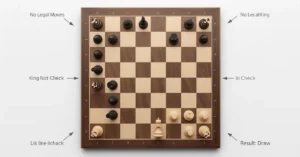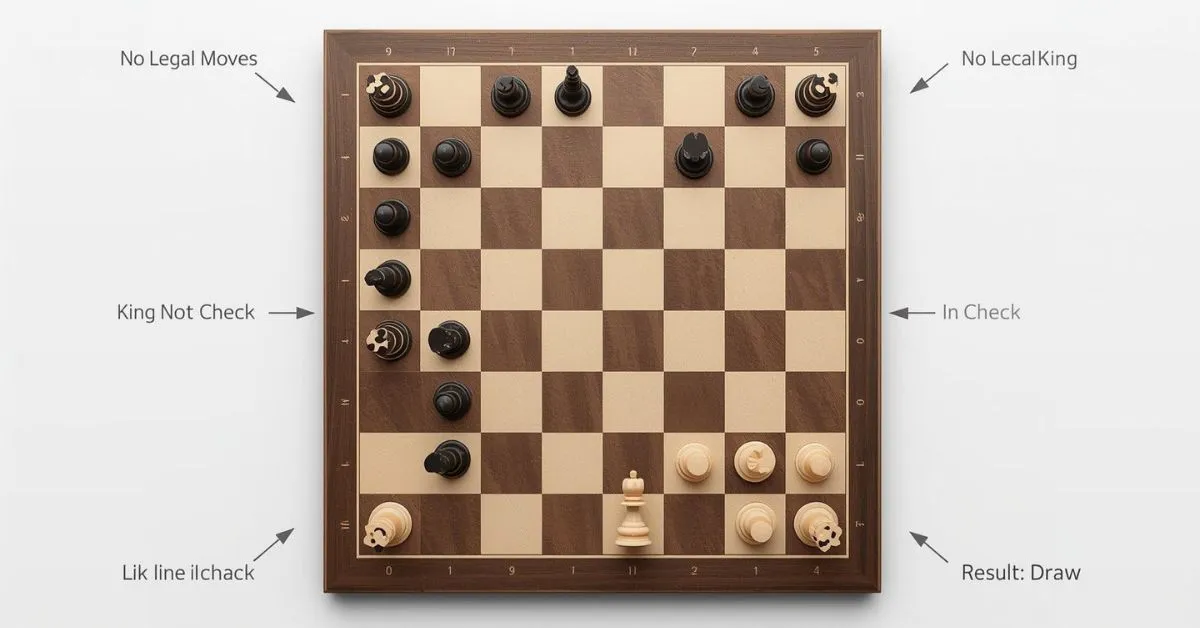
Stalemate in chess means the player whose turn it is has no legal move, but their king is not in check. When that happens, the game ends immediately as a draw.
A lot of players get confused because the king looks trapped, yet the game is not lost. The reason is simple: checkmate requires the king to be in check; stalemate does not. If there is no legal move and no check, the result is a draw, not a win.
Stalemate meaning in simple words
In plain English, stalemate means one side cannot make a legal move on its turn, and that side’s king is safe from check at that moment. Under FIDE’s Laws of Chess, that position immediately ends the game as a draw.
That definition contains the whole rule. Three things must all be true:
- It is that player’s turn
- That player has no legal move at all
- The king is not in check
If even one of those points is different, it is not stalemate.
Is stalemate a draw or a loss?
Stalemate is a draw. It is not a win for the attacking side, and it is not a loss for the defending side. Chess.com’s definitions and FIDE’s laws both treat stalemate as one of the standard drawing outcomes in chess.
That is why stalemate matters so much in real games. A player who is losing can sometimes save half a point by forcing stalemate, while a player who is winning can accidentally throw away the win by leaving the opponent with no legal move.
Chess.com and ChessKid both highlight that practical idea in their beginner explanations of draws and stalemate.
Stalemate vs checkmate
This is the distinction readers usually want first.
| Situation | King in check? | Any legal move? | Result |
|---|---|---|---|
| Stalemate | No | No | Draw |
| Checkmate | Yes | No | Loss for side to move |
FIDE’s rules make the difference exact: no legal move + king not in check = stalemate, while no legal move + king in check = checkmate.
That is the easiest way to explain it to a beginner:
If the king is trapped but not attacked, it is stalemate. If the king is trapped and attacked, it is checkmate.
How to tell if a position is stalemate in 10 seconds
Use this quick checklist:
1. Check whose turn it is
Stalemate only applies to the side to move. The same board position can be stalemate for one player and not for the other, depending on whose turn it is. FIDE’s laws define this directly through the player to move having no legal move.
2. See whether that king is in check
If the king is under attack, it cannot be stalemate. It may be checkmate, or there may still be a legal defense.
3. Look for any legal move from any piece
Do not look only at the king. Check every pawn and every piece. If there is even one legal move, the game continues. Chess.com’s help article explains this clearly: it is not stalemate if any piece can move legally without exposing the king to check.
That last point is where people make the most mistakes. A king that cannot move does not automatically mean stalemate.
Simple stalemate examples
Example 1: The classic corner stalemate
Imagine this position:
- Black king on h8
- White king on f7
- White queen on g6
- Black to move
Black is not in check. But Black cannot move to g8, g7, or h7 because those squares are controlled by White.
If Black has no other legal move, that is stalemate. It fits the rule perfectly: the side to move has no legal move, and the king is not in check.
Example 2: Accidental stalemate in a winning endgame
This often happens in king and queen vs king endings. The stronger side keeps pushing the enemy king to the edge and then makes a move that removes every legal square without actually giving check.
The position looks winning, but the result becomes a draw. ChessKid and Chess.com both use this type of pattern when teaching beginners how stalemate appears in practice.
Example 3: Defensive stalemate resource
A losing player can sometimes sacrifice the last movable piece or block their own remaining squares so that, after the opponent’s move, no legal move remains. That turns a likely loss into a draw.
ChessKid’s material on draws specifically notes stalemate as a surprise resource when the stronger side is careless about leaving a legal move.
Can stalemate happen with pieces still on the board?
Yes. Stalemate is about legal moves, not about how many pieces remain. It can happen in a bare-king endgame, but it can also happen with pawns, queens, rooks, or other pieces still on the board if the side to move has no legal move and is not in check.
Chess.com’s help article states this directly by explaining that no piece can be moved legally when stalemate occurs.
This matters because many readers wrongly assume stalemate only happens in very simple endgames. It does not.
Why stalemate matters in endgames
Stalemate is one of the most important practical endgame ideas because it changes how winning positions must be finished. A player who is ahead in material still has to leave the opponent either:
- a legal move, or
- a checking move that leads to mate soon after
If the stronger side removes every legal move without giving check, the game is drawn immediately. FIDE’s rules and beginner teaching pages from Chess.com both support this core practical lesson.
That is why strong endgame technique is not just about attacking. It is also about avoiding the one move that turns a win into a draw.
Common stalemate patterns beginners should know
Queen and king vs king accidental stalemate
This is probably the most common version for new players. The queen controls too many squares, the king helps trap the enemy king, and the final move freezes everything without giving check. Chess.com and ChessKid both teach stalemate through exactly this kind of beginner-friendly pattern.
King and pawn vs king defensive stalemate
Sometimes the weaker side uses the edge of the board and blocked pawn structures to reach a position where no move is possible. That can save a draw from a position that looked lost a few moves earlier. ChessKid’s draw lessons and stalemate examples point beginners toward this defensive idea.
Trapped king with blocked pawns
A king may be boxed in by enemy control while its own pawns are blocked and its remaining pieces cannot move legally. That is still stalemate if the king is not in check and there is no legal move anywhere.
Stalemate vs other draw rules
Stalemate is only one way a chess game can end in a draw.
| Draw type | What it means |
|---|---|
| Stalemate | Side to move has no legal move and king is not in check |
| Dead position | Neither side can checkmate by any legal series of moves |
| Agreement | Both players agree to a draw |
| Other draw rules | Repetition and move-count rules may also produce draws under chess rules |
FIDE distinguishes stalemate from dead position. A dead position is different because the draw comes from the impossibility of checkmate by any legal sequence, not from the side to move having no legal move right now.
That distinction is useful because readers often lump every non-win ending into one category. In chess rules, these are separate outcomes with separate definitions.
How to avoid stalemate if you are winning
If you are ahead, use this practical checklist before your move:
- Make sure the opponent will still have at least one legal move, unless your move gives check
- Check all enemy pawns and pieces, not just the king
- Be especially careful in queen endgames and edge-of-board positions
- When in doubt, give the opponent a small amount of space before building the final mating net
This is the simplest habit that prevents most accidental stalemates.
How to use stalemate if you are losing
If your position is hopeless, look for ways to remove your own legal moves while keeping your king out of check. That may sound strange, but it is a real defensive resource.
In practical chess teaching, stalemate is often presented as something to avoid when winning and something to look for when losing. ChessKid and Chess.com both teach it that way for beginners.
A lost position is not always fully lost until all drawing resources are gone.
What Most Articles Miss About This Topic
Most articles get the basic definition right, but they leave out the part that actually helps players use the rule correctly.
First, stalemate is not only about a king that cannot move. It is about the entire side to move having no legal move. If one pawn or one piece can move legally, there is no stalemate. Chess.com’s help page makes this practical point very clearly.
Second, stalemate and dead position are not the same thing. Both are draws, but they come from different rules and different board situations. FIDE treats them separately.
Third, stalemate is not a minor technicality. It is one of the most important endgame ideas in chess because it can rescue a draw from a losing position or waste a winning one. ChessKid and Chess.com both frame stalemate as a practical endgame lesson, not just a vocabulary term.
FAQ
What does stalemate mean in chess in simple words?
It means the player whose turn it is cannot make any legal move, but their king is not in check, so the game ends as a draw.
Is stalemate a draw?
Yes. Under the official chess rules, stalemate is a draw.
Is stalemate the same as checkmate?
No. In stalemate, the king is not in check. In checkmate, the king is in check and there is no legal escape.
Can stalemate happen with other pieces still on the board?
Yes. It can happen whenever the side to move has no legal move and is not in check, even if other pieces remain.
Does stalemate end the game immediately?
Yes. FIDE says stalemate immediately ends the game, provided the move that created the position was legal.
Why do beginners get stalemate wrong so often?
Because many players only look at whether the king can move. The real test is whether any legal move exists for the side to move, while the king is not in check.
Conclusion
Stalemate in chess means no legal move, no check, and therefore a draw. Once you understand that one formula, the rule becomes much easier to spot. It also becomes easier to use correctly: avoid it when you are winning, and look for it when you are losing. That is what makes stalemate one of the most important rules in practical chess.
Click Below To Read About These Posts:
What Does MIS Mean? Management Information Systems Explained
What Does It Mean When It Burns When You Pee?
What Does PPF Mean? Finance, Cars, Economics, and Pensions
Hi, I’m Clara Lexis from Meanvia.com. I break down words and expressions so they’re easy to understand and enjoyable to learn. My mission is simple: make language approachable and fun, one word at a time.