Ope is a casual interjection people use in small, awkward, or polite moments. It usually means something close to “oops,” “sorry,” or “excuse me,” and it is strongly associated with Midwestern U.S. speech, though it is not limited to the Midwest.
Pronunciation: most people say it like “ohp.”
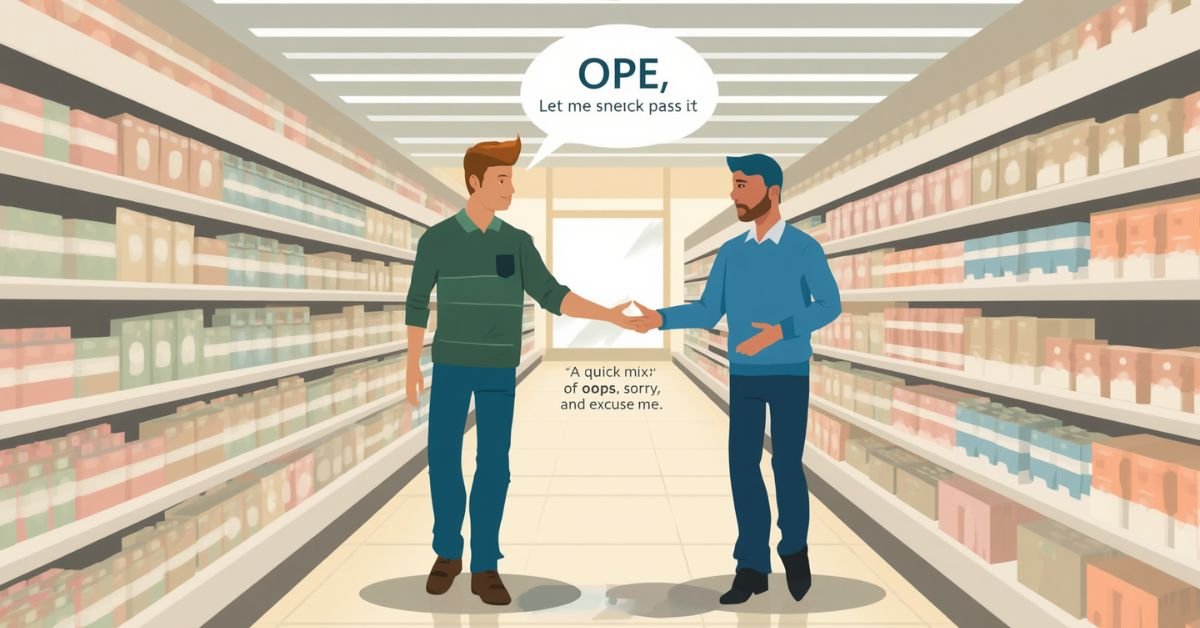
If you have heard someone say, “Ope, sorry,” or “Ope, let me sneak past you,” they are usually reacting to a tiny social moment: bumping into someone, getting in the way, dropping something, or noticing a small mistake. That is the easiest way to understand the word.
What does ope mean in slang?
In slang, ope is a small reaction word. It often comes out automatically when something minor happens. Depending on the situation, it can sound like:
- oops
- sorry
- excuse me
- a quick polite reaction to a tiny mistake or interruption
That is why people sometimes struggle to define it with one exact word. Ope is less about a strict dictionary translation and more about the kind of moment it appears in. It usually shows up when the situation is small, slightly awkward, and socially minor.
WPR’s language coverage also notes that some experts describe it less like a standard word with one fixed meaning and more like a quick vocal reaction or discourse-style marker.
The easiest way to understand “ope”
If the moment is tiny, polite, and a little awkward, ope probably fits.
For example:
- You lightly bump into someone in a store: “Ope, sorry.”
- You need to squeeze by someone: “Ope, let me sneak past.”
- You drop your pen: “Ope.”
- You notice something small too late: “Ope, there it is.”
That is what makes ope different from heavier or more formal phrases. It softens the moment instead of stopping it.
How people actually use “ope”
1. After a tiny mistake
This is one of the most common uses. You spill a little water, hit the wrong key, or almost knock something over.
Example:
“Ope, my bad.”
Here, the word works a lot like a light oops.
2. When slipping past someone politely
This is one of the best-known uses and one reason the word is so connected with Midwestern politeness.
Example:
“Ope, let me sneak past you.”
In this case, it is closer to excuse me than oops.
3. When lightly bumping into someone
Example:
“Ope, sorry.”
This is the “small apology” use. It usually signals that the speaker knows a tiny inconvenience just happened and wants to smooth it over quickly.
4. When noticing something suddenly
Example:
“Ope, there’s your phone.”
Some people use ope not only for apology or surprise, but also when they suddenly notice or point out something small. That wider use is one nuance many short dictionary-style pages skip.
Quick meaning table
The table below turns the word into practical use cases instead of treating it like a flat dictionary entry. It is based on how major dictionary and language sources describe the word in real conversational contexts.
| Situation | What “ope” usually means | Closest standard phrase | Example |
|---|---|---|---|
| You make a tiny mistake | mild acknowledgment | “oops” | “Ope, dropped it.” |
| You bump into someone | soft apology | “sorry” | “Ope, sorry about that.” |
| You need to get by | polite interruption | “excuse me” | “Ope, let me sneak past.” |
| You suddenly notice something | quick reaction | “oh” / “there it is” | “Ope, found it.” |
Is ope a Midwestern word?
Yes, but that answer needs nuance. The word is strongly associated with Midwestern speech, and Merriam-Webster specifically ties it to states such as Minnesota, Wisconsin, Michigan, and Illinois.
At the same time, it is better not to describe it as exclusively Midwestern. WPR’s reporting on the term notes that linguists and language observers have pointed to usage beyond the Midwest too. So the most accurate summary is this: ope has strong Midwestern identity, but the sound and usage are not necessarily limited to one region.
That distinction matters because many weak articles oversimplify the topic. Readers do not only want a label. They want to know whether they can still understand the word if they hear it elsewhere. Yes, they can.
Is ope the same as oops?
Not exactly.
Oops usually points more directly to a mistake.
Ope often feels softer and more social.
That means ope can cover some of the same ground as oops, but it also overlaps with sorry and excuse me in a way oops usually does not. Merriam-Webster explicitly defines it through those overlapping contexts.
A simple way to think about it:
- oops = “I made a small mistake”
- ope = “something small just happened, and I’m smoothing it over”
That is why “ope, let me get by” sounds natural, while “oops, let me get by” sounds a little off.
What does ope mean in text?
In text messages, comments, memes, or chats, ope usually keeps the same meaning it has in speech. It signals a small mistake, a quick apology, or a light awkward moment.
Examples:
- “ope sorry, just saw this”
- “ope, sent that too soon”
- “ope didn’t mean to reply all”
So the text meaning is not really separate. It is just the written version of the same casual spoken reaction. That makes this keyword partly a slang query and partly a texting-meaning query.
How do you pronounce ope?
Most people pronounce it like “ohp.” Dictionary.com gives the pronunciation as /oʊp/, which matches the common spoken form.
Where does ope come from?
The exact origin is not perfectly settled in a neat, universally agreed way. Merriam-Webster notes that it may be an alteration of “oops,” while WPR’s coverage shows that language experts treat the history with some caution rather than presenting a single clean origin story as proven fact.
That uncertainty is actually useful. It reminds readers not to overcomplicate the word. In real life, ope matters less as a historical puzzle and more as a tiny spoken reaction people use instinctively.
Does ope ever mean something else?
Yes. There is one other meaning worth knowing so you do not get confused.
In older English, ope can mean open. Merriam-Webster’s main dictionary entry for ope is the archaic verb form meaning open, and Dictionary.com also records that older sense.
So if you see the word in older writing, poetry, or older-style phrasing, it may have nothing to do with slang at all.
Common mistakes people make with this word
Mistake 1: Thinking it only means “oops”
That is too narrow. Ope often sits between oops, sorry, and excuse me.
Mistake 2: Thinking only Midwesterners say it
It is strongly linked to the Midwest, but that does not mean it belongs only to one region.
Mistake 3: Treating it like formal vocabulary
It is casual, spoken, and context-driven. It works best in conversational writing, dialogue, slang explainers, or informal social content.
Mistake 4: Ignoring tone
The tone is what makes the word work. Ope is usually mild, friendly, brief, and low-stakes.
What Most Articles Miss About This Topic
Most articles stop at “ope means oops” or “it’s a Midwestern word.” That is not enough.
What they often miss is that ope is really a social smoothing word. It helps speakers handle tiny moments of friction without making them bigger than they are. That is why it feels natural in lines like:
- “Ope, sorry.”
- “Ope, let me get past you.”
- “Ope, found it.”
That small social function is the real reason the word sticks in people’s minds. It is not just a funny regionalism. It reflects how people soften everyday interactions. WPR’s coverage also points toward this broader view by discussing how experts see the term as a small reflexive vocal reaction, not just a one-word substitute with a rigid definition.
FAQs
What does ope mean in slang?
It usually means a quick reaction like “oops,” “sorry,” or “excuse me” in a small everyday moment.
What does ope mean in text?
In text, it usually means the same thing it does in speech: a light apology, a tiny mistake, or a quick awkward reaction.
Is ope a Midwestern word?
It is strongly associated with the Midwest, especially states like Minnesota, Wisconsin, Michigan, and Illinois, but it is safer not to call it exclusively Midwestern.
Is ope the same as oops?
Not exactly. Oops focuses more on the mistake itself, while ope often softens the whole social moment.
How do you pronounce ope?
Most people say it like “ohp.”
Does ope mean open?
Sometimes, yes, but only in older English. In modern casual speech, the slang meaning is much more likely.
Conclusion
Ope means a quick, casual reaction like “oops,” “sorry,” or “excuse me.” It is strongly connected to Midwestern speech, but the bigger point is how it works: it smooths over tiny awkward moments in a friendly, low-key way. Once you understand that, the word becomes easy to recognize in speech, text, and online slang.
Click Below To Read About:
What Do Dreams Mean? Common Dream Themes, How to Interpret Them
What Does POS Mean in Slang? Texting Meaning, /pos, Uses
Hi, I’m Clara Lexis from Meanvia.com. I break down words and expressions so they’re easy to understand and enjoyable to learn. My mission is simple: make language approachable and fun, one word at a time.