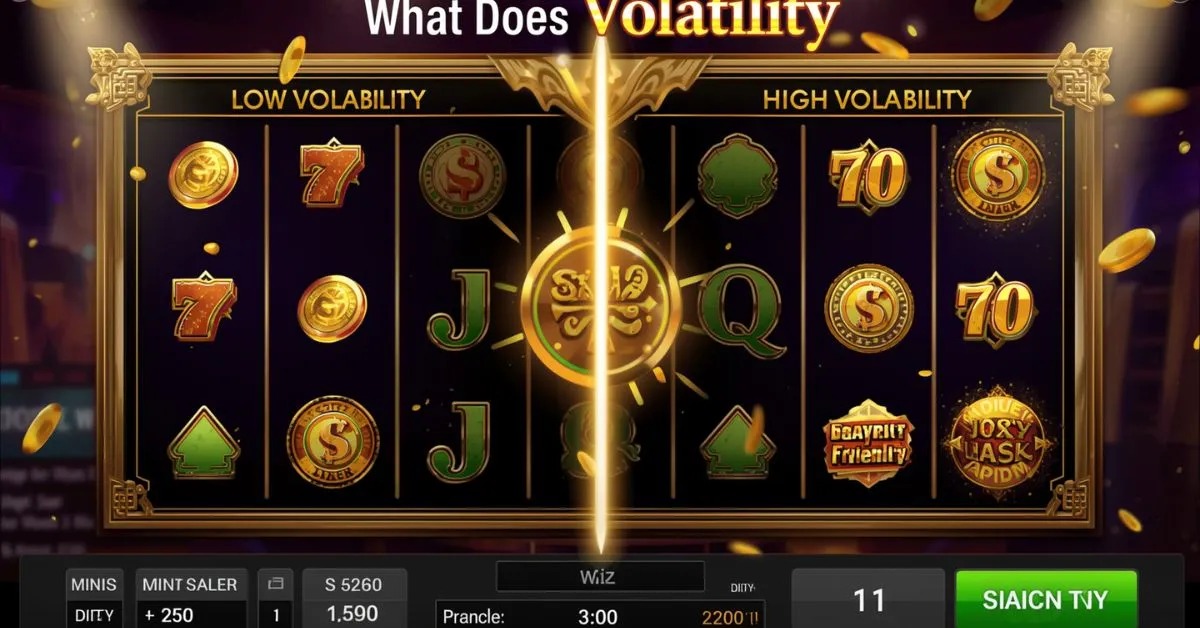
Volatility in slots means the game’s risk level: how often it usually pays and how large those payouts tend to be. Low-volatility slots usually give smaller wins more often, while high-volatility slots tend to pay less often but can produce larger wins when they hit.
If you are new to online slots, words like volatility, variance, RTP, hit frequency, and RNG can feel confusing. Many players think volatility tells them whether a slot machine is “good” or whether a big win is due. It does not. What it really tells you is what kind of ride to expect from the game. Some slots feel steady, with regular small wins.
Others can stay quiet for a long time and then hit much bigger through a bonus round, free spins feature, multiplier, or max-win event. Once you understand volatility, it becomes much easier to read a paytable, compare slot providers like NetEnt and Pragmatic Play, and choose a game that fits your bankroll and patience.
What does volatility mean in slots?
In simple terms, slot volatility describes the balance between win frequency and win size. One defines volatility as how often a game hits a pay and how much that pay is worth, while Rivalry describes it as a gauge for how often a slot pays and the typical size of those payouts. That is why volatility is often also called variance: it measures how much your results tend to swing.
This matters because two slot games can have similar RTP and still feel completely different. One slot machine may give many small line wins across its paylines and symbols.
Another may go through long quiet stretches and then pay through scatters, wilds, multipliers, or a bonus round. The long-term math may look similar, but the player experience is not.
Low, medium, and high volatility slots explained
Most online casino guides group slots into low volatility, medium volatility, and high volatility. Some slot providers use more detailed labels, but the idea stays the same: the higher the volatility, the more swingy the experience usually feels.
| Volatility level | What usually happens | Typical session feel | Often suits |
|---|---|---|---|
| Low volatility | Smaller wins happen more often | Smoother and steadier | Beginners, smaller bankrolls |
| Medium volatility | Mix of regular wins and occasional bigger hits | Balanced | Casual players |
| High volatility | Wins happen less often but can be much bigger | Swingy and riskier | Players comfortable with long dry spells |
Low-volatility slots
Low-volatility slots usually pay smaller amounts more often. They can feel more active because the reels produce frequent returns, even if many wins are modest. Casino.org notes that low-volatility slots tend to hit pays very frequently, but those wins are not worth very much.
These games are often easier for beginners because they can stretch a bankroll longer. They may not offer the same dramatic upside as a high-volatility slot, but they usually create a steadier session.
Medium-volatility slots
Medium-volatility slots sit in the middle. They still give regular action, but they also leave room for more noticeable wins from free spins, stacked symbols, bonus features, or multipliers.
This is often the most comfortable category for casual players because it balances excitement and session length.
High-volatility slots
High-volatility slots usually pay less often, but the upside can be much larger when a feature lands. Provider pages often link high volatility with larger max-win potential.
For example, Pragmatic Play labels Mysterious Egypt as a high-volatility slot and Dwarf & Dragon as a high-volatility slot with a max win of 14,000x bet.
This does not mean high volatility is better. It means the game can be tougher on a bankroll and patience level, especially during cold stretches.
Volatility vs RTP, hit frequency, and RNG
This is the section many readers need most, because these terms are closely related but not the same.
Volatility vs RTP
RTP means return to player. Gaming Laboratories International explains that RTP is calculated by evaluating or simulating possible outcomes using payout-table data to determine a game’s theoretical return. In other words, RTP is the long-run expected return built into the math of the game.
Volatility is different. RTP tells you the long-run average return. Volatility tells you how that return tends to arrive during play. A slot with 96% RTP can still feel brutal if it is high volatility, while another 96% slot may feel much smoother if wins come more often in smaller amounts.
Volatility vs hit frequency
Hit frequency measures how often some kind of win appears. NetEnt game pages show RTP, volatility, and hit frequency as separate fields, which makes it clear that providers treat them as different metrics.
For example, Cashomatic lists 96.33% RTP and 12% hit frequency, while Victorious MAX lists 96.95% RTP and 43% hit frequency.
That does not mean the 43% game is automatically “better.” A slot can hit more often but still pay many very small returns. This is why smart players look at RTP, volatility, hit frequency, paylines, paytable, and bonus design together, not one number alone.
Why RNG matters
Slots use a random number generator, or RNG, to determine outcomes. GLI’s gaming-device standards say RNG outcomes should be statistically independent, conform to the intended random distribution, pass recognized statistical tests, and be unpredictable.
That means volatility does not say a slot is due. A losing streak on a high-volatility game does not mean a jackpot or bonus round is coming next. Every spin is still its own event. Volatility describes the game’s payout pattern over time, but RNG controls each individual spin.
Why volatility changes the player experience so much
Volatility is not just a technical word. It changes how a slot feels from the first few spins to the last.
Session length
Low-volatility games often keep a balance alive longer because smaller wins arrive more regularly. High-volatility games can drain a bankroll fast if the reels stay quiet. That is why low and medium volatility usually suit smaller budgets better.
Perceived excitement
High-volatility slots often feel more dramatic because bonus rounds, free spins, wild reels, expanding symbols, or multipliers can lead to bigger jumps in balance. Pragmatic Play often connects high-volatility titles with bigger max-win language, such as Magic Money Maze at 10,000x max win and Extra Juicy Megaways at 5,000x max win.
Why “small wins” can still feel disappointing
A low-volatility slot may hit often, but many of those wins may be smaller than your total stake. So a player can see many green flashes and still slowly lose money over time. That is why win frequency alone can mislead beginners. The paytable, symbol values, and feature rules matter too.
Real examples: what volatility looks like in practice
Example 1: A $20 bankroll player
Imagine two players both make the same bet size.
- A player on a low-volatility slot may see more regular small line wins and may last longer.
- A player on a high-volatility slot may see fewer wins, hit more dead spins, and burn through the same bankroll faster, but may also have a chance at a much larger bonus result.
That does not guarantee either outcome on a single session. It simply shows why volatility matters for bankroll planning and expectation setting.
Example 2: Provider design makes volatility visible
Pragmatic Play’s Zeus vs Hades – Gods of War is a useful teaching example because it offers two different styles inside one title.
Its Olympus side gives a higher chance to trigger the bonus with a lower average win, while the Hades side gives a lower chance to trigger the bonus with a higher average win. That is volatility made visible through game design.
Example 3: Metrics published on game pages
NetEnt game pages help show how many moving parts affect the feel of a slot. Codex of Fortune shows RTP, volatility, hit frequency, reels and rows, bonus mode, and bet range on the game page. That is a good reminder that volatility is one part of the picture, not the whole picture.
How to spot a slot’s volatility before you play
Check the information screen
Many online slots publish game details in the help menu, info panel, or provider page. NetEnt and Pragmatic Play commonly publish RTP, and some pages also include hit frequency, max payout, bonus mode, reels, rows, and volatility labels.
Read the paytable and bonus features
A game with high multipliers, rare scatters, large free-spin potential, giant max-win marketing, or complex bonus features often leans toward higher volatility. PokerNews notes that higher multipliers tend to increase a game’s volatility because wins are less frequent but larger when they occur.
Use demo mode
Several provider pages offer demo play, including NetEnt titles like Cashomatic and Victorious MAX.
Demo mode cannot predict your real-money results, but it can help you understand the pace of the reels, the symbol values, the payline behavior, and how hard it is to reach bonus rounds.
Common mistakes players make with slot volatility
Mistake 1: Thinking high volatility means better value
It does not. High volatility means more risk and bigger swings, not automatically better value. RTP and volatility are separate.
Mistake 2: Chasing a “due” win
Because RNG outcomes are statistically independent and unpredictable, a cold slot is not building toward a guaranteed payout.
Mistake 3: Ignoring bankroll fit
A high-volatility game can be a poor match for a small bankroll. Many players choose a slot based on theme, jackpot size, or flashy graphics and ignore the risk profile. That often leads to frustration.
Mistake 4: Looking at RTP only
RTP matters, but without volatility and hit frequency it does not tell you how the session will feel. A slot with a familiar RTP can still be much more punishing than another game with similar math.
Which slot volatility is best for you?
| Player type | Best fit | Why |
|---|---|---|
| Beginner | Low or medium volatility | Easier to understand and usually gentler on a bankroll |
| Smaller bankroll player | Low volatility | More frequent wins may extend playtime |
| Casual player | Medium volatility | Offers balance between action and upside |
| Big-risk player | High volatility | More comfortable with long dry spells and bigger swings |
| Bonus-feature chaser | Medium or high volatility | More likely to prefer bigger upside from free spins, multipliers, or bonus rounds |
The best volatility is not universal. It depends on your bankroll, patience, and reason for playing. If you want a smoother experience, lower volatility is often the smarter choice. If you accept more risk for the possibility of larger hits, high volatility may be more appealing.
A quick responsible play note
Volatility is not a winning system. It is just a way to understand risk. GamCare recommends tools such as limit setting, taking frequent breaks, and self-exclusion when needed, and the National Council on Problem Gambling recommends setting time and financial limits and never chasing losses.
If you gamble, use a licensed operator, treat slots as entertainment, and stop when your limit is reached.
FAQs
Is volatility the same as variance in slots?
Yes. In slot content, volatility and variance are commonly used to mean the same thing: the game’s risk and payout pattern over time.
Does high volatility mean bigger jackpots?
Not always, but high-volatility games are often associated with larger potential wins, bigger bonus rounds, and higher max-win marketing. Pragmatic Play’s high-volatility titles often highlight large max-win potential.
Can two slots have the same RTP and different volatility?
Yes. RTP is the long-run expected return, while volatility describes how those returns tend to show up during play. Two slots can share similar RTP but feel very different.
How do I know if a slot is high volatility?
Check the game info screen, provider page, paytable, max-win language, hit frequency, and feature design. Providers like NetEnt and Pragmatic Play often publish some of these details directly.
Are high-volatility slots better for experienced players?
Not automatically, but they are usually better suited to players who understand bankroll swings and can handle longer losing stretches without chasing losses.
Does volatility affect session length?
Usually yes. Lower-volatility games often produce more frequent small wins, which can make a bankroll last longer, while high-volatility games can produce faster swings.
Should beginners choose low or high volatility?
Most beginners do better with low or medium volatility because the play tends to be steadier and easier to manage.
Does a long losing streak mean a slot is about to pay?
No. RNG-based slots are designed so outcomes are statistically independent and unpredictable. A losing streak does not mean a win is due next.
Conclusion
So, what does volatility mean in slots? It means the risk profile of a slot machine: how often it tends to pay and how large those wins tend to be. Low volatility usually means smaller, more frequent payouts. High volatility usually means fewer wins, bigger swings, and larger potential rewards when features hit.
Once you understand that, you can compare slots more intelligently, read provider pages better, and choose games that actually fit your bankroll, goals, and tolerance for risk.
Read Also About: What Does DMV Mean?

Hi, I’m Evan Lexor, the voice behind Meanvia.com. I break down English words, slang, and phrases into clear, simple meanings that actually make sense. From modern internet terms to everyday expressions, my goal is straightforward: help you understand English better, faster, and with confidence, one word at a time.