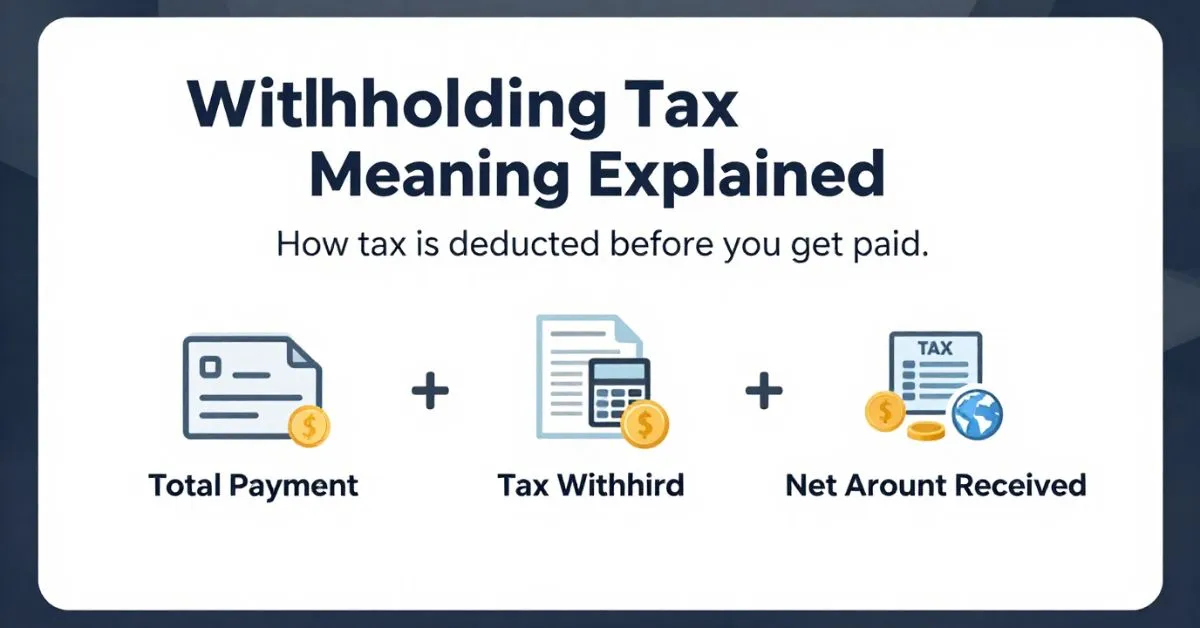
Withholding tax means part of a payment is deducted before the money reaches you, and that amount is sent to the government for tax purposes. It often applies to wages, but it can also apply to dividends, interest, royalties, contractor payments, and some cross-border payments.
In many systems, it works as an advance payment of tax, though the exact rules differ by country and payment type.
If you saw “withholding tax” on a paycheck, bank payment, invoice, dividend statement, or tax document, the basic idea is the same: the payer does not give you the full amount upfront.
Instead, part of the money is withheld and paid to the tax authority first. That is why withholding tax is often described as tax deducted at source.
In the United States, the IRS explains this through paycheck withholding and pay-as-you-go tax rules. In Pakistan, FBR describes withholding tax as an advance payment of tax deducted during specified economic activities, with some deductions treated as final and others adjustable.
What does withholding tax mean in simple words?
In simple words, withholding tax means tax is taken out before you receive the full payment. The payer could be an employer, a bank, a company paying a dividend, a customer, or another business that is legally required to deduct tax. The person receiving the money gets the remaining amount, and the withheld amount goes to the government.
That is the clearest way to understand it:
- You are owed money
- The payer deducts a tax amount first
- You receive the reduced amount
- The withheld amount is remitted to the tax authority
So withholding tax usually is not an extra surprise charge added on top of your tax. In many common situations, it is simply one method of collecting tax earlier instead of waiting until the end of the tax year.
The IRS specifically describes withholding and estimated tax as the two main ways pay-as-you-go federal income tax is paid during the year.
Why withholding tax exists
Governments use withholding so tax can be collected as money is earned or paid. That helps reduce nonpayment risk, spreads tax payments across the year, and can lower the chance that a taxpayer faces a large bill later.
The IRS explains that if enough tax is not paid through withholding or estimated tax, a taxpayer may owe additional tax and possibly a penalty.
Withholding is also common outside salary. The OECD notes that withholding taxes often apply to payments such as dividends, interest, and royalties, especially in international settings where tax has to be collected when income crosses borders.
Where you usually see withholding tax
Many people think withholding tax only appears on a paycheck, but that is too narrow. It can show up in several places.
On wages and salaries
In the U.S., employers commonly withhold federal income tax from employee paychecks and pay it to the IRS in the employee’s name. The amount withheld depends largely on earnings and the information the employee provides on Form W-4.
On reportable non-payroll payments
Some non-payroll payments can also be subject to withholding. In the U.S., backup withholding can apply to certain reportable payments in specific situations, such as when a taxpayer identification number is missing or incorrect. The IRS says backup withholding is generally 24% under those rules.
On dividends, interest, and royalties
Investment income and similar payments may also involve withholding. The OECD identifies dividends, interest, and royalties as common payment categories where withholding taxes may apply, especially in cross-border tax systems.
On payments to foreign recipients
Cross-border withholding is one of the most common reasons people search this term. In the U.S., many payments of U.S.-source income to foreign persons may be subject to withholding, and the IRS explains that this regime often involves Form 1042 and Form 1042-S. Treaty rules may lower the rate in some cases.
In Pakistan business and transaction settings
In Pakistan, FBR describes withholding tax as an advance tax deducted during specified economic activities under the Income Tax Ordinance and Sales Tax Act.
FBR also states that the treatment differs by section, with some deductions treated as final discharge and others adjustable against final tax liability. That makes withholding tax in Pakistan broader than the narrow “paycheck only” meaning many readers expect.
How withholding tax works
The process is usually simple:
- A payment becomes due
- The payer checks whether withholding rules apply
- A portion of the payment is deducted
- The recipient gets the remaining amount
- The withheld amount is reported and paid to the tax authority
- Depending on the system, the withheld amount may count as final tax, advance tax, or a credit against the recipient’s tax bill
That last point matters. The meaning of withholding tax is easy, but the effect of withholding tax can differ.
In one case, the withheld amount may simply be a prepayment. In another, it may fully settle tax on that payment. That is why readers often get confused when they move between countries, payment types, or tax systems.
Simple real-life examples
Example 1: Withholding tax on a paycheck
Imagine your gross pay is $1,000. Your employer withholds $120 for income tax and pays you $880. The withheld $120 is not automatically lost. In the U.S. system, that amount is generally credited on your tax return. If too much was withheld over the year, you may get a refund. If too little was withheld, you may still owe more.
Example 2: Withholding tax on a dividend
A company declares a dividend payment. Before sending you the money, it withholds part of the amount because tax rules require collection at the source. You receive the net amount. Depending on the jurisdiction and your status, the withheld amount may be final, creditable, or reduced by treaty.
Example 3: Withholding tax in Pakistan
A business payment in Pakistan may trigger withholding because the law requires tax to be deducted at source for that type of transaction. Under FBR’s framework, the deducted amount may be adjustable against final liability in some cases, while in others it may count as final discharge.
What withholding tax means for you in real life
Here is the practical interpretation most readers want:
| Situation | What withholding tax means |
|---|---|
| Paycheck | Tax was taken before you were paid, usually as part of pay-as-you-go income tax |
| Dividend or interest payment | The payer deducted tax before sending the income |
| Foreign payment | Tax may have been withheld because of source-country rules |
| Pakistan transaction | Tax may have been deducted at source as advance tax, sometimes adjustable and sometimes final |
This is why the term feels confusing. The basic meaning stays the same, but the legal result can change depending on the payment and the country.
Is withholding tax the same as income tax?
Not exactly.
Income tax is the underlying tax. Withholding tax is usually a collection mechanism. In many systems, it is one way of paying income tax before filing a return.
The IRS explains that withheld tax can be taken as credit on the return, which shows that withholding often functions as prepaid tax rather than a separate tax category for everyday users.
But this is where country differences matter. In Pakistan, FBR explicitly says withholding tax may be treated as final discharge in some sections and adjustable in others. So the smartest explanation is this:
- sometimes withholding is a prepayment
- sometimes it is the final tax on that payment
- the exact answer depends on the rule that applies
Withholding tax vs estimated tax
These are related, but they are not the same.
Withholding happens when the payer deducts tax before paying you. Estimated tax happens when you pay tax yourself during the year because withholding does not cover enough, or because your income is not fully subject to withholding. The IRS explains that self-employed people often pay this way.
So if you are an employee, withholding may handle much of your tax during the year. If you are self-employed, receive untaxed income, or have complex income sources, estimated tax may still matter.
U.S. meaning vs Pakistan meaning
This is one of the biggest missing clarifications on many competing pages.
In the United States
The most common beginner meaning is paycheck withholding. Employers withhold federal income tax from wages, and the amount depends on earnings and Form W-4 information. The broader U.S. system also includes backup withholding and withholding on some payments to foreign persons.
In Pakistan
The term is often used more broadly. FBR describes withholding tax as advance tax deducted during specified economic activities, and it makes clear that different sections can have different rates and different treatment, including final and adjustable outcomes.
Why this matters
If your article does not explain this difference, readers may leave with the wrong impression. A U.S. reader may think only of salary withholding.
A reader may think of a much wider deducted-at-source tax system tied to transactions, banking activity, services, contracts, imports, and other specified payments. That is exactly why a stronger article needs this distinction.
Common mistakes and misconceptions
“Withholding tax means I lost that money forever.”
Not usually. In many ordinary income-tax systems, withheld tax counts toward what you owe and can increase a refund if too much was withheld. The IRS says taxpayers take credit on the return for tax withheld and estimated tax paid.
“Withholding tax only applies to salary.”
No. It can also apply to certain reportable payments, dividends, royalties, interest, and foreign-person payments, depending on the applicable rules.
“If tax was withheld, my taxes are fully settled.”
Not always. In the U.S., withholding may be only part of the year’s tax payment. In Pakistan, some withholding is adjustable while other withholding may be final.
“The same withholding rule applies everywhere.”
Definitely not. Country rules, payment types, tax treaties, documentation, and residency status can all change the result.
What affects how much gets withheld
The amount withheld can depend on several factors, including:
- the type of payment
- your tax status or residency
- the information or forms you provided
- whether domestic or international rules apply
- whether a treaty or specific section changes the rate
- whether the withholding is meant to be final or adjustable
For example, in the U.S., Form W-4 affects employee wage withholding. For foreign-person withholding, different documentation and rules apply. In Pakistan, the applicable section and activity determine both the rate and treatment.
Practical takeaway
If you want the simplest accurate answer, it is this:
Withholding tax means tax is deducted from a payment before you receive it.
That payment might be salary, a dividend, interest, a royalty, a contractor payment, or a cross-border payment.
In many cases, the withheld amount is an advance payment of tax. In other cases, it may be final for that specific payment. The exact result depends on the country, the payment type, and the rule that applies.
FAQs
What does withholding tax mean on a paycheck?
It means your employer deducted part of your wages for income tax before paying you and sent that amount to the tax authority on your behalf. In the U.S., this is part of the pay-as-you-go system.
Is withholding tax refundable?
It can be. If the withheld amount is creditable and more than your actual tax liability, you may receive a refund after filing. In other systems or payment categories, withholding may be final instead.
Is withholding tax the same as payroll tax?
Not necessarily. The phrase “withholding tax” often refers to income tax withheld from a payment, while payroll taxes can include other required deductions depending on the jurisdiction. The exact label differs by country.
Does withholding tax apply only to employees?
No. It can also apply to certain non-payroll payments, investment income, and payments to foreign persons.
What is backup withholding?
In the U.S., backup withholding is a specific withholding rule for certain reportable non-payroll payments, and the IRS says the rate is generally 24%.
What is withholding tax on foreign payments?
It usually means the source country requires part of a payment to a foreign person to be withheld before the payment is sent. In the U.S., many U.S.-source payments to foreign persons may be subject to NRA withholding, often at a statutory 30% rate unless a lower treaty rate applies.
What does withholding tax mean in Pakistan?
FBR describes it as advance tax deducted at the time of specified economic activities. Depending on the section, the deduction may be final or adjustable against the taxpayer’s final liability.
What is the difference between withholding tax and estimated tax?
Withholding tax is deducted and paid by the payer before you receive the money. Estimated tax is paid directly by the taxpayer during the year when withholding does not fully cover the tax due.
Conclusion
When people search “what does withholding tax mean,” they usually want a plain answer they can apply to real life. The plain answer is that part of a payment is withheld before it reaches you and sent to the government for tax purposes.
The better answer is that the same basic idea appears in different ways: on paychecks, on investment income, on foreign payments, and in broader deducted-at-source systems like Pakistan’s withholding regime.
Click Here To Read About: What Does Fugazi Mean in Slang

Hi, I’m Clara Lexis from Meanvia.com. I break down words and expressions so they’re easy to understand and enjoyable to learn. My mission is simple: make language approachable and fun, one word at a time.