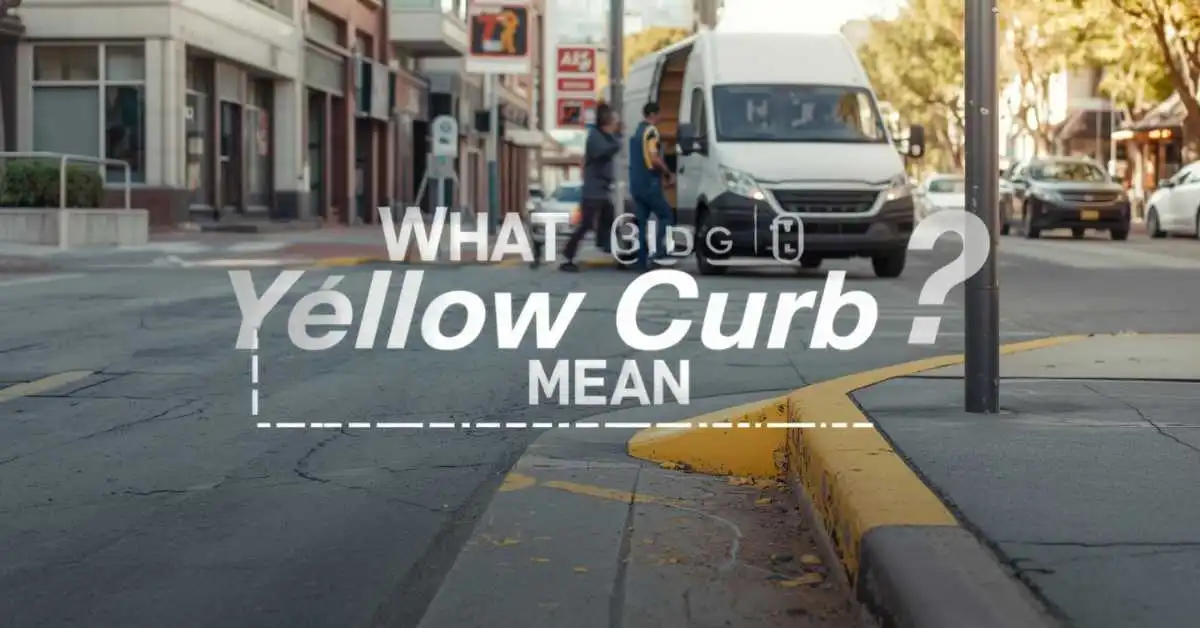
If you see a yellow curb, do not assume it means you can park there. In many places, yellow curbs mark a restricted curb area, often used for loading, unloading, commercial vehicles, or other special purposes. However, the exact rule can change from one city or location to another.
That is why the yellow curb meaning is best understood together with nearby parking signs, posted hours, and local traffic rules. A yellow curb may allow brief loading in one area but have a different restriction somewhere else. Some cities also use yellow curbs for specific zones such as truck loading areas or taxi stands.
In this guide, you will learn what a yellow curb means, when you can stop or park near one, how yellow differs from other curb colors, and why checking local signs matters before leaving your vehicle.
The quick answer: What does a yellow curb mean?
In many cities, a yellow-painted curb marks space for loading and unloading people or goods rather than standard parking. The California DMV says yellow means load and unload passengers and freight, with any time limit posted on signs or painted on the curb.
It also notes that drivers of noncommercial vehicles usually must stay with the vehicle. Seattle’s SDOT also uses yellow curbs for load/unload zones and several commercial loading uses.
That said, yellow curb meaning is not universal. Corvallis says yellow-painted curbs denote no-parking zones, often near a fire hydrant, stop sign, intersection, transit stop, bike lane transition, or driveway approach.
Sidney says even more directly that a yellow curb means no parking at any time. So the most accurate answer is this: a yellow curb usually signals a restricted curb space, often for loading, but the exact rule depends on the location.
What Does Yellow Curb Mean
A yellow curb signals a restricted zone mainly for loading and unloading. In most U.S. cities, especially on the West Coast, it allows commercial vehicles up to 30 minutes for freight and passenger cars only a few minutes for people or bags. Restrictions often apply only during daytime hours on weekdays; evenings, nights, and Sundays may permit regular parking unless signs say otherwise. Always check nearby signs because rules differ by city. Ignoring them risks a ticket or tow. Understanding this color helps drivers avoid fines and keeps delivery areas clear for businesses.
Examples:
- A delivery truck stops at a yellow curb outside a store at 10 a.m. to unload boxes for 20 minutes, then leaves.
- A parent briefly pulls up at a yellow curb near a school at 3 p.m. to pick up a child and drives away within five minutes.
[Context and how people use it]
Drivers look up yellow curb rules when they see the paint and wonder if they can stop without getting ticketed. Delivery drivers, parents, and shoppers use these zones daily for quick stops while checking local hours to stay legal.
Yellow Curb
Yellow curb paint marks special street sections reserved for short-term loading activity rather than regular parking. Commercial trucks usually get longer time for goods, while everyday drivers may only drop off or pick up passengers quickly. Many cities limit the restriction to business hours, so the same spot can become open parking after 6 p.m. or on weekends. Local signs always override general rules, and faded paint is still enforced. Knowing the meaning prevents costly mistakes and supports smooth traffic flow in busy areas.
Examples:
- A courier van uses a yellow curb downtown during the morning to load packages and stays under the 30-minute limit.
- On a Sunday evening a resident parks overnight at a yellow curb that has no active restrictions posted.
[Context and how people use it]
People search “yellow curb” when they notice the bright paint and need a fast answer before stopping. Everyday drivers and commercial operators rely on this color code to find legal short-stop spaces without blocking traffic.
Yellow Curb Parking Rules
Yellow curb parking rules usually depend on the city, road signs, and the exact purpose assigned to the curb. A yellow-painted curb commonly indicates a loading or commercial-use area, so ordinary parking may be restricted. The permitted activity can also change during certain hours. Always check nearby signs before leaving your vehicle, because curb rules are set locally rather than by one universal rule.
Context and how people use it:
People use this phrase when they want to know whether they can legally park beside a yellow curb.
It is especially useful when checking local parking restrictions before leaving a car unattended.
Examples:
- “I need to check the yellow curb parking rules before parking here.”
- “Do the yellow curb parking rules allow passenger loading?”
Yellow Curb Loading Zone
A yellow curb loading zone is generally an area marked for temporary loading or unloading rather than regular parking. Depending on local regulations, it may be intended for commercial deliveries, passenger pickup, or both. The allowed activity and time limit can vary by location. A nearby sign may explain exactly who can use the space and when. If no clear information is visible, checking the local parking authority’s rules is safer than assuming that a yellow curb means unlimited loading.
Context and how people use it:
People search this term when they need to understand what they can do at a yellow-painted curb.
It commonly comes up when making deliveries, picking someone up, or unloading items.
Examples:
- “The yellow curb loading zone gives delivery drivers a place to unload.”
- “Can I wait briefly in this yellow curb loading zone?”
Yellow Curb Parking Hours
Yellow curb parking hours refer to the specific times when restrictions at a yellow-painted curb apply. These hours are not necessarily the same everywhere. A curb may have different rules during business hours, evenings, weekends, or holidays. Signs placed near the curb are often important because they can show when loading or stopping is permitted. If there is no sign, local municipal regulations may provide the answer. Never assume that a yellow curb has identical hours in every city.
Context and how people use it:
People use this phrase when they want to know when yellow-curb restrictions begin and end.
It is helpful for drivers who need to plan a short stop or delivery around posted restrictions.
Examples:
- “What are the yellow curb parking hours on this street?”
- “I checked the sign to confirm the yellow curb parking hours.”
Yellow Curb Time Limit
A yellow curb time limit is the maximum period a vehicle may remain in a designated yellow-curb area when local rules allow temporary stopping or loading. The exact limit can differ between cities and locations. Some areas may permit only brief loading, while others may provide a longer period for specific vehicles or activities. Signs are especially important because they may state both the permitted hours and maximum duration. Staying beyond the posted limit can result in a parking citation or other enforcement.
Context and how people use it:
People search this term when they want to know how long they can remain at a yellow curb.
It is commonly used by drivers making deliveries, pickups, or short loading stops.
Examples:
- “I checked the yellow curb time limit before unloading the boxes.”
- “Do you know the yellow curb time limit on this block?”
Can You Stop at a Yellow Curb
Whether you can stop at a yellow curb depends on the local parking rules and the reason for stopping. A yellow curb often indicates a designated loading area, but it does not automatically mean every type of stopping is allowed. Some locations permit brief loading or passenger activity, while others impose specific hours or vehicle restrictions. Look for nearby signs and curb markings before stopping. If the area has a posted time limit, following it is important because enforcement can apply even during a short visit.
Context and how people use it:
People use this question when they are unsure whether a quick stop is legal.
It often appears when someone needs to pick up a passenger, unload something, or make a delivery.
Examples:
- “Can you stop at a yellow curb to pick up a passenger?”
- “I wasn’t sure if I could stop at a yellow curb for a delivery.”
Yellow Curb Parking Ticket
A yellow curb parking ticket is a citation that may be issued when a driver violates the restrictions applying to a yellow-painted curb. Common issues can include parking instead of loading, staying longer than the permitted period, or stopping outside the allowed hours. The exact violation and fine depend on the local authority. If you receive a ticket, read the citation carefully for the stated violation, payment instructions, and any available dispute or appeal process.
Context and how people use it:
People search this phrase after receiving a citation or when trying to understand the risk of parking at a yellow curb.
It can also help drivers learn which actions may lead to enforcement.
Examples:
- “I received a yellow curb parking ticket while making a delivery.”
- “How can I check why I got a yellow curb parking ticket?”
Yellow Curb Towing
Yellow curb towing refers to a vehicle being removed because it violated restrictions associated with a yellow-painted curb. However, a yellow curb does not automatically mean every illegally parked vehicle will be towed. Towing authority depends on local laws, posted signs, the type of violation, and the circumstances. In some places, a vehicle may receive a citation first, while certain violations can lead to immediate removal. Drivers should check signs and local regulations instead of relying on assumptions about enforcement.
Context and how people use it:
People use this phrase when they want to know whether parking at a yellow curb can result in towing.
It is also searched by drivers trying to understand what happens after a vehicle is removed.
Examples:
- “Can yellow curb towing happen if a car blocks a loading area?”
- “I want to understand the local rules about yellow curb towing.”
Yellow Curb vs White Curb
The difference between a yellow curb vs white curb usually involves the purpose assigned to each marked area. Yellow curbs commonly indicate loading-related restrictions, while white curbs often designate passenger loading, short-term stopping, or another locally defined use. However, these meanings can vary by jurisdiction. Color alone should not be treated as a complete rulebook. Nearby signs and local parking regulations can add time limits, vehicle restrictions, or special conditions. Checking the specific city’s rules gives a more reliable answer.
Context and how people use it:
People search this comparison when they see different curb colors and want to understand their purposes.
It is especially useful for drivers deciding where they may stop, load, or park.
Examples:
- “What is the difference between a yellow curb vs white curb?”
- “I looked up yellow curb vs white curb rules before stopping downtown.”
Yellow Curb Meaning California
The yellow curb meaning in California generally relates to restrictions on stopping or parking and often identifies an area intended for loading or other specifically regulated activity. However, the exact rules can differ between California cities and locations. Signs may establish the permitted hours, maximum stopping time, or types of vehicles allowed. Because curb regulations are enforced locally, drivers should not rely on color alone. Checking the posted sign and the applicable city parking rules is the best way to understand what a particular yellow curb allows.
Context and how people use it:
People use this phrase when they want to understand California yellow-curb rules before stopping or parking.
It is common among residents, visitors, delivery drivers, and people driving through unfamiliar California cities.
Examples:
- “What is the yellow curb meaning in California?”
- “I searched the yellow curb meaning in California before parking downtown.”
What Do Yellow Curb Lines Mean
What do yellow curb lines mean is a common question from drivers who are unsure whether a yellow-painted curb allows ordinary parking. In many locations, yellow markings identify a special stopping or loading restriction rather than general parking. The exact meaning depends on local regulations and posted signs. A yellow curb may have designated hours or a specific time limit. Before leaving a vehicle there, check the sign and curb markings carefully. This helps avoid confusion and reduces the chance of receiving a citation.
Context and how people use it:
People ask this question when they encounter yellow curb lines in an unfamiliar parking area.
It is mainly used to learn what the marking permits and what restrictions may apply.
Examples:
- “What do yellow curb lines mean on this street?”
- “I wasn’t sure what do yellow curb lines mean, so I checked the parking sign.”
Parking on Yellow Curb
Parking on a yellow curb is usually not allowed for ordinary long-term stays. The zone exists for active loading or unloading only. Commercial vehicles with proper plates may stop longer for freight, while private cars are limited to a few minutes for passengers. Many locations lift the ban after business hours or on Sundays, turning the space into regular parking. Always read any accompanying signs for exact times and vehicle types. Leaving a car unattended or exceeding time limits commonly results in a citation or tow.
Examples:
- A moving truck parks at a yellow curb for 25 minutes while workers carry furniture into a nearby office during allowed hours.
- A driver leaves a car overnight at a yellow curb after 7 p.m. when restrictions have ended and no signs prohibit it.
[Context and how people use it]
Drivers ask about parking on yellow curbs right before or after receiving a ticket to understand the violation. Delivery companies and residents check these rules to decide whether a yellow-painted spot is usable at different times of day.
Yellow Curb Meaning
The yellow curb meaning centers on controlled short stops rather than free parking. It designates space for loading passengers or commercial goods so that deliveries and drop-offs can happen without blocking regular traffic. Time limits are strict—often five minutes for cars and up to 30 minutes for trucks—and frequently apply only on weekdays during business hours. Outside those windows the curb may allow normal parking. Local ordinances and posted signs provide the final authority, so checking them is essential to avoid penalties.
Examples:
- A restaurant supplier stops at a yellow curb at noon to unload food supplies and departs within the commercial time limit.
- After 6 p.m. a shopper parks at the same yellow curb for an evening dinner because the daytime restriction has expired.
[Context and how people use it]
Searchers type “yellow curb meaning” when they need a clear definition before deciding whether to stop. Parents, delivery drivers, and tourists use the information to navigate city streets safely and legally.
What Does a Yellow Curb Mean
A yellow curb means the area is set aside for loading and unloading activities instead of regular parking. In California and many other states it permits brief passenger stops or longer commercial freight handling during posted hours. Restrictions commonly end in the evening and on Sundays, allowing free parking then. Some East Coast cities treat yellow more like a full no-parking zone. Because rules vary, drivers should always look for accompanying signs. Following the color code keeps streets clear for essential deliveries and reduces congestion.
Examples:
- A taxi briefly stops at a yellow curb to let a passenger exit with luggage and immediately continues.
- A commercial van parks at a yellow curb for 20 minutes on a weekday morning to deliver office supplies.
[Context and how people use it]
People search this exact phrase when they see yellow paint and want an instant, reliable explanation. Commuters and service workers rely on the answer to make quick, ticket-free decisions in unfamiliar neighborhoods.
What Does a White Curb Mean
A white curb marks a passenger loading and unloading zone only. Drivers may stop briefly—usually three to five minutes—to pick up or drop off people or to place mail in a nearby box. The driver is expected to remain with the vehicle and leave as soon as the activity ends. Commercial freight loading is not allowed here; that is reserved for yellow zones. Restrictions often run during daytime hours, though some locations near hotels or hospitals enforce them around the clock. White curbs support quick turnover in busy spots without permitting long parking.
Examples:
- A parent pulls up at a white curb outside a school for two minutes to pick up a child and then drives away.
- A rideshare driver stops at a white curb in front of a hotel, waits while the passenger loads bags, and departs within five minutes.
[Context and how people use it]
Drivers look up white curb rules when they need a quick passenger stop and want to avoid a fine. Families, rideshare users, and travelers use these zones daily for short, efficient drop-offs and pick-ups in crowded areas.
Why yellow curb rules change from one city to another
There is no single everyday rule that works in every city. Local transportation agencies and municipal codes control curb management.
That is why California DMV, SFMTA in San Francisco, SDOT in Seattle, Portland Bureau of Transportation rules, Corvallis Public Works, and Sidney’s parking FAQ do not describe yellow curbs in exactly the same way.
This is also why parking signs override your guess. SFMTA says yellow zones are marked with yellow curb paint and their effective times vary, with the rule shown on signs or painted on the curb.
Seattle’s parking guide breaks yellow-curb uses into separate categories such as load and unload, truck load and unload, and commercial vehicle load zones. In practical terms, the paint tells you the curb is restricted, while the sign tells you who may use it, for how long, and during which hours.
When can you stop at a yellow curb?
You can usually stop at a yellow curb only when you are actively loading or unloading. That may include dropping off a passenger, picking up a passenger, unloading freight, moving merchandise, or making a delivery.
California DMV says not to stop longer than the posted time, and SFMTA says vehicles without commercial plates may use a yellow zone only briefly for active loading, with the driver staying with the vehicle.
Seattle gives a useful example of how this works in the real world. SDOT separates yellow-curb spaces into a general Load/Unload Zone for quick loading of people and goods from private vehicles.
A Truck-Only Load Zone for truck-licensed vehicles, and a Commercial Vehicle Load Zone (CVLZ) for commercial service delivery vehicles such as trucks delivering beverages, food supplies, office goods, and large merchandise. Some of those spaces also require payment at a nearby pay station or payment by phone.
So if you are asking, can you park at a yellow curb? the safest answer is usually no, not as regular parking.
At most, you may be allowed a short stop for active loading, and sometimes only if your vehicle qualifies as a truck or commercial vehicle. If you are waiting, running inside, sitting idle, or using the curb like an ordinary parking spot, you are taking a risk.
When you should not use a yellow curb
Do not use a yellow curb when you are not actively loading or unloading. SFMTA says vehicles parked in a yellow zone but not loading, or parked beyond the time limit, may be cited and towed. That is an important distinction because many drivers think staying in the car makes the stop legal. It does not if the zone is for active loading only.
You also should not assume a disabled person placard or disabled license plate overrides a yellow curb. California DMV says disabled parking privileges do not allow parking next to yellow curbs, which it describes as spaces for commercial vehicles to load and unload passengers or freight. That is a common and costly mistake.
Yellow curb vs other curb colors
Yellow curbs make more sense when you compare them with other painted curbs.
California DMV says white curbs are for passenger pickup and drop-off, green curbs allow limited-time parking, red curbs mean no stopping, standing, or parking, and blue curbs are for disabled parking with the proper placard or special license plate.
Seattle adds another useful point: an alternating red and yellow curb can mark a bus zone, where parking is not allowed even temporarily.
| Curb color | Usual meaning | What it means for drivers |
|---|---|---|
| White curb | Passenger loading | Brief pickup and drop-off only |
| Green curb | Time-limited parking | Park only for the posted limit |
| Yellow curb | Loading zone or other restricted curb use | Usually active loading only; check signs |
| Red curb | No stopping, standing, or parking | Do not stop there |
| Blue curb | Disabled parking | Requires valid placard or plate |
| Red and yellow curb | Bus zone in Seattle | No parking, even temporarily |
This comparison matters because drivers often confuse a yellow curb with a white curb. White is generally meant for quick passenger loading.
Yellow is more often tied to freight, deliveries, commercial loading, truck-only loading, or another restricted curb use. That difference is one reason yellow curb parking tickets are so common.
Real city examples that show why the signs matter
California DMV
California DMV gives the broad rule many drivers know best: a yellow curb is for loading and unloading passengers and freight, with posted time limits, and a noncommercial driver usually must stay with the vehicle. This is a strong baseline, but it is still only a baseline.
San Francisco
The San Francisco Municipal Transportation Agency, or SFMTA, is more specific. It says yellow zones are commercial loading zones marked with yellow curb paint. The effective hours vary by sign or curb marking.
Vehicles without commercial license plates may use them for up to three minutes for active loading only, and the driver must stay with the vehicle. That is much stricter than what many drivers assume.
Seattle
The Seattle Department of Transportation, or SDOT, uses yellow curbs for multiple curbside functions: general load/unload zones, truck-only load zones, and commercial vehicle load zones.
Seattle’s broader system shows why a yellow curb by itself does not tell the whole story. You need the sign to know whether the space is for a private vehicle, truck, delivery van, taxi-related curb use nearby, or another special curb management purpose.
Portland
Portland’s code says parking is prohibited adjacent to a curb painted or taped yellow if that yellow marking is authorized by the City Administrator. That makes Portland a good example of a city where yellow curb paint can function as a direct parking prohibition under city code.
Corvallis
Corvallis Public Works says yellow-painted curbs denote no-parking zones. It specifically mentions fire hydrants, stop signs, intersections, transit stops, bike lane transition areas, and driveway sight lines. That is very different from the simple “loading only” answer many articles give.
Sidney
Sidney’s street parking FAQ is even clearer: a yellow curb means no parking at any time. It also says white curbs are loading zones and notes that yellow paint may define the no-parking area near a fire hydrant. This is exactly why a location-aware article is more trustworthy than a generic one.
Common mistakes drivers make with yellow curbs
The most common mistake is assuming yellow always means the same thing everywhere. It does not. Another mistake is treating a yellow curb like short-term parking instead of active loading.
A third mistake is ignoring the posted time limit, curb stencil, or meter instructions. And one more mistake is assuming disability parking privileges automatically apply there when California DMV says they do not.
Drivers also confuse standing, waiting, and parking. In a commercial loading zone, the key issue is whether the vehicle is actively being used for loading or unloading.
If you are sitting in the car checking your phone, waiting for someone who is not coming out, or leaving the vehicle for a personal errand, that usually does not qualify as legal loading use. SFMTA’s enforcement language makes that clear.
A simple yellow curb checklist before you leave your car
When you pull up to a yellow curb, follow this order.
First, read the nearest sign.
Second, check the hours and any time limit.
Third, look for words like commercial loading, truck load only, load/unload, passenger loading, tow-away, or bus zone.
Fourth, check whether payment is required at a pay station or meter.
Fifth, ask yourself whether you are actively loading or unloading right now. If the answer is no, move on and find another legal space.
That one checklist solves most of the real-world confusion behind the search query what does a yellow curb mean.
The curb color warns you that the space is restricted. The sign tells you the exact rule. And the city’s parking system decides whether that rule means passenger loading, freight delivery, truck-only loading, commercial vehicle access, or no parking at all.
FAQs
Q: White curb meaning
A: A white curb usually indicates a short-term passenger loading or unloading area, depending on local parking rules.
Q: What does yellow curb mean San Diego
A: A yellow curb in San Diego generally indicates a commercial loading area where parking is restricted.
Q: What does yellow curb mean in california
A: A yellow curb in California generally indicates a loading zone with specific stopping or parking restrictions.
Q: What does yellow curb mean oakland
A: A yellow curb in Oakland generally marks a commercial loading zone where regular parking may be restricted.
Q: What does yellow curb mean SF
A: A yellow curb in San Francisco generally indicates a commercial loading zone with restrictions on parking.
Q: What does yellow curb mean Berkeley
A: A yellow curb in Berkeley generally indicates a loading zone where parking is limited by local regulations.
Q: Green curb meaning
A: A green curb generally indicates limited-time parking, with the permitted time shown on nearby signs.
Q: Can you park on yellow curb after 6pm
A: You can park on a yellow curb after 6pm only if the local signs or regulations allow parking during those hours.
Conclusion
So, what does a yellow curb mean? In many places, it means loading zone, not regular parking. But the strongest and most accurate answer is this: a yellow curb marks a restricted curb space, and the exact rule depends on local signs and city regulations. If you want to avoid tickets, towing, and mistakes, never rely on the paint color alone. Read the sign, check the hours, and only use the space if your stop matches the posted rule.
Discover More Post
- What Does TMU Mean? Meaning, Uses & Examples
- What Does GTS Mean? The Real Meaning Explained
- IKTR Meaning in Text: Simple Meaning & Examples
- RQ Meaning in Text: Meaning, Uses & Examples

Hi, I’m Clara Lexis from Meanvia.com. I break down words and expressions so they’re easy to understand and enjoyable to learn. My mission is simple: make language approachable and fun, one word at a time.