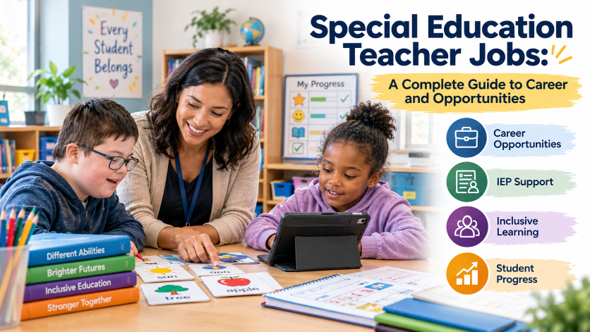
If you are looking for a career that’s both meaningful and stable, special education teacher jobs might be the best choice you ever make. This is not a job… It is the kind of job where you finish each day knowing you changed someone’s life.
America is facing a shortage of special education teachers. Research shows that the demand for special education teachers is especially urgent, with nearly half of all teaching vacancies filled by substitute teachers. Many school districts have to rely on emergency permits just to fill these positions. This means one thing: for qualified special education teachers, job opportunities are more plentiful than ever before.
This guide will walk you through everything you need to know about education teacher jobs. From what the work involves to what qualifications you need, how much you can earn and how to find the best position for you. Whether you are an education graduate or someone considering a career change, this guide is for you.
What Does a Special Education Teacher Actually Do?
Many people have an idea about special education teachers. They think it is just “taking care of kids.” The reality is more complex and far more skilled.
A special education teacher’s core job is to provide specially designed instruction to students with learning differences. These students may face learning disabilities, emotional and behavioral disorders, autism spectrum disorder, intellectual disabilities, physical disabilities or other health challenges.
Daily Responsibilities
Based on job descriptions, special education teachers typically:
Develop and implement IEPs (Individualized Education Programs). Every special education student has a required personalized learning plan. Teachers assess student needs, set goals, design instructional strategies and review progress regularly.
Adapt education curriculum. Special education teachers modify curriculum content to make it accessible for students with learning differences. This might mean simplifying reading materials using aids or adjusting test formats.
Collaborate with education teachers. In settings, special education teachers work closely with general classroom teachers to ensure students with special needs receive appropriate support in mainstream classrooms.
Supervise paraprofessionals. Special education teachers often direct teaching assistants and paraprofessionals, helping them support students effectively.
Communicate with parents. Teachers update parents on progress, participate in IEP meetings and help families understand their child’s needs.
Manage behavior. Many special education students have challenges. Teachers implement strategies to support positive behavior while understanding that behavior is often a form of communication.
Types of Special Education Teacher Jobs
education is not a single role. There are types of positions depending on student needs and settings.
By Setting
Resource Specialist (RSP). Resource specialists work in general school settings, providing support to students who spend most of their day in general education classrooms. Students typically receive instruction in a resource room for part of the day.
Special Day Class (SDC). Special day classes serve students who need intensive support. These classes provide instruction all day with smaller class sizes and higher teacher-to-student ratios.
Inclusion Support Teacher. These teachers work alongside education teachers in mainstream classrooms, providing support to ensure students with special needs can fully participate in the general curriculum.
By Student Population
Mild/Moderate Disabilities. Serving students with learning disabilities, emotional disturbances, ADHD and similar needs. This is one of the common types of special education positions.
Moderate/Severe Disabilities. Serving students with disabilities, autism spectrum disorder, multiple disabilities and similar needs. These positions often require specialized training and credentials.
Specific Categories. Some positions focus on populations, such as deaf/hard-of-hearing students, visually impaired students or students with emotional/behavioral disorders.
Qualifications for Special Education Teacher Jobs
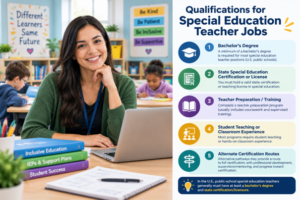
To land an education teacher job you need to meet specific education and certification requirements. These vary by state and country. Some common patterns exist.
Education Background
The minimum requirement is usually a bachelor’s degree. Many positions. Prefer a master’s degree in special education, education or a related field. In some districts, teachers with master’s degrees can earn higher starting salaries.
Teaching Credentials
All public school positions require a valid special education teaching credential. The specific credential type depends on the position you are applying for.
Mild/Moderate Credential. Allows you to teach students with mild learning differences.
Moderate/Severe Credential. Allows you to teach students with complex needs, including autism, intellectual disabilities and multiple disabilities.
Specific Area Credentials. Such as /hard-of-hearing education, visual impairment education and others.
Alternative Pathways
Due to special education teacher shortages, many states offer certification pathways. These programs allow people with bachelor’s degrees in fields to earn temporary or emergency certification through additional coursework and exams.
Research shows that enrollment in certification programs is growing by nearly 6% per year while enrollment in traditional teacher preparation programs is declining.
Other Requirements
Background check. All school positions require passing a background check. Selected candidates typically need to provide criminal record clearance.
English language proficiency. In schools or bilingual education settings, proof of English proficiency may be required.
Student teaching. Most programs require completion of student teaching experience.
Special Education Teacher Salary: 2026 Data
Salary is a concern for many people. Special education teacher pay varies by region, experience and education level.
U.S. Salary Overview
According to Bureau of Labor Statistics data, the median annual salary for education teachers is roughly between $60,000 and $63,000. Specific figures vary by grade level:
Special education teachers: About $61,400 with roughly 23,000 positions
Kindergarten and elementary special education teachers: About $60,620 with roughly 193,000 positions
Middle school special education teachers: About $61,820 with roughly 84,700 positions
High school special education teachers: About $62,320, with roughly 143,000 positions
Real-World Salary Examples
Actual job postings show a wide range of starting salaries:
A charter school in Howard County, Maryland (LAMB) offers special education teachers starting salaries of $50,630 (bachelor’s) to $54,920 (masters), with master’s-level teachers at 19+ years earning up to $89,250.
Sonora High School in California offers special education teacher positions with salary ranges of $53,433 to $96,198 plus a annual $10,000 case management stipend and approximately $11,398 in health benefit contributions.
Royalton-Hartland School District in New York offers starting salaries of around $46,589 to $47,705.
Factors Affecting Salary
Education level. A master’s degree typically brings higher starting salaries and higher salary caps.
Years of experience. Salary schedules usually increase by years of service. Teachers with 19+ years of experience earn more than new teachers.
Location. Areas with a higher cost of living typically offer higher salaries. California and Maryland salaries are noticeably higher than New York.
Additional responsibilities. Teachers who take on case management, mentoring teachers or leading special programs may receive extra stipends.
Job Outlook for Special Education Teachers
The job outlook for special education teacher positions is generally very positive compared to other teaching fields. According to the Bureau of Labor Statistics, growth projections vary across subspecialties:
Growth Projections
Bureau of Labor Statistics data shows varying growth projections across subspecialties:
Preschool special education teachers: 8.3% growth, faster than average
Other special education teachers: 8.5% growth, much faster than average
Kindergarten and elementary: 2.9% growth, slower than average
Middle school: 2.6% growth, slower than average
High school: 3.2% growth, about average
Shortage Means Opportunity
Despite flat growth projections in some subspecialties, special education teachers face a persistent shortage. Research shows special education teachers are among the highest-demand teaching roles.
An Ed Trust report notes that special education teachers are doing some of the difficult and technical work in education, often with little compensation, preparation or ongoing professional learning. This is both a problem and an opportunity—it means qualified candidates have negotiating power.
How to Find Special Education Teacher Jobs
Finding a special education teacher job requires strategy. Here are the effective approaches.
Online Job Platforms
EDJOIN. This is the platform for California and several other states’ school district positions. All California special education jobs are posted here.
District websites. Many districts post positions on their own websites. This is the source for the most accurate information.
Indeed. These general platforms also list special education positions, especially for private and charter schools.
Application Materials Checklist
A typical special education teacher job application requires:
Resume and cover letter. Highlight your education experience and ability to work with student populations.
Teaching copy. Clear. CTC website screenshots of your credential.
Transcripts. Official or unofficial transcripts showing degree conferral.
Letters of recommendation. Usually 2-3 required, with at least one from an administrator or supervisor.
CBEST/CSET scores. In California, these basic skills test scores are required.
English Learner authorization. Such as CLAD, BCLAD or similar.
Internship and Emergency Permit Pathways
If you are not yet fully certified, many school districts offer internship permits or emergency permits. These allow you to begin teaching while finishing the steps needed for certification.
Fremont Unified School District clearly says they are looking for teachers who are eligible for internships. They ask for a letter from a university that confirms the teacher is eligible for an internship.
Final Thoughts
Special education teacher jobs provide a career that’s both rewarding and steady. If you have patience, creativity, and a real wish to help students with learning needs, this field is welcoming.
The current shortage of education teachers means there are more job openings than ever for qualified people. Alternative ways to get certified make it easier for people changing careers to get into this field. Salaries and benefits are slowly getting better in places where there is a big shortage.
This is not a job. You will deal with behavior problems, lots of paperwork and emotional tiredness… You will be the person who really makes a difference in a student’s life. In some cases, you will be the first person in that student’s life who believed they could do well.
If you are ready to begin this path, now is the time. Look for special education teacher jobs in your area, learn about the steps needed for certification and take the step.
Frequently Asked Questions
- What education is needed for special education teacher jobs?
The basic requirement is usually a bachelor’s degree. Many jobs ask for a master’s degree. A master’s degree in special education is preferred. Some districts pay more if a teacher has a master’s degree.
- Can someone apply for education jobs without a teaching certificate?
Yes,. There are limits. Many states have internship or emergency permit options that let a person start teaching while getting certified. This usually needs a letter from a university that shows the person is eligible and some extra classes.
- How much do special education teachers make?
The average yearly pay for education teachers in the U.S. Is around $60,000 to $63,000. The actual amount can be as low as $46,000 or more than $100,000 depending on the school district, years of experience and level of education.
- Are special education teacher jobs steady?
Very steady. Special education teachers are in demand, with many schools having trouble finding enough teachers. Almost half of all teaching openings are filled by substitute teachers. Qualified special education teachers often get job offers.
- Do international schools hire education teachers?
Yes. For instance, Ventana International School in Finland is looking for an education teacher. They need an education degree, special education qualifications and the ability to speak English. International schools often offer good pay and good working conditions.

Hi, I’m Evan Lexor, the voice behind Meanvia.com. I break down English words, slang, and phrases into clear, simple meanings that actually make sense. From modern internet terms to everyday expressions, my goal is straightforward: help you understand English better, faster, and with confidence, one word at a time.