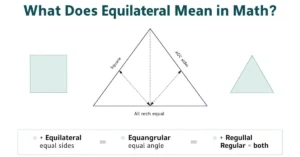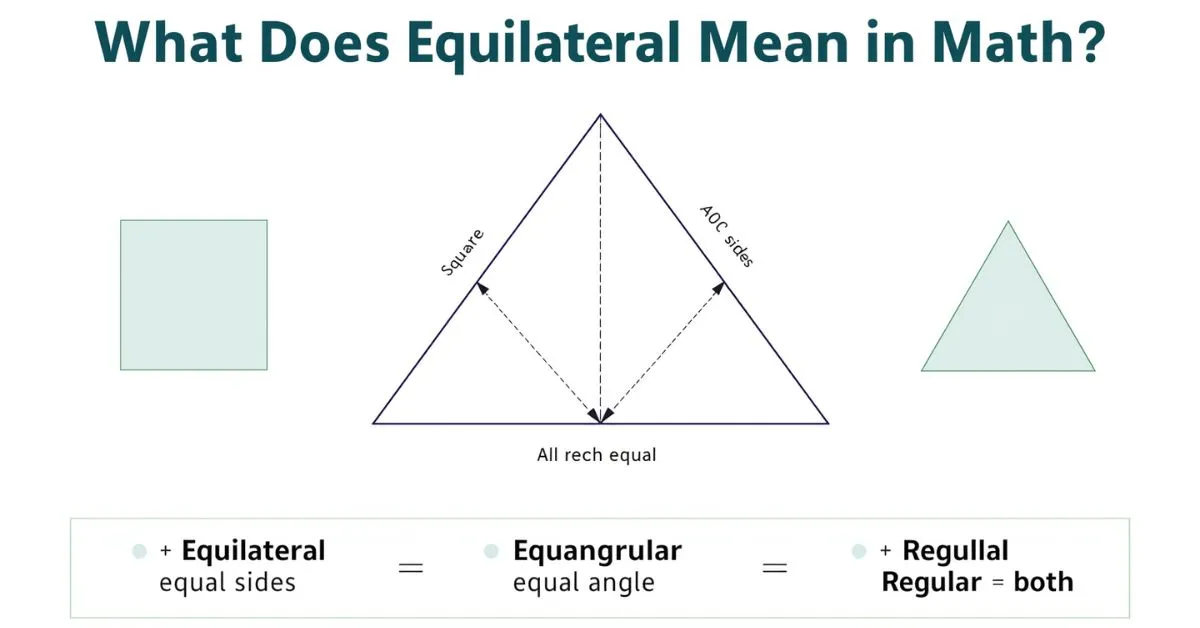
Equilateral means all sides are equal in length. In geometry, the word is most often used for an equilateral triangle, which has three equal sides.
In triangles, that also means the three angles are equal, but the word equilateral itself mainly refers to equal side lengths.
If you saw this word in math class, on homework, or in a geometry diagram, the short version is simple: equilateral = equal-sided.
Quick Answer
| Term | Simple meaning |
|---|---|
| Equilateral | All sides are equal |
| Equiangular | All angles are equal |
| Regular | All sides and all angles are equal |
Example:
A triangle with side lengths 5 cm, 5 cm, and 5 cm is equilateral.
Equilateral meaning in simple words
The easiest way to remember the word is this:
Equilateral means a shape has sides of the same length.
That is the core idea.
So if all the sides match, the shape is equilateral. If even one side is different, it is not.
Simple examples
- 4, 4, 4 → equilateral
- 6, 6, 8 → not equilateral
- 3, 5, 7 → not equilateral
Most people first learn the word through triangles, but it is not only a triangle word.
What does equilateral mean in geometry?
In geometry, equilateral describes a polygon whose sides are all equal in length.
The most common example is an equilateral triangle, but other shapes can be equilateral too.
Equilateral triangle
An equilateral triangle has:
- 3 equal sides
- 3 equal angles
Because the angles inside any triangle add up to 180°, each angle in an equilateral triangle is 60°.
That is why teachers often use equilateral triangles to introduce the term.
Other equilateral shapes
A shape does not need to be a triangle to be equilateral.
Examples include:
- Square → all 4 sides are equal
- Rhombus → all 4 sides are equal
- Regular pentagon → all 5 sides are equal
So the word is broader than many students think.
Does equilateral mean equal angles?
Not always.
This is the most common misunderstanding.
Equilateral means equal sides.
It does not automatically mean equal angles in every shape.
In triangles
In triangles, an equilateral triangle is also equiangular. That means:
- all sides are equal
- all angles are equal
So in triangles, equal sides and equal angles go together.
In other polygons
In other shapes, equal sides do not always guarantee equal angles.
For example:
- A square is equilateral and equiangular.
- A rhombus is equilateral, but its angles do not all have to be equal.
That is why it helps to keep the words separate:
- Equilateral = equal sides
- Equiangular = equal angles
If a shape has both, it is called regular.
Equilateral vs equiangular vs regular
These terms are related, but they are not interchangeable.
| Word | What it tells you | Example |
|---|---|---|
| Equilateral | The sides are equal | Equilateral triangle, rhombus |
| Equiangular | The angles are equal | Rectangle |
| Regular | Both sides and angles are equal | Square, regular pentagon |
This is where many articles stop too early. They define the word, but they do not explain how to use it correctly.
The useful takeaway is this:
- If a math problem is about side lengths, think equilateral
- If it is about angles, think equiangular
- If both are equal, think regular
Equilateral vs isosceles vs scalene
If you are learning triangle classification, this comparison makes the term much easier to remember.
| Triangle type | Side lengths | Meaning |
|---|---|---|
| Equilateral | 3 equal sides | all sides match |
| Isosceles | 2 equal sides | two sides match |
| Scalene | no equal sides | no sides match |
Quick examples
- Equilateral: 7, 7, 7
- Isosceles: 7, 7, 4
- Scalene: 7, 5, 4
So an equilateral triangle is more specific than an isosceles triangle. It is not just “at least two equal sides.” It is all three.
How to tell if a shape is equilateral
Here is the simplest way to identify one.
1. Check the side lengths
If all the side measurements are the same, the shape is equilateral.
2. Look for matching side marks
In geometry diagrams, equal sides are often shown with the same tick marks.
3. Do not rely only on appearance
A shape may look equal-sided but still not be equilateral. In math diagrams, pictures are not always drawn to exact scale.
4. In triangles, equal angles can be a clue
If a triangle has three equal angles, it is also equilateral.
Worked example
Example 1: Triangle side lengths
A triangle has side lengths 8 cm, 8 cm, and 8 cm.
Is it equilateral?
Yes. All three sides are equal, so the triangle is equilateral.
Example 2: Looks equal, but is not
A triangle in a worksheet looks perfectly balanced, but the side lengths are labeled 5 cm, 5 cm, and 6 cm.
Is it equilateral?
No. It is not enough for the picture to look equal. The measurements matter more than the drawing.
Example 3: A four-sided shape
A rhombus has four equal sides.
Is it equilateral?
Yes. It is equilateral because all sides are equal. But it is not automatically equiangular.
Can shapes other than triangles be equilateral?
Yes.
This is another place where students often get confused.
The word equilateral can apply to many polygons, not just triangles.
Common examples
- Equilateral triangle
Three equal sides - Rhombus
Four equal sides - Square
Four equal sides and four equal angles - Regular pentagon
Five equal sides and five equal angles
So when you hear “equilateral,” do not assume the shape must be a triangle. The real question is: Are all the sides equal?
Common mistakes people make
Mistake 1: Thinking equilateral means equal angles
It mainly means equal sides. Equal angles are a separate idea.
Mistake 2: Thinking the word only applies to triangles
Triangles are the most common example, but squares, rhombuses, and regular polygons can be equilateral too.
Mistake 3: Confusing equilateral with isosceles
An isosceles triangle has two equal sides. An equilateral triangle has three.
Mistake 4: Trusting the picture instead of the labels
Always check the measurements or side marks. Geometry diagrams are not always to scale.
Mistake 5: Assuming every equilateral shape is regular
A shape can have all sides equal without having all angles equal. A rhombus is the best example.
Why the term matters in math
Understanding what equilateral means helps with more than just one vocabulary word.
It helps you:
- classify shapes correctly
- read geometry diagrams more accurately
- understand side-length relationships
- compare triangle types
- avoid common worksheet mistakes
- follow lessons on regular polygons, perimeter, and area
Once you understand the difference between equal sides and equal angles, a lot of geometry language becomes easier.
What Most Articles Miss About This Topic
Most pages define equilateral correctly, but they often miss the part that actually helps beginners:
1. Equilateral is about sides first
The word tells you about side lengths, not automatically about angles in every shape.
2. Triangle rules are not always shape rules
In triangles, equal sides also mean equal angles. In other polygons, that is not always true.
3. Equilateral is not just a triangle term
It is commonly taught through equilateral triangles, but the concept applies more broadly to polygons.
4. “Looks equal” is not a reliable test
Many students get questions wrong because they trust the drawing instead of the measurements.
5. Regular and equilateral are not the same word
A regular shape is both equilateral and equiangular. An equilateral shape is not always regular.
That distinction is where many readers finally stop being confused.
FAQ
What does equilateral mean in math?
In math, equilateral means a shape has all sides equal in length.
What does equilateral mean in a triangle?
It means all three sides of the triangle are equal. In that case, all three angles are equal too.
Does equilateral mean all angles are equal?
Not by itself. It mainly means all sides are equal. In triangles, equal sides also lead to equal angles.
Can a square be equilateral?
Yes. A square has four equal sides, so it is equilateral. It is also equiangular.
Is a rhombus equilateral?
Yes. A rhombus has all sides equal, so it is equilateral. Its angles do not have to all be equal.
Is every equilateral triangle also regular?
Yes. An equilateral triangle is also equiangular, so it is a regular triangle.
Does equilateral only apply to polygons?
In geometry, the word is mainly used for polygons and similar shape descriptions where side lengths can be compared.
Conclusion
If you want the simplest possible answer, here it is:
Equilateral means all sides are equal in length.
In geometry, you will see this most often with an equilateral triangle, but the idea can apply to other shapes too. The safest way to use the word correctly is to remember this rule:
Equilateral = equal sides
Equiangular = equal angles
Regular = both
Once that clicks, the term becomes easy to recognize, explain, and use in math problems.
If this page is part of a larger math glossary, the best next internal links would be triangle types, isosceles triangle explained, what scalene means, equiangular meaning, and regular polygon definition.
Click Below To Read About New Articles:
What Does Stay Frosty Mean? Military Meaning, Slang Use, Examples
What Does YNS Mean on TikTok? Youngins, “You’re Not Serious,”
What Does La Mean in Spanish? Examples, Complete Explanation

Hi, I’m Clara Lexis from Meanvia.com. I break down words and expressions so they’re easy to understand and enjoyable to learn. My mission is simple: make language approachable and fun, one word at a time.