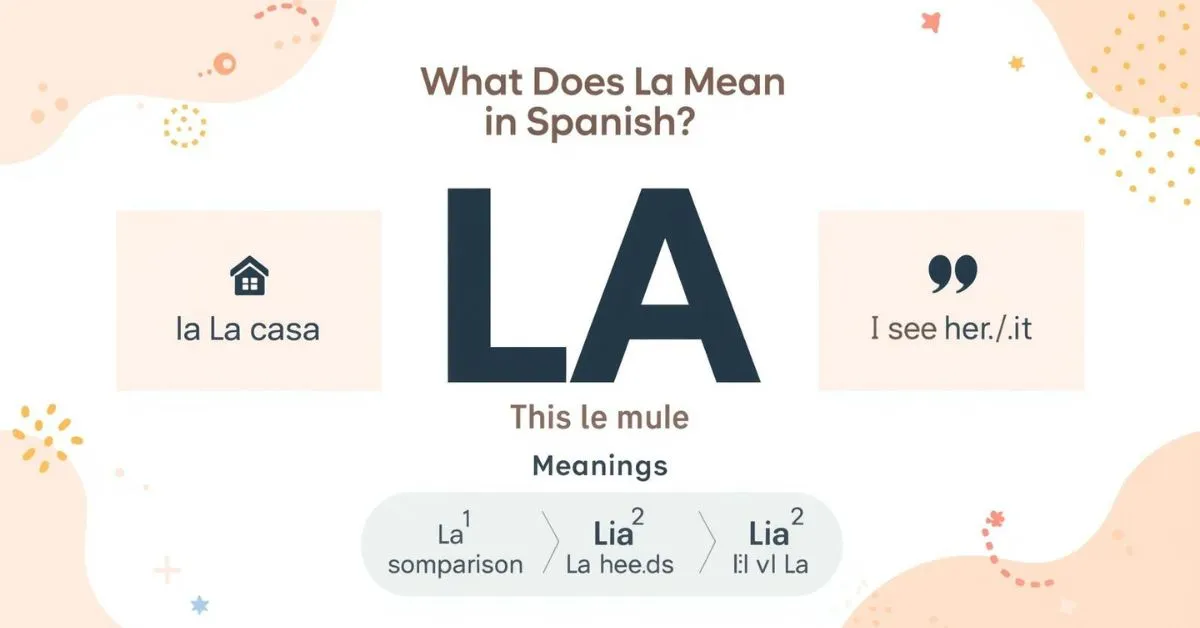
LA most often means “the” in Spanish when it comes before a feminine singular noun, as in LA casa (“the house”). But la can also mean “her” or “it” when it works as a pronoun, as in la veo (“I see her” / “I see it”). The correct meaning depends on the sentence.
That is the short answer. The fuller answer is what usually confuses beginners: LA is a very common Spanish word with more than one job.
Once you know how to spot its role in a sentence, it becomes much easier to understand.
La Meaning in Spanish at a Glance
| Use of la | What it means | Example | Translation |
|---|---|---|---|
| Definite article | the | la mesa | the table |
| Direct object pronoun | her / it | la veo | I see her / I see it |
| Part of names or titles | often stays as part of the name | La Paz | La Paz |
| Musical note | la | la | the note A |
For most readers, the two meanings that matter most are these:
- la = the
- la = her / it
Does La Mean “The” in Spanish?
Yes. Most commonly, la means “the.”
It is the feminine singular definite article in Spanish. In simpler words, it is used before a specific feminine singular noun.
Examples:
- la casa = the house
- la puerta = the door
- la silla = the chair
- la escuela = the school
If you have seen la in beginner Spanish lessons, subtitles, menus, signs, or simple conversations, this is probably the meaning you saw.
Why “feminine singular” matters
Spanish nouns are grouped into masculine and feminine categories. They also have singular and plural forms.
That means Spanish definite articles change depending on the noun:
- el = masculine singular
- la = feminine singular
- los = masculine plural
- las = feminine plural
Examples:
- el libro = the book
- la mesa = the table
- los libros = the books
- las mesas = the tables
So when someone asks, “What does la mean in Spanish?” the strongest first answer is:
La usually means “the” before a feminine singular noun.
When La Means “Her” or “It”
This is the second major use, and it is the reason many learners get stuck.
La can also be a direct object pronoun. That means it can replace a feminine noun, or refer to a woman or girl, depending on the sentence.
Examples:
- La veo. = I see her / I see it.
- La llamé ayer. = I called her yesterday.
- La compré. = I bought it.
- La encontré. = I found her / it.
Here, la is not “the.” It is standing in for the object of the sentence.
That is why translating la by itself can be misleading. The word does not always have one fixed English meaning. Its meaning changes with its job in the sentence.
How to Tell What La Means in a Sentence
This is the fastest practical rule:
If la comes before a noun, it usually means “the.”
- la casa = the house
- la comida = the food
If la comes before a verb, it often means “her” or “it.”
- la veo = I see her / it
- la conozco = I know her / it
Compare these:
- La puerta está abierta. = The door is open.
- La abrí. = I opened it.
In the first example, la introduces the noun puerta, so it means the.
In the second, la replaces the noun, so it means it.
That one distinction clears up a lot of beginner confusion.
La vs El vs Las vs Lo
Many articles explain la in isolation, but learners understand it better when they see the nearby forms too.
| Word | Main use | Example | Meaning |
|---|---|---|---|
| la | feminine singular article / pronoun | la casa, la veo | the / her / it |
| el | masculine singular article | el libro | the |
| las | feminine plural article | las casas | the |
| lo | different pronoun/article use, often more advanced | lo veo, lo importante | him / it / what is… |
For this keyword, the most important contrast is still:
- la → usually feminine singular
- el → usually masculine singular
Examples:
- la niña = the girl
- el niño = the boy
- la ventana = the window
- el edificio = the building
la meaning
The word “la” is most commonly a Spanish feminine singular article. In English, it usually means “the” when it comes before a feminine singular noun. For example, la casa means “the house,” while la mesa means “the table.” The meaning can depend on the sentence because “la” may also appear as a pronoun in some situations. Spanish speakers use it naturally in everyday conversation and writing. Learning “la” is helpful because articles often show whether a Spanish noun is feminine or singular, making sentences easier to understand.
Context and how people use it:
People use “la” before feminine singular nouns when talking about a specific person, place, object, or idea.
It is one of the basic Spanish words beginners often learn early.
Examples:
- La niña está feliz. — The girl is happy.
- La puerta está abierta. — The door is open.
la meaning in spanish
In Spanish, “la” generally means “the” and is used with feminine singular nouns. It is called a feminine singular definite article. For instance, la escuela means “the school,” and la película means “the movie.” Unlike English, Spanish nouns have grammatical gender, so the article changes depending on the noun. “La” is therefore different from “el,” which is normally used with masculine singular nouns. Understanding this small word can help learners recognize how Spanish sentences are structured and why different nouns use different forms of “the.”
Context and how people use it:
Spanish speakers use “la” when referring to a specific feminine singular noun in everyday speech and writing.
It commonly appears before nouns related to people, things, places, and ideas.
Examples:
- La profesora llegó temprano. — The teacher arrived early.
- La ciudad es hermosa. — The city is beautiful.
what does la mean in spanish
“La” in Spanish usually means “the.” It is used before a feminine singular noun when the speaker is talking about something specific. For example, la casa means “the house,” and la canción means “the song.” Spanish uses grammatical gender, so “la” is generally paired with feminine nouns. In some sentences, “la” can also function as a feminine singular pronoun, meaning “her” or “it,” depending on context. Therefore, its exact English translation is not always identical. Looking at the complete sentence helps determine how “la” is being used.
Context and how people use it:
Most learners first encounter “la” as the Spanish equivalent of “the” before feminine singular nouns.
Its meaning can change slightly when “la” works as a pronoun instead of an article.
Examples:
- La mujer vive aquí. — The woman lives here.
- La compré ayer. — I bought it yesterday.
la mean
“La” can mean “the” in Spanish when it comes before a feminine singular noun. It is one of the most common Spanish articles and appears in countless everyday phrases. For example, la casa means “the house,” while la comida means “the food.” However, “la” does not always have one fixed translation. In certain sentences, it can act as a pronoun and refer to a feminine person or thing. The surrounding words provide the clue. Understanding this difference makes it easier to read Spanish naturally and avoid translating every word in isolation.
Context and how people use it:
In normal Spanish conversation, “la” is frequently placed directly before feminine singular nouns.
As a pronoun, its meaning depends on what feminine person or object the sentence refers to.
Examples:
- La película empieza a las ocho. — The movie starts at eight.
- La vi en el parque. — I saw her at the park.
what does a la mean
“A la” is a common Spanish combination made from the preposition “a” and the feminine singular article “la.” Depending on context, it can mean “to the,” “at the,” or be part of an expression describing a style or manner. For example, Voy a la escuela means “I am going to the school,” while a la mañana can appear in regional or specific expressions. The phrase is also used in expressions such as a la francesa, meaning “French-style.” Its exact meaning becomes clear from the words surrounding it.
Context and how people use it:
People use “a la” in everyday Spanish to describe movement, direction, time, style, or manner.
The phrase appears naturally in both casual conversations and formal writing.
Examples:
- Voy a la tienda. — I am going to the store.
- Cocinaron a la francesa. — They cooked French-style.
la in spanish means
In Spanish, “la” most often means “the” when it appears before a feminine singular noun. It helps identify a specific noun, such as la playa (“the beach”) or la puerta (“the door”). Spanish speakers choose “la” because these nouns are grammatically feminine and singular. However, “la” can sometimes be used as a pronoun, where it may refer to a feminine person or object. This is why understanding the sentence is important. The simple word “la” has an important role in Spanish grammar and everyday communication.
Context and how people use it:
Spanish speakers commonly use “la” before feminine singular nouns when referring to something known or specific.
As a pronoun, it can replace a feminine noun when the meaning is already clear.
Examples:
- La bicicleta es nueva. — The bicycle is new.
- La encontré en la cocina. — I found it in the kitchen.
la meaning spanish
The Spanish word “la” generally translates to “the” in English. It is the feminine singular definite article and is placed before feminine singular nouns. You can see it in phrases such as la casa (“the house”), la flor (“the flower”), and la música (“the music”). Spanish uses different articles according to grammatical gender and number, which is why “la” is not normally used with masculine or plural nouns. In some contexts, “la” also works as a pronoun. The sentence around it helps determine its exact meaning and grammatical role.
Context and how people use it:
People use “la” throughout everyday Spanish when identifying specific feminine singular nouns.
It is also common as a pronoun when the feminine noun has already been mentioned or is understood.
Examples:
- La profesora habla español. — The teacher speaks Spanish.
- La llamé anoche. — I called her last night.
Why Spanish Uses La Differently From English
One reason la feels confusing is that Spanish and English do not always use articles the same way.
In English, we often use words like my, your, or no article at all. In Spanish, the definite article is often more natural.
Example:
- Me duele la cabeza.
A word-for-word translation would sound like:
- “The head hurts me.”
But natural English is:
- My head hurts.
Spanish often says la cabeza, where English prefers my head.
This matters because sometimes la literally means “the,” but the best English translation may not use “the” at all. That does not mean the Spanish is strange. It just means the two languages build sentences differently.
A Special Exception: Why It’s El Agua, Not La Agua
This is one of the most useful grammar details many short articles skip.
Some feminine singular nouns that begin with a stressed a- or ha- sound take el instead of la in the singular for easier pronunciation.
Examples:
- el agua = the water
- el águila = the eagle
But these nouns are still feminine.
You can see that in adjectives and plural forms:
- el agua fría = the cold water
- las aguas frías = the cold waters
So agua is still feminine even though it uses el in the singular.
This exception is important because beginners sometimes think every feminine noun must always take la. Usually that is true, but not always.
Does La Change in Plural Form?
Yes.
The plural form of la as a feminine article is las.
Examples:
- la casa = the house
- las casas = the houses
- la silla = the chair
- las sillas = the chairs
This helps show that Spanish articles agree with the noun in both gender and number.
Does La Form Contractions?
No. La does not form the common contractions that el does.
In Spanish, these contractions happen:
- a + el = al
- de + el = del
Examples:
- Voy al parque. = I am going to the park.
- Vengo del mercado. = I come from the market.
But with la, there is no contraction:
- Voy a la escuela. = I am going to the school / I am going to school.
- Vengo de la casa. = I come from the house.
This is a small point, but it helps learners understand how la behaves differently from el.
Common Real-Life Examples of La
Here are practical examples you are likely to see:
La as “the”
- La cuenta, por favor. = The bill, please.
- La estación está cerca. = The station is nearby.
- La música me gusta. = I like the music.
- La tienda está cerrada. = The store is closed.
La as “her” or “it”
- La vi ayer. = I saw her yesterday.
- La compré esta mañana. = I bought it this morning.
- La escuché. = I heard her / it.
- La necesito. = I need it / her.
These examples matter because they show how normal and frequent the word is. La is not a rare grammar point. It appears everywhere in everyday Spanish.
Common Mistakes With La
Thinking la always means only “the”
It often does, but not always. Sometimes it clearly means her or it.
Ignoring the next word
A quick look at the next word helps a lot:
- la + noun → often the
- la + verb → often her or it
Translating too literally
Spanish does not always match English word for word. A direct translation may sound unnatural even when the sentence is correct.
Mixing up grammar gender with real-life gender
A noun can be grammatically feminine without referring to a female person. For example, la mesa is feminine in grammar, but it is just “the table.”
Assuming every feminine noun uses la
Usually yes, but words like agua and águila show why exceptions matter.
What Most Articles Miss About This Topic
Most weak articles stop at this:
La means “the” in Spanish.
That answer is not wrong, but it is incomplete.
What learners really need is this fuller picture:
- la often means the
- la can also mean her or it
- the meaning changes by context
- Spanish article use does not always match English article use
- there are small grammar details, like el agua, that explain why simple rules sometimes appear to break
In other words, the real skill is not memorizing a single translation. The real skill is learning to identify what la is doing in the sentence.
That is the difference between just knowing a definition and actually understanding the word.
A Simple Way to Remember It
If you want one memory shortcut, use this:
When la comes before a feminine singular noun, it usually means “the.” When it replaces a noun and appears before a verb, it often means “her” or “it.”
That rule will help you interpret most beginner-level examples correctly.
FAQs
Q: What does el mean in Spanish
A: In Spanish, el is the masculine singular definite article meaning “the.”
Q: What does la mean in French
A: In French, la is the feminine singular definite article meaning “the.”
Q: What does la mean in English
A: In English, la can refer to the musical note “la” or appear as a word borrowed from other languages.
Q: What does las mean in Spanish
A: In Spanish, las is the feminine plural definite article meaning “the.”
Q: What does la mean in italian
A: In Italian, la is the feminine singular definite article meaning “the.”
Q: What does los mean in Spanish
A: In Spanish, los is the masculine plural definite article meaning “the.”
Q: What does el mean in Spanish names
A: In Spanish names, el usually means “the” and may be part of a name or title.
Q: What does l mean in Spanish
A: The letter L in Spanish is called “ele.”
Conclusion
So, what does LA mean in Spanish?
Most of the time, la means “the” before a feminine singular noun. In other sentences, it can mean “her” or “it.” The correct meaning depends on context.
Once you stop trying to translate la as one fixed English word and start reading it by its role in the sentence, it becomes much easier to understand. That is the real takeaway.
Click Below To Read About:
What Does Stay Frosty Mean? Military Meaning, Slang Use, Examples
What Does the Name Naomi Mean? Definition & Explanation
What Does Stalemate Mean in Chess? Complete Explanation

Hi, I’m Clara Lexis from Meanvia.com. I break down words and expressions so they’re easy to understand and enjoyable to learn. My mission is simple: make language approachable and fun, one word at a time.