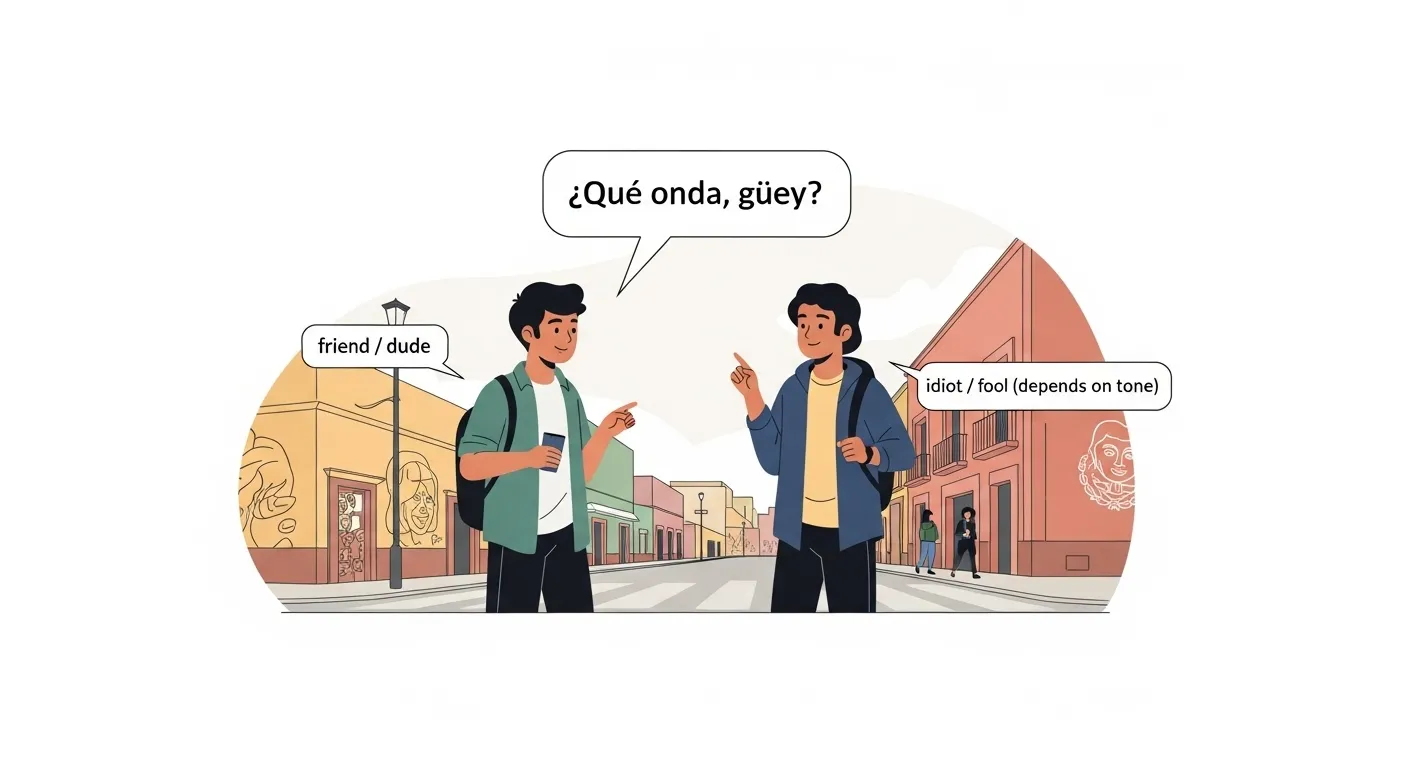
Have you ever heard someone say “güey” in a Mexican movie, TikTok, or in a conversation and wondered what it means? Güey is a very common word in Mexican Spanish. It can mean friend, dude, or bro in a friendly way. But it can also mean idiot or fool if said in the wrong tone.
This word is used in youth slang, in street language, and in casual conversations. It is informal and should be used carefully. In this guide, you will learn:
- What güey means in different contexts
- How to spell and pronounce it
- Its origin and cultural significance in Mexico
- Related slang words like vato, cabrón, compa, and amigo
- When to use it and when not to
By the end, you will know how to use güey naturally like a native speaker.
What Does Güey Mean?
Güey is a slang noun in Mexican Spanish. It can be:
- Friendly meaning: friend, dude, bro
- Negative meaning: idiot, fool
Examples:
- Friendly: “¿Qué onda, güey?” → “What’s up, dude?”
- Insulting: “No seas güey” → “Don’t be stupidd”
- Neutral: “Ese güey trabaja aquí” → “That guy works here”
Tone and context are very important. In informal conversations, güey is mostly positive. In serious or angry situations, it can be insulting.
Spelling and Pronunciation
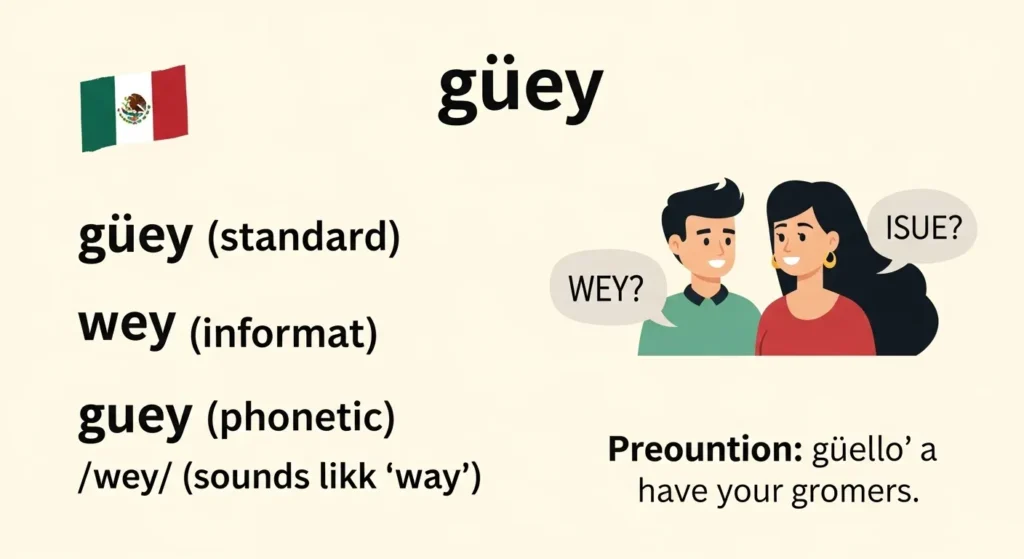
You will see güey spelled in different ways:
- Güey – Correct, standard spelling
- Wey – Common in social media and texts
- Guey – Phonetic, used by non-native speakers
All three are pronounced like “way”. Always use güey in writing for accuracy.
Origin of Güey
The word comes from buey, which means ox in Spanish. Originally, it was an insult. Over time, it became a friendly slang term.
Today, güey is used in:
- Youth slang
- Casual street conversations
- Movies, TV shows, and social media
Its dual nature, friendly or insulting, depends entirely on tone.
Where Is Güey Used?
Güey is mostly used in Mexico. People in Spain or South America may know it from movies or TikTok, but they rarely use it.
In Mexico:
- Used among friends and peers
- Common in casual conversations and youth culture
- Avoided in formal settings or with elders
Güey Article — Ready-to-Paste Fixes & New Sections
1. TYPO FIXES (do these first — find & replace)
| Find (wrong) | Replace with (correct) |
|---|---|
| “Don’t be stupidd” | “Don’t be stupid” |
| “That stupidd guy is always late!” | “That stupid guy is always late!” |
| “Don’t be stuppid, study more.” | “Don’t be stupid, study more.” |
| “Don’t be stuppid” (table) | “Don’t be stupid” |
2. NEW SECTION: Why Güey Was Originally an Insult
Place this right after the “Origin of Güey” section.
The Darker History Behind Güey
Long before güey became a friendly way to say “dude,” it carried a much harsher meaning. The word comes from buey, the Spanish word for ox — specifically, a castrated bull used for farm labor.
In older Mexican Spanish, calling a man a “buey” was a serious insult. It implied he was a cuckold — a husband whose wife had been unfaithful — because oxen, like cuckolded men in old folk sayings, were seen as “unaware” and “led along” without control over their own situation.
Over decades, the “b” sound softened into a “g,” turning buey into güey, and the word gradually lost its sharp edge. Today, most Mexicans use güey casually and don’t think about its insulting origin at all — but understanding this history explains why güey can still sound like an insult in the right (or wrong) tone.
Example 1: In the 1900s, calling someone “buey” openly could start a fight — today, “güey” between friends is completely normal. Example 2: The shift from insult to friendly slang shows how much tone and generation change a word’s meaning.
3. NEW SECTION: Is Güey Used Outside Mexico?
Place this after “Where Is Güey Used?”
| Region | Is güey used? | Notes |
|---|---|---|
| Mexico | Yes, very common | The word’s home — used constantly in daily speech |
| United States (Mexican communities) | Yes | Common in Mexican-American communities, especially in Los Angeles and Texas |
| Argentina / Paraguay (Rioplatense Spanish) | Rarely, as “güey” | People may use the original spelling buey instead, but with a different regional flavor |
| Dominican Republic | Occasionally | Used in vocative form (calling out to someone), but far less common than in Mexico |
| Spain | Almost never in daily speech | Spaniards mostly recognize it from Mexican movies, TV, or TikTok, but use their own slang like “tío” instead |
Key takeaway: Güey is a distinctly Mexican word. If you’re speaking Spanish in Spain or Argentina, using “güey” will likely mark you as having learned Mexican Spanish specifically — it may sound unusual to locals there.
4. NOTE ON AUDIO PRONUNCIATION
Since no competitor offers this, add a simple line + free tool:
🔊 Hear it pronounced: [Add a Google Text-to-Speech widget or a free embeddable audio pronunciation plugin here] — güey is pronounced like the English word “way.”
(You can use a free WordPress plugin like “Pronunciation Helper” or embed a simple <audio> tag with a recorded MP3 if you want full control.)
5. MERGE INSTRUCTION: Cultural Sections
Combine “Why Güey Is Important in Mexican Culture” and “Cultural Impact” into ONE section. Suggested merged version:
Why Güey Matters in Mexican Culture
Güey is more than a word — it reflects social bonds, humor, and identity in Mexico.
- Youth identity: Mostly used by young people to show familiarity and equality among friends.
- Pop culture presence: Appears constantly in movies, songs, TikTok videos, and memes — instantly recognizable to anyone familiar with Mexican media.
- Social dynamics: Signals peer relationships, casual hierarchy, and humor between speakers.
- Media examples: Films like Amores Perros and Y Tu Mamá También use güey naturally to show casual, authentic friendship between characters.
Knowing güey well shows cultural awareness. Misusing it — especially with elders or strangers — can come across as disrespectful or awkward for a language learner.
6. NEW SECTIONS FOR TARGET QUERIES
Güey vs. Wey — What’s the Spelling Difference?
There’s no real difference in meaning — only in formality.
- Güey — the correct, standard Spanish spelling (used in dictionaries and formal writing)
- Wey — the informal spelling most common in texting, social media, and casual writing
- Guey (no accent) — a simplified version often used by non-native speakers or when typing without special characters
All three are pronounced the same way. If you’re writing formally or want to look correct, use güey. For texting friends, wey is just as common.
Is Güey Rude to Say?
Güey is not considered a strong swear word in Mexico, but whether it’s rude depends entirely on context:
- Not rude: Saying it casually to a close friend (“¿Qué onda, güey?”)
- Slightly rude: Using it with someone you just met or in a formal setting
- Rude: Using it in an angry tone toward someone, or saying “no seas güey” as a genuine insult rather than a joke
Golden rule: If you wouldn’t call someone “dude” in that situation in English, don’t say “güey” either.
Can You Say Güey to a Girl?
Yes — although güey was traditionally used to refer to men, it’s now commonly used for women too, especially among younger speakers. Women in Mexico frequently call each other “güey” the same way friends say “dude” or “girl” in English. It’s rarely seen as disrespectful when used casually between friends.
What Does “Órale Güey” Mean?
Órale güey is a common combo phrase in Mexican slang. Depending on tone, it can mean:
- “Come on, dude!” (encouragement)
- “Alright, bro.” (agreement)
- “Whoa, man!” (surprise)
Example: “¡Órale güey, no puedo creer que ganaste!” → “Whoa dude, I can’t believe you won!”
What Does “No Seas Güey” Mean?
Literally, “Don’t be a güey,” meaning “Don’t be stupid” or “Don’t be an idiot.” It’s usually said jokingly between friends, but tone matters — said harshly, it becomes a genuine insult.
Example: “No seas güey, ya sabes la respuesta.” → “Don’t be silly, you already know the answer.”
What Does “Qué Onda Güey” Mean?
“¿Qué onda, güey?” is one of the most common greetings in Mexican Spanish. It translates to “What’s up, dude?” and is used almost exclusively between friends or peers in casual settings.
Buey vs. Güey — Are They the Same Word?
Yes, historically. Buey is the original Spanish word meaning “ox,” and güey is the slang evolution of it. In modern Spanish:
- Buey — still used literally to mean the animal (ox), and in some regions (like Rioplatense Spanish) as slang for a foolish person
- Güey — the Mexican slang form, now mostly friendly and used for “dude” or “guy”
Güey in Pop Culture: Movies, Shows & Memes
Güey shows up frequently in Mexican and Mexican-American media:
- Film: Amores Perros, Y Tu Mamá También, and many other Mexican films use güey naturally in dialogue between friends.
- TV & streaming: Shows set in Mexico or featuring Mexican characters (including some scenes in shows like Narcos: Mexico) use güey to add authenticity.
- TikTok & memes: Güey is extremely common in Mexican TikTok content and memes, often exaggerated for comic effect — “no seas güey” is a frequent meme caption.
Other Mexican Slang Words Like Güey
If you’re learning güey, these related words will round out your Mexican slang vocabulary:
- Vato — casual “dude,” with a streetwise vibe
- Cabrón — stronger word, can be affectionate or offensive depending on tone
- Compa — affectionate term for a close friend, short for “compadre”
- Amigo — the standard, neutral word for “friend”
How to Use Güey in Everyday Conversation
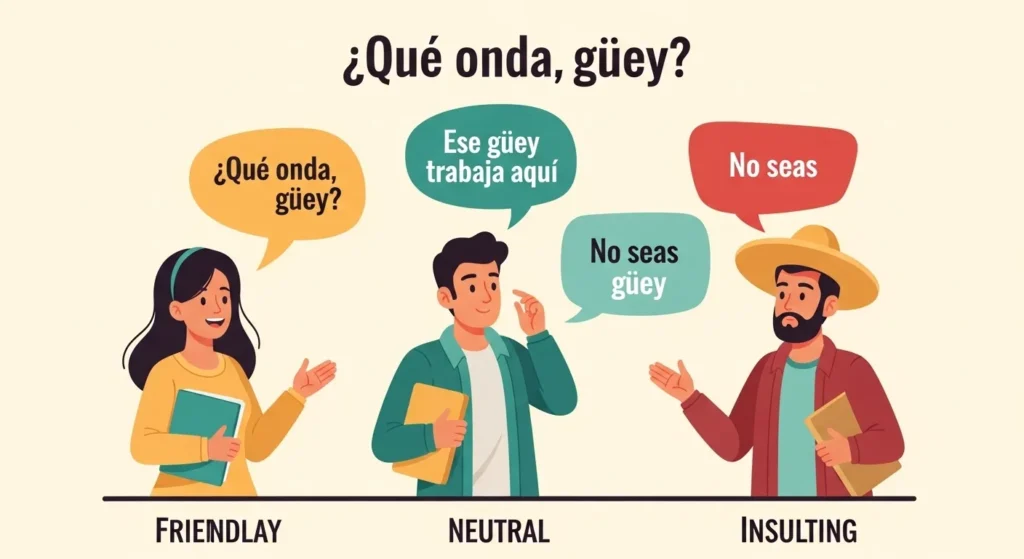
One of the best ways to learn how to use güey correctly is by looking at real-life examples. This shows how tone, context, and relationship affect meaning.
Friendly / Positive Examples:
- “¿Qué onda, güey?” → “What’s up, dude?” (casual greeting among friends)
- “Vamos al cine, güey.” → “Let’s go to the movies, bro.”
- “Gracias, güey.” → “Thanks, dude.”
Neutral / Descriptive Examples:
- “Ese güey es mi vecino.” → “That guy is my neighbor.”
- “Vi a un güey en el parque.” → “I saw a guy at the park.”
Negative / Insulting Examples:
- “No seas güey, estudia más.” → “Don’t be stupiid, study more.”
- “¡Pinche güey siempre llega tarde!” → “That stupidd guy is always late!”
Tips for Using Güey:
- Use it only in informal settings.
- Avoid using it with authority figures or strangers.
- Pay attention to tone smiling vs. angry changes the meaning.
- Combine it with other slang for emphasis, like vato or compa, but carefully.
This section adds practical value for learners, keeps readers engaged
Why Güey Is Important in Mexican Culture
Güey is more than a word it reflects social and cultural norms in Mexico. Knowing it helps you see how people talk, joke, and show friendship or anger.
Cultural Significance:
- Youth identity: Used mostly by young people to show familiarity and equality.
- Pop culture: Appears in movies, songs, TikTok videos, and memes, making it instantly recognizable.
- Social dynamics: Indicates peer relationships, casual hierarchy, and humor.
Examples in Media:
- In movies like Amores Perros or Y Tu Mamá También, characters frequently use güey to show casual, friendly interaction.
- On TikTok and YouTube, memes use güey to exaggerate humor or highlight foolish behavior.
Why It Matters for Learners:
- Using güey correctly shows cultural awareness.
- Misusing it may offend someone or make a learner sound awkward.
- Knowing slang words like vato, cabrón, compa, and amigo helps you understand how people talk in Mexico.
How Meaning Changes With Context
| Context | Meaning | Example |
|---|---|---|
| Friendly | friend, dude, bro | “¿Qué onda, güey?” → “What’s up, dude?” |
| Neutral | that guy | “Ese güey trabaja aquí” → “That guy works here” |
| Insulting | idiot, fool | “No seas güey” → “Don’t be stuppid” |
Common Phrases With Güey
- ¿Qué onda, güey? – friendly “What’s up?”
- No seas güey – joking or scolding “Don’t be stuppid”
- Ese güey – neutral “That guy”
- Pinche güey – stronger insult, tone matters
Is Güey a Bad Word?
Güey is not a strong swear word, but it can be rude if used incorrectly. Use it with:
- Friends or peers
Avoid using it with: - Elders, strangers, or in formal situations
When to Use and Not Use Güey
Use güey:
- With friends, peers, or younger people
- In casual conversations, social media, or street slang
Do NOT use güey:
- In work, school, or professional settings
- With strangers, elders, or in serious situations
- Overusing it can make you seem rude or immature
Güey vs Related Mexican Slang Words
- Vato – casual “dude,” streetwise vibe
- Cabrón – stronger, can be affectionate or offensive
- Compa – affectionate term for a close friend
- Amigo – standard friend, neutral
Güey is versatile, moving from friendly to neutral to slightly insulting depending on context.
Cultural Impact
Güey is part of Mexican culture:
- Found in movies, TV, memes, TikTok, and music
- Shows friendship, humor, and casual interaction
- Reflects youth slang and street language
It is one of the most recognizable words in Mexican Spanish.
Common Mistakes Learners Make
- Overusing it in conversations
- Using it with elders or strangers
- Misunderstanding tone (friendly vs insulting)
- Wrong spelling or pronunciation
Correct usage requires context awareness and cultural understanding.
Quick Summary
- Friendly meaning: friend, dude, bro
- Negative meaning: idiot, fool
- Register: informal, colloquial
- Variant spellings: güey (standard), wey, guey
- Usage: Mexico, youth slang, casual conversations
- Key rule: tone and context decide meaning
FAQs
Q: What does güey mean in spanish to a girl
A: Güey usually means dude, guy, or buddy and can sound friendly, casual, or slightly rude depending on the context.
Q: What does güey mean in spanish slang
A: In Spanish slang, güey is commonly used for dude, bro, guy, or mate.
Q: What does güey mean in spanish pronunciation
A: Güey is generally pronounced like way in English, though the exact sound can vary by region.
Q: Is güey a bad word
A: Güey is not always a bad word, but it can be disrespectful or vulgar when used in an insulting way.
Q: What does buey mean in Spanish
A: Buey literally means ox in Spanish and can also be used as slang for a foolish or gullible person.
Q: Órale güey meaning
A: Órale güey is a casual Mexican expression that can mean Come on, dude, Alright, bro, or Wow, man, depending on context.
Q: Güey pronunciation
A: Güey is commonly pronounced with a sound similar to the English word way.
Q: Güey origin
A: Güey comes from the Spanish word buey, meaning ox, and developed into Mexican slang over time.
Conclusion
Güey is a versatile Mexican slang word. It can mean friend, dude, or bro or idiot/fool, depending on context. It is part of youth slang, casual street language, and popular culture in Mexico. If you know how güey is used, what it means, and how Mexicans use it, you can say güey the right way.
Next time someone says “¿Qué onda, güey?”, you’ll know how to respond, just like a native speaker!

Hi, I’m Evan Lexor, the voice behind Meanvia.com. I break down English words, slang, and phrases into clear, simple meanings that actually make sense. From modern internet terms to everyday expressions, my goal is straightforward: help you understand English better, faster, and with confidence, one word at a time.



