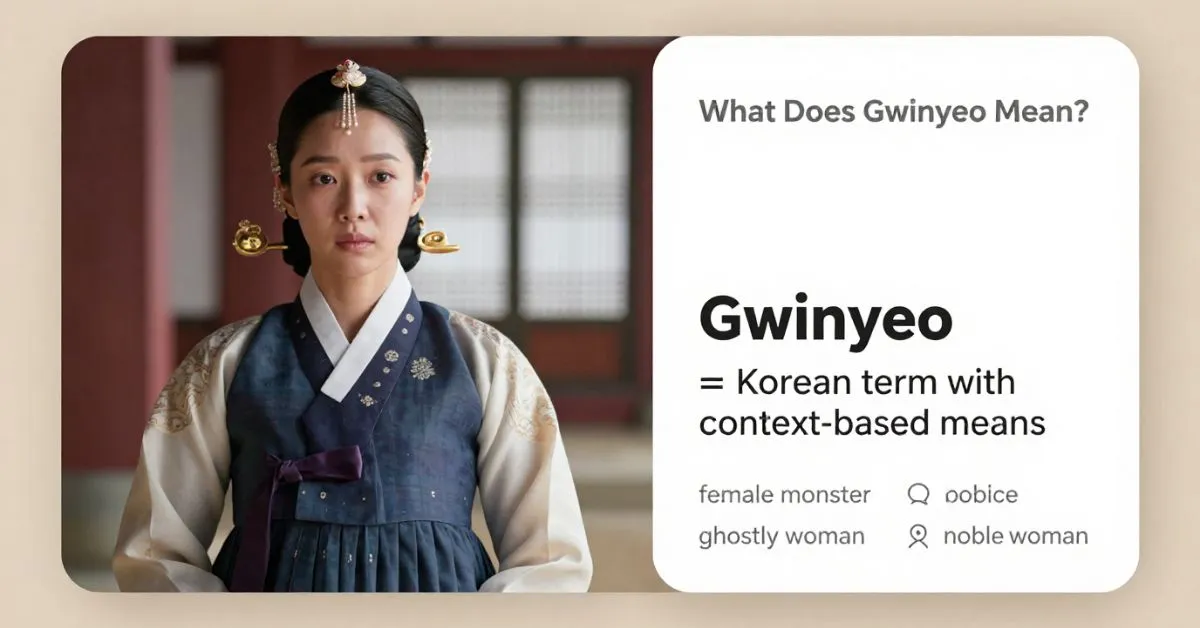
Gwinyeo is the romanized form of the Korean word 귀녀. In current K-drama context, especially around Bon Appétit, Your Majesty, it usually means something like a female monster, ghostly woman, or witch-like woman.
But the same Korean word can also mean noblewoman in another sense, which is why the term confuses so many readers.
If you searched this after hearing it in a drama, that is probably the right path. Current public search results include a viewer thread asking what “gwinyeo” means in Bon Appétit, Your Majesty, while reference-style sources show the word has multiple meanings depending on context and hanja.
The fastest Plain-English answer
If someone in a Korean drama calls a woman gwinyeo, the intended meaning is often not “lady” in a polite sense.
In a fantasy, historical, or suspicious scene, it usually points to something darker: a woman seen as eerie, dangerous, unnatural, ghostly, or monster-like. That is the reading that best fits the live drama context around this search term.
Why gwinyeo has more than one meaning
This is the part most thin pages skip.
The Korean word 귀녀 can map to different hanja. Wiktionary shows two major senses: 貴女, meaning noblewoman, and 鬼女, meaning witch, hag, or ogress. That split explains why one person may read the word as refined or aristocratic while another sees it translated in a supernatural or hostile way.
So the real answer is not “there is only one correct translation.” The real answer is that context decides which meaning fits.
What gwinyeo means in Bon Appétit, Your Majesty
In the synopsis for Bon Appétit, Your Majesty, the main character is described as being mistaken for “a suspicious gwinyeo,” and the page glosses the word as female monster.
That is the clearest public clue for how most current searchers are encountering the term. The series itself aired on tvN from August 23, 2025 to September 28, 2025, which also helps explain why interest in the word is tied to that show rather than to a general dictionary lookup alone.
So if your question is really:
“What does gwinyeo mean in the show?”
the best simple answer is:
It means they see her as a suspicious, unnatural, ghostly, or monster-like woman.
Why subtitles may translate gwinyeo differently
Subtitle translation is rarely just word-for-word. Translators often choose the English phrase that best fits the scene’s tone.
Because 귀녀 can carry different meanings, one subtitle or explainer might lean toward female monster, another toward witch-like woman, and another toward ghost woman if the scene feels more supernatural than literal. The dictionary evidence supports the broader “witch/ogress” side, while the drama synopsis supports the “female monster” rendering.
That does not mean the translators disagree on the core idea. It means they are choosing the English phrasing that sounds most natural for the moment.
Quick meaning breakdown
| Form | Meaning | Best time to use it |
|---|---|---|
| 귀녀 (貴女) | noblewoman | when the context is refined, aristocratic, or status-related |
| 귀녀 (鬼女) | witch, hag, ogress, female monster | when the context is dark, fearful, supernatural, or insulting |
| gwinyeo in current drama searches | usually “female monster” or ghostly woman | when readers are coming from Bon Appétit, Your Majesty or similar K-drama discussion |
The first two meanings are supported by the dictionary entry, while the third line reflects how the word is being surfaced in the current drama-related search environment.
Gwinyeo vs gungnyeo vs ginyeo
A big part of the confusion comes from similar-sounding Korean words.
Gwinyeo vs gungnyeo
Gungnyeo (궁녀) means palace women or court ladies in pre-modern Korea. Reference material describes it as the term for women serving the king and other royalty in traditional court life. That is a very different meaning from gwinyeo.
So if you mean court lady, the word you probably want is gungnyeo, not gwinyeo.
Gwinyeo vs ginyeo
Ginyeo is tied to kisaeng. Current reference material describes kisaeng, also called ginyeo, as women trained as courtesans and entertainers in historical Korea. Again, that is a separate term, separate role, and separate cultural meaning.
So if you mean courtesan or entertainer, you are likely thinking of ginyeo, not gwinyeo.
Gwinyeo vs gwisin
Another useful contrast is gwisin (귀신), which means ghost or spirit. This matters because readers sometimes assume “gwinyeo” must literally equal “ghost woman.” That is not quite the same thing, but the ghost-related feel can overlap in scene interpretation.
Why people get confused by this word
There are four main reasons:
- The same romanized form can point to different meanings.
- Drama context pushes the darker meaning to the front.
- Similar-sounding words like gungnyeo and ginyeo cause mix-ups.
- Subtitles optimize for scene meaning, not just dictionary literalness. This is an inference from the documented dual meaning and the drama’s use of “female monster.”
If you heard this word in a K-drama, use this rule
Ask yourself three quick questions:
- Is the scene tense, suspicious, supernatural, or hostile?
- Is the speaker treating the woman like a threat or something unnatural?
- Is this coming from Bon Appétit, Your Majesty or a similar fantasy-historical setting?
If the answer is yes, the best reading is usually female monster, witch-like woman, or ghostly woman, not noblewoman.
What most articles miss about this topic
Most articles either give one bare translation or turn the page into a dictionary note. Neither is enough.
What readers actually need is this:
- dictionary meaning: the word can mean more than one thing
- drama meaning: current live searches are often about the darker usage
- confusion fix: it is not the same as gungnyeo or ginyeo
That three-part explanation is what makes the term finally click for a beginner. The evidence for the dual meaning comes from the dictionary entry, and the evidence for the drama-led search intent comes from the show synopsis and current public viewer discussion.
FAQ
Is gwinyeo a real Korean word?
Yes. Gwinyeo is the romanized form of 귀녀. The difficulty is that 귀녀 can carry more than one meaning depending on the hanja and context.
Does gwinyeo mean female monster?
In current drama context, especially around Bon Appétit, Your Majesty, that is often the best plain-English reading. The synopsis itself glosses gwinyeo as female monster.
Does gwinyeo mean noblewoman?
It can. Wiktionary lists 귀녀 (貴女) as noblewoman.
Is gwinyeo the same as gungnyeo?
No. Gungnyeo (궁녀) refers to palace women or court ladies in pre-modern Korea.
Is gwinyeo the same as ginyeo?
No. Ginyeo is associated with kisaeng, meaning historical courtesans or entertainers.
Is gwinyeo the same as gwisin?
No. Gwisin (귀신) means ghost or spirit. The terms can feel related in supernatural scenes, but they are not the same word.
Conclusion
If you want the clearest takeaway, here it is:
Gwinyeo usually means a ghostly, witch-like, or monster-like woman in current K-drama-related usage, especially in Bon Appétit, Your Majesty.
But the Korean word behind it can also mean noblewoman in another sense, which is why the term feels confusing at first.
Read Also These Posts:
What Does DRL Mean in a Car? Daytime Running Lights Explained
What Does Withholding Tax Mean? Explanation & Examples
What Does DC Mean in Text? Don’t Care, Disconnect, Other Common Uses

Hi, I’m Evan Lexor, the voice behind Meanvia.com. I break down English words, slang, and phrases into clear, simple meanings that actually make sense. From modern internet terms to everyday expressions, my goal is straightforward: help you understand English better, faster, and with confidence, one word at a time.