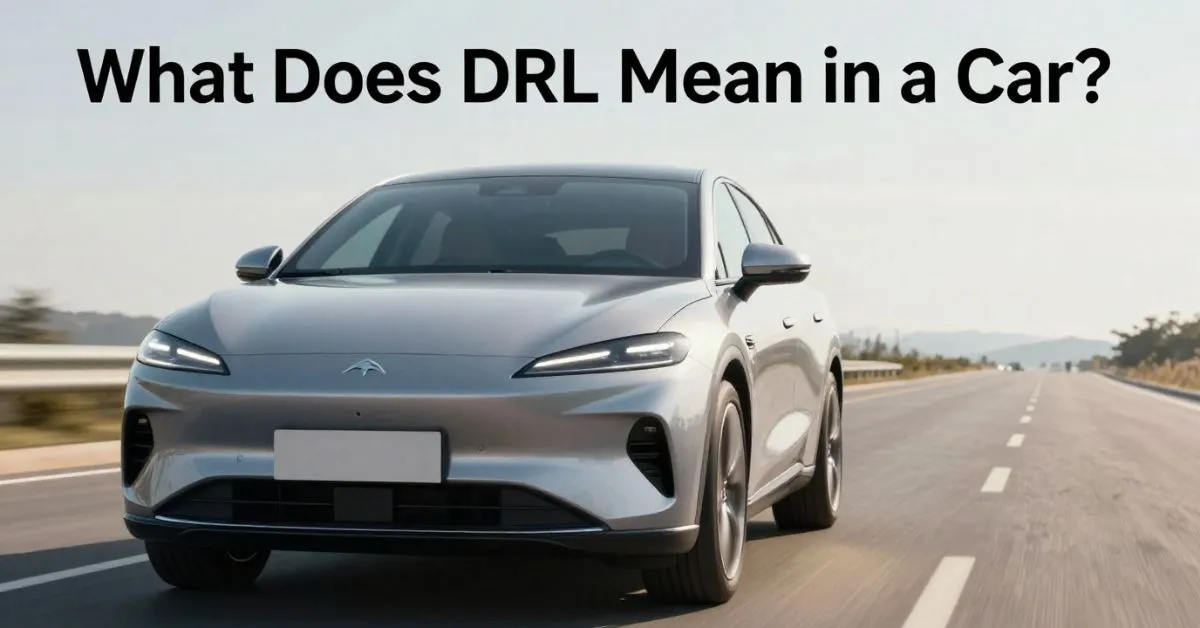
DRL in a car means daytime running lights. These are front lights that usually come on automatically to make your vehicle easier to see during the day. They are not the same as full headlights, and they do not provide enough light for safe driving at night or in bad weather.
If you saw DRL on your dashboard, in your owner’s manual, in a vehicle setting, or in a car listing, the short answer is simple: it refers to a lighting feature designed to improve your car’s visibility in daylight.
The part many drivers miss is that DRLs are mainly about helping other people see your vehicle, not about helping you see the road better.
What does DRL stand for in a car?
DRL stands for daytime running lights. You may also see the more formal term daytime running lamps.
Road-safety guidance describes DRLs as a front lighting system that generally operates automatically when the engine is running and emits white light to increase the vehicle’s visibility during daylight conditions.
That is why DRLs are common on newer cars, SUVs, and vans. They are a visibility feature, not a separate “night-driving mode.”
Where people usually see “DRL”
Most readers come across DRL in one of five places:
- on the dashboard
- in the owner’s manual
- in the vehicle-light settings
- in a used-car listing
- in a parts or repair page
This matters because “DRL” can refer either to the feature itself or to an indicator related to that feature, depending on context. That is one reason so many searches around this keyword are slightly mixed in intent.
How do daytime running lights work?
On many modern vehicles, DRLs come on automatically when the vehicle is started and daytime conditions are detected.
Some systems work with sensors and a DRL module, and on many cars the DRLs turn off or change behavior when the headlights switch on. The exact setup can vary by make and model, which is why checking the owner’s manual is still important.
In practical terms, DRLs usually work like this:
- The car is started or put in motion.
- The DRL system activates front-facing lights for daytime visibility.
- If ambient light drops enough, some vehicles switch to full headlights automatically if the light control is set to auto.
So when someone asks, “What is DRL in a car?” the best plain-English answer is: it is the car’s automatic daytime visibility lighting system.
What are daytime running lights?
Daytime running lights (DRLs) are lights on a vehicle that stay on while driving during daylight hours. Their main purpose is to help other drivers, cyclists, and pedestrians notice the vehicle more easily. DRLs are usually less bright than headlights and are designed to improve visibility without lighting the road like normal headlights. Many newer cars turn them on automatically when the engine starts or the vehicle begins moving. DRLs are different from headlights because they are mainly for being seen, not for seeing the road ahead.
Context and how people use it
People usually use the term when discussing vehicle safety, lighting systems, car features, or driving laws.
Example 1: “My new car has daytime running lights that turn on automatically.”
Example 2: “Daytime running lights can make a car easier to notice in traffic.”
Table of Contents
A table of contents gives readers a quick view of the main topics covered in an article about daytime running lights. It can help visitors find information about DRL definitions, benefits, disadvantages, technology, regulations, and differences between DRLs and other vehicle lights. For a longer guide, a clear table of contents also makes the page easier to scan. It is especially useful when readers want a specific answer instead of reading the entire article from beginning to end.
Context and how people use it
People use a table of contents to navigate longer articles and quickly find the section they need.
Example 1: “I used the table of contents to find the DRL safety section.”
Example 2: “The table of contents helped me jump directly to the regulations section.”
What are daytime running lights? (DRL)
Daytime running lights, commonly called DRLs, are vehicle lights designed to remain on during daytime driving. They help make a moving vehicle more visible to other road users, especially in situations where a car might blend into its surroundings. DRLs are usually located near the front of the vehicle and may use LED technology on newer models. They are not intended to replace headlights at night. Depending on the vehicle, DRLs may switch on automatically when the engine starts and turn off or change when the regular headlights are activated.
Context and how people use it
The term “DRL” is common in car manuals, automotive discussions, safety information, and vehicle specifications.
Example 1: “The dealer explained that DRL means daytime running light.”
Example 2: “Her car’s DRLs come on automatically during the day.”
Advantages and disadvantages of daytime running lights drl
Daytime running lights can make vehicles easier to notice during daylight, which may help other road users recognize an approaching or moving car. They can also provide a convenient automatic lighting feature because drivers do not usually need to switch them on manually. However, DRLs are not a complete lighting system. They generally do not provide enough illumination for dark roads, and they may not turn on the rear lights. They can also use a small amount of energy, although modern LED DRLs are usually efficient.
Context and how people use it
People discuss the advantages and disadvantages of DRLs when comparing vehicle safety features or deciding how useful daytime lighting is.
Example 1: “One advantage of DRLs is better daytime visibility.”
Example 2: “A disadvantage is that DRLs should not be treated as nighttime headlights.”
Technological aspects of DRLs
Modern daytime running lights use several technologies to create bright, efficient, and reliable daytime visibility. LED systems are common because LEDs can produce strong light while using relatively little electrical power and taking up limited space. Some vehicles connect DRLs to automatic lighting controls, allowing the system to respond to conditions or other vehicle settings. Manufacturers can also design DRLs as part of a car’s front lighting style. The exact operation varies by vehicle, so the owner’s manual is the best source for understanding how a specific DRL system works.
Context and how people use it
This topic is usually discussed when people want to understand how modern vehicle lighting systems operate.
Example 1: “The car uses LED DRLs to improve visibility without large bulbs.”
Example 2: “The owner’s manual explains when the automatic DRLs switch on.”
DRL regulations in different regions
Rules for daytime running lights are not the same everywhere. Some countries or regions require DRLs on certain vehicles, while others allow or recommend their use without making them mandatory for every vehicle. Requirements can also differ based on vehicle type, manufacturing date, lighting design, and local road laws. Drivers should check the rules that apply where they drive rather than assuming that another country’s requirements are the same. Vehicle manufacturers may also build lighting systems to meet specific regional standards.
Context and how people use it
People search for DRL regulations when checking whether daytime running lights are legally required, permitted, or regulated in their area.
Example 1: “Before changing my DRLs, I checked the lighting rules in my region.”
Example 2: “The vehicle was designed to meet the DRL requirements for its market.”
DRLs vs. headlights vs fog lamps
DRLs, headlights, and fog lamps have different jobs. DRLs mainly help other people see a vehicle during the day. Headlights are designed to illuminate the road and help the driver see in darkness or poor visibility. Fog lamps are designed for specific low-visibility conditions and are positioned to provide useful light closer to the road. These lights should not be treated as interchangeable. Using the correct lighting system for the conditions can improve visibility for both the driver and other road users.
Context and how people use it
People compare these lights when they are unsure which vehicle lighting feature should be used in a particular driving situation.
Example 1: “DRLs help others notice my car, while headlights help me see at night.”
Example 2: “I use the vehicle’s fog lamps only when conditions call for them.”
DRL safety benefits
The main safety benefit of daytime running lights is increased vehicle visibility. A vehicle with its front lights illuminated may be easier for other drivers and road users to notice, particularly against certain backgrounds or during changing daylight conditions. This can help people recognize an approaching vehicle sooner. However, DRLs are only one part of safe driving. They do not replace headlights when it is dark, and drivers still need to use the correct lights for weather and road conditions. Their effectiveness can also vary with the vehicle and environment.
Context and how people use it
People discuss DRL safety benefits when learning how daytime vehicle lighting may improve visibility and awareness on the road.
Example 1: “The driver uses DRLs to make the car more noticeable during the day.”
Example 2: “DRLs can improve visibility, but they are not a substitute for headlights at night.”
Are DRLs the same as headlights?
No. This is the biggest confusion point, and fixing it clearly is what makes this article more useful than a generic definition page.
Headlights are meant to light the road ahead when it is dark or visibility is poor.
DRLs are meant to make the vehicle more noticeable during the day.
Transport Canada says daytime running lights do not give you enough light to drive safely in the dark or in bad weather, while low beams are used to light the road in front of the vehicle. RSA says DRLs do not produce enough light to illuminate the road at night-time.
DRL vs headlights vs fog lights
| Lighting type | Main job | Best for | Not enough for |
|---|---|---|---|
| DRL | Making the car easier to see in daytime | Daylight visibility | Night driving, fog, heavy rain |
| Low-beam headlights | Lighting the road ahead without excessive glare | Night driving, dusk, rain, tunnels | Very dark open roads where high beams may be needed |
| Fog lights | Short, wide beam for poor visibility close to the road | Fog, snow, heavy mist | Replacing normal headlights |
This is the simplest practical rule: if you need to see the road better, DRLs are not the answer—headlights are.
drl meaning
DRL usually means Daytime Running Lights. These are lights on a vehicle that stay on during the day to make the car easier for other drivers, cyclists, and pedestrians to see. DRLs are usually less bright than headlights and are not mainly designed to light the road. They often turn on automatically when the engine starts or the car is moving. The exact design can vary by vehicle.
Context and how people use it:
People commonly use “DRL” when talking about a car’s daytime lighting system or dashboard messages.
It may also appear in a vehicle manual when explaining automatic lights and safety features.
Examples:
- “My car’s DRL turned on when I started the engine.”
- “The DRL makes the vehicle easier to see during the day.”
what does drl mean
DRL means Daytime Running Lights. It refers to lights fitted to a vehicle that operate during daylight hours. Their main purpose is to improve the vehicle’s visibility rather than help the driver see the road. In many modern cars, DRLs work automatically and may switch on whenever the vehicle is running. They can be located near the headlights, in the front bumper, or integrated into the vehicle’s lighting design.
Context and how people use it:
People ask “what does DRL mean?” when they see the abbreviation on a car dashboard, display, or manual.
It is most often used when discussing vehicle lights and road visibility.
Examples:
- “What does DRL mean on this dashboard?”
- “DRL means Daytime Running Lights on my vehicle.”
what is drl
DRL stands for Daytime Running Lights. They are vehicle lights designed to help make a car more noticeable during daylight. Unlike regular headlights, DRLs are generally intended for visibility instead of illuminating the road ahead. Many newer vehicles automatically activate them when the car is started. Depending on the model, DRLs may use LED strips, small lamps, or part of the main headlight assembly. Their operation can differ between vehicles, so the owner’s manual is the best source for model-specific details.
Context and how people use it:
DRL is commonly used in conversations about vehicle safety, lighting, and dashboard indicators.
Drivers may also see the term when checking their car’s lighting settings or manual.
Examples:
- “My new SUV has bright LED DRLs.”
- “I checked the manual to learn how the DRL works.”
what is drl light
A DRL light is a Daytime Running Light used on a vehicle to improve visibility during the day. It is usually positioned at the front of the vehicle and turns on automatically in many cars. DRLs are not the same as high beams or normal headlights because their main purpose is to help other road users notice the vehicle. Modern DRLs are often made with LED technology because LEDs use relatively little energy and can fit neatly into modern vehicle designs.
Context and how people use it:
People use “DRL light” when referring to the daytime lights fitted to the front of a car.
The phrase often appears in car questions, repair discussions, and vehicle manuals.
Examples:
- “The DRL light comes on automatically in my car.”
- “One DRL light stopped working yesterday.”
drl light meaning
The meaning of DRL light is Daytime Running Light. It describes a vehicle light that helps increase visibility during daylight. DRLs normally operate automatically while the vehicle is running, although the exact behavior depends on the car. They are generally different from headlights because they are intended mainly to make the vehicle visible to others, not to provide strong illumination for the driver. If a DRL warning appears on the dashboard, the meaning can vary by vehicle, so checking the owner’s manual is recommended.
Context and how people use it:
People search for “DRL light meaning” when they want to understand a car’s daytime lighting feature.
It is also commonly searched when a DRL symbol or warning appears on the dashboard.
Examples:
- “What is the DRL light meaning on my dashboard?”
- “The DRL light helps other drivers notice the car.”
drl meaning car
In a car, DRL means Daytime Running Lights. These are front-facing lights that operate during daylight to make the vehicle more visible to other road users. Many cars activate DRLs automatically when the engine starts, but the exact system depends on the manufacturer and model. DRLs usually do not replace headlights when driving at night or in poor visibility. Drivers should use the appropriate headlights when conditions require them, even if the DRLs remain active.
Context and how people use it:
“DRL meaning car” is commonly searched by drivers who want to understand a vehicle lighting feature.
It may also come up when checking dashboard symbols or a car’s lighting controls.
Examples:
- “I searched for the DRL meaning in my car manual.”
- “The car’s DRLs turn on automatically during the day.”
what does dlr mean
DLR is different from DRL, and the meaning depends on the context. In a car-lighting discussion, “DLR” may simply be a typing mistake for DRL, which means Daytime Running Lights. There is no need to assume that DLR always refers to a vehicle light. In other fields, DLR can have completely different meanings. If you saw “DLR” on a dashboard, vehicle display, or manual, checking the exact wording and your car’s documentation can help identify what it means.
Context and how people use it:
People sometimes type “DLR” when they actually mean “DRL” while searching for car-light information.
Outside automotive topics, DLR can have other meanings depending on the subject.
Examples:
- “I typed DLR, but I was looking for the DRL meaning.”
- “Check the manual if DLR appears on your vehicle display.”
drl light on car
A DRL light on a car refers to a Daytime Running Light. It is designed to make the vehicle easier to see during daylight. On many modern cars, the DRLs switch on automatically when the vehicle is running. They are usually located at the front and may appear as LED strips or small lamps. If one DRL stops working or a warning message appears, the cause could involve a bulb, LED unit, fuse, wiring, or another vehicle-specific component. The manual can provide the correct troubleshooting steps.
Context and how people use it:
People use this phrase when asking about the purpose or operation of daytime lights on their car.
It can also refer to a DRL warning or a light that is not working correctly.
Examples:
- “The DRL light on my car stays on during the day.”
- “My car displayed a warning about the DRL light.”
what does drl mean in a car
In a car, DRL means Daytime Running Lights. These lights are designed to increase the vehicle’s visibility during daylight hours. They usually operate automatically and are commonly found at the front of the vehicle. DRLs are different from headlights because their main job is to help others see the car rather than illuminate the road. When driving at night, in rain, fog, or other low-visibility conditions, drivers may need to use the vehicle’s regular headlights and other required lighting.
Context and how people use it:
People ask this question when they see “DRL” on a dashboard, vehicle display, or car manual.
The term is mainly used when discussing a car’s daytime lighting and visibility.
Examples:
- “What does DRL mean in a car?”
- “The DRL turns on automatically when I start my car.”
drl light means
DRL light means Daytime Running Light. It is a vehicle light that helps improve the car’s visibility during daylight. In many vehicles, these lights turn on automatically when the engine is running. They are generally less focused on illuminating the road and more focused on helping other drivers, cyclists, and pedestrians notice the vehicle. The exact appearance and operation of DRLs vary between car models, so drivers should check their vehicle’s manual for specific information about the lighting system.
Context and how people use it:
People use “DRL light means” when trying to understand a daytime-light feature or dashboard indicator.
It is especially common in searches about car lights, automatic lighting, and vehicle safety.
Examples:
- “The DRL light means my daytime running lights are active.”
- “I checked the manual to see what the DRL light means.”
Do DRLs turn on tail lights too?
Not always, and this is one of the most important safety details people miss.
Transport Canada warns that a bright dashboard does not always mean your headlights and tail lights are on, and its DRL guidance notes that marking lights can be off. RSA also says rear lights and instrument lights may not be on in some cases when DRLs are in use.
That means a driver can look illuminated from the front but still be hard to see from behind in low-light conditions.
Canada changed its newer-vehicle lighting standard in September 2021 to address this kind of “phantom vehicle” problem by requiring one of several solutions, such as tail lights coming on automatically with DRLs or full automatic lighting behavior in the dark.
Quick rule to remember
If it is:
- getting dark
- raining hard
- foggy
- snowing
- overcast enough that visibility drops
- a tunnel or parking structure
then switch to proper headlights or make sure your automatic headlights are actually set to Auto.
DRL on a dashboard: what it means
This is where intent often splits.
On some vehicles, a DRL indicator simply means the daytime running lights are on and operating normally.
On others, a DRL warning light or message may point to a fault, and manufacturer behavior can differ. That is why the safest interpretation is: look at the symbol, the message wording, and your owner’s manual together.
If your DRLs are not working properly, common causes can include:
- a failed bulb or LED
- a blown fuse
- damaged wiring
- a bad sensor
- a faulty DRL or headlamp module
So if you searched this because your dashboard says DRL, there are really two possibilities:
- it is just telling you the DRL system is active
- it is warning you that the DRL system has a fault
The manual-specific meaning matters more than the letters alone.
What kinds of DRLs do cars use?
Not every DRL system looks the same.
NHTSA interpretations show that manufacturers can use different front-lamp designs for DRL operation as long as the setup meets the relevant lighting requirements.
For example, some systems use dedicated LED elements, while others use lamps that serve more than one function depending on brightness and operating mode. NHTSA also notes that parking lamps are not used as DRLs in the relevant interpretation context because they are too small to be effective, and fog lamps are too bright for that role.
In plain English, that means your DRLs may appear as:
- a slim LED strip
- a bright front light inside the headlamp unit
- a reduced-intensity headlamp-style light
- a multifunction lamp system, depending on the vehicle design
Are DRLs enough, or do you need headlights?
Use this table as the simplest answer.
| Situation | DRLs enough? | Use headlights instead? |
|---|---|---|
| Bright daytime | Yes | No |
| Heavy rain | No | Yes |
| Fog | No | Yes |
| Dusk | No | Yes |
| Night | No | Yes |
| Tunnel | Usually no | Yes |
That guidance aligns with official road-safety advice that DRLs are for daylight visibility and do not provide enough road illumination in darkness or bad weather.
Are DRLs required by law?
The short answer is: requirements vary by country and by vehicle market.
RSA says new vehicles have had to be fitted with DRLs under EU rules since November 2014, and it notes that the DRLs are only required at the front of vehicles in that framework.
Canada also has specific lighting requirements for newer vehicles sold there, including changes introduced from September 2021 to improve low-light visibility and reduce confusion around rear lighting.
That is why DRL behavior is not identical on every car. A vehicle’s country of sale, model year, and manufacturer design can all affect how the system behaves.
Common mistakes drivers make with DRLs
Thinking DRLs are enough at night
They are not. Both Transport Canada and RSA say DRLs do not provide enough light for safe night driving.
Assuming rear lights are on too
That is not always true. This is one of the biggest practical risks with DRL confusion.
Confusing DRLs with automatic headlights
DRLs are a daytime visibility feature. Automatic headlights are a separate function that can switch the full lights on when outside light drops low enough.
Believing every dashboard DRL light means a fault
Sometimes it is only an indicator that the feature is active. Other times it may point to a problem. You need the manual-specific meaning.
What Most Articles Miss About This Topic
Most articles stop after saying “DRL means daytime running lights.” That definition is correct, but it is not enough.
What people really need to know is this:
- DRLs are for being seen, not for seeing better
- DRLs and headlights are not interchangeable
- rear lights may not be on when DRLs are on
- the dashboard meaning of DRL can vary by vehicle
- the safest source for the exact behavior on your car is still the owner’s manual
That practical layer is what turns a dictionary-style answer into a genuinely useful one.
FAQs
Q: DRL meaning on Honda
A: DRL on a Honda means Daytime Running Lights, which help make the vehicle more visible during the day.
Q: What does DRL mean on a Honda Civic
A: DRL on a Honda Civic means Daytime Running Lights, designed to improve visibility to other drivers.
Q: DRL meaning volkswagen
A: DRL on a Volkswagen means Daytime Running Lights, which automatically provide front lighting during daytime driving.
Q: How to fix DRL light on dash
A: Check the DRL bulbs, fuses, wiring, and related system components to identify and fix the problem.
Q: What does DRL mean on a Honda CRV
A: DRL on a Honda CR-V means Daytime Running Lights, which improve the vehicle’s visibility during daylight.
Q: What does it mean when it says Check DRL system
A: “Check DRL system” means the vehicle has detected a problem with its Daytime Running Light system.
Q: What does DRL mean on a Honda accord
A: DRL on a Honda Accord means Daytime Running Lights, which help other road users see the vehicle during the day.
Q: Check DRL system Honda Civic
A: “Check DRL system” on a Honda Civic indicates a possible fault with the vehicle’s Daytime Running Lights or related components.
Conclusion
If you wanted the simplest answer, here it is: DRL means daytime running lights. They help make your vehicle more visible during the day, but they are not a replacement for proper headlights in darkness, rain, fog, or other low-visibility conditions.
The smartest habit is simple: enjoy DRLs for daytime visibility, but switch to full headlights whenever conditions stop being truly daytime-clear.
Read Also These Posts:
What Does DC Mean in Text? Don’t Care, Disconnect, Other Common Uses
What Does Detrimental Mean? Definition, Examples, How to Use
What Does the Name Brian Mean? Complete Explanation

Hi, I’m Evan Lexor, the voice behind Meanvia.com. I break down English words, slang, and phrases into clear, simple meanings that actually make sense. From modern internet terms to everyday expressions, my goal is straightforward: help you understand English better, faster, and with confidence, one word at a time.