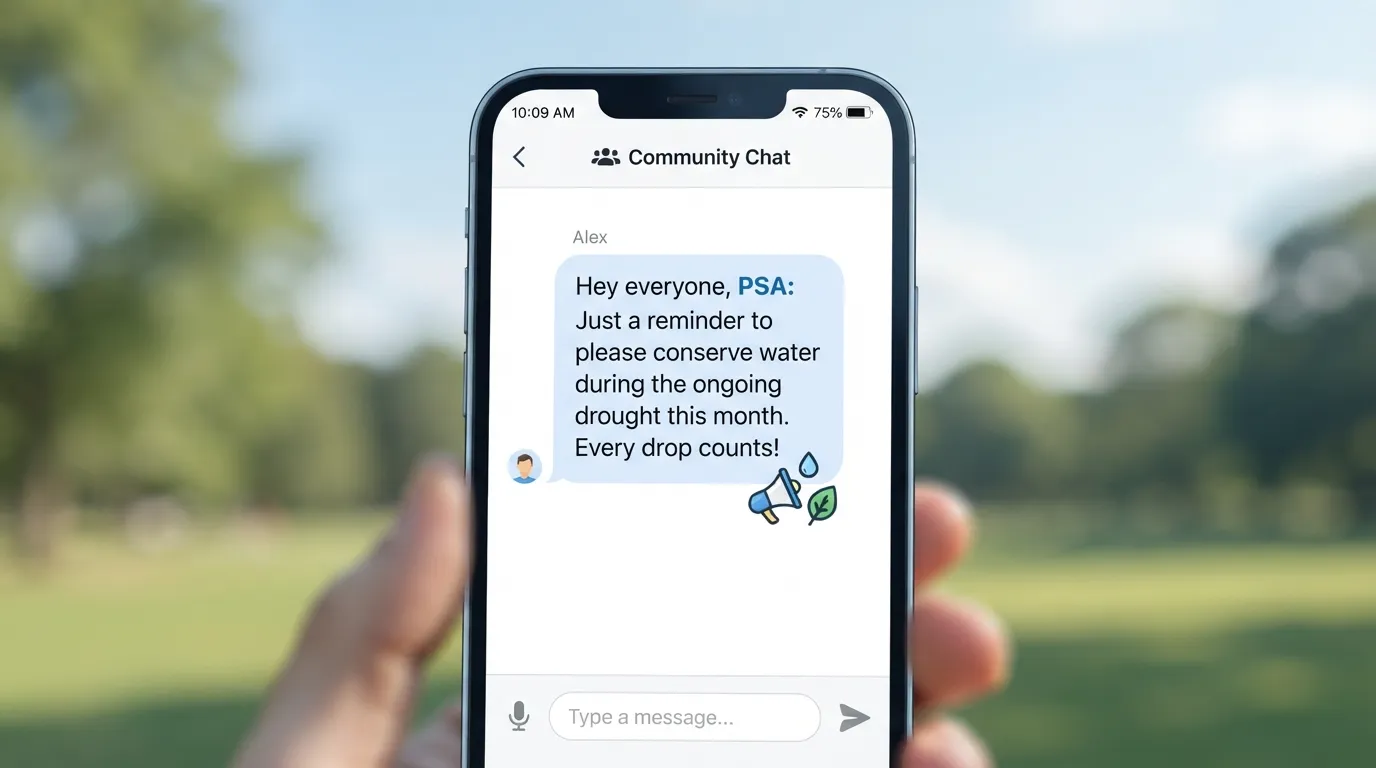
PSA usually means Public Service Announcement. In texting, social media, and casual online talk, people use it to introduce a tip, warning, reminder, or message they want others to notice.
It can be serious or funny. So if someone writes a PSA: before a sentence, they are often saying, Here’s something you should know.
The exact tone comes from the words that follow it and the setting where you see it.
What Does PSA Mean in Slang?
PSA means Public Service Announcement.
In everyday online talk, people often use PSA in a casual way. It can appear in a text, group chat, comment, caption, or social media post.
The original phrase refers to a message meant to give the public useful information. Online, people have made the term much more flexible.
For example:
PSA: The store closes early today.
This does not mean the person works for the store. They are simply using PSA to make the message stand out.
People may use PSA to share:
- A quick reminder
- A warning
- A useful tip
- Important information
- Advice
- A small announcement
- A funny thought
The basic meaning stays the same, but the tone can change with the context.
What Does PSA Mean in Texting?
In texting, PSA usually stands for Public Service Announcement.
A person may put PSA at the start of a message when they want you to pay attention.
For example:
PSA: Don’t forget your appointment tomorrow.
Or:
Quick PSA: Bring a jacket tonight.
Here, PSA acts like an attention signal. It tells the reader that the next part of the message may be useful.
It does not mean the message must be formal. Friends can use PSA in normal conversations.
How Is PSA Used on Social Media?
PSA is also common in social media posts.
Someone may write:
PSA: Check your email before deleting old messages.
The writer is sharing something they think other people should know.
But PSA can also be playful:
PSA: Fries always taste better when someone else orders them.
This is not a real public announcement. The person is using the phrase for humor.
You may see this type of use in posts, comments, captions, memes, and short videos.
What Does PSA Stand For?
PSA stands for Public Service Announcement.
A public service announcement is generally a message that gives people information or raises awareness about an issue.
The short form, PSA, is now widely used in casual communication too.
For example:
PSA: Save your work before closing your laptop.
This is a personal reminder, not an official announcement. The writer is using PSA because it makes the message sound more noticeable.
Is PSA Always Serious?
No. PSA can be serious, helpful, casual, or funny.
Look at these examples:
PSA: Wear sunscreen when spending a long time outside.
This has a serious and helpful tone.
PSA: The coffee shop closes at 6 today.
This is a simple reminder.
PSA: Never trust anyone who says they don’t like pizza.
This is clearly playful.
So, the word PSA does not tell you the tone by itself. The rest of the message does.
PSA Examples in Texting
Here are some natural examples of PSA in everyday messages:
PSA: Our class starts at 9 tomorrow.
PSA: Don’t forget your keys.
Quick PSA: The deadline is Friday.
PSA: Charge your phone before the trip.
Friendly PSA: Drink some water today.
PSA: Don’t watch the next episode without me.
Each example uses PSA to bring attention to information.
The message can be useful, simple, personal, or funny. That is why PSA works well in casual texting.
What Does PSA Mean From a Girl or Guy?
If a girl or guy sends you PSA, it normally has the same meaning: Public Service Announcement.
PSA does not automatically mean flirting, attraction, or anything romantic.
For example:
PSA: We’re meeting at 6 instead of 7.
That is simply a reminder.
Now consider:
PSA: You look really good today.
The message could be friendly, playful, or flirty. You cannot determine that from PSA alone.
The relationship, wording, and rest of the conversation give the message its meaning.
PSA vs. FYI: What’s the Difference?
PSA and FYI are similar because both can introduce information, but they have a different feel.
FYI means For Your Information. It is often used to give someone information they may need or find useful.
PSA means Public Service Announcement. It often makes the message feel more like a reminder, warning, or attention-grabbing announcement.
For example:
FYI: The store closes at 6.
PSA: Don’t wait until 5:55 to go to the store.
The first simply gives information. The second puts more attention on the point.
Neither term has to be formal in a text.
Can PSA Be Used as a Joke?
Yes. People often use PSA for jokes online.
The humor usually comes from treating an ordinary thought as if it were an important public announcement.
For example:
PSA: Five more minutes of sleep is never really five minutes.
Or:
PSA: Never go grocery shopping when you’re hungry.
The writer is not making an official announcement. They are using the familiar phrase in a funny way.
This casual use is common in social media posts and group chats.
Is PSA Formal or Informal?
The full phrase Public Service Announcement can be formal when used in an official setting.
But PSA is often informal when people use it online.
| Context | Common use |
| Official message | Public information |
| Text message | Reminder or warning |
| Group chat | Quick announcement |
| Social media | Tip, advice, or opinion |
| Joke or meme | Funny statement |
This means you should look at the context before deciding how serious a PSA message is.
Common Phrases With PSA
You may see PSA used in several forms.
PSA:
A direct way to introduce information.
Quick PSA:
Usually a short reminder or tip.
Friendly PSA:
A softer, more casual announcement.
PSA for everyone:
A way to address a larger group.
For example:
Quick PSA: Save your files before restarting your computer.
Or:
Friendly PSA: Check the weather before you leave.
These phrases all point to the same basic idea: pay attention to this information.
When Should You Use PSA?
PSA works well when you want to make a message noticeable.
You might use it before:
- A reminder
- A warning
- A helpful tip
- A group announcement
- A useful fact
- A lighthearted observation
For example:
PSA: The deadline changed to Monday.
You can also use it for something funny:
PSA: Never shop for food when you’re starving.
Still, PSA may sound too dramatic for a very personal message. In those cases, a direct sentence or FYI may sound more natural.
Common Misunderstandings About PSA
One common mistake is thinking that PSA must always be official.
In casual online speech, that is not true.
Someone might write:
PSA: Bring snacks for the road trip.
They are not pretending to represent a public agency. They are simply using PSA to draw attention to their message.
Another common mistake is assuming PSA has a secret slang meaning. In most texts and social media posts, it still means Public Service Announcement.
The surrounding words tell you what the person means by using it.
Is PSA a Slang Word or an Abbreviation?
PSA is best described as an abbreviation or initialism, rather than a slang word.
It comes from the first letters of Public Service Announcement.
However, its casual use online gives it a slang-like feel in some conversations.
So, if someone asks what PSA means in slang, the simple answer is still:
PSA = Public Service Announcement.
The difference is that online users often use it in a much more relaxed way than the original phrase suggests.
What Does PSA Mean in a Sentence?
PSA can appear at the beginning of a sentence.
For example:
PSA: The meeting has been moved to Friday.
It can also appear with a short introduction:
Just a quick PSA: Bring your ID with you.
Or:
Friendly PSA: Don’t forget to back up your photos.
In most casual messages, putting PSA before the main point is enough. You do not need to explain what the abbreviation means to people who already know it.
Quick Answer: PSA Meaning Slang
If you only need the short answer, here it is:
PSA means Public Service Announcement.
In texting and social media, people use it to say:
Here is something you should know.
It can introduce a reminder, warning, tip, announcement, opinion, or joke.
The tone depends on the message that follows it.
FAQs
Psa meaning slang urban dictionary
In slang, PSA usually means “public service announcement.” People use it before sharing a warning, reminder, tip, or useful piece of information.
PSA meaning social media
On social media, PSA usually means “public service announcement.” It is often used before a short message meant to inform or remind other people about something.
Psa meaning slang urban
In casual slang, PSA commonly means “public service announcement.” It signals that someone is about to share information they think others should know.
Psa meaning slang from a girl
If a girl writes PSA, she usually means “public service announcement.” It does not have a special meaning based on gender; the message after it gives the context.
PSA meaning slang pokemon
In Pokémon discussions, PSA can have a context-specific meaning, but it may also simply mean “public service announcement.” The surrounding Pokémon-related conversation helps determine which meaning applies.
Psa meaning slang reddit
On Reddit, PSA usually means “public service announcement.” Users often put it at the start of a post or comment to share a helpful warning, tip, or reminder.
PSA meaning relationship
In a relationship discussion, PSA usually still means “public service announcement.” It may introduce advice, a reminder, or information about dating and relationships.
PSA meaning abbreviation
PSA most commonly stands for “public service announcement,” a message meant to give people useful information or raise awareness about an issue.
Humanize 235 words
Final Takeaway
PSA means Public Service Announcement. In texting and social media, it is often used in a casual way to get attention before a reminder, warning, tip, or announcement. It can also be funny or sarcastic. PSA does not usually have a hidden romantic meaning, and it does not always mean the message is official. If you see PSA: in a text or post, read the rest of the message to understand what the person is trying to say.
For more useful meanings, see [common texting abbreviations] and [popular social media slang].
Discover More Post
- What Is OP Meaning Slang? Easy Guide to OP
- Opp Meaning Slang: Meaning, Uses, and Text Examples
- Chud Meaning Slang Explained: Meaning, Use & Examples
- Torta Meaning Slang: What Does Torta Mean?
Hi, I’m Clara Lexis from Meanvia.com. I break down words and expressions so they’re easy to understand and enjoyable to learn. My mission is simple: make language approachable and fun, one word at a time.