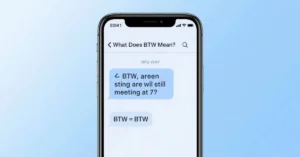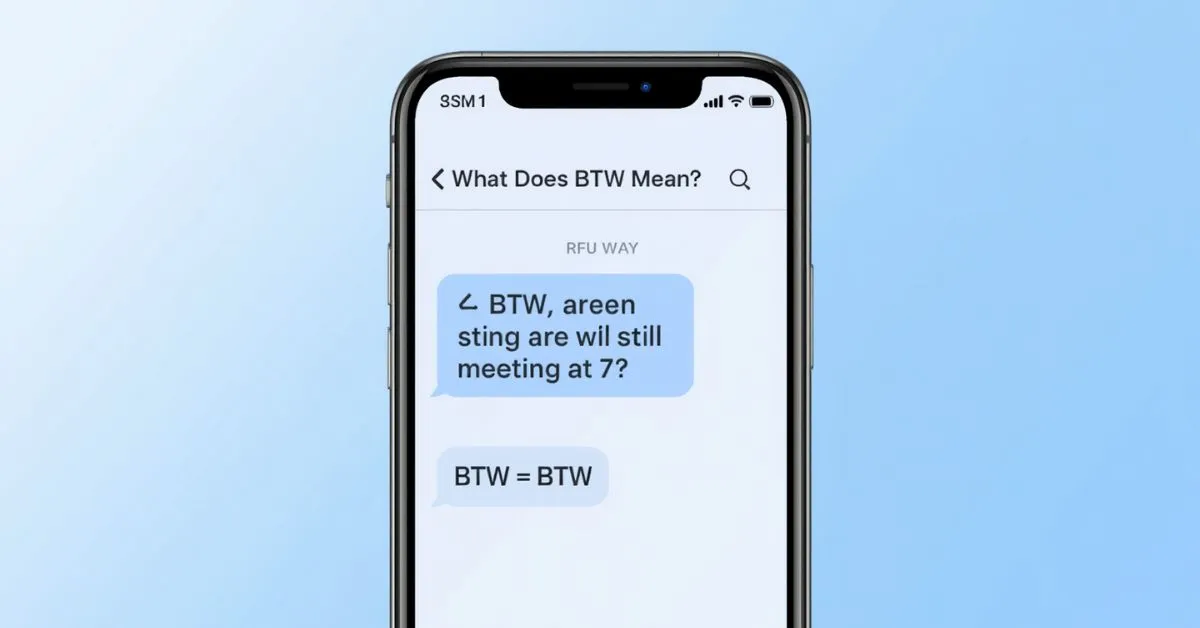
BTW means “by the way.” It is a common written abbreviation used in texts, chats, social media, and some emails when someone wants to add an extra thought, side note, or quick question.
Quick Answer
| Term | Full Meaning | Tone | Common Use |
|---|---|---|---|
| BTW | By the way | Informal | Texts, chats, casual online messages |
Example:
“BTW, are we still meeting at 7?”
If you searched “what is btw mean,” the natural phrasing is “what does BTW mean?” The meaning is simple: BTW = by the way. People use it when they want to add something extra without making it the main point of the message.
That is the short answer. The more useful question is this: how is BTW actually used, and when does it sound natural or too casual? That is where many short definition pages stop too early.
What Does BTW Stand For?
BTW stands for “by the way.”
It is a written abbreviation people use in digital communication, especially in:
- text messages
- chat apps
- social media
- casual emails
- online comments
- group chats
You will usually see it written as:
- BTW
- btw
Both are widely understood. Uppercase and lowercase usually mean the same thing. The choice mostly depends on the style of the message.
What Does BTW Mean in Text?
In text messages, BTW usually introduces an extra piece of information that is related to the conversation, but not the main point.
For example:
- “BTW, I sent you the link.”
- “BTW, thanks for helping yesterday.”
- “I finished the homework. BTW, did you do question 5?”
In each case, the person is adding a side note, reminder, or follow-up thought.
So when someone writes BTW, they are often saying one of these things:
- one more thing
- also
- before I forget
- just to mention it
- while we are talking about that
That is why BTW feels natural in casual conversation. It helps shift the message slightly without starting a completely new topic.
How BTW Is Actually Used
A lot of articles only give the definition. In real life, people use BTW in a few common ways.
1. To add extra information
Example:
“BTW, the restaurant closes at 9.”
The main message is already clear. This adds one more useful detail.
2. To ask a side question
Example:
“BTW, did you get my email?”
This is very common in text and chat because people often remember something mid-conversation.
3. To shift the conversation slightly
Example:
“Your trip looked amazing. BTW, what hotel did you stay at?”
Here, the speaker is moving into a related topic in a smooth way.
4. To add a casual reminder
Example:
“BTW, don’t forget the meeting tomorrow.”
This use is short, natural, and very common in everyday messaging.
Is BTW Formal or Informal?
BTW is usually informal.
That means it works best in:
- personal texts
- friendly chats
- casual online conversation
- relaxed internal messages
It is less suitable for:
- formal emails
- job applications
- academic writing
- legal or professional documents
- serious or sensitive communication
For example, this sounds casual:
“BTW, I wanted to follow up on the invoice.”
In a more professional setting, this may sound better:
“I also wanted to follow up on the invoice.”
Or:
“By the way, I wanted to follow up on the invoice.”
The meaning is the same, but the tone is more polished.
Should You Write BTW or “By the Way”?
That depends on the situation.
Use BTW when:
- you are texting
- the conversation is casual
- you want to sound quick and natural
- the other person already writes informally
Use by the way when:
- you are writing an email
- you want the message to feel more complete
- the situation is professional
- you want to avoid sounding too casual
Avoid both when:
- the message is serious
- the tone needs to be careful
- a direct sentence would be clearer
For example, instead of:
“BTW, your payment is overdue.”
A better version may be:
“This is a reminder that your payment is overdue.”
That is clearer and more appropriate for a serious message.
BTW in Text, Chat, Email, and Social Media
Here is the easiest way to understand where it fits.
| Context | Is BTW a Good Fit? | Better Choice if You Want More Formality |
|---|---|---|
| Personal text | Yes | BTW is fine |
| Group chat | Yes | BTW is fine |
| Social media comment or DM | Usually | BTW is fine |
| Casual work chat | Often | BTW or by the way |
| Email to coworker | Sometimes | “By the way” is often safer |
| Client email | Usually not ideal | “By the way” or a direct sentence |
| Formal writing | No | Avoid BTW |
This is one of the most useful distinctions because many readers are not confused about the meaning. They are confused about the tone.
Is BTW Rude?
No, BTW is not usually rude.
Most of the time, it is just a casual abbreviation. But it can feel:
- too informal
- too brief
- too relaxed
if the message is serious, sensitive, or professional.
So the problem is usually not rudeness. The real issue is fit. A word can be correct and still feel wrong for the situation.
BTW vs FYI
People often confuse BTW and FYI, but they are not the same.
| Term | Full Form | Main Purpose |
|---|---|---|
| BTW | By the way | Add a side note or topic shift |
| FYI | For your information | Share useful information |
Example of BTW
“BTW, the meeting moved to 3.”
This sounds conversational.
Example of FYI
“FYI, the meeting moved to 3.”
This sounds more like information being passed along.
So:
- BTW = one more thing
- FYI = just so you know
That is a small difference, but it matters in real communication.
Common Mistakes People Make With BTW
Using it in very formal writing
Even though people understand it, BTW can look too casual in polished writing.
Using it in serious messages
If you are discussing a complaint, apology, job application, payment issue, or sensitive topic, BTW may sound too light.
Thinking it only belongs in texting slang
It is most common in casual digital writing, but it can also appear in emails and online comments. The bigger question is whether the tone fits.
Overusing abbreviations
A message full of abbreviations can feel rushed or unclear, especially if the other person does not write that way.
Forgetting that tone matters as much as meaning
Knowing the full form is not enough. You also need to know whether it sounds natural in the situation.
What Most Articles Miss About This Topic
Most articles tell you that BTW means “by the way.” That part is easy.
What they often miss is that BTW is not just a definition. It is a tone signal.
When someone uses BTW, they are doing more than shortening words. They are showing that the next part of the message is:
- extra
- slightly off to the side
- casually inserted
- not the main point
That is why BTW often feels friendly and natural in text messages, but less suitable in formal writing.
Another thing many pages skip is this: readers often search this term because they saw it in a message and want to know both the meaning and the social meaning. They want to know:
- Is it casual?
- Is it okay to use?
- Does it sound rude?
- Can I use it in an email?
- Is “by the way” better?
A strong page should answer all of those questions, not only expand the letters.
Simple Examples of BTW in Real Messages
Here are some realistic examples that show how it is used naturally.
Casual text
“BTW, I’m outside.”
Friendly chat
“BTW, that movie was better than I expected.”
Follow-up question
“BTW, did you ever call the doctor?”
Reminder
“BTW, your jacket is still in my car.”
Light work chat
“BTW, I updated the shared document.”
These examples all work because the tone is quick and informal.
Should You Punctuate BTW With a Comma?
Usually, yes, when it starts a sentence or short message.
Examples:
- “BTW, I already sent it.”
- “By the way, I already sent it.”
In very casual texting, people may skip punctuation, but if you want the message to look cleaner, a comma helps.
Does BTW Have Other Meanings?
In everyday English messaging, the dominant meaning is “by the way.”
In some niche industries, usernames, titles, or non-English contexts, the letters BTW can stand for something else. But for texting, social media, and casual online communication, “by the way” is by far the meaning most people intend.
That is the meaning most readers are looking for when they search this keyword.
FAQs About BTW Meaning
What does BTW mean in texting?
It means “by the way.” People use it to add an extra thought, detail, or question.
What does BTW stand for?
BTW stands for “by the way.”
Is BTW formal?
No. It is usually informal and best for casual writing.
Can I use BTW in an email?
You can use it in a casual email, especially with someone you know well. In more professional emails, writing “by the way” or rewording the sentence is usually better.
Is btw the same as BTW?
Yes. Lowercase btw and uppercase BTW usually mean the same thing.
Is BTW slang?
Not exactly in the narrow sense. It is better described as a common written abbreviation or internet shorthand. But many people casually group it with texting slang.
What is the difference between BTW and FYI?
BTW adds a side note. FYI shares information someone should know.
Conclusion
If you wanted the direct answer, here it is again:
BTW means “by the way.”
It is a common informal abbreviation used in texts, chats, social media, and some emails to add a side note, extra detail, or quick question. The key thing to remember is not only the meaning, but the tone.
In casual conversation, it sounds natural. In formal communication, writing out “by the way” or using a more direct sentence is usually the smarter choice.
Read Also These Posts:
What Does Eminent Domain Mean? Public Use and Compensation
What Does PPF Mean? Finance, Cars, Economics, and Pensions

Hi, I’m Evan Lexor, the voice behind Meanvia.com. I break down English words, slang, and phrases into clear, simple meanings that actually make sense. From modern internet terms to everyday expressions, my goal is straightforward: help you understand English better, faster, and with confidence, one word at a time.