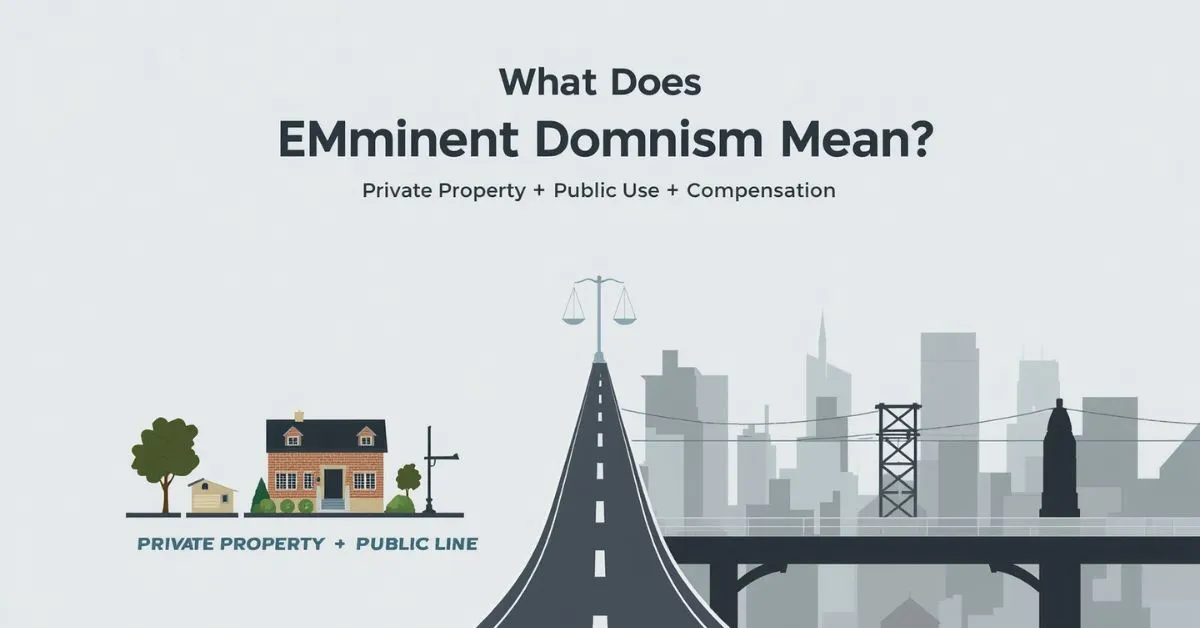
Eminent domain means the government can take private property for public use, but it must pay just compensation. In simple terms, it is the legal power to force a sale of property for an approved public purpose, even if the owner does not want to sell, as long as compensation is required by law.
Editorial note: This article explains general U.S. eminent domain principles. Specific procedures, deadlines, and owner protections can vary by state and by the type of project involved.
You usually hear the term when a government project affects land, a home, a business site, or a property right such as an easement. Most readers are not really asking for a dictionary definition alone.
They want to know what the phrase means in real life, what “public use” actually covers, what compensation usually includes, and whether an owner can challenge the taking.
Eminent domain meaning in plain English
A simple way to think about eminent domain is this:
The government can require a property owner to give up property for a public project or public purpose, but it must pay for what it takes. The Fifth Amendment is the constitutional starting point: private property cannot be taken for public use without just compensation.
That sounds straightforward, but the phrase contains three separate ideas that people often mix together:
- The power to take property
- The rule that the taking must be for public use
- The rule that the owner must receive just compensation
If you understand those three parts, you understand the core meaning of eminent domain.
Why eminent domain exists
Governments use eminent domain when they say they need land or property rights for projects that serve the public. Common examples include roads, schools, parks, public utilities, and transit-related infrastructure.
Courts have long recognized eminent domain as an inherent government power, but the Constitution limits how that power can be used.
This is why eminent domain is often described as a forced sale, not a simple confiscation. The owner’s consent is not required, but payment is.
How eminent domain usually works
The exact process depends on the jurisdiction, but official state guidance shows a pattern that is broadly familiar across many eminent domain systems: the condemning authority identifies the needed property, values it, makes an offer, and turns to condemnation proceedings if no agreement is reached. That general pattern can be seen in transportation-agency and landowner-rights materials from California and Texas.
A typical sequence looks like this
- A public project is approved or planned.
- The government identifies the land or property rights it says it needs.
- An appraisal is used to estimate fair market value.
- The owner receives an offer to purchase.
- If the parties do not agree, a condemnation action may follow.
- A court or another legal process determines the remaining issues, often including compensation.
In California, for example, Caltrans says it generally tries to settle first, uses an approved appraisal for the offer, and moves to condemnation only if no agreement is reached. It also notes that court proceedings address compensation if negotiations fail.
Texas’s Landowner’s Bill of Rights similarly describes notice, appraisal, a good-faith offer, and then a legal condemnation process if the owner does not accept the offer.
Public use: the part people misunderstand most
Many readers assume “public use” means the public must literally walk on the property or own it directly. That is not always how courts have treated the concept.
The constitutional rule is that the taking must be for public use, but courts have often interpreted that requirement broadly and given substantial deference to legislative judgments about public purpose.
That broad approach became especially well known in Kelo v. City of New London, where the Supreme Court allowed a taking connected to economic development, treating it as a public use because it was rationally related to a conceivable public purpose.
That does not mean every state uses the broadest possible standard today. Cornell’s Wex notes that after Kelo, many states adopted laws that restrict eminent domain more tightly than the federal baseline. So the plain-English meaning of eminent domain is stable, but the legal boundaries can vary by state.
Public use examples
Public use often includes things like:
- roads and highways
- schools
- parks
- public utilities
- rail or transit operations
- other infrastructure serving the public
What is just compensation?
Just compensation is the payment the government must provide when it takes private property for public use. In general, it means the property’s fair market value; what a willing buyer would pay a willing seller.
The purpose is to place the owner in as good a financial position as if the property had not been taken.
That usually leads to an important misunderstanding:
What just compensation usually does not mean
It does not usually mean the owner gets paid for emotional attachment, memories, or purely sentimental value. Cornell explains that fair market value is the usual baseline, and eminent domain materials from state agencies likewise center compensation around appraisal-based market value.
In some situations, compensation issues can become more complicated than a single sale price. State materials may also discuss damage to the remaining property, relocation-related issues, or compensation questions tied to partial takings.
For example, Texas’s Landowner’s Bill of Rights notes that compensation can include reduction in value to remaining property in some cases.
Eminent domain vs. condemnation vs. taking
These terms are closely related, but they are not identical.
| Term | What it means | Why it matters |
|---|---|---|
| Eminent domain | The government’s power to take private property for public use | This is the core legal power |
| Condemnation | The legal process used when the government exercises eminent domain | This is often the lawsuit or formal proceeding |
| Taking | The actual seizure of property or a government action severe enough to count as one | This is the event that triggers compensation issues |
| Inverse condemnation | A claim by the owner when government action effectively takes or damages property without normal eminent domain proceedings | This matters when the owner, not the government, starts the case |
This distinction matters for search intent too. Many people ask “what does eminent domain mean” when they are really trying to understand all four ideas at once.
Types of takings you should know
A big weakness in many basic articles is that they act like eminent domain only means the government bulldozes an entire parcel. The law is broader than that.
1) Physical taking
This is the easiest kind to understand. The government acquires or occupies property directly.
2) Regulatory taking
Sometimes the government does not physically seize property, but restrictions on use can go so far that the law may treat them as a taking. Cornell explains that a taking may occur when government regulation limits use to the point that it becomes the equivalent of a taking.
3) Partial taking
Sometimes only part of the property, or only a specific property interest, is taken. State eminent domain materials often address the effect on the remainder of the property when this happens.
4) Easement taking
The government may take an easement rather than full ownership. Cornell specifically notes that takings law is not limited to full seizures of land and can extend to easements and other property interests.
5) Inverse condemnation
If the government takes or damages property for public use without starting formal eminent domain proceedings, the owner may bring an inverse condemnation claim. Cornell defines inverse condemnation as a remedy for property owners in that situation.
Can the government take your house if you refuse to sell?
In general, yes; if the legal requirements for eminent domain are satisfied. That is the whole point of the doctrine. The power exists because the government does not always need the owner’s consent. But it still must comply with the public-use requirement and the just-compensation requirement, and owners may challenge authority or compensation in court.
Can property owners challenge eminent domain?
Yes. Official legal and state materials show that owners can challenge at least some part of the process, though the scope of the challenge depends on the jurisdiction and the issue.
Challenges may focus on authority, public use, procedure, or compensation. Cornell’s condemnation page notes that a party can challenge condemnation in court on grounds such as overstepping authority or inadequate compensation.
Caltrans also notes that owners can contest certain project-necessity issues, while compensation is determined separately if needed. Texas’s Landowner’s Bill of Rights describes the right to hire an appraiser or attorney and to seek trial-level review of compensation issues.
That does not mean every owner challenge succeeds. Courts often defer significantly to legislative judgments about public use, especially at the federal constitutional level.
Common misconceptions
“Eminent domain only applies to land.”
Not necessarily. The Takings Clause can apply to personal property as well as real property, and Cornell notes that takings law can extend to easements, personal property, contract rights, and trade secrets.
The Constitution Annotated also states that the government has a categorical duty to pay just compensation when it physically takes personal property, just as when it takes real property.
“If the government pays, it can take property for any reason.”
No. The Constitution still requires a public use. Payment alone is not enough.
“Condemnation and eminent domain are exactly the same.”
They are related, but condemnation is usually the process, while eminent domain is the underlying power.
“Just compensation means whatever feels fair to the owner.”
Usually not. The usual legal baseline is fair market value, not personal attachment or emotional value.
What Most Articles Miss About This Topic
Most articles answer the phrase but skip the real source of confusion: eminent domain is simple as a definition and complicated in application.
The definition itself is short. The hard part is understanding that disputes usually arise over public use, scope of the taking, and how compensation is measured, not over whether the phrase exists.
Another thing many articles miss is that eminent domain is not limited to a full land grab. The law can involve easements, partial takings, regulatory takings, and inverse condemnation claims. That wider view makes the topic much easier to understand correctly.
Finally, many pages do not explain the federal-versus-state difference clearly enough. The Fifth Amendment gives the national constitutional baseline, but state laws can be stricter, and many states tightened their rules after Kelo. So anyone facing a real property dispute needs state-specific guidance, not just a general definition.
FAQ
What does eminent domain mean in simple words?
It means the government can take private property for a public use, but it must pay just compensation.
Is eminent domain legal in the United States?
Yes. The Fifth Amendment recognizes the takings rule by prohibiting the taking of private property for public use without just compensation.
What is the difference between eminent domain and condemnation?
Eminent domain is the power to take property. Condemnation is the legal process used to exercise that power.
What is just compensation in eminent domain?
It is generally the fair market value of the property taken, intended to place the owner in as good a financial position as if the property had not been taken.
Can eminent domain be used for private development?
At the federal constitutional level, Kelo v. City of New London allowed a broad public-purpose approach, but many states later imposed tighter limits.
What is inverse condemnation?
It is a remedy property owners may use when government action takes or damages property for public use without a normal eminent domain proceeding.
Does eminent domain apply only to real estate?
No. Takings law can also reach personal property and other property interests.
Conclusion
Eminent domain means the government can take private property for public use, but it must provide just compensation. That is the core definition. The more practical questions are whether the stated use really qualifies, what property rights are being taken, and whether the compensation is truly adequate under the law.
If you are dealing with an actual notice, dispute, easement demand, or valuation fight, the next step should be reviewing the specific law in your state and getting jurisdiction-specific legal advice.
Click Below To Read About:
What Does Dog Days Mean? Real Meaning, Origin, and Examples
What Does Eligible Mean? Definition, Usage, and Real Examples

Hi, I’m Evan Lexor, the voice behind Meanvia.com. I break down English words, slang, and phrases into clear, simple meanings that actually make sense. From modern internet terms to everyday expressions, my goal is straightforward: help you understand English better, faster, and with confidence, one word at a time.