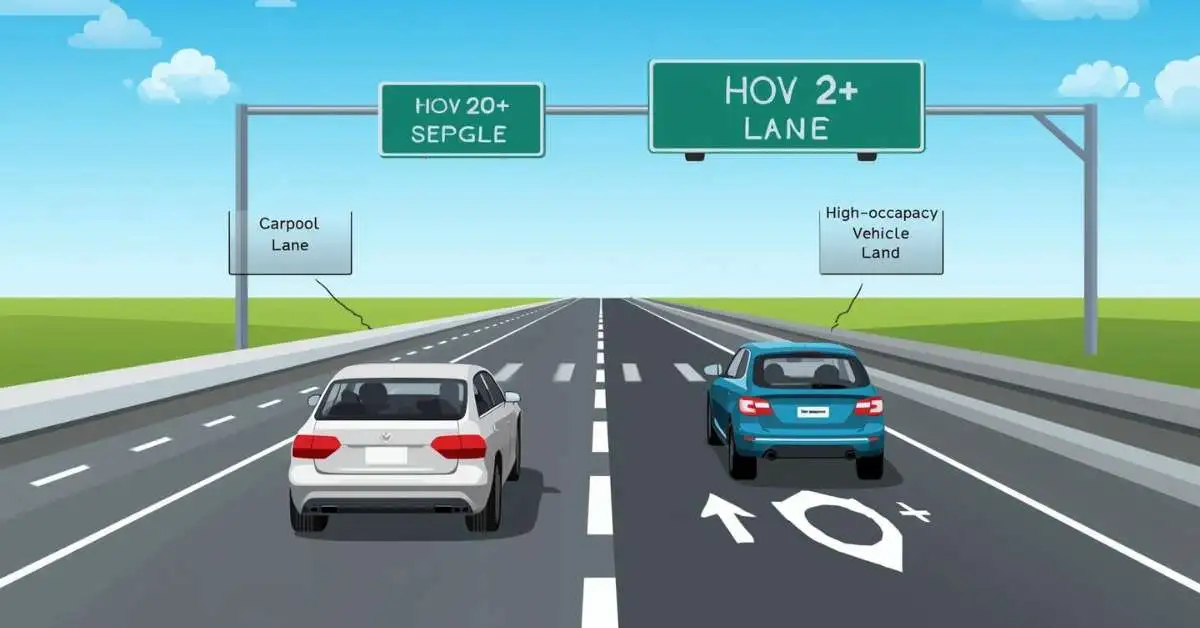
HOV means “High-Occupancy Vehicle.” In driving, it usually refers to a vehicle carrying the required number of people to use an HOV lane, also called a carpool lane or diamond lane. Most HOV lanes require at least two people, but some require three or more.
If you searched “what does HOV mean,” you probably saw the term on a highway sign, near a carpool lane, or on a traffic app. While HOV can appear as an abbreviation in other contexts, the main public meaning in transportation is High-Occupancy Vehicle.
On roads and freeways, it is strongly tied to HOV lanes, carpool lanes, diamond lanes, managed lanes, and sometimes HOT lanes. This guide explains the full meaning, how HOV lanes work, what HOV 2+ and HOV 3+ mean, who can use them, and the mistakes drivers should avoid.
What does HOV stand for?
HOV stands for High-Occupancy Vehicle. Federal Highway Administration guidance defines an HOV as a vehicle with no fewer than two persons, while dictionary sources describe it as a vehicle carrying the required minimum number of people, usually two.
In real-world traffic use, that usually means a car, van, or bus that qualifies for a special lane because it carries more than one person.
That is why the answer to “what does HOV mean?” is simple at the top level but practical in daily use: it is both an acronym and a traffic rule. The acronym tells you what kind of vehicle qualifies. The road sign tells you whether your car can legally use that lane at that time.
What does HOV mean on the highway?
On the highway, HOV usually points to an HOV lane. An HOV lane is a special lane reserved for qualifying vehicles such as carpools, vanpools, and buses.
In many states, these lanes are also called carpool lanes or diamond lanes because they are marked with white diamond symbols on signs or pavement. Official state DOT pages note that HOV lanes are often placed on the inside left lane of the freeway.
So when someone asks “what does HOV mean on the highway?” the practical answer is this: it means the lane is reserved for vehicles that meet the posted occupancy requirement, such as 2+ or 3+ occupants, during the posted hours or conditions.
Why do HOV lanes exist?
To move more people, not just more cars
Transportation agencies use HOV lanes to move more people through busy corridors, not simply to move more vehicles.
The FHWA explains that HOV facilities give priority treatment to buses, vanpools, carpools, and high-occupancy vehicles, while managed lane guidance describes HOV lanes as free carpool lanes meant to promote and reward shared travel.
To reduce congestion and support better commuting
HOV lanes are also linked to broader transportation goals such as ridesharing, congestion relief, and air quality improvement.
California’s transportation guidance says these lanes encourage ridesharing and maximize the people-carrying capacity of highways.
How HOV lanes work
What does HOV 2+ mean?
HOV 2+ means your vehicle must carry at least two people to use that lane when the restriction is active. In most cases, that means the driver plus one passenger.
FHWA guidance specifically explains that signs marked 2+ or 3+ refer to the minimum number of occupants needed to legally use the lane.
What does HOV 3+ mean?
HOV 3+ means the lane requires three or more occupants. Some corridors use HOV-3 rules during heavy congestion to preserve lane speed and capacity.
Virginia DOT guidance notes that HOV-2 lanes require two people and HOV-3 lanes require three during restricted periods.
Are HOV lanes active all day?
Not always. Some HOV lanes apply only during posted hours such as weekday rush periods, while others can be active longer.
Official transportation pages in Virginia and California both note that restrictions depend on the signs and time periods, and outside restricted periods some HOV lanes are open to general traffic.
HOV lane, carpool lane, and diamond lane: are they the same?
In most everyday U.S. driving, HOV lane, carpool lane, and diamond lane usually refer to the same basic concept: a lane reserved for qualifying high-occupancy traffic.
California’s official HOV page explicitly says HOV lanes are also known as carpool or diamond lanes. The diamond symbol is the most common visual clue that a lane has a special-use rule.
That means searchers using phrases like what is a carpool lane, what is a diamond lane, or what does HOV lane mean are often looking for the same answer from slightly different angles.
A strong article should naturally cover all three terms together, because search intent overlaps heavily.
Who can usually use an HOV lane?
Most HOV lanes are intended for:
- carpools
- vanpools
- buses
- other vehicles that meet the posted occupancy rule
Some jurisdictions also allow motorcycles or certain exempt vehicles. State rules can differ, which is why the sign and local DOT guidance matter more than assumptions.
For example, Virginia says some vehicles have exemptions, while California’s guidance explains that HOV access rules can differ by facility and signage.
Arizona’s HOV guidance also identifies HOV lanes by the white diamond symbol and treats them as restricted-use lanes.
Do children, motorcycles, and electric vehicles count?
Do children count as HOV occupants?
Official California transportation FAQs state that each vehicle using an HOV lane must carry the minimum number of people posted at the entrance signs.
In practice, that means occupants are counted as people in the vehicle, including children. Still, local enforcement rules should always be checked where you drive.
Can motorcycles use HOV lanes?
In many states, yes. California’s HOV guidance and Arizona driver guidance both indicate that motorcycles may use HOV lanes. But access rules still vary by state and facility, so drivers should verify local signs and regulations.
Can electric or alternative-fuel vehicles use HOV lanes?
Sometimes. Some states have allowed alternative fuel vehicles, clean-air vehicles, or certain sticker or plate holders to use HOV lanes, but those exemptions are not universal and can change over time.
Arizona, for example, has published updates showing that some federal access rules for electric vehicle HOV use have changed.
HOV vs HOT vs express lanes
A major ranking opportunity for this keyword is explaining the difference between HOV, HOT, and express lanes, because many searchers confuse them.
| Term | Meaning | Who can use it | Cost |
|---|---|---|---|
| HOV lane | High-Occupancy Vehicle lane | Vehicles meeting the posted occupancy rule | Usually free for qualifying vehicles |
| HOT lane | High-Occupancy Toll lane | HOV-qualified vehicles plus some non-qualifying vehicles that pay | Toll may apply |
| Express lane | A broader managed-lane term | Depends on the local system | Often toll-based |
FHWA guidance defines a HOT lane as an HOV lane that allows vehicles not meeting the minimum occupancy rule to use the lane by paying a toll.
FHWA also explains that HOT lanes combine HOV and pricing strategies as part of the broader managed lanes concept.
So the short version is this: HOV is occupancy-based, HOT is occupancy plus toll access, and express lane is a broader label that may or may not follow the same exact rules everywhere.
Real examples of what HOV means
Example 1: “HOV 2+ Weekdays 6–9 AM”
This means the lane is reserved for vehicles with at least two occupants during that restricted morning period. Outside those hours, the lane may be open to other traffic if the sign says so.
Example 2: White diamond painted on the roadway
A diamond symbol marks a special-use lane. On an HOV lane, it tells drivers the lane is not general-purpose traffic and is reserved for qualifying vehicles.
Example 3: “HOV 3+”
This means a driver with only one passenger does not qualify. The car would need three total occupants if the lane is active under posted rules.
Common mistakes to avoid
Thinking HOV means “fast lane”
An HOV lane is not simply a fast lane for anyone who wants to move quicker. It is a restricted lane tied to occupancy rules or posted exemptions.
Ignoring the posted hours
Many violations happen because drivers see the lane and miss the time restriction. Always read the sign before entering.
Confusing HOV with HOT
Some drivers assume they can pay to use any HOV lane. That is false. Paid access applies to HOT lanes, not automatically to every HOV lane.
Assuming all states use the same rule
HOV rules vary by corridor and state. Occupancy level, hours, motorcycle access, and clean-air exemptions can differ.
Other meanings of HOV
Because the exact keyword is broad, it helps to address this directly: HOV can have other meanings as an abbreviation in different industries or acronym lists.
But in dictionaries, highway signs, transportation pages, and everyday U.S. driving, the dominant meaning is High-Occupancy Vehicle. That is the meaning most searchers want when they ask “what does HOV mean?”
FAQ
What does HOV mean in driving?
In driving, HOV means High-Occupancy Vehicle. It usually refers to a vehicle that qualifies to use a special lane because it carries the required number of occupants.
What does HOV lane mean?
An HOV lane is a lane reserved for qualifying vehicles such as carpools, vanpools, and buses. It is often called a carpool lane or diamond lane.
What does HOV 2+ mean?
It means the vehicle must have at least two people inside to use the lane when the restriction is active.
What does HOV 3+ mean?
It means the vehicle must have three or more occupants to qualify for that lane.
Is HOV the same as a carpool lane?
Yes, in most everyday use, HOV lane and carpool lane mean the same thing. Diamond lane is another common name.
Are HOV lanes always active?
No. Some are active only during posted hours, while others may follow different local rules. Always read the sign.
What is the difference between HOV and HOT lanes?
An HOV lane is based on occupancy. A HOT lane lets some non-qualifying vehicles use the lane by paying a toll.
Can motorcycles use HOV lanes?
Often yes, but it depends on state and facility rules. California and Arizona both publish guidance allowing motorcycle access in HOV contexts.
Practical takeaway
If you only remember one thing, remember this: HOV means High-Occupancy Vehicle, and on the road it usually points to a carpool lane reserved for vehicles carrying the required number of people. Check the occupancy number, the posted hours, the diamond symbol, and whether the lane is a standard HOV lane or a HOT/express lane.
That simple check will help you understand highway signs faster, avoid mistakes, and drive more confidently. For stronger topical authority, this article also connects naturally with related topics like road sign meanings, managed lanes, commuter rules, toll lanes, and express lanes.
Click Here To Read About: What Does Nike Mean? Greek Origin, Brand Story, Real Meaning

Hi, I’m Clara Lexis from Meanvia.com. I break down words and expressions so they’re easy to understand and enjoyable to learn. My mission is simple: make language approachable and fun, one word at a time.