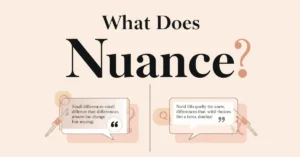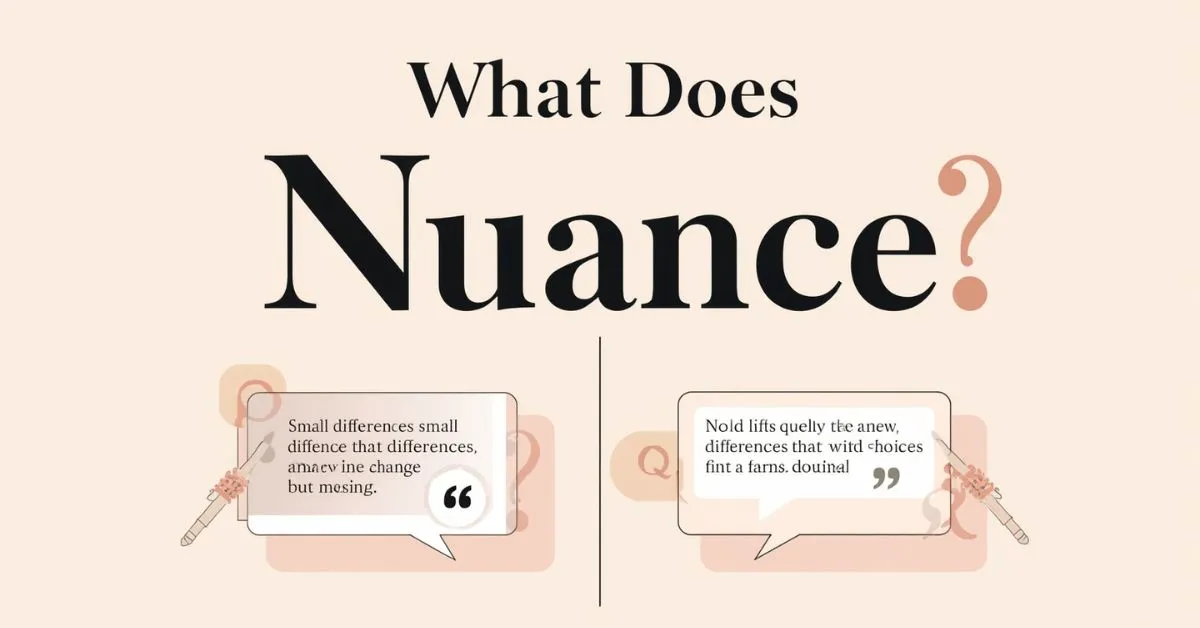
Nuance means a small but meaningful difference in meaning, tone, feeling, or interpretation. When something has nuance, it is not completely black-and-white. The word is often used for subtle distinctions in speech, writing, opinions, behavior, and ideas that can change how something should be understood.
If you want the simplest version: nuance is the fine detail that changes the real meaning.
Quick Answer at a Glance
| Term | Simple meaning |
|---|---|
| Nuance | A subtle but important difference |
| Nuanced | Showing careful distinction or layered understanding |
| In simple words | Not as simple as it first seems |
| Common use | “There’s more nuance to it than that.” |
How to Pronounce Nuance
Nuance is commonly pronounced like NOO-ahns or NYOO-ahns, depending on accent and region.
It is a noun.
Related form:
- Nuanced = adjective
- Example: “She gave a nuanced answer.”
What Nuance Means in Simple Words
In simple terms, nuance means a small difference that matters.
It is not just any detail. It is a detail that changes the way something feels, sounds, or should be interpreted.
For example:
- “She was honest.”
- “She was brutally honest.”
Both sentences involve honesty, but the second adds a different tone and judgment. That extra shade of meaning is nuance.
Why People Search for the Meaning of Nuance
Many people hear words like:
- “That’s a nuanced issue.”
- “Your argument lacks nuance.”
- “The film handles the topic with nuance.”
- “You’re missing the nuance.”
The problem is that the word often sounds abstract. A lot of pages define it as a “subtle difference” and leave it there.
That is not enough for most readers.
People usually want to know:
- What does nuance actually mean in real life?
- Is it the same as subtlety?
- Does nuance mean complicated?
- Does it mean unclear?
- How do I use the word correctly?
This article answers those questions directly.
What Nuance Usually Refers To
Nuance often shows up in:
- language
- tone of voice
- writing
- conversation
- arguments
- relationships
- art and media
- social or political discussion
In each case, nuance means there is more than one layer of meaning, and the smaller distinctions matter.
A Simple Real-Life Example of Nuance
Imagine someone says:
“That was interesting.”
Depending on the context, that could mean:
- genuinely interesting
- strange
- disappointing
- polite but not impressed
- uncertain but curious
The words stay the same, but tone, facial expression, and context change the meaning.
That change is nuance.
What Does “Nuanced” Mean?
If nuance is the noun, nuanced is the adjective.
Something is nuanced when it shows careful distinction, depth, or layered understanding.
Examples
- “Her opinion was nuanced rather than extreme.”
- “The novel gives a nuanced picture of family conflict.”
- “He offered a nuanced explanation instead of a simple yes-or-no answer.”
A nuanced answer does not have to be vague. It can still be clear. It just avoids oversimplifying.
Nuance in Writing
In writing, nuance means using word choice, tone, context, and implication to express more exact meaning.
A strong writer often avoids flat statements and instead shows shades of meaning.
Example
Less nuanced:
“The manager was rude.”
More nuanced:
“The manager was polite on the surface, but his tone was cold and dismissive.”
The second version gives a more accurate picture. It shows tone, implication, and subtext instead of reducing everything to one blunt label.
Why nuance matters in writing
Nuance makes writing:
- more precise
- more credible
- more human
- more persuasive
- more realistic
This is especially important in essays, fiction, analysis, reviews, and emotional writing.
Nuance in Conversation
In conversation, nuance often comes from things beyond the literal words.
That includes:
- tone of voice
- pauses
- emphasis
- facial expression
- shared context
- relationship history
For example, “I’m fine” can mean many different things depending on how it is said.
That is why text messages sometimes lose nuance. Without vocal tone or facial expression, people may miss the intended meaning.
Nuance in Opinions and Arguments
Nuance matters when people discuss serious or complicated topics.
A non-nuanced statement often sounds too absolute:
- “This is always wrong.”
- “That side is completely right.”
- “The answer is obvious.”
A nuanced statement sounds more careful:
- “There are valid concerns on both sides.”
- “The situation depends on context.”
- “The main issue is clear, but there are important exceptions.”
Nuance does not mean refusing to take a position. It means understanding the full shape of the issue before judging it.
Nuance vs Similar Words
People often confuse nuance with other related words. Here is the clearest way to separate them.
| Word | Meaning | How it differs from nuance |
|---|---|---|
| Nuance | A subtle but meaningful difference | Focuses on fine distinctions that affect understanding |
| Subtlety | Something delicate or not obvious | Very close, but broader and less specific |
| Ambiguity | More than one possible meaning | Creates uncertainty; nuance usually adds precision |
| Complexity | Many layers or parts | May include nuance, but not the same thing |
| Detail | A specific piece of information | A detail may create nuance, but is not always nuance |
| Connotation | Emotional or implied meaning of a word | Often one source of nuance in language |
| Subtext | Meaning beneath the surface | Can carry nuance, especially in dialogue or tone |
Nuance vs Ambiguity
This is one of the most important distinctions.
Ambiguity means something is unclear or could be understood in multiple ways.
Nuance means something contains fine distinctions that make the meaning more exact.
Example
Ambiguous:
“He saw her duck.”
That sentence could mean different things.
Nuanced:
“He sounded supportive, but there was a hint of impatience in his voice.”
That sentence is not unclear. It is more detailed and layered.
Nuance vs Subtlety
These two are close, but not identical.
Subtlety often describes something delicate, understated, or not obvious.
Nuance usually points to a specific shade or distinction in meaning.
A painting can have subtlety.
A sentence can contain nuance.
A person’s reaction can show both.
Common Phrases with Nuance
These phrases help show how the word is actually used.
“There’s more nuance to it”
The issue is more layered than a simple summary suggests.
“Lacks nuance”
The explanation is too blunt, simplistic, or one-sided.
“A nuanced view”
A balanced or carefully reasoned perspective.
“Capture the nuance”
To express the full subtle meaning, tone, or emotional detail.
“A nuanced performance”
A performance with emotional depth and fine expression.
How to Use Nuance in a Sentence
Here are natural sentence examples:
- “The article explains the issue with real nuance.”
- “His comment sounded simple, but the nuance was in his tone.”
- “There is an important nuance between confidence and arrogance.”
- “The movie treats grief with nuance rather than cliché.”
- “She made a fair point, but her view lacked nuance.”
- “You need context to catch the nuance of what he meant.”
Common Misconceptions About Nuance
1. Nuance means complicated
Not always.
Something can be nuanced and still be easy to understand. Nuance adds precision, not unnecessary difficulty.
2. Nuance means unclear
No.
That is closer to ambiguity. Nuance often makes understanding better, not worse.
3. Nuance means staying neutral
Not necessarily.
A nuanced view can still be strong and clear. It just recognizes context, distinctions, and exceptions.
4. Nuance is only for academics or writers
Not true.
People use nuance in everyday life when they talk about emotions, relationships, work situations, media, and misunderstandings.
5. Nuance is just another word for detail
Not exactly.
A nuance is a detail that changes interpretation. Not every detail does that.
How to Recognize Nuance
You are probably dealing with nuance when:
- two similar words create different emotional effects
- the tone changes the meaning of the sentence
- a situation has important context or exceptions
- an opinion cannot be judged fairly in one simple sentence
- the literal words say one thing, but the implication says more
- a person’s behavior does not fit a single label perfectly
Why Nuance Matters
Nuance matters because people often misunderstand each other when they reduce everything to black-and-white thinking.
Without nuance, communication becomes:
- flatter
- harsher
- less accurate
- easier to misread
- less fair
With nuance, communication becomes:
- more precise
- more thoughtful
- more persuasive
- more human
- more trustworthy
This is why nuance matters in:
- reading comprehension
- writing
- debate
- relationships
- leadership
- media analysis
- critical thinking
Practical Tips for Understanding Nuance Better
If you want to spot nuance more easily, ask yourself:
What exactly is different here?
Look for the fine distinction, not just the broad idea.
What does the tone suggest?
Tone of voice, wording, and emphasis often carry nuance.
What does the context add?
Context clues can change the meaning of a sentence or reaction.
Is this unclear, or just layered?
Do not confuse nuance with ambiguity.
Am I oversimplifying this?
Sometimes the biggest misunderstanding comes from forcing a complex reality into a simple label.
What Most Articles Miss About This Topic
Most articles say nuance is a “subtle difference” and stop there.
That misses the most important part.
A nuance is not just a tiny detail. It is a detail that changes interpretation.
That is why nuance matters so much in real communication.
A nuance can affect:
- whether a comment sounds sincere or sarcastic
- whether a person seems confident or arrogant
- whether a character feels realistic or flat
- whether a message sounds supportive or controlling
- whether a topic is treated fairly or oversimplified
Another thing many articles miss is this:
Nuance is not the opposite of clarity.
Good nuance does not make meaning muddy. It makes meaning more exact.
The goal is not to make simple things sound complex.
The goal is to avoid making layered things sound falsely simple.
Quick Reference Table
| If you notice this | Is it nuance? |
|---|---|
| A slight wording change changes the emotional meaning | Yes |
| Tone changes the message | Yes |
| Context makes the meaning more specific | Yes |
| The message is open to several unrelated meanings | Usually ambiguity, not nuance |
| The issue has many parts | Maybe complexity, not always nuance |
| The answer recognizes exceptions and distinctions | Often yes |
FAQ
What does nuance mean in simple terms?
Nuance means a small but important difference that changes how something should be understood.
What does nuanced mean?
Nuanced means showing careful distinction, depth, or layered understanding.
How do you pronounce nuance?
It is commonly pronounced like NOO-ahns or NYOO-ahns, depending on accent.
Is nuance a positive word?
Usually, yes. It often suggests thoughtfulness, precision, and maturity. But it can also be neutral and simply describe subtle distinction.
Is nuance the same as subtlety?
They are related, but not identical. Nuance usually points to a specific meaningful difference, while subtlety is a broader idea.
Is nuance the same as ambiguity?
No. Ambiguity causes uncertainty. Nuance adds finer shades of meaning.
What is a simple example of nuance?
The difference between calling someone “persistent” and “stubborn” is a nuance. The core idea is similar, but the tone and judgment are different.
What does it mean when someone says an opinion lacks nuance?
It usually means the opinion sounds too simplistic and ignores context, exceptions, or important distinctions.
Conclusion
Nuance means a subtle but meaningful difference in meaning, tone, feeling, or interpretation. It helps people understand ideas more accurately instead of reducing them to flat, black-and-white labels.
If you remember one thing, remember this:
Nuance is not confusion. It is precision with depth.
Click Below To Read About New Posts:
What Does MIS Mean? Management Information Systems Explained
What Does Demi-Permanent Mean in Hair Color?
What Does Detail-Oriented Mean? Definition, Examples, Career Use

Hi, I’m Clara Lexis from Meanvia.com. I break down words and expressions so they’re easy to understand and enjoyable to learn. My mission is simple: make language approachable and fun, one word at a time.