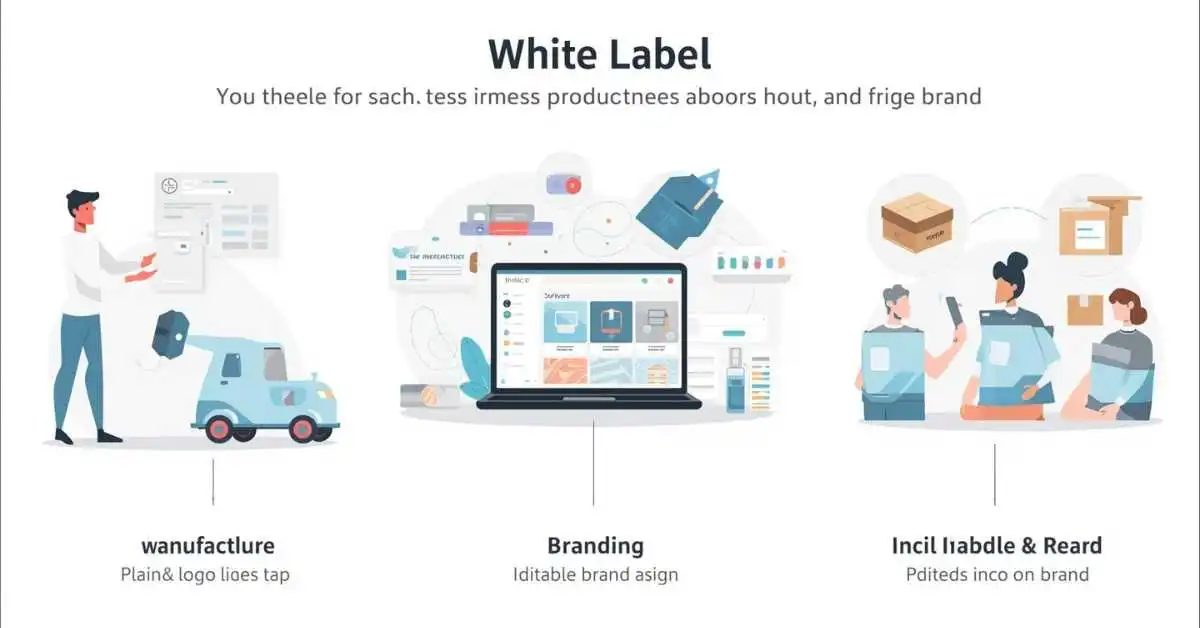
If you want to know what does white label mean, the simple answer is this: one company makes a product or service, and another company sells it under its own brand. The seller adds its own logo, packaging, pricing, or customer experience, even though it did not build the core product.
White labeling is common in ecommerce, retail, SaaS, payments, and marketing services because it helps businesses launch faster and avoid building everything from scratch.
This guide explains the full white label meaning, how white labeling works, where it is used, and how it compares with private label, dropshipping, print on demand, and OEM models.
It also includes simple examples, tables, and a supplier checklist to help readers make smart business decisions.
Quick Answer
White label meaning in one sentence
A white label product or white label service is made by one company and rebranded by another company to sell as its own. The product stays mostly the same, but the brand, packaging, dashboard, or customer-facing look can change.
A simple example
Imagine a factory makes a face cream. Three beauty brands buy the same cream. Each brand puts on its own label, box, and price. The cream is the base product.
The branding is what changes. That is white labeling. Shopify says white label products may have different logos, packaging, and prices even when the basic product stays the same.
How White Labeling Works
The manufacturer builds the core product
In a white label model, the manufacturer, supplier, or software vendor creates the product first. This could be a skincare item, a supplement, a coffee blend, a software platform, a payment gateway, or a marketing service. The producer handles production, technology, or delivery.
The reseller adds the brand
The reseller, retailer, agency, or partner then adds its own brand. That may include a logo, custom packaging, a website, a custom domain, client reports, or branded emails. In white label SaaS, the reseller may change the name, logo, and design to match its brand guidelines.
The customer sees one brand
The customer usually sees the reseller’s brand, not the original supplier’s brand. That is why white labeling is popular with companies that want a branded offer without building a factory, hiring a full dev team, or creating a new service department.
The table below shows the usual split of work in a white label setup.
| Step | Supplier or Vendor | Brand or Reseller |
|---|---|---|
| Product creation | Makes the product or platform | Does not build the core product |
| Branding | Offers a blank or rebrandable base | Adds logo, label, colors, packaging |
| Pricing | Sells wholesale or licenses access | Sets retail price or client package |
| Delivery | Produces, hosts, or fulfills | Markets, sells, and manages customers |
| Support | May handle backend issues | Often handles front-end customer support |
White Label vs Other Business Models
White label vs private label
This is the comparison most readers want.
With white label, one supplier can sell the same base product to many brands. With private label, the product is usually made for one retailer or brand only, often with more control over ingredients, materials, features, or packaging.
That means white label is often faster and simpler, while private label often gives more exclusivity and more product control.
White label vs dropshipping
Dropshipping is a fulfillment model. It means you sell products you do not keep in stock, and a third party ships them to the customer.
Some dropshipping suppliers offer branded packaging or white label options, but dropshipping itself does not always include your own brand. White label is about branding.
Dropshipping is about how orders are fulfilled. Sometimes a business can use both at the same time.
White label vs print on demand
Print on demand is a model where a supplier prints your design on a blank item only after a customer places an order. In POD, you usually customize the design, not the product itself.
Some POD suppliers also offer white label shipping or packaging, so the customer sees your brand instead of the printer’s brand.
White label vs OEM
An OEM, or original equipment manufacturer, usually makes parts or components that are used in another company’s finished product. White label is different.
In white label, the finished product itself is often resold under another brand. OEM is more common when one company supplies parts that another company uses in its own product system.
This quick table makes the differences easier to scan.
| Model | What changes? | Who owns the brand? | Main use |
|---|---|---|---|
| White label | Brand, packaging, or interface | Reseller | Fast branded launch |
| Private label | Product specs and brand | Retailer or brand | More control and exclusivity |
| Dropshipping | Fulfillment method | Usually seller, but branding may vary | Low-inventory selling |
| Print on demand | Printed design on blank products | Seller | Custom designs without inventory |
| OEM | Components or parts inside another product | Final brand owns finished product | Manufacturing supply chain |
White Label Examples in Real Life
Ecommerce and retail
White labeling is common in beauty, skincare, supplements, coffee, fashion basics, and household goods. A third-party manufacturer makes the item. The seller chooses the label, packaging, price, and brand story.
BigCommerce notes that white labeling is especially common in repeatable product categories like fashion, skincare, and cosmetics.
Example: A small online skincare brand buys a ready-made face serum from a supplier. The brand adds custom bottles, a logo, and a product page. Customers see a branded beauty product, even though the formula came from a third-party manufacturer.
SaaS and software
A white label SaaS platform lets a company sell software under its own name. The software vendor builds the platform. The reseller changes the name, logo, colors, and sometimes the domain. This model is common in CRM tools, analytics dashboards, ecommerce platforms, and client portals.
Example: A marketing agency uses a reporting tool made by another company. It adds its own branding and gives clients a dashboard that looks like the agency’s own software.
Agencies and services
White labeling is also common in services. Indeed describes white label marketing as a model where a business outsources a product idea, service, or marketing strategy from another company. This often happens in SEO, PPC, web design, content writing, and social media management.
Example: A local agency sells SEO packages to clients. A white label partner does the keyword research, content work, and reports behind the scenes. The client only sees the local agency’s brand.
Payments and customer portals
White label systems also show up in payments and portals. Investopedia notes that a white label payment gateway lets merchants accept payments through third-party services while using their own branding. White label branding also appears in customer portals and knowledge platforms.
Benefits of White Label
Faster time to market
One of the biggest benefits is speed. Because the base product already exists, a business can launch much faster than if it had to build everything from scratch. Shopify and Investopedia both describe white label as a faster route to market than building a unique product from zero.
Lower startup cost
White labeling can lower upfront costs because the seller does not need to fund full manufacturing, research and development, or core software development. The business can spend more on branding, packaging, sales, and customer acquisition.
Easier brand expansion
White label makes it easier to add new product lines or services. A business can enter a new category without building a factory or hiring a large expert team. That is why the model is common in ecommerce brands, digital agencies, and SaaS resellers.
Risks and Limits of White Label
Less control over the product
The core product is made by someone else, so you may have less control over ingredients, features, update speed, or production quality. If the supplier changes something, your brand can still take the blame. Investopedia points to reduced direct control over quality as a common trade-off.
Harder to stand out
If several brands sell the same base product, it can be hard to look truly different. Your edge often comes from brand positioning, packaging, customer service, niche focus, or better marketing, not from the product alone.
Dependence on one supplier
Your margins, stock levels, support speed, and delivery times can depend on a third-party supplier. If the supplier raises prices or has delays, your customers may feel it too.
What Exactly Is a White Label Product?
A white label product is an item made by one company but sold by another company under its own brand name. The manufacturer creates the product, while the seller adds its logo, packaging, or branding and presents it as part of its own product line. This can save businesses the time and cost of creating products from scratch. White label products can be physical goods, software, or digital services. The seller usually chooses from products already made by the supplier and then markets them to its target customers.
Context and how people use it:
Businesses use white label products when they want to offer something under their own brand without building the product themselves.
The term often appears in ecommerce, software, beauty, food, supplements, and other business industries.
Examples:
- A skincare company buys an existing face cream from a manufacturer and sells it with its own brand name.
- A small software company uses a ready-made platform but adds its own logo and branding for customers.
Understanding a White Label Product
Understanding a white label product starts with knowing who makes it and who sells it. A supplier develops and produces the item, while another business purchases it and markets it under its own name. The final customer may not know which company originally manufactured the product. The seller can often customize parts of the product, such as the label, packaging, colors, or branding. However, the amount of customization depends on the supplier. This model lets businesses focus more on marketing, customer service, and sales instead of product development.
Context and how people use it:
People use the term when discussing a business model where the same basic product can be branded and sold by different companies.
It is especially useful for businesses that want to launch products faster or expand their product range.
Examples:
- A company orders plain coffee bags from a supplier and sells them using its own brand and packaging.
- A marketing agency offers a reporting tool to clients under the agency’s own name, even though another company built the software.
Industries Utilizing White Label Products
Many industries use white label products because they allow businesses to offer established products without handling every part of production. Ecommerce businesses may sell white label clothing, accessories, home goods, or beauty products. The technology industry uses white label software, apps, websites, and business tools. Beauty and personal care companies may use ready-made formulas for products such as lotions and shampoos. Food and beverage businesses can also use products made by outside suppliers. The model is useful across many industries because it can reduce development time and help smaller companies compete with larger brands.
Context and how people use it:
The phrase is used when explaining which business sectors buy products or services from manufacturers and sell them under their own brands.
The industries and level of customization can vary widely depending on the supplier and product type.
Examples:
- A fitness brand sells protein products made by a third-party manufacturer under its own label.
- A small tech company offers customer-management software with its own branding instead of developing the entire system itself.
Pros and Cons of White Label Products
White label products can offer several benefits, but they also have limits. One major advantage is speed because a business can start selling an existing product without spending years developing it. It can also reduce some production and development costs. Businesses can focus their resources on branding, marketing, and customer relationships. However, sellers may have less control over the product itself. Other companies may sell similar products, making it harder to stand out. Product quality also depends heavily on the supplier. Before choosing this model, businesses should check quality, pricing, customization options, supplier reliability, and customer demand.
Context and how people use it:
People use this phrase when comparing the benefits and possible risks of choosing white label products for a business.
It helps business owners decide whether this model fits their goals, budget, brand, and customers.
Examples:
- A startup may choose a white label product because it can launch quickly without building a factory or production team.
- A growing brand may avoid a white label supplier if limited customization makes its products look too similar to competitors.
How to Choose a White Label Supplier
Check reputation and order samples
A strong supplier should have a track record of reliability. Shopify advises doing a background check on suppliers and ordering samples before you commit to bigger orders. Samples let you inspect real quality and keep control samples for later comparison.
Review MOQ, lead times, and margins
Before you sign a deal, look at MOQ or minimum order quantity, lead times, wholesale pricing, and your likely profit margin. BigCommerce says businesses should review MOQs, lead times, competitive pricing, and quality standards before placing large orders.
Check branding, packaging, and support
Make sure the supplier can support your brand needs. Ask about labels, boxes, inserts, branded emails, dashboards, fulfillment, returns, and support.
In software, ask what parts of the interface can be rebranded. In physical goods, ask what packaging and compliance options are available. CloudBlue notes that white label SaaS often includes changing the product name, logo, and design.
This checklist can help before you choose a supplier.
| What to check | Why it matters |
|---|---|
| Product samples | You can test real quality |
| MOQ | It affects cash flow and risk |
| Lead time | It affects stock and launch speed |
| Branding options | It shapes how much the product feels like yours |
| Packaging | It affects customer experience |
| Margin | It decides if the model is worth it |
| Fulfillment and returns | It affects service quality |
| Contract terms | It protects pricing, service levels, and brand rights |
Is White Label Right for You?
White label is a good fit when
White label often makes sense when you want to launch fast, test a market, add a new service, or grow a brand without building everything yourself. It is often a good fit for small ecommerce brands, agencies, SaaS resellers, and niche retailers.
Example: A web agency wants to offer SEO and client dashboards, but it does not want to hire a full SEO team or build software. A white label partner lets it launch faster.
White label is not a good fit when
White label may be the wrong choice if your main goal is deep product control, unique features, patented technology, or a very strong product moat. In those cases, private label or custom product development may fit better.
Example: A founder wants a supplement with a custom formula, special ingredients, and full control over claims and packaging. That is closer to private label than white label.
A quick decision checklist
White label may be right for you if you answer “yes” to most of these:
- Do you want a faster launch?
- Do you want lower upfront cost?
- Can you win through branding, niche focus, and service?
- Are you okay with sharing a base product with other sellers?
- Do you trust the supplier’s quality and delivery?
If you answer “no” to most of these, a private label or custom build may be a better path.
White Label
White label means a product or service is created by one company but sold by another company under its own brand name. The original maker usually stays behind the scenes, while the reseller handles branding, marketing, and customer relationships. This model is common in software, digital marketing, beauty products, food, and online services. It helps businesses offer ready-made solutions without building everything from scratch. For example, a marketing agency might use a third-party SEO service and present it to clients under the agency’s own name.
Context and how people use it:
People use “white label” when talking about products or services that can be branded and resold by another business.
It often appears in business, e-commerce, software, and agency discussions.
Examples:
- “We use a white label platform for our clients.”
- “This company sells white label skincare products.”
White Labeling
White labeling is the process of taking a product or service made by one company and selling it under another company’s brand. The reseller can add its own logo, name, packaging, or customer-facing identity. The original provider normally handles the underlying production or technology. This approach allows businesses to launch new offerings faster and with less development work. White labeling is especially popular among agencies, software companies, online stores, and product sellers that want to expand their services without creating everything internally.
Context and how people use it:
“White labeling” describes the business process rather than the product itself.
People often use it when discussing partnerships, reselling, branding, and business growth.
Examples:
- “Our agency uses white labeling to offer SEO services.”
- “White labeling lets the retailer sell the product under its own brand.”
White Label Content
White label content is content created by one person or company that another business can rebrand and publish as its own. It may include blog posts, social media captions, newsletters, videos, or marketing materials. The content provider does the research and writing, while the purchasing business usually adds its branding and publishes it for customers. This can save time for businesses that need regular content but do not have a large in-house writing team. Agencies commonly use white label content to serve multiple clients efficiently.
Context and how people use it:
People use this term when discussing ready-made content that can be branded and delivered to another company’s customers.
It is common in content marketing, SEO, social media, and digital agencies.
Examples:
- “The agency provides white label content for small businesses.”
- “We purchased white label content for our company blog.”
Whitelabel
“Whitelabel” is another way of writing “white label,” especially in technology, software, and online business discussions. It describes a product or service developed by one company that another company can brand and present as its own. The exact spelling depends on the company or industry, but the basic idea remains the same. A whitelabel platform, for example, may provide the technology while allowing a business to use its own logo, colors, domain, and customer-facing name. This makes launching a branded service easier.
Context and how people use it:
“Whitelabel” is often used as a single word in software, SaaS, marketing, and business settings.
It usually has the same meaning as “white label.”
Examples:
- “We are looking for a whitelabel software provider.”
- “The company offers a whitelabel app with custom branding.”
White Label Meaning
The meaning of “white label” is a product or service made by one company and offered by another company under its own brand. The customer may see only the reseller’s name and branding rather than the original provider. This business model allows companies to offer established products or services without developing them from the ground up. For instance, a digital agency can purchase a service from a specialist provider and deliver it to clients under the agency’s own brand.
Context and how people use it:
The phrase is commonly used in business and marketing to explain a behind-the-scenes supplier arrangement.
It can describe physical products, software, services, or digital content.
Examples:
- “The white label meaning is simple: one company makes it, another brands it.”
- “We chose a white label service to expand our business.”
What Does White Label Mean
“What does white label mean” usually asks for a simple explanation of a business model where one company creates a product or service and another company sells it using its own branding. The original provider may remain invisible to the final customer. Businesses choose this model because it can reduce development time, costs, and technical workload. It is widely used in industries such as software, marketing, cosmetics, supplements, clothing, and online services. The reseller focuses mainly on its brand, sales, and customer experience.
Context and how people use it:
People search this question when they encounter “white label” in business, e-commerce, software, or marketing.
It is usually asking for the basic meaning rather than a technical definition.
Examples:
- “What does white label mean in software?”
- “What does white label mean for an online store?”
What Is White Label
“What is white label” asks about a business arrangement in which a ready-made product or service can be branded and sold by another company. Instead of developing the product itself, the reseller works with a provider that handles the underlying creation or delivery. The reseller then uses its own branding to reach customers. This can help a business enter a market more quickly and offer additional services without hiring a large production or development team. White label models can be found in both physical and digital industries.
Context and how people use it:
People commonly use this question when they want a straightforward definition of white label business models.
It appears often in searches about e-commerce, SaaS, agencies, and product sourcing.
Examples:
- “What is white label marketing?”
- “What is white label software?”
What Is White Label Solution
A white label solution is a ready-made product, platform, or service that one company provides so another business can brand and offer it to its own customers. The provider usually manages the core technology, production, or service delivery, while the reseller controls the visible brand experience. White label solutions can help companies launch offerings faster without investing heavily in development. They are especially common in software, marketing, finance, e-commerce, and online services. Features such as custom logos, colors, domains, and dashboards may be available.
Context and how people use it:
People use “white label solution” when looking for a ready-to-use business product that can be customized with their branding.
The term is especially common in SaaS, technology, agencies, and digital services.
Examples:
- “The company provides a white label solution for online stores.”
- “We need a white label solution that supports our own branding.”
Whitelabeling
Whitelabeling refers to the practice of selling a product or service created by one company under another company’s brand. It is essentially the same concept as “white labeling,” with the words combined into one term. The business buying the solution usually focuses on branding, marketing, sales, and customer support, while the provider handles the underlying product or service. Whitelabeling can help businesses expand their offerings without building new systems or products themselves. However, the exact branding rights and customization options depend on the agreement between both companies.
Context and how people use it:
“Whitelabeling” is often used in business and technology discussions as a shorter form of “white labeling.”
It describes the overall practice of rebranding and reselling another company’s offering.
Examples:
- “Whitelabeling allows agencies to offer more services.”
- “The startup uses whitelabeling to launch its software quickly.”
White Label Online
“White label online” generally refers to white label products or services that are created, branded, sold, or delivered through the internet. An online business can use a third-party provider while presenting the final service under its own brand. This may include white label software, digital marketing, online courses, websites, content, e-commerce products, or other internet-based services. The main advantage is speed: businesses can start offering an established solution without developing the entire system themselves. The exact setup depends on the provider and business model.
Context and how people use it:
People use “white label online” when searching for internet-based white label business opportunities or services.
It often relates to e-commerce, SaaS, digital marketing, and online entrepreneurship.
Examples:
- “We are exploring white label online services for our agency.”
- “She started a white label online store with branded products.”
FAQs
Q: White Label whisky
A: White Label whisky commonly refers to a whisky product sold under a brand name featuring “White Label.”
Q: White Label price
A: The price of White Label depends on the specific brand, bottle size, country, and retailer.
Q: White Label Johnnie Walker
A: Johnnie Walker White Label is an older whisky label associated with the Johnnie Walker brand.
Q: White label brand
A: A white label brand sells products made by another company under its own brand name.
Q: White label clothing
A: White label clothing consists of ready-made garments produced by one manufacturer and sold under another brand.
Q: White Label alcohol
A: White label alcohol refers to alcoholic products made by one producer and marketed under another company’s brand.
Q: White labeling products list
A: A white labeling products list can include clothing, cosmetics, supplements, food, beverages, electronics, and household goods.
Q: White label vs private label
A: White label products are usually pre-made for multiple brands, while private label products are typically customized for one specific brand.
Conclusion
So, what does white label mean?
It means a business sells a product, software platform, or service under its own brand, even though another company created the core offer. White labeling is popular because it is fast, cost-friendly, and easy to scale. It is common in ecommerce, SaaS, agencies, payments, and customer portals. But it also has trade-offs, like less product control and more supplier dependence.
The best simple rule is this: choose white label when you want speed, lower cost, and a branded offer. Choose private label or a custom build when you need more control, stronger product differences, or a more exclusive brand position.
Discover More Post
- TMB Meaning in Text: Meaning, Uses & Examples in 2026
- FS Meaning in Text: Meanings You Should Know
- TM Meaning in Text: Meaning, Uses & Examples
- HRU Meaning in Text: Simple Meaning & Examples

Hi, I’m Clara Lexis from Meanvia.com. I break down words and expressions so they’re easy to understand and enjoyable to learn. My mission is simple: make language approachable and fun, one word at a time.