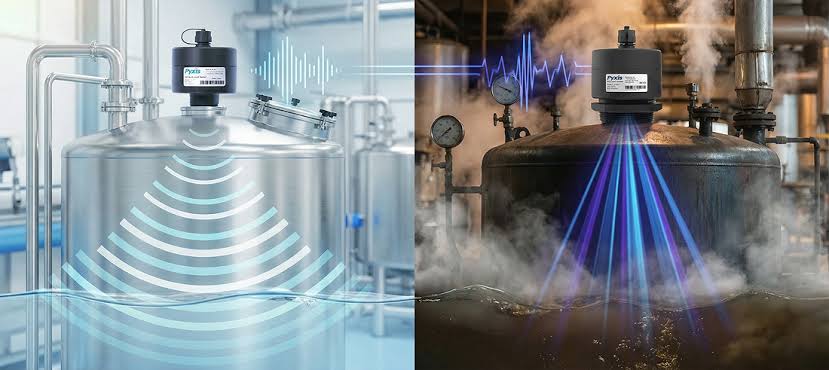
A false tank level can cause an overfill, a dry-running pump, an incorrect batch record, or an avoidable product loss. Different technologies respond differently to foam, pressure, temperature, and product composition. Before replacing the sensor, establish whether the displayed value is wrong, the tank calibration is wrong, or the process condition has changed. The most useful check compares an independent measurement with the sensor across several levels, not just at empty and full.
Identify the technology and its limits
Find out whether the system uses a pressure transmitter, load cells, radar, a sight glass, or another method. A bottom pressure sensor infers level from liquid density and can shift when the product or temperature changes. Load cells can be affected by pipe stress and supports. Radar or other noncontact sensors may struggle with foam or internal obstructions. A sight glass is simple but can be hard to read accurately and may not match the tank geometry.
Review the manufacturer’s operating range, installation orientation, cleaning limits, and calibration procedure. Do not apply a generic adjustment to a sensor whose behavior is not understood.
Compare against an independent reference
Choose a safe, documented way to establish actual volume or level: calibrated additions, a verified flow meter, or a tank chart based on measured geometry. Take readings at several points while filling or draining. Record product, temperature, pressure, tank status, and whether pumps or agitators are running. A sensor that is correct at one point but drifts at another may have a scaling or geometry issue.
Verify the reference too. A flow meter can be miscalibrated, and a tank chart can use nominal dimensions that differ from the installed vessel. If two methods disagree, investigate both before declaring the electronic sensor faulty.
Look for installation problems
Inspect the sensor port for deposits, trapped gas, damaged diaphragms, or blocked impulse lines. Check cables, connectors, and washdown damage. For load cells, inspect whether a rigid pipe or platform is transferring weight outside the intended supports. For noncontact sensors, examine the beam path, condensation, foam, and internal obstructions. A sensor can be sound yet installed where it cannot see the process reliably.
If the level changes abruptly when a valve opens, consider pressure effects or vibration rather than immediate volume movement. Trend the raw signal when available, not only the rounded display value.
Keep alarms separate from the display
An overfill alarm should not rely blindly on the same unverified reading used for routine inventory. Consider an independent high-level protection where the consequence justifies it, and have the design reviewed by a qualified engineer. Test alarms under controlled conditions according to the site’s procedure. A working display does not prove that the alarm output, horn, or shutoff action works.
Define a safe response when the level signal becomes implausible. Operators should know whether to stop the transfer, use an independent sight point, or switch to a manual measured fill. Do not simply silence a frequent alarm without finding its cause.
Recalibrate after relevant changes
Recheck the instrument after a sensor replacement, tank relocation, piping change, or new product with substantially different density. Document old and new calibration values and who approved the change. A maintenance repair that restores a stable signal can still leave the volume conversion wrong.
For new brewery tanks, specify the operating fill range, required level accuracy, product types, and desired alarm behavior. With craft brewing equipment, ask for sensor access and a documented tank-volume chart. The best instrument is one the brewery can verify and service without disrupting the vessel.
Close the loop with production records
Compare tank level change with measured transfers over several batches. If the numbers never reconcile, quantify the difference and look for systematic bias. A small repeated error can distort yield decisions, while a large intermittent error may signal a failing component. Treat level data as a measurement system that needs routine verification, not as an unquestionable number on a screen.
How can a simple fill test expose the error
Using an approved, calibrated volume source, add measured increments at a safe flow. Record the displayed level after each increment has settled. Repeat while draining if practical. A difference only near the bottom may indicate tank geometry or sensor dead band; a proportional error across the full range may suggest scaling. A sudden jump can point to trapped gas, foam, or wiring noise. Keep the data table with the instrument record so the repair can be checked against the original problem.
The test should not exceed normal operating levels or pressure. If the tank holds beer, plan the test around cleaning or commissioning rather than adding an unknown amount to a live batch.
What should be in the alarm test
Define the high-level and low-level actions, not just the displayed setpoints. Under a controlled procedure, verify the warning reaches the operator and the intended response occurs. If an independent switch exists, confirm it operates separately from the main display. Document bypasses and restore them after testing. A level alarm that has never been exercised may provide false confidence.
How do product changes affect the reading
Density-based sensors can report a different apparent volume when the product changes. Foam can affect some noncontact methods, and a pressurized tank may alter the conditions around a probe. The calibration plan should identify which product assumptions the display uses. If the brewery runs beer, cider, and other beverages through one tank, verify that the measurement remains fit for each product or provide a clear conversion procedure.
What should the operator do when the value looks wrong
Pause a transfer that depends on the disputed level and check a safe independent indication. Compare recent flow-meter totals and expected tank volume. Note whether the reading jumped during a valve operation or changed gradually. Call maintenance if the signal remains implausible; do not simply overwrite the display with a guessed number. Record the temporary method used to protect the batch. A repeatable response prevents an instrument fault from becoming a dry pump or overfilled vessel.