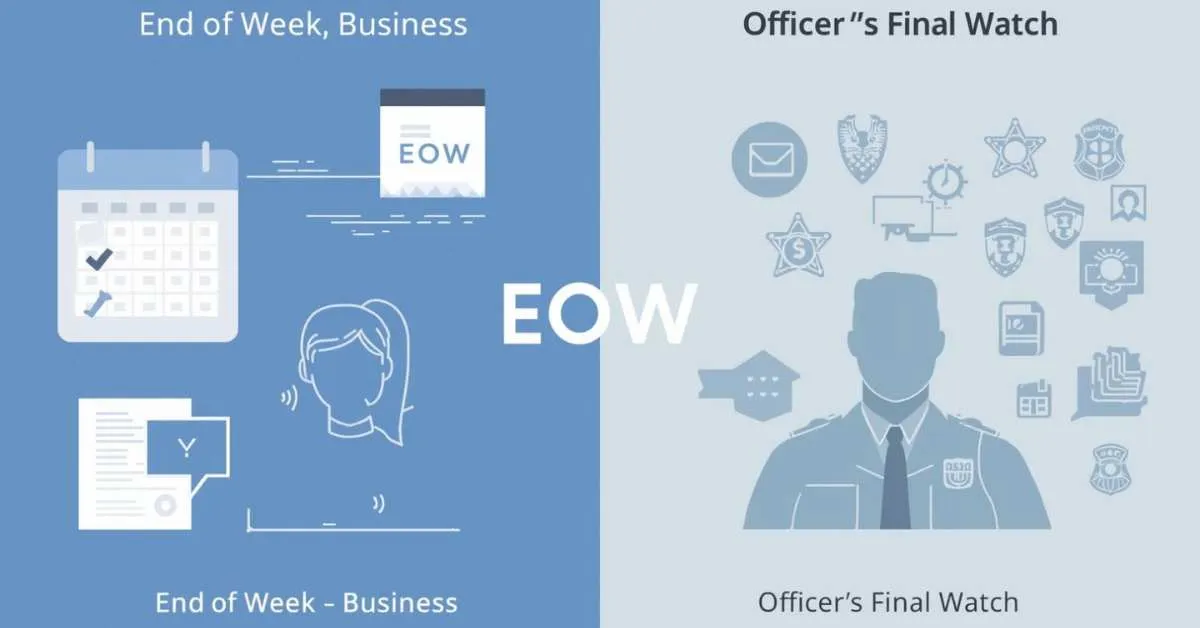
Short forms are everywhere in modern communication. One abbreviation you may often see in emails, workplace chats, or official statements is EOW. While it looks simple, its meaning changes depending on the situation.
In business settings, EOW typically refers to a weekly deadline. In law enforcement, however, it carries a solemn meaning related to honoring officers. Because of these different interpretations, understanding the context behind EOW is essential.
This guide explains the full form of EOW, how it is used in professional communication, its significance in law enforcement, and how to apply it correctly in messages, emails, and project updates.
What Is the Full Form of EOW?
The abbreviation EOW has multiple meanings. The correct interpretation depends entirely on context.
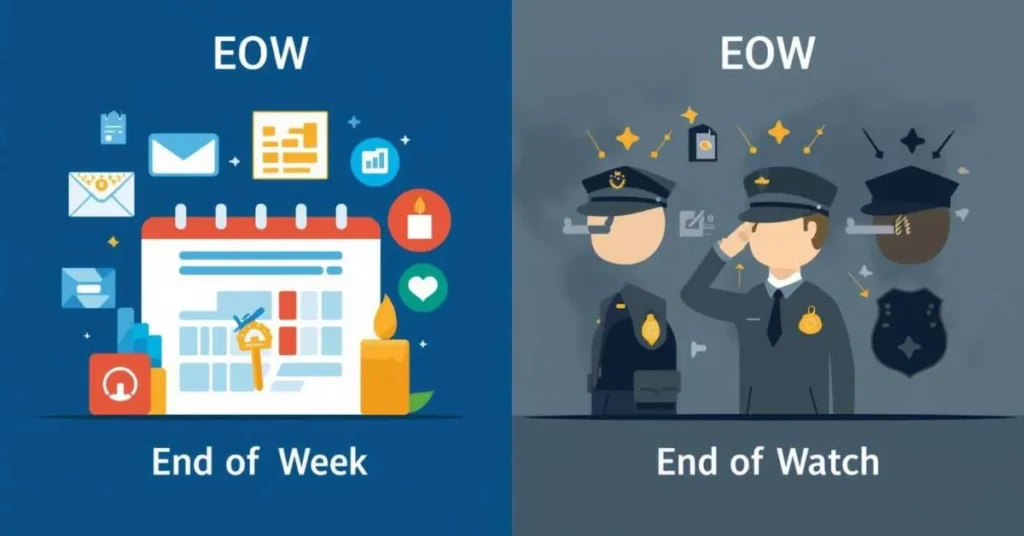
1. End of Week
In workplaces and corporate communication, EOW most commonly stands for End of Week. It indicates that something should be completed before the workweek ends — usually on Friday.
Example:
- “Please finalize the presentation before EOW.”
- “We expect the revised contract by EOW.”
2. End of Watch
In police and law enforcement communities. EOW means End of Watch. This phrase is respectfully used to mark the date an officer passed away while serving in the line of duty.
Example:
- “Officer Daniel Reed – EOW April 18, 2021.”
This usage carries emotional and ceremonial significance.
3. End of Warranty
In technical documents or service agreements, EOW may sometimes refer to the expiration of product coverage, meaning End of Warranty.
How EOW Is Used in Business Communication
In professional environments, clarity and efficiency matter. Abbreviations like EOW help reduce long phrases while keeping instructions clear.
Instead of writing by the end of this week, professionals often write:
- “Send the report by EOW.”
- “Client approval is needed before EOW.”
This shorthand saves time and keeps messages concise.
Best Practice for Professional Use
When working across teams or time zones, it’s helpful to include a specific date to avoid confusion.
Example:
“Submit the document by EOW (Friday, June 14).”
Adding the exact date ensures everyone understands the deadline.
What Does EOW Stand for Police?
EOW usually stands for Economic Offences Wing in a police department. It is a specialized unit that investigates serious financial crimes, such as fraud, cheating, large-scale scams, and certain cases involving financial misconduct. The exact role and name can vary by country or police department. People may see EOW in police reports, news stories, or legal notices when a financial crime is being investigated by this specialized team. For example, a major investment scam may be investigated by the EOW rather than a regular police station.
Example 1: “The EOW started investigating the company after several investors reported fraud.”
Example 2: “Police transferred the financial scam case to the EOW for further investigation.”
Context and how people use it:
People usually use EOW when discussing police investigations involving financial or economic crimes.
In news and legal contexts, “EOW” often refers to the specialized police unit handling such cases.
EOW Meaning Police
In a police context, EOW generally means Economic Offences Wing, a specialized branch that deals with economic and financial offenses. Its investigations can involve cases such as investment fraud, banking scams, forgery, cheating, and other complex financial crimes. Because these cases may involve large amounts of money, multiple people, or detailed financial records, they often require specialized investigation. When someone searches for “EOW meaning police,” they are usually trying to understand what this abbreviation means in a police report, news article, complaint, or investigation.
Example 1: “The EOW questioned several people connected to the alleged financial scam.”
Example 2: “The complaint was sent to the EOW because it involved a large-scale money fraud.”
Context and how people use it:
EOW is commonly used in police, legal, and news discussions about financial crime investigations.
The exact powers and responsibilities of the EOW can differ depending on the police department or jurisdiction.
EOW Meaning
EOW most commonly means “End of Week.” People use it in texts, emails, work chats, and everyday communication to describe something that should happen by the end of the current week. The exact meaning can change depending on the context, especially in business or medical settings. For example, if a coworker says, “Please send the report by EOW,” they usually mean the report should be sent before the workweek ends. EOW is a short and convenient abbreviation when talking about deadlines or weekly schedules.
Example 1: “Can you finish the project by EOW?”
Example 2: “I’ll send you the updated file by EOW.”
What Does EOW Mean in Business?
In business, EOW usually means “End of Week.” It is often used when discussing deadlines, tasks, meetings, reports, and project updates. When someone asks for something “by EOW,” they generally expect it to be completed before the working week ends. The exact deadline can depend on the company, so it may be helpful to confirm whether they mean Friday or another day. This abbreviation is common in professional emails, Slack messages, project management tools, and workplace conversations.
Example 1: “Please complete the sales report by EOW.”
Example 2: “We need the client’s approval by EOW.”
meaning of eow
EOW is a short acronym with two main everyday uses. In offices and work chats it usually means “End of Week,” pointing to a Friday deadline or the close of the workweek. In law-enforcement settings it stands for “End of Watch,” marking either the finish of an officer’s shift or, more solemnly, the date an officer died in the line of duty. Context always decides which meaning applies. Knowing both keeps messages clear and respectful.
Example 1: “Please send the final draft by EOW so we can review it Monday.”
Example 2: “Officer Rivera, EOW 12 March 2022 – remembered with honor.”
eow meaning slang
As casual slang, EOW almost always means “End of Week.” People drop it in texts, Slack, or group chats when they want a quick way to set a Friday-style deadline without typing the full phrase. It feels light and workplace-friendly rather than pure internet slang like LOL. You will rarely see it used for anything else in everyday messaging. Spotting the work context helps you reply correctly and stay on schedule.
Example 1: “Can you finish the slides EOW? Need them for the Monday call.”
Example 2: “I’ll update the shared folder EOW so everyone has the latest version.”
eow meaning business
In business language EOW stands for “End of Week.” Teams use it to set clear deadlines that usually land on Friday close of business. It appears in emails, project tools, and meeting notes to keep everyone aligned without long explanations. Some workplaces treat it as end of Friday; others include the weekend, so a quick check can avoid confusion. The term keeps communication short, professional, and action-focused.
Example 1: “All marketing proposals must reach me by EOW.”
Example 2: “Let’s lock the budget numbers EOW and present them next week.”
eow full form
The full form of EOW depends on the setting. In business it expands to “End of Week.” In police and military circles it expands to “End of Watch.” Both versions are widely understood once the context is clear. No other full forms dominate everyday use. Choosing the right expansion helps you speak accurately whether you are scheduling work or honoring service.
Example 1: “Full form in the office: End of Week – report due EOW.”
Example 2: “Full form in law enforcement: End of Watch – noted on the memorial wall.”
Eow definition
EOW is defined as either “End of Week” or “End of Watch.” The first definition marks the close of a workweek, commonly Friday, and is used for deadlines. The second definition marks the end of an officer’s duty shift or the date of a line-of-duty death. Dictionaries list both, so the surrounding words always guide the correct reading. This dual definition makes the acronym flexible yet precise.
Example 1: “Definition in email: End of Week – files needed EOW.”
Example 2: “Definition on a plaque: End of Watch – forever on duty in our hearts.”
What does e.o.w. stand for
E.O.W. stands for “End of Week” in most business writing and for “End of Watch” in law-enforcement records. The periods simply emphasize each letter. Both expansions are standard and instantly recognized in their own fields. Using the dotted form does not change the meaning; it only adds a slightly more formal look. Always match the expansion to the conversation at hand.
Example 1: “Please deliver the invoice by E.O.W. Friday.”
Example 2: “The memorial lists the officer’s E.O.W. date with quiet respect.”
Eow stand for
EOW stands for “End of Week” when people talk about schedules and deadlines, and “End of Watch” when they talk about police or military duty. These two expansions cover nearly every common appearance of the letters. The acronym stays short so messages stay fast. Picking the right stand-for phrase keeps both casual and serious talks clear.
Example 1: “EOW stands for End of Week – get the numbers in by then.”
Example 2: “EOW stands for End of Watch – the date we honor the fallen.”
Eow acronym
As an acronym, EOW packs two clear ideas into three letters. Business teams read it as “End of Week.” Law-enforcement teams read it as “End of Watch.” The same letters switch meaning only by context, making the acronym efficient yet flexible. Once you know both readings you can decode any message that contains it.
Example 1: “The project plan lists every task due by the EOW acronym deadline.”
Example 2: “On the officer’s page the EOW acronym marks the final day of service.”
Eow acronym meaning
The acronym EOW carries the meaning “End of Week” in workplaces and “End of Watch” in police or military use. Both meanings are short, practical, and widely accepted. No single definition overrides the other; the surrounding talk decides which one applies. Learning the dual meaning prevents mix-ups in emails or memorials.
Example 1: “Acronym meaning at work: End of Week – finish the draft EOW.”
Example 2: “Acronym meaning in uniform: End of Watch – remembered every year.”
Whats eow mean
What’s EOW mean? Most of the time it means “End of Week,” a handy way to set Friday-style deadlines in texts and emails. In police contexts it means “End of Watch,” either the end of a shift or the date an officer gave their life. A quick look at who is speaking tells you which meaning fits. The short form keeps messages fast and clear.
Example 1: “Whats EOW mean here? End of Week – send the file by Friday.”
Example 2: “Whats EOW mean on the wall? End of Watch – a life of service.”
What does eow mean in text
In text messages EOW almost always means “End of Week.” Friends and coworkers use it to set quick deadlines without typing a full sentence. It is not typical pure slang; it stays practical and schedule-focused. You will see it in work chats far more than in casual banter. Knowing this reading lets you answer on time and stay organized.
Example 1: “Can you check the numbers and reply EOW?”
Example 2: “I’ll drop the photos in the group chat EOW.”
What does eow mean for police
For police, EOW means “End of Watch.” On a normal day it simply notes the end of an officer’s shift. When an officer dies in the line of duty the same letters mark the date of that final sacrifice. Departments print it on memorials, reports, and tributes to honor the service given. The phrase carries both routine and deep respect.
Example 1: “Log shows Officer Lee’s EOW at 0700 after a quiet night shift.”
Example 2: “The memorial wall reads: Officer Chen, EOW 4 July 2019 – never forgotten.”
What Does EOW Stand For?
EOW most commonly stands for “End of Week.” It is a shortened expression used to talk about the point when a week finishes. You may see it in business communication, text messages, emails, calendars, and project updates. The phrase usually refers to the end of the working week rather than a specific hour. However, the intended deadline can vary by workplace or situation. If the timing matters, asking for the exact date or time can prevent confusion.
Example 1: “The payment should arrive by EOW.”
Example 2: “I’ll have the presentation ready by EOW.”
EOW Medical Abbreviation
In medical contexts, EOW can have a different meaning depending on the document, specialty, or healthcare setting. One possible meaning is “every other week,” particularly when describing a treatment or medication schedule. Medical abbreviations can vary between organizations, so readers should not assume one meaning without checking the surrounding information. If EOW appears on a prescription, treatment plan, or medical record, it is safest to confirm its meaning with a qualified healthcare professional.
Example 1: “The treatment is scheduled EOW.”
Example 2: “The patient returns for an EOW appointment.”
What’s EOW?
EOW is an abbreviation that most often means “End of Week.” It is commonly used when someone wants to describe a weekly deadline without writing the full phrase. You might see it in an email from a manager, a text from a coworker, or a project update. In some contexts, EOW can mean something else, so the surrounding words are important. In ordinary workplace communication, however, “end of week” is the most common interpretation.
Example 1: “Can you review this document by EOW?”
Example 2: “I’ll call you before EOW.”
What Does E.O.W. Mean?
E.O.W. usually means “End of Week.” The periods simply show that the letters are being written as an abbreviation. It has the same basic meaning as EOW without periods. People may use it in business emails, schedules, notes, and messages when referring to a weekly deadline. Depending on the context, E.O.W. can have another meaning, so it is always useful to look at the surrounding conversation before deciding what the abbreviation means.
Example 1: “Please submit the form by E.O.W.”
Example 2: “The final numbers are due E.O.W.”
EOW Abbreviation
EOW is an abbreviation most commonly used for “End of Week.” It helps people communicate a weekly deadline quickly and clearly. It is especially common in professional settings where employees regularly discuss tasks, reports, projects, and delivery dates. While EOW often refers to the end of the workweek, it does not always identify an exact day or time. Because different workplaces may define their workweek differently, checking the intended deadline is a good idea when timing is important.
Example 1: “Please send your feedback by EOW.”
Example 2: “The team hopes to finish testing by EOW.”
What Does EOW Mean?
EOW generally means “End of Week.” It is used to describe something that should happen before the week finishes. You can find this abbreviation in workplace messages, emails, project discussions, and casual conversations. For example, a manager might ask an employee to complete a task by EOW. In that situation, the person is expected to finish the task before the end of the working week. The abbreviation is short, practical, and easy to recognize in many professional settings.
Example 1: “Please update the spreadsheet by EOW.”
Example 2: “I should have an answer for you by EOW.”
What Does EOW Stand For in Police?
In a police or law-enforcement context, EOW can have a specialized meaning depending on the agency or source. One recognized use is “End of Watch,” which refers to the end of an officer’s duty or service period. The term is also widely associated with memorial and law-enforcement language, particularly when referring to an officer who has died in the line of duty. Because police abbreviations can differ between agencies, the surrounding context should be checked before assigning a specific meaning.
Example 1: “The report recorded the officer’s EOW date.”
Example 2: “The department honored the officer on the anniversary of his EOW.”
EOW Stands For
EOW most commonly stands for “End of Week.” It is frequently used when discussing deadlines, schedules, assignments, and workplace responsibilities. However, EOW does not have just one universal meaning. In law-enforcement contexts, it can refer to “End of Watch,” while certain medical contexts may use it for a different scheduling phrase. Therefore, the correct meaning depends on where you saw the abbreviation. Looking at the words around EOW usually makes the intended meaning much easier to identify.
Example 1: “The report is due by EOW.”
Example 2: “The department recorded the officer’s EOW.”
EOW/EOH Meaning
EOW/EOH can refer to two different time-related phrases, depending on the context. EOW commonly means “End of Week,” while EOH can mean “End of Hour” or, in some workplace contexts, “End of Hours/End of Business Hours.” Because these abbreviations are not universal, their exact meanings depend on the industry and conversation. If you see them together in a workplace message, the sender is likely referring to deadlines or timing. Always consider the surrounding message for the intended definition.
Example 1: “Please send the report by EOW.”
Example 2: “I need the figures by EOH today.”
What Does EOW Mean?
EOW usually means “End of Week,” especially in business communication. It tells someone that a task, response, payment, report, or other action is expected before the week ends. The abbreviation saves time and is common in emails, workplace chats, and project management conversations. However, EOW can mean different things in specialized fields. For that reason, context matters. If someone gives you an EOW deadline and you are unsure whether they mean Friday or another day, ask them to clarify.
Example 1: “Can you finish this task by EOW?”
Example 2: “The customer should receive an update by EOW.”
Define EOW
EOW can be defined as an abbreviation for “End of Week.” It describes the point at which a week comes to an end and is commonly used when setting deadlines or discussing schedules. In professional communication, someone might say “by EOW” to mean that an assignment should be completed before the workweek finishes. The exact day can depend on the organization’s schedule. EOW can also have specialized meanings in medical or law-enforcement contexts, so context should always be considered.
Example 1: “Please finish the review by EOW.”
Example 2: “We expect the order to ship by EOW.”
What Is an EOW?
An EOW is an abbreviation that most commonly means “End of Week.” It is used to refer to the conclusion of a week, especially when talking about deadlines and work schedules. For example, if your manager says something needs to be completed “by EOW,” they usually mean it should be finished before the working week ends. EOW is common in professional communication because it makes messages shorter. Its meaning can change in specialized fields, so context is important.
Example 1: “I’ll complete the assignment by EOW.”
Example 2: “The manager wants the final draft by EOW.”
What Is EOW?
EOW is a short form most commonly used for “End of Week.” You may encounter it in emails, text messages, work chats, calendars, or project discussions. It is especially useful when someone needs to set a deadline without writing the full phrase. For example, “Send it by EOW” generally means “Send it by the end of the week.” However, EOW may have different meanings in certain professions, including medicine and law enforcement. The context determines which definition is correct.
Example 1: “Let’s have the meeting notes ready by EOW.”
Example 2: “The team will review the proposal by EOW.”
What EOW Stands For
EOW generally stands for “End of Week.” It is a common abbreviation for describing a deadline or schedule. In everyday professional communication, it usually means something should be completed before the current workweek ends. However, EOW can have other meanings in specialized situations. For example, law-enforcement sources may use it for “End of Watch,” while medical usage can refer to a recurring schedule. Therefore, the surrounding context is important when determining what EOW stands for.
Example 1: “Please submit the application by EOW.”
Example 2: “We should know the final result by EOW.”
Understanding the Difference: EOW, EOD, and COB
Several abbreviations are commonly used in office communication. They are similar but not identical.
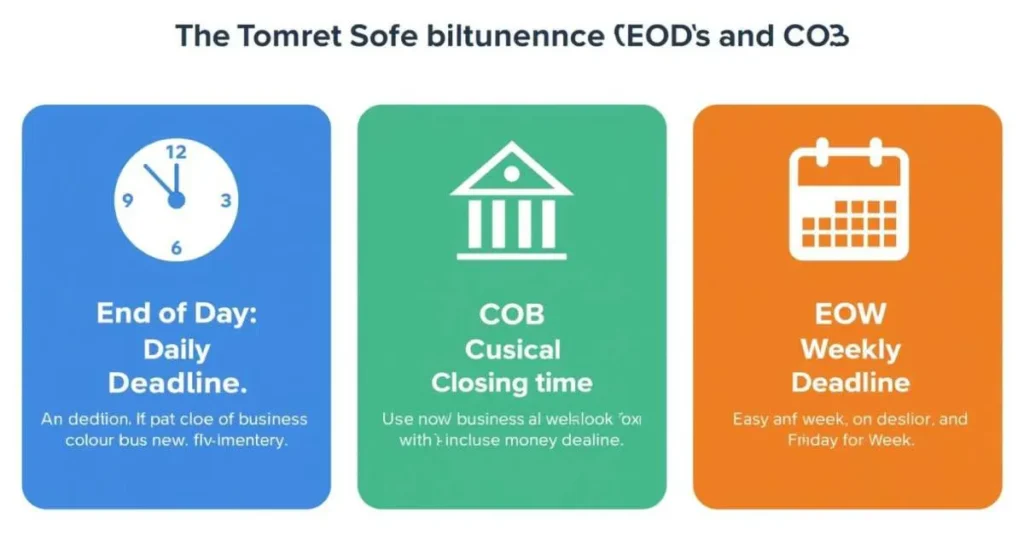
- EOD (End of Day): Refers to the close of a single working day.
- COB (Close of Business): Means the official closing time of a business day.
- EOW (End of Week): Refers to the final working day of the week.
Example:
- EOD = By 5 PM today
- COB = By the end of business hours
- EOW = By Friday
Knowing these distinctions helps prevent deadline misunderstandings.
The Meaning of EOW in Law Enforcement
Outside the business world, EOW has a deeply respectful meaning. In policing communities, it stands for End of Watch.
This phrase is used to honor officers who have died while serving their communities. It appears in official announcements, memorial tributes, and remembrance posts.
Unlike workplace usage, this meaning carries emotional weight. It is important to use it respectfully and only in appropriate contexts.
Use of EOW in Chat and Messaging Apps
In workplace messaging platforms such as Slack or Microsoft Teams, EOW usually retains its business meaning.
Examples:
- “Please update the task list before EOW.”
- “Let’s finalize the strategy by EOW.”
In informal conversation, some people also use it when setting personal goals for the week.
Example:
- “My goal for EOW is to complete all pending tasks.”
If communicating with someone unfamiliar with business abbreviations, writing the full phrase may be clearer.
EOW Meaning in Hindi and Urdu
For multilingual communication, the business meaning of EOW (End of Week) can be expressed as:
Hindi:
सप्ताह के अंत तक
Urdu:
ہفتے کے آخر تک
These translations are helpful when explaining deadlines in regional or local contexts.
When You Should Avoid Using EOW
Although EOW is common in professional communication, there are situations where using the abbreviation may not be appropriate.
1. Communication With New Clients
If you are emailing someone outside your organization, they may not be familiar with internal abbreviations. Writing “end of week” instead of EOW ensures clarity and avoids misunderstandings.
Example:
Instead of:
“Please send the contract by EOW.”
Write:
Please send the contract, by the end of the week (Friday).
This improves professionalism and builds trust.
2. International Teams
Different countries follow different workweeks. In some regions, the week may end on Thursday or Saturday. Simply writing EOW could cause confusion.
Always clarify the exact date when working globally.
3. Formal Documents and Legal Agreements
In contracts, policy documents, and legal paperwork, abbreviations should be minimized. Writing the full phrase provides legal clarity and avoids ambiguity.
Clear communication reduces risk.
4. Sensitive Contexts
Since EOW can also mean “End of Watch” in law enforcement, using it casually in the wrong environment could be inappropriate. Always consider the audience and setting.
Using abbreviations wisely reflects strong communication skills.
The Role of Abbreviations Like EOW in Modern Workplace Culture

Abbreviations have become part of modern professional communication. They help teams communicate faster and manage workloads efficiently.
1. Encourages Concise Communication
Short forms like EOW allow professionals to deliver instructions quickly without long explanations. This is especially useful in fast-paced environments.
2. Supports Agile Project Management
Weekly milestones are common in project cycles. Referring to deadlines as “end of week” helps structure workflow into manageable time frames.
Teams often organize tasks around:
- Start of week planning
- Midweek reviews
- End of week delivery
This structure improves productivity.
3. Reflects Workplace Norms
Corporate culture often includes common abbreviations such as:
- EOD
- COB
- ETA
- FYI
Understanding and using them correctly demonstrates familiarity with professional communication standards.
4. Balancing Clarity and Efficiency
While abbreviations save time, clarity should always come first. The best communicators know when to shorten phrases and when to write them fully.
Strong communication is not about using more abbreviations — it is about using them correctly.
Why These Sections Help SEO
These H2 additions help you rank for related search terms such as:
- When to use EOW
- How to use EOW in emails
- EOW in professional communication
- Business abbreviations explained
- Workplace communication tips
They also improve:
- Content depth
- Topical authority
- Dwell time
- Semantic relevance
Without repeating the main keyword excessively.
Common Questions About EOW
Does EOW always refer to Friday?
In most workplaces, yes. It typically points to the last working day of the standard week, which is Friday.
Does EOW include weekends?
Generally, it does not. It usually refers to the official workweek ending.
Is EOW formal?
It is acceptable in professional emails and internal communication. However, spelling out the phrase may be better in formal documents.
Can EOW be misunderstood?
Yes. Since it has more than one meaning, context is essential.
Why Context Matters
The same abbreviation can have completely different meanings depending on the environment.
- In business → It signals a deadline.
- In law enforcement → It honors a fallen officer.
- In technical settings → It may refer to warranty expiration.
Understanding the surrounding context ensures accurate interpretation and respectful usage.
Conclusion
EOW is a versatile abbreviation used in several professional and formal settings. Most commonly, it represents End of Week, indicating a weekly deadline. In law enforcement communities, it stands for End of Watch, a phrase used to honor officers who died in service.
Because the abbreviation has multiple meanings, clear communication is essential. When needed, include exact dates or spell out the phrase to prevent confusion.
By understanding its context and correct usage, you can use EOW confidently in emails, project management, messaging platforms, and formal communication.
Discover More Post
- What Is The? Meaning, Uses & Examples
- Hiraeth Meaning: Origin, Feeling & Examples
- Tsk Tsk Meaning: Full Definition & Examples
- What Is Th? Meaning, Examples & Facts

Hi, I’m Evan Lexor, the voice behind Meanvia.com. I break down English words, slang, and phrases into clear, simple meanings that actually make sense. From modern internet terms to everyday expressions, my goal is straightforward: help you understand English better, faster, and with confidence, one word at a time.