
Quick Definition:
Tuition means the money paid for instruction, courses, and classes in an academic program.
Think of it like a menu price: tuition is the main item, but extras can raise the final bill. Once you learn what the word covers, you can compare schools faster and avoid surprise costs.
Tuition is money paid for learning. It is a fee. It is an education cost and it is a charge you pay so you can study in a program.
You may see this word in two ways:
- On a school bill (the cost of teaching)
- In daily talk (extra tutoring, like “tuition classes”)
This guide explains both meanings in very simple words. It also shows what is included, what is not, and how to plan your budget.
Tuition as a School Cost

When schools use this word, they mean the main cost for teaching.
Who pays it?
The payer can be:
- the student
- parents/guardian
- a sponsor
- an employer
- the government
Who receives it?
The provider can be:
- a school
- a college
- a university
- a training institute
Why do you pay it?
You pay for a service:
- instruction
- courses
- classes
- an academic program
On bills, you will often see it written as a tuition fee.
Tuition as Tutoring (Tuition Classes)

In many places (including Pakistan/India and some UK-style English), “tuition” can mean private tutoring.
Examples:
- “I take tuition classes after school.”
- “I go to a tuition center for math.”
- “My tuition teacher helps me with English.”
So in daily speech:
- Tuition classes = extra coaching / tutoring
- Tuition center = coaching center
- Tuition teacher = tutor
Both meanings are correct. The sentence tells you which one is best.
What This Cost Usually Covers Tuition
Most of the time, this charge pays for the core teaching part of education.
It often covers:
- your place in classes
- lessons and lectures
- teacher time for teaching and checking work
- grading and exams
- the basic structure of your program (the planned subjects you must finish)
Many schools also include basic access to learning tools, like:
- a student portal for results and schedules
- an online system to submit homework
Still, each institution is different. Always check what your school includes.
How to Pronounce Tuition
Tuition is pronounced as “too-ISH-un.” Stress falls on the second syllable, with a soft “sh” sound. Say it slowly: too – ISH – un. Native speakers often blend it smoothly in conversation. Practicing aloud helps build confidence, especially for non-native speakers discussing education costs.
Example 1: When asking about college fees, you can say, “How do you pronounce tuition correctly?”
Example 2: A student might tell a friend, “I finally learned how to pronounce tuition the American way.”
[Context and how people use it]
People search this when preparing for school interviews or conversations about education costs.
It is commonly used by international students and parents wanting clear, natural pronunciation.
Tuition Definition
Tuition is the fee charged by a school, college, or university for instruction and academic services. It covers the cost of classes, teaching staff, and basic educational resources. Unlike room and board or books, tuition specifically pays for the learning experience itself. Amounts vary widely depending on the institution, program, and location.
Example 1: “The tuition definition in the college handbook clearly lists the annual fee for each major.”
Example 2: A parent might explain, “According to the tuition definition, this amount does not include housing.”
[Context and how people use it]
Learners look up the tuition definition when comparing school costs or reading official documents.
Parents and students use it to understand exactly what the fee covers before enrolling.
Tuition Meaning
The meaning of tuition centers on the money paid for formal teaching. It represents the price of knowledge and guided learning at an educational institution. In everyday talk, people use the word to discuss how expensive or affordable a school is. The core idea remains the same: payment in exchange for instruction.
Example 1: “Understanding the tuition meaning helped me budget for next semester.”
Example 2: A counselor might say, “Let’s clarify the tuition meaning so you know what you are paying for.”
[Context and how people use it]
People search the tuition meaning when they want a simple explanation of school fees.
It appears often in conversations about college planning and financial aid.
What Is Tuition
Tuition is the charge a student or family pays to receive formal education at a school or university. It funds teachers, classrooms, and academic programs. Public colleges usually cost less than private ones, and rates can differ by degree level. Knowing what tuition is helps families plan finances early.
Example 1: “What is tuition at this university? I need the exact yearly amount.”
Example 2: A high-school senior might ask, “Can someone explain what is tuition before I apply?”
[Context and how people use it]
Students and parents use this question when starting college research.
It helps them separate teaching costs from other expenses like books or housing.
What Does Tuition Mean
What does tuition mean? It means the payment required for instructional services at an educational institution. The word focuses on the cost of teaching rather than living expenses or materials. Clear understanding prevents confusion when reading financial aid letters or school websites.
Example 1: “What does tuition mean on this invoice? Is it only for classes?”
Example 2: A parent might text, “Can you tell me what does tuition mean in simple terms?”
[Context and how people use it]
This question appears when people receive their first college bill or catalog.
Families use it to confirm they understand the main education cost.
Tuition
Tuition refers to the money paid for teaching and academic instruction. Schools set tuition rates based on program type, location, and whether the student is in-state or out-of-state. It is one of the largest education expenses and often discussed alongside scholarships and loans.
Example 1: “Tuition went up this year, so we need a bigger budget.”
Example 2: A student might post, “Looking for ways to lower my tuition next semester.”
[Context and how people use it]
People simply search “tuition” when they want quick facts about school costs.
It is used in both casual talk and formal financial planning conversations.
What Is a Tuition
What is a tuition? It is the specific fee charged for educational instruction. The article “a” is sometimes added in informal speech, though the standard term is simply “tuition.” The concept stays the same: payment for teaching services provided by a school or college.
Example 1: “What is a tuition payment plan, and how does it work?”
Example 2: A new student might ask, “Can someone explain what is a tuition fee at this school?”
[Context and how people use it]
This phrasing appears in everyday questions from first-time college families.
It helps clarify the main cost of attending classes.
Tuition Class Meaning
Tuition class meaning refers to the idea that the fee covers participation in formal instructional sessions. In some regions, “tuition class” also describes extra after-school lessons, but the core meaning remains payment for teaching. Understanding this helps students know what their money supports.
Example 1: “The tuition class meaning includes both lectures and lab sessions.”
Example 2: A parent might say, “I finally get the tuition class meaning after reading the brochure.”
[Context and how people use it]
People search this when they see the phrase on school websites or invoices.
It is useful for families comparing regular school fees with extra coaching classes.
Whats a Tuition
Whats a tuition is a casual way of asking what the education fee actually covers. In short, it is the cost of instruction at a school or college. The informal spelling reflects everyday speech, yet the answer stays clear and practical for budgeting.
Example 1: “Whats a tuition cost at community college versus a private university?”
Example 2: A teen might text a friend, “Hey, whats a tuition payment supposed to include?”
[Context and how people use it]
This casual search is common among young students and first-generation families.
It helps them get a quick, friendly explanation of school fees.
What Is the Tuition
What is the tuition asks for the specific amount charged by a particular school or program. The answer usually includes the yearly or semester rate and may note extra fees. Knowing the exact figure allows accurate financial planning and comparison between institutions.
Example 1: “What is the tuition for the nursing program this year?”
Example 2: A parent might call the admissions office and ask, “What is the tuition for out-of-state students?”
[Context and how people use it]
Families use this question when they need the precise cost for a chosen school.
It appears frequently during application season and financial-aid discussions.
whats tuition
Tuition usually means teaching or education given to a student, especially through private lessons or classes. In some places, “tuition” also means the money paid to a school, college, or university for education. The meaning depends on the context. For example, a student may attend tuition classes after school to get extra help with difficult subjects. A college may charge tuition each semester for its educational services.
Context and how people use it:
People use “tuition” when talking about extra teaching, private lessons, or the cost of education.
The exact meaning can change depending on the country and sentence.
Examples:
- I go to tuition after school to study math.
- Her parents pay the college tuition every year.
tuition classes meaning
Tuition classes are extra educational classes where students receive teaching outside their regular school or college lessons. These classes may help students understand difficult topics, prepare for exams, or improve their grades. Tuition can happen in a classroom, at home, or online. Some students attend group classes, while others choose one-to-one lessons with a tutor. The subjects can include math, English, science, languages, or test preparation.
Context and how people use it:
People often say “tuition classes” when referring to additional lessons taken outside normal school hours.
The phrase is especially common when students need extra academic support.
Examples:
- My brother attends tuition classes for chemistry.
- She joined tuition classes before her final exams.
tution
“Tution” is a common misspelling of “tuition.” The correct spelling is tuition, with an “i” after the “t” and before the “o.” People may accidentally write “tution” because that spelling can sound natural when the word is spoken quickly. If you are writing an essay, school assignment, website, or formal message, use tuition instead. The word can refer to private teaching or the cost of education, depending on the context.
Context and how people use it:
“Tution” often appears in informal searches or messages when someone is unsure about the correct spelling.
For formal English, always use the standard spelling tuition.
Examples:
- Incorrect: I attend tution classes.
- Correct: I attend tuition classes.
tuition full form
Tuition does not have a full form because it is a complete English word, not an abbreviation or acronym. Some people search for “tuition full form” because they may expect the word to represent several words. However, there is no standard official expansion of TUITION in English. The word generally relates to teaching, instruction, or the money charged for education. Its meaning depends on how it is used in a sentence.
Context and how people use it:
People commonly search “tuition full form” when they want to know whether TUITION stands for something.
In standard English, it is simply the word tuition, not a shortened form.
Examples:
- Tuition means instruction or teaching in an educational setting.
- The university charges tuition for each academic year.
tuition def
“Tuition def” means “tuition definition.” Tuition can have two main meanings. First, it can mean teaching or instruction, especially private or additional lessons. Second, it can mean the amount of money charged for education at a school, college, or university. The correct meaning depends on the sentence. For example, a student might receive tuition from a private tutor, while a university student might pay tuition every semester.
Context and how people use it:
People searching “tuition def” usually want a quick and simple definition of the word.
The term can describe either educational instruction or the cost of receiving education.
Examples:
- The tutor provides tuition in English.
- His university tuition is expensive.
annual tuition meaning
Annual tuition means the total amount of money charged for education over one year. It is commonly used when discussing schools, colleges, universities, or other educational institutions. Annual tuition may cover the cost of instruction for the academic year, but it does not always include other expenses such as books, housing, transportation, meals, or activity fees. The exact amount and what it covers depend on the institution.
Context and how people use it:
People use “annual tuition” when comparing the yearly cost of attending different educational institutions.
It usually refers specifically to education costs rather than every expense a student may have.
Examples:
- The university has an annual tuition of $20,000.
- We are checking the annual tuition before choosing a school.
tuition mean
“Tuition mean” is usually a search phrase asking what the word tuition means. Tuition can refer to teaching or instruction, especially lessons provided by a tutor. It can also mean the money a student pays to an educational institution for instruction. For example, when someone says “I take tuition,” they may mean they attend extra lessons. When someone says “college tuition,” they usually mean the cost charged by the college for education.
Context and how people use it:
The meaning of tuition depends on whether the sentence discusses teaching or educational costs.
Students, parents, and schools commonly use the word in both contexts.
Examples:
- She takes tuition to improve her English.
- The college increased its tuition this year.
tuition fee meaning
Tuition fee means the money paid for educational instruction at a school, college, university, or similar institution. It normally covers the cost of teaching and academic services. Tuition fees are different from expenses such as accommodation, food, transportation, books, and personal supplies, although some institutions may combine certain charges. The amount can vary widely depending on the institution, program, location, and level of education.
Context and how people use it:
People use “tuition fee” when discussing how much an educational program costs.
The phrase is common in admission forms, university websites, student applications, and financial discussions.
Examples:
- I need to pay my tuition fee before the semester starts.
- The tuition fee for this course is affordable.
what is tution
“What is tution” is a common search query for the meaning of “tuition.” The correct spelling is tuition. It can mean extra teaching or lessons given to students, often by a private tutor or teacher. It can also refer to the money charged for education by a school, college, or university. Therefore, the meaning depends on the context. If someone says they attend tuition, they usually mean extra classes or private lessons.
Context and how people use it:
People often search this phrase when they want a simple explanation of tuition or are unsure about its spelling.
In standard English, write tuition, not “tution.”
Examples:
- What is tuition? It can mean extra teaching or educational instruction.
- I go to tuition classes every evening.
tuition spelling
The correct spelling is “tuition.” It is spelled T-U-I-T-I-O-N. A common mistake is writing “tution,” but that version is incorrect in standard English. Remember that tuition contains “tu-i” near the beginning: tuition. Checking the spelling is especially important in school applications, essays, academic documents, and professional writing. Pronunciation can make the word seem shorter than its written form, which may be why the misspelling is common.
Context and how people use it:
People search “tuition spelling” when they want to confirm how to write the word correctly.
Use tuition in formal and informal English; avoid the misspelling tution.
Examples:
- Correct: The tuition fee must be paid on time.
- Incorrect: The tution fee must be paid on time.
What It Usually Does Not Cover Tuition
This is where many students get surprised.
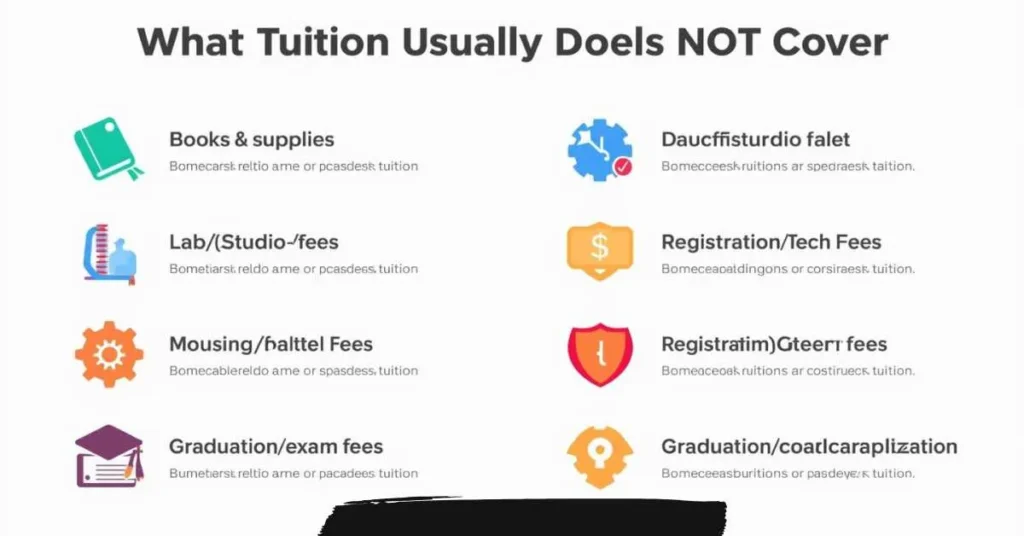
Many costs are separate, such as:
- books and supplies (textbooks, notebooks, tools, software)
- course add-ons (lab, studio, clinical, fieldwork)
- living costs (hostel/dorm, rent, meals)
- transport (bus, fuel, parking)
- extra fees (registration, technology, student services)
- insurance (required in some places)
A simple rule helps:
This charge pays for teaching. Other charges pay for services, materials, and living.
Tuition vs Fees vs Total Cost (Simple Table)
| Item | What it means | Common examples |
|---|---|---|
| Tuition | Main cost for teaching | classes, instruction |
| Fees | Extra required charges | registration, tech, services |
| Total cost | All costs to study and live | tuition + fees + books + housing + transport |
If you only look at the first number, you may under-plan your budget.
How Schools Set the Tuition Price (Billing Styles + Examples)
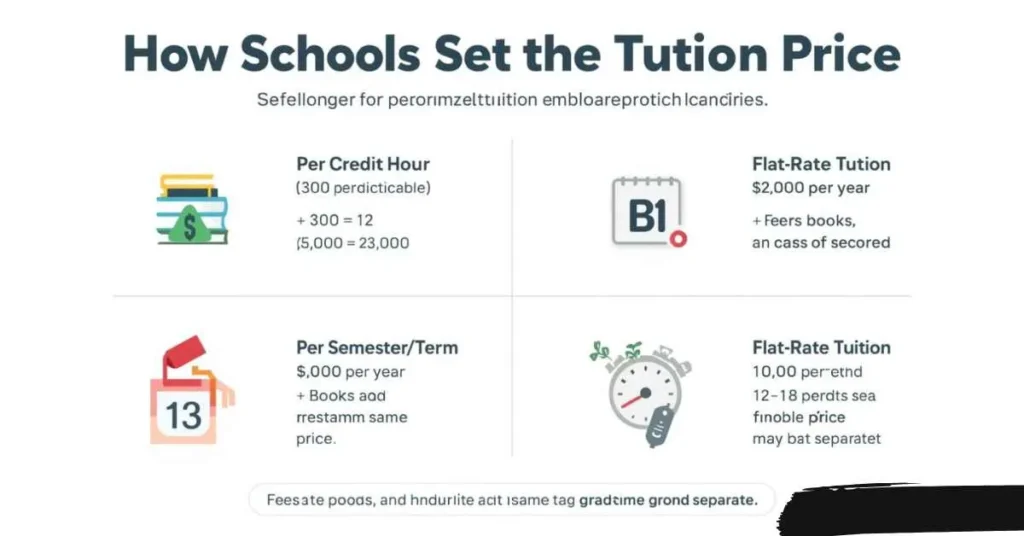
Schools use different billing styles. Here are the most common ones.
1) Per credit hour
You pay based on how many credits you take.
Example:
Cost per credit: 300
Credits this term: 12
Total class cost = 300 × 12 = 3,600
This style is common for part-time study and flexible programs.
2) Per semester/term
You pay one set amount for the term.
Example:
Cost for the term: 5,000
You pay that amount for the semester.
3) Annual tuition
Some schools show a yearly amount to help families plan.
Example:
Yearly amount: 12,000
This is the yearly teaching cost (before other items).
4) Flat-rate tuition
You pay one price if you stay in a credit range (often full-time).
Example:
Flat rate covers 12–18 credits
You take 12 credits or 18 credits → you pay the same base amount
This can be a good deal if you take more credits.
Why One Person Pays More Tuition Than Another
Prices can change based on rules and categories.
Common categories include:
- In-state vs out-of-state tuition (common in the US)
- Domestic vs international tuition
- Undergraduate vs graduate tuition
Other factors also matter:
- public vs private school
- program type (some programs need costly labs or training)
- location (big cities often have higher overall costs)
Always check the exact category used for your offer letter or bill.
Common Terms About Tuition You Will See And What Its Mean
These words show up on admission letters and invoices.
Tuition deposit
A tuition deposit is money paid to hold your seat after you accept an offer.
Sometimes it is used later as part of your first bill. Refund rules can differ.
Tuition waiver
A tuition waiver lowers or removes the teaching charge for eligible students.
It may not cover other fees.
Tuition assistance
Tuition assistance is support that helps pay the teaching cost.
It can come from an employer, a sponsor, or the government.
Tuition reimbursement
Tuition reimbursement usually means you pay first, then get paid back later.
Many employers do this after you finish a term.
Tuition grant/scholarship (covers tuition)
A tuition grant/scholarship can cover part or all of the teaching cost.
Important: some awards cover only tuition, not fees or living costs.
How to Read a Student Tuition Bill (Step-by-Step)
A bill can look scary. Use this simple order:
- Base teaching charge
- often based on credits or a flat rate
- Required fees
- registration, technology, student services
- Course fees
- labs, studios, training placements
- Credits and discounts
- scholarship, grant, waiver, sponsor payment
- Deposit line (if you paid one)
- may show as “deposit received”
- Due date and late rules
- late fees, account holds, blocked services
If a line is not clear, ask the accounts office for an itemized explanation.
Ways People Pay Tuition (Real-Life Options)
Many students use more than one source.
Common sources:
- student payment
- parents/guardian help
- sponsor support
- employer support
- government support
Common payment methods:
- bank transfer
- card payment (if allowed)
- installment plan (monthly payments for one term)
Tip: Ask if your school offers a payment plan. It can reduce stress.
Refunds, Drops, and Withdrawals (Very Important)
Most schools have rules about refunds. These rules are often strict.
Key points:
- There is often an add/drop time at the start of a term.
- Refunds often get smaller each week after classes begin.
- Some fees and deposits may be non-refundable.
- Dropping one class may lower your bill only if you pay per credit.
- With a flat rate, dropping one class may not change the base amount.
Also, aid can change if you withdraw. Some scholarships and government aid require full-time study.
Always check the dates before you drop or withdraw.
Simple Budget Planner (Copy and Use)
Use this checklist to estimate your real cost.
Step 1: School charges
- teaching cost (tuition)
- required fees
- course fees (lab/studio/training)
2: Study items
- books
- supplies
- software or equipment
3: Living costs
- hostel/dorm or rent
- meals
- transport
- personal costs
4: Subtract support
- scholarships and grants
- waiver (if any)
- sponsor payments
- employer help
- government support
Final estimate = (Step 1 + Step 2 + Step 3) − Step 4
This keeps you safe from surprise bills.
Mini Glossary (Easy Words)
- Credit hour: a unit that shows course load
- Full-time: enough credits for full-time status
- Part-time: fewer credits than full-time
- Add/drop period: early days to change classes
- Total cost: all study + living costs
- Student accounts/bursar: the office that makes bills
- Sticker price: the listed cost before aid
- Net cost: what you pay after aid
FAQs
Q: What does tuition mean for students
A: Tuition is the money students pay for their education, usually to attend a school, college, or university.
Q: What does tuition mean in education
A: Tuition means the cost charged by an educational institution for teaching and academic instruction.
Q: Is tuition monthly or yearly
A: Tuition can be charged monthly, per semester, or yearly, depending on the school or institution.
Q: Tuition class meaning
A: A tuition class is an extra educational class where students receive additional teaching or academic support.
Q: Tuition vs tution meaning
A: Tuition is the correct spelling, while “tution” is a common misspelling of the word tuition.
Q: Does tuition mean per year
A: Tuition does not always mean per year because schools may charge it annually, by semester, or monthly.
Q: What does tuition reimbursement mean
A: Tuition reimbursement means an employer or organization pays back some or all of a student’s eligible education costs.
Q: What does tuition cover
A: Tuition usually covers teaching and academic instruction but may not include books, supplies, housing, or other fees.
Conclusion:
Tuition is an education cost paid for instruction, courses, and classes in a program. It is paid to a school, college, university, or training institute. The payer might be the student, parents/guardian, a sponsor, an employer, or the government.
To plan well, do this:
- check what the base teaching cost includes
- list all fees, books, and living costs
- subtract scholarships and other support
- read refund rules before making changes
That is the safest way to avoid surprises.
Read Also This Post: What Does EOW Mean? Full Guide to Its Full Form, Usage

Hi, I’m Evan Lexor, the voice behind Meanvia.com. I break down English words, slang, and phrases into clear, simple meanings that actually make sense. From modern internet terms to everyday expressions, my goal is straightforward: help you understand English better, faster, and with confidence, one word at a time.