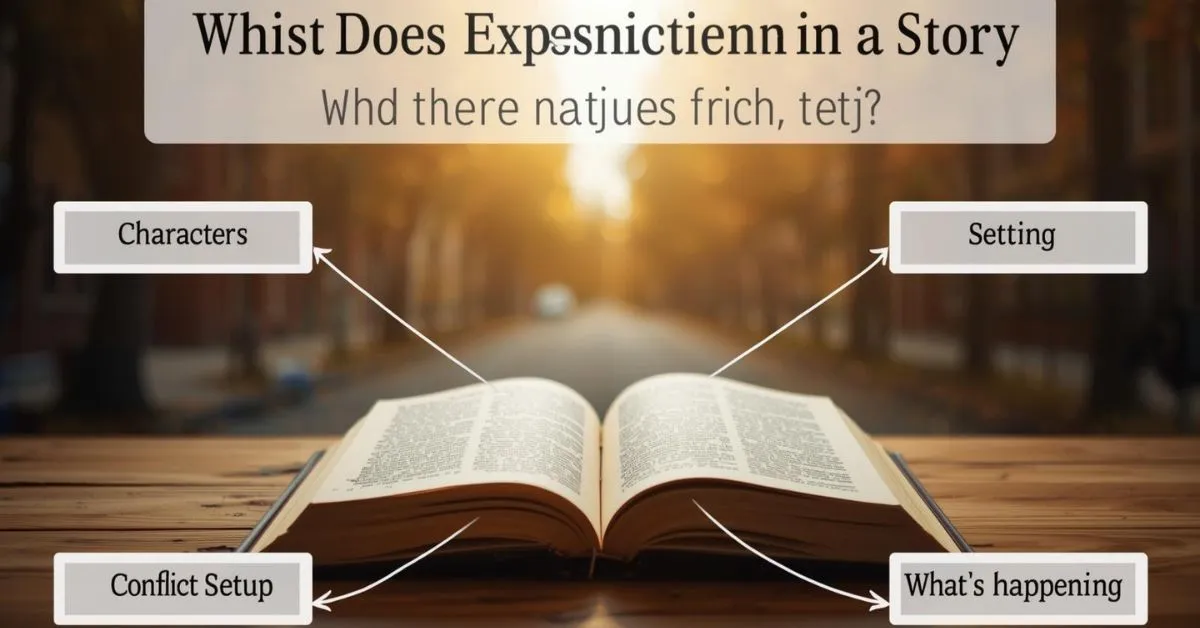
Exposition in a story is the part that gives readers the key background they need to understand what is happening. It usually introduces the setting, main characters, story world, and starting situation, and it may also hint at the conflict before the plot fully moves into rising action.
If you want the simplest possible answer, this is it: exposition is the setup of the story.
It helps readers understand questions like:
- Who is this story about?
- Where and when does it happen?
- What is the character’s situation?
- What kind of conflict or problem is beginning to form?
Without exposition, a story can feel confusing. With too much of it, a story can feel slow. Good exposition gives readers enough context to follow the narrative without burying them in information.
What exposition means in simple words
In plain English, exposition is the information a story gives you so the rest of it makes sense.
That information often includes:
- the setting
- the main characters
- the story world
- the basic situation
- the early tension or conflict
For example, if a novel opens by showing a lonely boy starting his first day at a strict boarding school in winter, that opening may already be doing exposition. It is telling you who matters, where the story happens, what the atmosphere feels like, and what emotional situation the character is in.
Exposition does not always sound like explanation. Sometimes it is woven naturally into action, dialogue, narration, or description.
Exposition as a literary device
Exposition is also considered a literary device because writers use it deliberately to orient the reader.
That means exposition is not just a random block of background details. It serves a purpose. It helps readers:
- enter the story world
- understand the stakes
- recognize important relationships
- prepare for the main conflict
- follow later events more easily
This is why exposition matters in fiction, drama, short stories, novels, and even film scripts. Every story needs some form of setup. The real difference is how skillfully that setup is delivered.
Where exposition fits in plot structure
In traditional plot structure, exposition usually comes near the beginning of the story. It often appears before or around the point where the central conflict begins to grow.
In a basic plot diagram, the order often looks like this:
| Plot Element | Main Job |
|---|---|
| Exposition | Introduces the story world, characters, and starting situation |
| Inciting Incident | Triggers the main change or problem |
| Rising Action | Builds tension through complications and developments |
| Climax | Reaches the turning point or peak conflict |
| Falling Action | Shows what happens after the climax |
| Resolution | Brings the story to its ending |
Exposition and the inciting incident
These two are often confused.
- Exposition gives the reader the setup.
- Inciting incident is the event that pushes the story into motion.
For example, imagine a story about a girl living quietly in a coastal town.
- The opening pages showing her home, her family, and her fear of the ocean are exposition.
- The sudden arrival of a storm warning that changes everything is the inciting incident.
Exposition and rising action
Exposition comes before the story is fully in motion. Rising action begins when the conflict starts growing through new events, obstacles, and decisions.
A useful shortcut is this:
- Exposition explains the starting situation
- Rising action develops the problem
What exposition usually includes
Strong exposition often introduces several things at once.
Setting
Readers usually need to know where and when the story takes place.
That might be:
- a small town during summer
- a futuristic city
- a war-torn kingdom
- a high school hallway before graduation
- a farmhouse during a drought
Setting is part of exposition because it shapes how readers interpret everything else.
Main characters
Exposition often introduces the protagonist and sometimes key side characters too. This does not mean the writer tells us everything immediately. It just means the story begins giving us enough to understand who matters.
Story world
Some stories require more worldbuilding than others. Fantasy, science fiction, historical fiction, and dystopian fiction often need readers to understand social rules, political conditions, traditions, dangers, or unusual systems.
That background is often part of exposition.
Starting situation
This is the character’s “before” state. What is life like before the story’s central change fully takes over?
Early tension
Good exposition often hints that something is off, unstable, or about to change. That hint keeps the opening from feeling flat.
Types of exposition in a story
One major weakness in many articles is that they treat exposition as only one thing. In reality, writers use several methods.
Direct exposition
Direct exposition gives information more openly.
This may happen through:
- narration
- a character explaining something clearly
- a straightforward opening paragraph
- a short summary of important background
Example:
Mara had lived above the bakery with her aunt since her parents died, and everyone in town expected her to inherit the shop.
This is direct because the information is given clearly and efficiently.
Indirect exposition
Indirect exposition gives information through clues rather than plain explanation.
This may happen through:
- character behavior
- setting details
- dialogue
- objects
- habits
- reactions
Example:
Mara counted the bakery’s coins twice before opening, then tucked the rent notice deeper under the flour sack when her aunt came downstairs.
That sentence does not directly explain financial stress, responsibility, or family situation, but it reveals them.
Exposition through dialogue
Characters can reveal important background through conversation, but it has to sound natural.
Good example:
- A brother teasing his sister about never leaving town again after last summer
Weak example:
- “As you know, sister, we have lived here for twelve years since our parents disappeared”
The second version feels fake because real people rarely speak that way.
Exposition through flashback
A flashback can deliver exposition by showing a past event that helps the reader understand the present story.
This works best when the past event genuinely changes how readers interpret the character or current conflict.
Exposition through prologue
Some stories use a prologue to establish important background before the main narrative begins.
This can work well when readers need to understand:
- an earlier event
- a larger conflict
- a secret the main character does not yet know
- a historical or political setup
Exposition in stories that begin in medias res
Some stories begin in medias res, meaning in the middle of action. Even then, exposition still exists. It is just delivered later in pieces.
So exposition does not always mean “slow beginning.” A story can open with urgency and still layer in the necessary context afterward.
Direct vs indirect exposition
This distinction is especially useful for both students and writers.
| Type | How it works | Best use |
|---|---|---|
| Direct exposition | Tells the reader key facts clearly | Fast setup, clarity, efficient openings |
| Indirect exposition | Reveals context through clues | More immersive, natural, emotionally engaging storytelling |
The best stories often use both.
Direct exposition helps readers avoid confusion. Indirect exposition makes the story feel alive.
Exposition vs backstory
These are related, but they are not the same.
- Exposition is the information readers need to understand the story’s current starting point.
- Backstory is information about events that happened before the main timeline.
Backstory can be part of exposition, but exposition is broader.
For example:
- “James lives alone in his grandfather’s house and never opens the locked attic” is exposition.
- “Ten years earlier, his brother vanished in that attic” is backstory.
The second detail may be used as part of the exposition if it helps explain the current situation, but it is still backstory specifically.
Exposition vs introduction
The introduction is simply the way the story begins.
The exposition is the meaningful setup inside that beginning.
An introduction can contain:
- action
- tone
- mystery
- setting
- dialogue
- exposition
So exposition is not the same as the whole opening. It is the part of the opening that helps readers understand the world and situation.
Exposition vs infodump
This is one of the most important distinctions.
Exposition is necessary.
An infodump is usually too much exposition delivered too heavily.
Infodumping often happens when a story pauses to explain more than the reader needs at that moment.
Signs of weak exposition or infodumping
- long paragraphs of background before the story begins
- unnatural dialogue used only to explain facts
- too many names, rules, places, or events introduced at once
- explanations that kill curiosity instead of building it
- repeated information the reader already understands
What good exposition does instead
- gives just enough context
- leaves room for discovery
- feels connected to the scene
- supports tension instead of stopping it
- answers key questions without overexplaining
A simple example of exposition
Here is a clear example:
Every morning before sunrise, Naila unlocked her father’s repair shop and swept dust from the doorway before school. Since his arrest the year before, the shop had been the only thing keeping the family afloat, and the men who came by asking questions never sounded like customers.
This short passage gives readers a lot of useful context:
- who the main character is
- what her daily life looks like
- what kind of setting she is in
- that her father is absent
- that the family is under pressure
- that tension already exists
That is exposition doing its job.
Famous examples of exposition in literature and drama
Well-known works often begin with strong exposition, even when the writer hides it inside style, action, or voice.
Shakespearean drama
In some plays, the audience receives exposition through an opening speech or prologue. This quickly establishes the situation, conflict, or social background before the action unfolds.
Novels with strong opening context
Many novels introduce exposition by showing the main character’s ordinary life before disruption begins. Readers meet the protagonist, learn the environment, sense the mood, and notice an early tension that will matter later.
Fantasy and science fiction
These genres often rely heavily on exposition because readers must understand more than just one character. They may need to understand the world’s rules, dangers, politics, technology, or history.
The challenge is balance. Too little worldbuilding confuses the reader. Too much turns into a lecture.
How to identify exposition in a story
If you are reading for class or writing analysis, use this quick checklist.
Ask yourself:
- What am I learning here about the character, setting, or world?
- Is this information helping me understand the starting situation?
- Does this passage orient me before or during the main conflict?
- Would the story be harder to follow without this detail?
- Is this giving context more than advancing a major complication?
If the answer to several of those is yes, the passage is probably functioning as exposition.
Why exposition matters
Exposition is not just technical structure. It affects how readers feel.
Strong exposition can:
- build curiosity
- create emotional investment
- establish tone
- clarify stakes
- make a story world believable
- help readers follow the conflict
Weak exposition can:
- confuse the reader
- slow the pacing
- make the opening feel flat
- overload the audience with details
- reduce tension by explaining too much too soon
In other words, exposition is one of the things that helps a story feel clear without feeling obvious.
Common mistakes people make about exposition
Thinking exposition is always boring
It is not. Badly delivered exposition is boring. Well-crafted exposition can be tense, vivid, emotional, or mysterious.
Thinking exposition only happens in the first paragraph
It usually begins early, but it can continue in layers throughout opening chapters or scenes.
Thinking exposition means summary
Summary and exposition can overlap, but exposition has a specific job: helping the reader understand the story’s setup.
Thinking backstory and exposition are the same
Backstory is the past. Exposition is the broader setup the reader needs now.
Thinking good writing avoids exposition completely
That is not realistic. Every story needs some setup. The goal is not to remove exposition. The goal is to deliver it well.
Quick-reference comparison table
| Term | Meaning | Main Purpose |
|---|---|---|
| Exposition | The setup of the story | Gives essential context |
| Backstory | Past events before the main timeline | Explains what happened earlier |
| Inciting Incident | The event that starts the main change | Launches the plot |
| Rising Action | Events that build the conflict | Increases tension and complication |
| Infodump | Too much exposition at once | Overexplains and slows the story |
FAQ
What is exposition in simple words?
Exposition is the part of a story that gives readers the background they need to understand the characters, setting, and situation.
Is exposition always at the beginning of a story?
It usually starts early, but it can continue through later scenes as the writer reveals more context.
What is the difference between exposition and the inciting incident?
Exposition sets up the story. The inciting incident is the event that pushes the main plot into motion.
What is the difference between exposition and backstory?
Backstory is what happened before the story’s main timeline. Exposition is the broader setup readers need in order to understand the story now.
Can exposition happen in dialogue?
Yes. Dialogue can deliver exposition naturally, as long as it sounds realistic and not forced.
What is an infodump?
An infodump is a heavy block of explanation that gives too much information at once and often interrupts the flow of the story.
Is exposition a literary device?
Yes. Exposition is a literary device because writers use it intentionally to provide necessary context and guide the reader into the narrative.
Conclusion
Exposition in a story means the setup that helps readers understand the world, characters, and starting situation before the plot fully unfolds. It often includes setting, relationships, background, and early tension, but it does not have to appear as a dull block of explanation.
The easiest way to remember it is this:
Exposition tells you what you need to know so the story can begin making sense.
When it is done well, readers barely notice it. They simply feel grounded, interested, and ready for what comes next.
Click Below To Read About:
What Does Gen Mean on Grindr?Examples, Chats, Profiles
What Does Nuance Mean? Complete Guide and Explanation
What Does Equilateral Mean in Math? Complete Guide With Examples
Hi, I’m Clara Lexis from Meanvia.com. I break down words and expressions so they’re easy to understand and enjoyable to learn. My mission is simple: make language approachable and fun, one word at a time.