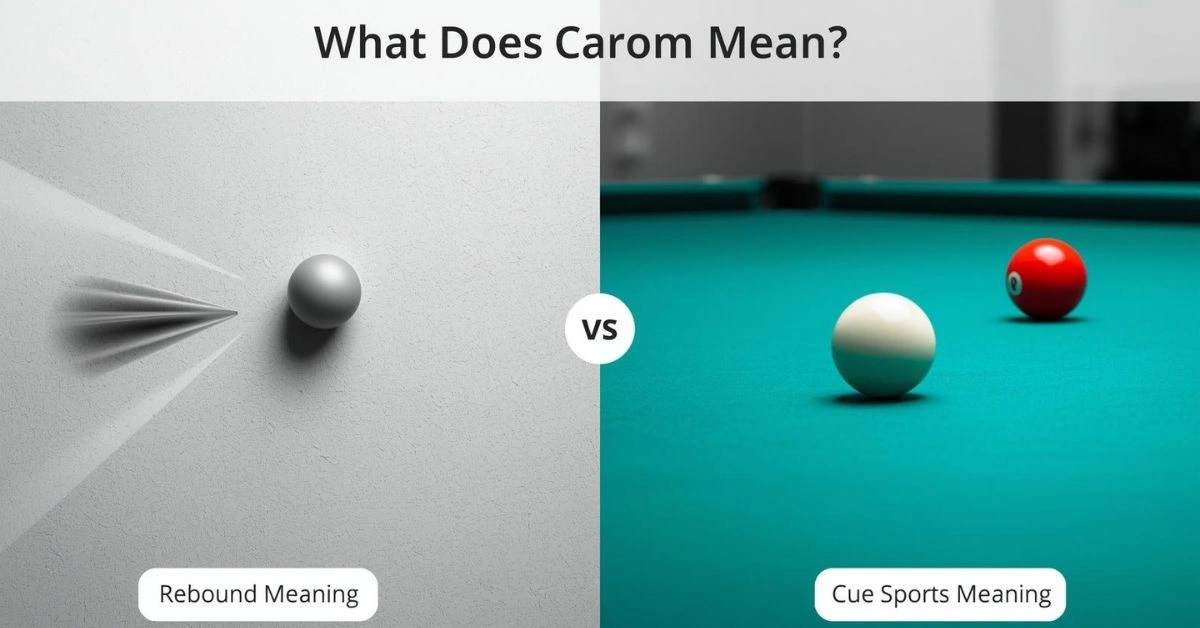
Carom usually means to hit something and bounce away, often at an angle. In billiards, a carom is a shot in which the cue ball contacts two object balls.
In pool, it can also mean a shot where one ball hits another before dropping into a pocket. The word can also be used more figuratively for moving quickly from one place, topic, or direction to another.
If you searched “what does carom mean,” the fastest correct answer is this: carom means rebound, glance off, or ricochet.
The exact meaning depends on context. In everyday English, it usually describes something bouncing off a surface. In cue sports, it has a more specific game meaning.
What does carom mean?
Carom usually means a rebound or bounce after something hits another object. The word is also used in sports, especially carom billiards, where one ball strikes another ball and then changes direction. In everyday English, “carom” can describe an object bouncing off a surface or moving quickly after hitting something. It can be used as a noun or a verb, depending on the sentence. The meaning is easy to understand when you look at what caused the bounce or change in direction.
Context and how people use it:
People use “carom” when talking about bouncing objects, sports, or sudden changes in movement.
It is more common in sports writing and formal English than in casual texting.
Examples:
- “The ball caromed off the wall and rolled across the floor.”
- “His shot caromed off another ball during the game.”
Carom meaning at a glance
Pronunciation: carom is commonly pronounced roughly like KAIR-um or KAR-um, depending on dictionary style and accent. Cambridge lists UK and US pronunciations, and Merriam-Webster shows two pronunciations as well.
Part of speech:
- Noun: a rebound, or a specific billiards/pool shot
- Verb: to strike something and bounce off, often at an angle
Closest simple synonyms: rebound, ricochet, bounce, glance off. Merriam-Webster’s thesaurus lists bounce, rebound, and ricochet among the closest verb synonyms.
The simplest definition of carom
In normal everyday use, carom describes an impact followed by a change of direction.
Something hits a wall, rim, rail, board, or another object, then bounces away instead of stopping. That is why the word often feels close to ricochet or rebound.
Cambridge defines it as hitting something and bouncing back, especially at an angle, and Merriam-Webster defines the noun sense as a rebounding, especially at an angle.
Simple examples
- The ball caromed off the wall.
- The shot caromed off the rim.
- The puck caromed into the corner.
In each case, the basic idea is the same: hit something, then bounce away in a different direction.
What does carom mean in billiards?
In billiards, a carom has a technical meaning. Merriam-Webster defines it as a shot in which the cue ball strikes each of two object balls.
Britannica’s description of carom billiards explains the larger game context: it is played on a table without pockets, uses three balls, and the object is to drive the cue ball into both object balls. Each completed carom counts as a point.
That means in billiards, carom is not just any bounce. It refers to a specific scoring action or shot pattern.
A beginner-friendly way to picture it
You strike the cue ball.
It hits one object ball.
Then it continues and hits the second object ball.
That completed sequence is a carom.
What does carom mean in pool?
This is a meaning many weaker articles skip.
Merriam-Webster lists a pool-specific sense: a carom can also be a shot in which an object ball strikes another ball before falling into a pocket, and it compares that with a combination shot.
So if a reader only learns the billiards definition, they are getting an incomplete answer.
Carom can also be a verb
Yes, carom is commonly used as a verb. Merriam-Webster defines the verb as to strike and rebound or to make a carom, and Oxford defines it as hitting a surface and coming off it fast at a different angle. Merriam-Webster also lists the forms caromed, caroming, and caroms.
Examples:
- The ball caromed off the backboard.
- The car caromed off the guardrail.
- The puck caromed back into play.
This is one reason the word appears so often in sports writing. It is short, vivid, and precise.
Another meaning people often miss
Carom is not limited to sports or games.
Cambridge includes another sense: to move or change in an uncontrolled way between different places, things, or subjects. Merriam-Webster also gives a figurative verb sense: to proceed by or as if by caroms, with an example like “carom from city to city.”
So you might read sentences like:
- The conversation caromed from politics to movies to money.
- The story caroms between comedy and tragedy.
- His work took him caroming from city to city.
In these cases, the word suggests fast, abrupt shifts rather than a literal bounce.
Carom Meaning
Carom means to bounce or rebound after hitting something, especially when an object strikes a surface or another object. The word can also describe a billiards shot in which one ball hits another ball after first contacting a cushion. In everyday English, carom is often used when something suddenly changes direction after making contact. It can work as both a verb and a noun, depending on the sentence.
Context and how people use it:
People use carom when describing objects bouncing or changing direction after hitting something.
It is also common in sports and billiards when explaining a shot that involves a rebound.
Example 1: “The ball caromed off the wall and rolled across the floor.”
Example 2: “The player made a clever carom shot off the cushion.”
Carom Definition
The definition of carom is a rebound or a movement that happens when something strikes another object or surface. As a verb, carom means to bounce, ricochet, or rebound after making contact. As a noun, it can refer to the rebound itself. The term is especially familiar in billiards, where a carom involves one ball contacting another. Understanding this word becomes easier when you think of something hitting a surface and then moving away in a new direction.
Context and how people use it:
In general English, carom describes an object bouncing away after hitting something.
In billiards, it refers to a shot involving contact between balls, often as part of a planned move.
Example 1: “The puck caromed off the boards and reached another player.”
Example 2: “He used the carom to send the billiard ball toward the pocket.”
Carom vs. carrom vs. cannon
This is where a lot of readers get confused.
Carom
Usually means:
- a rebound or ricochet
- a billiards shot
- a pool shot in a specific sense
Carrom
Dictionary.com and Merriam-Webster both note carrom as a spelling variant of carom. In everyday search behavior, though, many people use carrom specifically for the tabletop board game, as in carrom board. That is why the two spellings often get mixed up online.
Cannon
Cambridge and Dictionary.com note that in the UK, the billiards sense is often called cannon. So a British reader may be more familiar with cannon where an American reader expects carom.
Quick comparison table
| Term | Main meaning | Most common context | Easy example |
|---|---|---|---|
| carom | rebound, ricochet, or cue-sport shot | sports, billiards, pool, general English | “The ball caromed off the wall.” |
| carrom | variant spelling of carom; often associated with the board game in practice | searches about carrom board or informal usage | “They were playing carrom.” |
| cannon | UK term for the billiards sense | British cue-sport usage | “He scored a cannon.” |
| ricochet | bounce away after impact | general movement, sports, projectiles | “The shot ricocheted off the post.” |
This comparison reflects standard dictionary treatment of carom/carrom and Cambridge’s note that cannon is the UK term.
What does carom billiards mean?
If you come across carom billiards, that refers to a whole family of cue sports rather than just one casual use of the word.
Britannica describes carom billiards, also called French billiards, as a game played with three balls on a pocketless table, where players score by driving the cue ball into both object balls.
Britannica also notes that three-cushion billiards is a popular version in which the cue ball must contact cushions before striking the second object ball.
This matters because some readers search “what does carom mean” after seeing the word in a cue-sport context. In that case, a plain rebound definition is not enough.
Word origin
Oxford says carom is a late-18th-century abbreviation of carambole, from Spanish carambola, apparently from bola, meaning “ball.” Merriam-Webster also traces it to an alteration and shortening of carambole, from Spanish carambola. Dictionary.com gives a similar origin note.
You do not need the origin to understand the word, but it helps explain why carom, carrom, and carambole feel related.
Common places people see the word
Most readers encounter carom in one of four places:
1. Sports commentary
Announcers use it when a ball or puck bounces off a rim, board, wall, or defender and changes direction. Cambridge’s example about a shot caroming off the back of the rim fits this usage exactly.
2. Billiards or pool
Players and writers use it for a shot type, scoring action, or cue-sport family. Merriam-Webster and Britannica both support this technical use.
3. General writing
Authors sometimes use carom figuratively when ideas, chapters, moods, or events move quickly from one thing to another. Cambridge includes that broader verb sense.
4. Searches for carrom board
Some users type carom when they actually mean carrom, which is why a good article should explain both spellings clearly.
Common mistakes people make
Mistake 1: Thinking carom only means billiards
Not true. It absolutely has a cue-sport meaning, but dictionaries also define it more broadly as a rebound or angled bounce.
Mistake 2: Thinking carom and carrom always mean different things
Not exactly. Dictionaries recognize carrom as a variant spelling, but in real-world usage people often associate carrom more strongly with the tabletop game. That is why context matters.
Mistake 3: Missing the figurative sense
A lot of pages explain only the bounce meaning and skip the broader sense of moving abruptly between places, topics, or directions. Cambridge and Merriam-Webster both show that wider use.
Mistake 4: Assuming it always means the exact same thing in every sport
In general sports language, carom usually means a bounce or deflection. In billiards and pool, it can mean a much more specific shot.
What Most Articles Miss About This Topic
Most articles define carom but do not explain that the real challenge is context.
The word itself is not especially hard. What confuses people is that it appears in:
- everyday English
- sports commentary
- billiards and pool
- figurative writing
- spelling overlap with carrom
- regional variation such as the UK term cannon
Another thing many pages miss is that carom often suggests directional change after impact, not just any contact. That nuance is why it works so well in sports writing. Merriam-Webster’s verb sense “to strike and rebound” and Cambridge’s “bounce back, especially at an angle” both point to that sharper meaning.
The strongest explanation is not just “carom means bounce.” It is:
- in everyday English: bounce off or ricochet
- in billiards: cue ball contacts two object balls
- in pool: one ball strikes another before pocketing
- in figurative writing: move abruptly between places or subjects
- in UK cue-sport language: often called cannon
FAQs
Q: Carom verb meaning
A: Carom as a verb means to bounce or rebound off something, often moving quickly in another direction.
Q: Carrom or carom
A: Carom is the standard English spelling, while carrom usually refers to the board game.
Q: Carom in a sentence
A: The ball caromed off the wall and rolled across the floor.
Q: Carom pronunciation
A: Carom is pronounced with the stress on the first syllable.
Q: What does carom mean in spanish
A: Carom can be translated into Spanish as “rebotar” when it describes bouncing or rebounding.
Q: Carom around meaning
A: Carom around means to bounce or move quickly and unpredictably from one place to another.
Q: What does carom mean urban dictionary
A: On Urban Dictionary, carom may have informal meanings that depend on how the term is used.
Q: Carum meaning in english
A: Carum is generally the name of a plant genus, while “carom” is the English word meaning to rebound or bounce.
Conclusion
If you want the clearest takeaway, it is this: carom usually means a rebound, ricochet, or angled bounce, but in billiards and pool it can mean a more specific shot. The easiest way to understand it is to check the setting.
If the sentence is about motion after impact, think bounce off. If it is about cue sports, think technical shot. And if you see carrom, check whether the writer means the variant spelling or the board game context.
Click Below To Read About:
What Does It Mean to Take Up Your Cross? Complete Explanation
What Does It Mean When You See a Shooting Star? Explained
What Does Exposition Mean in a Story? Complete Guide

Hi, I’m Evan Lexor, the voice behind Meanvia.com. I break down English words, slang, and phrases into clear, simple meanings that actually make sense. From modern internet terms to everyday expressions, my goal is straightforward: help you understand English better, faster, and with confidence, one word at a time.