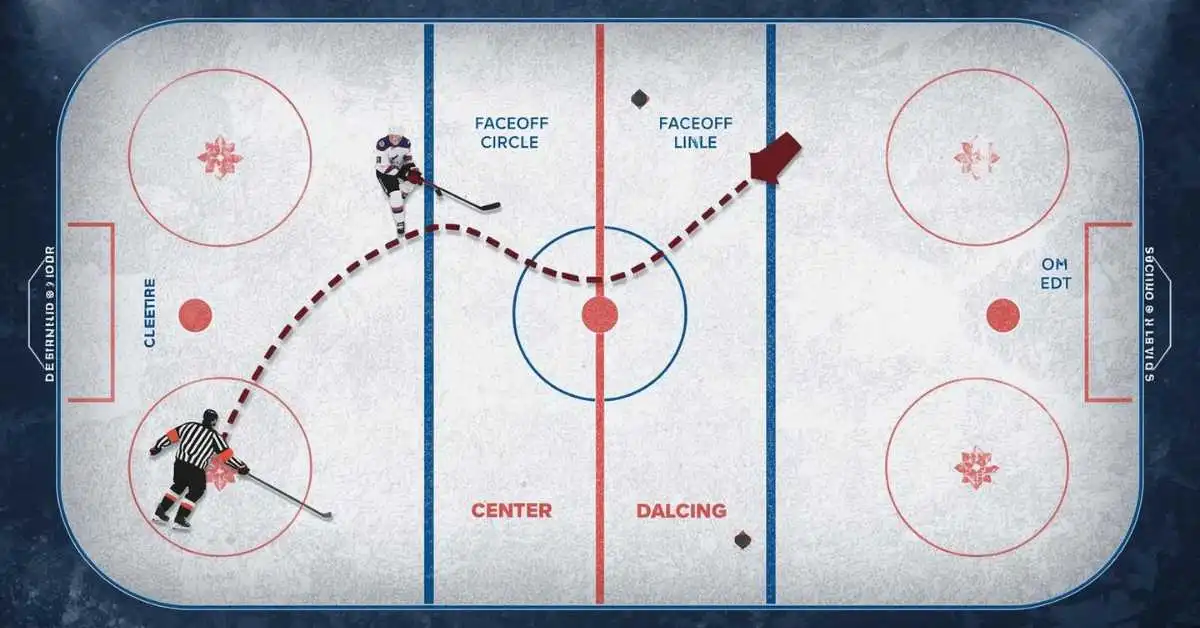
In simple words, icing happens when a team shoots the puck from its own side of center ice all the way past the other team’s goal line, and no one legally plays it first.
If you are new to hockey, icing can seem hard. The whistle blows, play stops, and the puck goes back the other way. So what does icing mean in hockey?
The rule helps stop teams from just firing the puck away to escape pressure. That makes the game fair, faster, and easier to watch. Official NHL, USA Hockey, and IIHF sources all treat icing as a basic game-flow rule, though some details change by league.
This guide answers the main question first, stays on real game situations, and uses official hockey sources. That makes it useful for readers and strong for search.
Quick Answer: What Does Icing Mean in Hockey?
One-line meaning
Icing means a team sends the puck from its own side of the center red line all the way over the other team’s goal line, and play stops if no valid exception applies. In the NHL, officials use hybrid icing. In USA Hockey youth and adult games, officials use automatic icing.
Simple example
A defenseman is stuck in his own end. He slaps the puck hard down the ice. The puck slides past everyone and crosses the far goal line. The whistle blows. That is icing.
Fast rule table
The table below shows the basic parts of an icing call in simple terms. It is based on official NHL and USA Hockey guidance.
| Part of the play | What it means |
|---|---|
| Where the puck starts | On the team’s own side of center ice |
| Where the puck ends | Over the other team’s goal line |
| What usually happens | Play stops for icing |
| Where the faceoff goes | Back in the team’s own end |
| Why the rule exists | To stop easy clears and delay tactics |
How the Icing Rule Works
Step 1: The puck starts from deep in the team’s own half
For icing to happen, the puck must be sent from the team’s own side of center ice. That is why players try to “gain center” first. If they reach center ice before sending it deep, they can avoid icing.
Step 2: The puck crosses the far goal line
In USA Hockey, icing is completed once the puck completely crosses the opponent’s goal line. In other words, it is not enough for the puck to travel far. It must go all the way over the far goal line.
Step 3: The official checks the race or the league rule
League rules matter here. USA Hockey youth and adult games use automatic icing, so the play is dead once the puck fully crosses the goal line in a valid icing situation. The NHL uses hybrid icing, which lets the linesman judge the race to the puck sooner for safety.
Example
Think of it like this. Team A is under pressure. A player flips the puck out from his own end. It crosses the far goal line untouched. In youth hockey, that is usually an instant whistle. In the NHL, the linesman uses hybrid icing rules to judge the play.
What Happens After Icing?
The puck comes back
When icing is called, the faceoff comes back into the offending team’s end. That gives the other team an attacking-zone faceoff and a good chance to keep pressure on.
NHL teams cannot change players after icing
In the NHL, the team that iced the puck is not allowed to change players before the faceoff. That makes icing costly, especially when tired players are stuck on the ice. Official NHL coverage also notes that the other team gets a strong setup after the call.
Example
A tired line ices the puck late in a shift. The whistle blows. Now the players must stay out there in the NHL, and the other team gets an offensive-zone faceoff. That can lead to another shot or even a goal chance.
What changes after icing table
| Before icing | After icing |
|---|---|
| Team is under pressure | Play stops |
| Puck is deep down the ice | Puck returns to offending team’s end |
| Players may hope for relief | NHL offending team stays on the ice |
| Attack is broken for a moment | Other team gets a faceoff chance |
This is one reason coaches tell players not to ice the puck unless they must.
Why Hockey Has the Icing Rule
It stops easy delay plays
The icing rule exists so teams cannot just blast the puck away every time they are in trouble. NHL history records show that rules governing icing were introduced in the 1937-38 season.
It keeps the game moving
Without icing, teams could waste time and remove pressure too easily. The rule pushes players to make smarter passes, exits, and clears. That helps pace, flow, and fairness.
Example
A team is pinned in its own zone. If there were no icing rule, it could just fire the puck away again and again. The icing rule stops that shortcut.
When Icing Is Waved Off
A short-handed team may be allowed to clear it
In the NHL, a short-handed team on the penalty kill can clear the puck down the ice without icing. USA Hockey has age-level differences. For the 2025-26 rule cycle, USA Hockey approved short-handed icing in Youth 15O and above and Girls 16U and above.
The goalie moves to play the puck
If the goalie moves to play the puck, icing can be waved off. USA Hockey casebook guidance says that if the goalkeeper makes any motion to play or feign playing the puck, icing should be waved off.
An opponent could have played the puck
If an opposing player could have played the puck first but did not make a real effort, the official may wave icing off. This keeps players from slowing down on purpose just to get a whistle. IIHF rule text in its published rule materials explains this kind of exception clearly.
The puck touches an opponent
If the puck deflects off an opponent on the way down the ice, icing is usually waved off. IIHF rule text includes this exception, and it matches the general way icing is judged across rulebooks.
Example
A defender races back, but the goalie leaves the crease and reaches for the puck. The official waves icing off. Or the puck clips an opponent’s stick on the way down. Again, no icing.
Called vs waved off table
| Situation | Icing called? |
|---|---|
| Puck goes untouched over goal line from own side of center | Yes |
| Goalie moves to play the puck | No |
| Puck hits an opponent on the way down | No |
| Opponent could have played the puck first | Often no |
| Short-handed NHL team clears the puck | No |
The exact rule can change by league and age group, so coaches and parents should always check the rulebook used in their games.
NHL vs USA Hockey vs International Play
NHL: hybrid icing
The NHL uses hybrid icing. NHL official materials include a video rulebook section for icing and a separate race-to-puck icing clip, showing how the league handles these calls. NHL history pages also note that hybrid icing was introduced for the 2013-14 season.
USA Hockey: automatic icing
USA Hockey says all youth and adult level games use automatic icing. That means play stops as soon as the puck completely crosses the opponent’s goal line in a valid icing play.
International play: check the IIHF book
International events use the IIHF rulebook and situation handbook published on the IIHF rules page. That means fans should check the current IIHF book for event-specific wording and interpretation.
League comparison table
| League or ruleset | Main icing style | Key note |
|---|---|---|
| NHL | Hybrid icing | Linesman judges the race safely |
| USA Hockey youth/adult | Automatic icing | Play stops once puck fully crosses goal line |
| IIHF events | Check current IIHF rulebook | Use the official event rulebook and handbook |
This table keeps the big picture simple: the core idea is the same, but enforcement can change.
Icing vs Offside
They are not the same rule
New fans often mix up icing and offside. Icing is about how far the puck travels from the wrong place. Offside is about players entering the attack zone too early.
Easy way to remember it
A simple memory trick helps:
- Icing = the puck went too far
- Offside = the player went in too early
Example
If a winger skates into the offensive zone before the puck, that is offside. If a defender fires the puck from his own side of center all the way over the far goal line untouched, that is icing.
Comparison table
| Rule | What causes it? | What fans should watch |
|---|---|---|
| Icing | Puck sent too far down the ice | Center line, goal line, whistle |
| Offside | Player enters zone before puck | Blue line, player skates, puck entry |
Why Icing Matters in Real Games
It changes pressure
Icing gives the attacking team a fresh chance in the offensive zone. That matters after a forecheck, which is the pressure a team puts on the puck in the other team’s end.
It changes line changes
In the NHL, players who ice the puck cannot change before the faceoff. So icing can trap tired skaters on the ice.
It changes coaching choices
Sometimes a team still chooses to ice the puck. A coach may prefer an icing whistle over a bad pass in front of the net. But in general, teams want a clean breakout, not an icing call.
Example
Late in a shift, a defenseman is tired. He has two bad choices: force a pass through traffic or send the puck down the ice. He may choose the icing and live with the faceoff. That is why the rule is about both skill and risk.
Simple Tips for New Fans
Watch the center red line
If the puck starts from behind the center red line and flies all the way down, icing may be coming.
Watch the goalie
If the goalie moves to play the puck, the official may wave icing off.
Watch for the raised arm
On a possible icing play, the linesman raises an arm first. Then the official either stops play or waves it off. NHL and other hockey explainers show this as a normal part of the call.
Example
The puck is dumped hard down the ice. The linesman raises an arm. If the goalie stays back and no one touches the puck, the whistle may come next.
FAQ
What does icing mean in hockey in simple words?
It means a team shoots the puck from its own side of center ice all the way over the other team’s goal line, and the play stops if no exception applies.
Is icing a penalty?
No. Icing is not a penalty like tripping or hooking. It is a stoppage of play that sends the puck back for a faceoff.
Can you ice the puck on a penalty kill?
In the NHL, yes. In USA Hockey, it depends on the age group and rule set. USA Hockey approved short-handed icing in Youth 15O and above and Girls 16U and above for the 2025-26 rule cycle.
What is hybrid icing?
Hybrid icing is the NHL-style version that lets the linesman judge the race to the puck earlier for safety, instead of sending players into a dangerous full-speed touch race.
What is the difference between icing and offside?
Icing is about the puck going too far from the wrong place. Offside is about a player entering the attack zone before the puck.
Conclusion
So, what does icing mean in hockey? It means a team sent the puck too far down the ice from its own side of center, and play stops unless an exception cancels the call. The rule keeps the game fair, stops easy delay plays, and creates pressure after the whistle. Once you watch the center red line, the goal line, the goalie, and the linesman’s arm, icing becomes much easier to spot.

Hi, I’m Clara Lexis from Meanvia.com. I break down words and expressions so they’re easy to understand and enjoyable to learn. My mission is simple: make language approachable and fun, one word at a time.