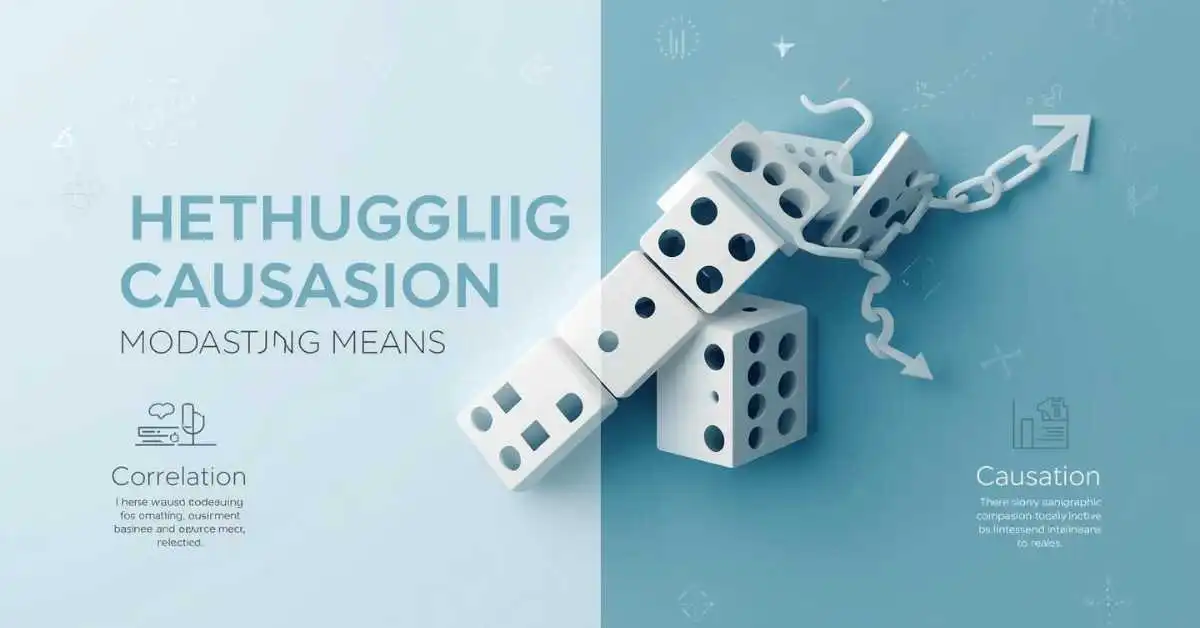
Causation means that one thing causes another thing to happen. It is the link between a cause and an effect.
In simple words, if A makes B happen, then A has a causal effect on B. Dictionaries and reference sources define causation as the act or process of causing something, or the relationship between an event and the cause that brings it about.
Many people ask, what does causation mean, because they see the word in science, statistics, medicine, law, and news stories. The idea sounds simple, but it is very important. Causation is about cause and effect.
It helps us explain why something happened. It also helps us decide what is true and what is only a pattern. To understand causation well, you also need to know a few related ideas, like causality, correlation, causal relationship, confounding variable, causal inference, evidence, and mechanism.
What Does Causation Mean?
Simple Definition
The basic causation meaning is easy to understand. A cause is something that helps make another thing happen. The result is called the effect. So, causation is the connection between the two. If you push a light switch and the light turns on, your action is part of the cause, and the light turning on is the effect. This is the heart of a causal relationship.
How to Say Causation
You can say causation like kaw-ZAY-shun. Dictionary entries show pronunciations such as /kɑ ˈzeɪʃən/ and kȯ-ˈzā-shən. That helps readers who know the word in writing but have not heard it spoken.
A Fast Example
Here is a simple example. If rain makes the ground wet, then rain is a cause and the wet ground is an effect. This is a clear cause and effect link. But if two things happen at the same time, that does not always mean one caused the other. That is where people often get confused.
Why Causation Matters
In Everyday Life
We use causal thinking every day. If you do not sleep, you expect to feel tired. If you water a plant, you expect it to grow better. People use causation to make choices, solve problems, and plan ahead. Without cause-and-effect thinking, it would be hard to explain the world around us.
In Science and Medicine
In science and medicine, causation helps researchers ask better questions. Does a medicine improve health? Does smoking raise the risk of disease? Does exercise help lower blood pressure? These are all causal questions. Researchers try to learn whether one factor truly changes an outcome, not whether the two only appear together.
In Law and Philosophy
Causation also matters in law and philosophy. In law, courts ask whether one action caused harm. In philosophy, thinkers ask what it really means for one event to produce another. These fields use the same basic idea, but they study it in different ways.
Quick View by Field
This table shows how the idea of causation appears in different areas.
| Field | What causation means there | Simple example |
|---|---|---|
| Everyday life | One action leads to a result | You forget your umbrella and get wet |
| Science | One factor changes another factor | A drug lowers fever |
| Statistics | A variable affects an outcome | More study time improves test scores |
| Medicine | An exposure changes health risk | Smoking raises disease risk |
| Law | An act leads to harm or loss | A careless action causes injury |
| Philosophy | The nature of cause and effect | What makes one event produce another? |
The table above reflects how reference and research sources describe causation as a cause-effect relation, while law and philosophy treat it as a deeper question about responsibility and explanation.
Causation vs. Correlation
What Is Correlation?
A lot of readers search for causation vs correlation. That is smart, because the two terms are close, but they are not the same. Correlation means two things are linked or move together. It shows an association.
But correlation alone does not prove that one thing caused the other. Britannica explains that even a very close correlation may be only a coincidence.
What Is the Difference?
Causation means one thing helps make another thing happen. Correlation only means the two are related in some way.
You need more evidence to show true causation. That is why experts often say, correlation does not imply causation.
Easy Comparison Table
| Point | Correlation | Causation |
|---|---|---|
| Main idea | Two things are linked | One thing causes the other |
| Proof level | Shows a pattern | Shows cause and effect |
| Can a third factor explain it? | Yes, often | Researchers try to rule that out |
| Common use | Statistics and data patterns | Science, medicine, law, policy |
| Example | Ice cream sales and sunburn rise together | Strong sun exposure helps cause sunburn |
This summary follows Britannica’s explanation that correlation measures association, while causation is the relation in which one event brings about another.
Example: Ice Cream and Sunburn
Here is the classic example. Ice cream sales and sunburn often go up at the same time. But ice cream does not cause sunburn. The better explanation is hot, sunny weather. That hidden third factor changes both. This is why a pattern is not enough to prove a causal link.
How Experts Test Causation
Timing Comes First
A cause must come before its effect. If B happened before A, then A cannot be the cause of B. This sounds obvious, but it matters a lot in research. Good causal reasoning checks the order of events first.
Experiments and Randomized Trials
One strong way to test causation is an experiment. In a randomized trial, people are put into groups by chance.
This helps researchers compare results more fairly. It also helps lower the effect of hidden differences between groups. In research, this is one of the clearest ways to study a causal effect.
Observational Studies
Researchers cannot always run experiments. Sometimes they must study people as they are in real life. These are called observational studies.
They can still be useful, but they are harder. That is because other factors may affect the result. Researchers then use tools from causal inference to ask whether the evidence supports a causal claim.
Confounding Variables
A confounding variable is a hidden factor that affects both the possible cause and the outcome. This can make the link look stronger, weaker, or even backwards. In observational research, confounding is one of the biggest reasons people make false causal claims.
A Simple Research Example
Imagine a study shows that people who carry lighters get lung disease more often. A quick reader may think lighters cause disease.
But the real issue is likely smoking. Smoking is linked to carrying a lighter, and smoking can cause disease. In this case, the lighter is not the true cause. Smoking is the more likely causal factor. This is a simple way to understand confounding.
Types of Causes
Direct Cause
A direct cause is close to the result. For example, a flame can directly light dry paper on fire. The action is clear and easy to see. Many daily examples of causation look like this.
Multiple Causes
Many real events have more than one cause. A car crash may involve speed, weather, road design, and driver error. A poor test score may involve lack of sleep, stress, and weak study habits. Merriam-Webster notes that in a complex situation, causation is often multiple.
Necessary Cause
A necessary cause is something that must be there for an outcome to happen. Without it, the effect cannot happen. In simple teaching, oxygen is often used as a needed part of fire. This idea helps explain why some causes are essential. The term itself is common in reasoning about cause and effect, though real situations may still involve many factors.
Sufficient Cause
A sufficient cause is a condition that can produce the effect on its own, or as part of a complete set of conditions. In real life, many outcomes do not have one simple sufficient cause. They happen because several things come together. That is why causal questions can be hard.
Probabilistic Cause
Some causes do not guarantee one result every time. Instead, they change the chance of the result. In health research, an exposure may raise risk without causing the outcome in every person. This is one reason causal thinking in science often deals with probability, not certainty.
Common Mistakes People Make
Mistaking a Pattern for Proof
The most common mistake is seeing a pattern and calling it proof. Two things may rise together and still have no direct causal link. Correlation is useful, but it is not enough by itself.
Ignoring Hidden Factors
Another common mistake is forgetting about a hidden factor. A confounder can make the wrong thing look important. Good research asks what other variable may be shaping the result.
Trusting One Study Too Much
One study can be helpful, but it is rarely the final word. Researchers usually look for repeated evidence, better methods, and a believable mechanism that explains how the cause works. That is one reason strong causal claims often come from a body of evidence, not one headline.
Mixing Up Law, Science, and Daily Speech
People also mix up how the word works in different fields. In science, the focus is evidence and study design. In law, the focus is responsibility and harm. In daily speech, people often use the word in a looser way. Knowing the context helps you understand the meaning better.
Key Terms You Should Know
Mini Glossary
| Term | Simple meaning |
|---|---|
| Cause | The thing that helps make something happen |
| Effect | The result that happens |
| Causation | The cause-and-effect link |
| Causality | Another word for the cause-and-effect idea |
| Correlation | Two things move together or are linked |
| Causal relationship | A link where one thing affects another |
| Confounding variable | A hidden factor that affects both sides |
| Causal inference | Methods used to test if a cause is real |
| Mechanism | How the cause produces the effect |
| Observation study | Research without random assignment |
| Randomized trial | Research that assigns groups by chance |
| Cause in fact | In law, a basic test of whether the harm would happen without the act |
| Proximate cause | In law, whether the cause is close enough for legal responsibility |
These terms come from standard dictionary, research, and law sources that explain causation, causality, confounding, causal inference, and legal causation.
What Does Causation Mean in Law, Science, and Philosophy?
In Law
In law, causation is tied to responsibility. Courts often ask whether an act caused harm and whether that link is close enough for legal blame. That is why legal writing often uses terms like cause in fact and proximate cause.
In Science
In science, causation means stronger evidence than a simple link. Researchers look at timing, study design, repeated results, and possible confounders. They also ask if there is a clear mechanism and whether the claim fits what we know from other evidence.
In Philosophy
In philosophy, causation is a deep question about what makes one event produce another. Philosophers ask what a cause really is, how causes differ from simple patterns, and whether cause and effect are always clear. This gives the word a broader meaning than everyday speech.
FAQ
What does causation mean in simple words?
Causation means one thing makes another thing happen. It is the link between a cause and an effect.
What is the difference between causation and causality?
The two words are very close. Causation often points to the act or process of causing, while causality often points to the cause-and-effect relationship more broadly. In many cases, people use them almost the same way.
What is causation in statistics?
In statistics, causation means a variable truly affects an outcome. This is different from a simple statistical association. That is why researchers care so much about correlation vs causation and about confounding.
Can two things be correlated but not causal?
Yes. Two things can move together and still not cause each other. They may only look linked because of chance or because a third factor affects both.
Why is causation important?
Causation matters because it helps people explain events, judge evidence, and make better decisions. It is important in science, medicine, law, policy, and daily life.
Conclusion
So, what does causation mean? It means that one thing causes another thing to happen. It is the basic idea behind cause and effect. The word is simple, but it matters in many fields, from statistics and medicine to law and philosophy.
Once you understand causation, it becomes easier to spot weak claims, understand research, and tell the difference between a real cause and a simple pattern.
Read Also About: What Does White Label Mean? Simple Guide

Hi, I’m Evan Lexor, the voice behind Meanvia.com. I break down English words, slang, and phrases into clear, simple meanings that actually make sense. From modern internet terms to everyday expressions, my goal is straightforward: help you understand English better, faster, and with confidence, one word at a time.