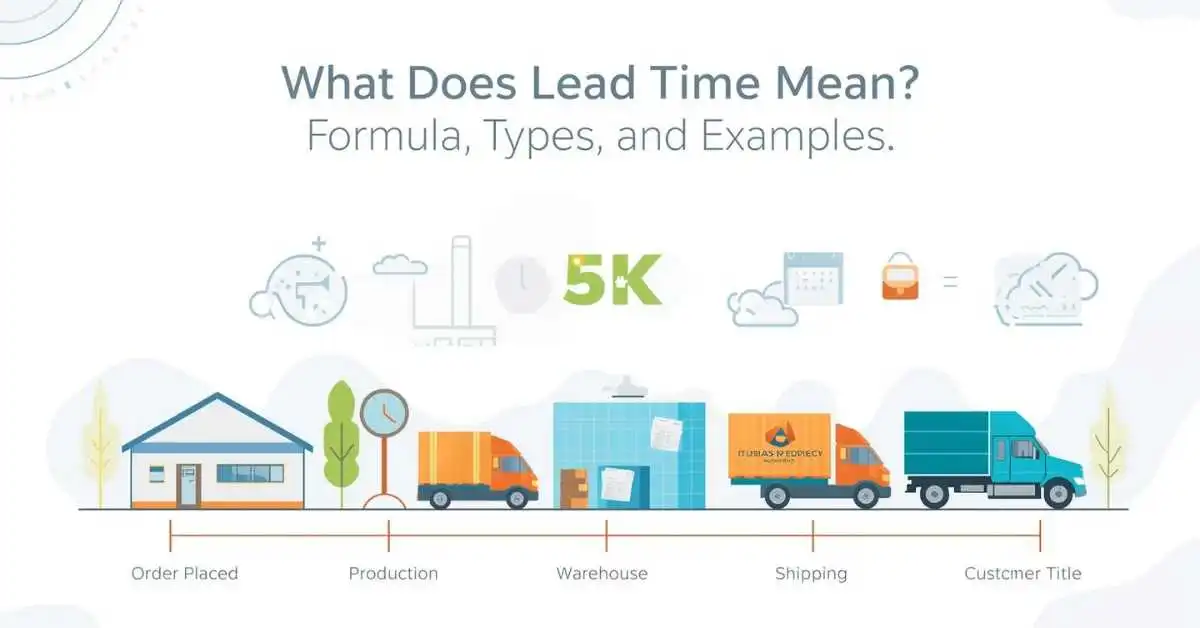
Lead time means the total time between the start of a process and its completion. In business, it usually describes the time from placing an order to receiving the product or service. Lead time can include order processing, procurement, production, packing, shipping, and delivery.
If you have ever seen a product page say “2-week lead time,” it means you will likely wait about two weeks from order placement to delivery or readiness. It affects stock levels, supplier planning, production scheduling, safety stock, reorder points, and delivery promises.
In this guide, you will learn what lead time means, how to calculate it, the main types of lead time, how it differs from cycle time and delivery time, and how businesses reduce long lead times without hurting service quality.
What does lead time mean in simple words
In simple words, lead time is how long you wait from the moment something starts until it finishes.
1. In a customer order, that usually means the time from order date to delivery date.
2. In a factory, it may mean the time from buying raw materials to producing finished goods.
3. In a procurement workflow, it may mean the time from creating a purchase order to receiving materials at the warehouse or manufacturing facility.
A helpful way to remember it is this:
Lead time = total elapsed time, including active work and waiting time.
That waiting time matters. Orders may sit in approval queues, suppliers may need time to source materials, production lines may have setup time, shipments may wait for carrier pickup, and imported goods may face customs delays. All of that can be part of lead time.
Why lead time matters in business
Lead time matters because businesses use it to plan inventory, production, purchasing, and customer commitments. In supply chain planning systems, lead time helps determine when materials are needed and when finished goods can be promised to customers.
Oracle’s manufacturing documentation notes that lead time is used for material requirements planning and available-to-promise calculations.
A long or unstable lead time can create several problems:
- stockouts and missed sales
- excess inventory and higher holding cost
- rushed production and overtime
- poor supplier coordination
- late customer deliveries
- weaker demand forecasting and replenishment decisions
A shorter and more predictable lead time usually improves customer satisfaction and reduces waste in fulfillment and inventory management.
The main types of lead time
Lead time is not just one thing. Different teams track different versions depending on the process they manage.
Order lead time
Order lead time is the time between when a customer places an order and when that customer receives it. This is common in e-commerce, wholesale, retail, and distribution.
Procurement lead time
Procurement lead time is the time required to identify a need, create a purchase requisition, approve it, issue a purchase order, and receive the goods from the supplier. It often includes administrative time inside the business, not only supplier time.
Material lead time
Material lead time is the time between ordering raw materials, components, or supplies and having them ready for production. This is critical in manufacturing because missing components can stop the entire production schedule.
Production lead time
Production lead time is the time it takes to produce an item. In manufacturing systems, this can include queue time, setup time, run time, move time, inspection time, and putaway time.
Shipping or delivery lead time
Shipping lead time is the time from fulfillment to final delivery. It may include picking, packing, carrier handoff, transportation, and last-mile delivery. Shipping time is part of total lead time, but it is not the whole thing.
Customer lead time
Customer lead time is the time the buyer experiences directly, from order placement to order receipt. It is closely tied to customer expectations, promised dates, and service level performance.
Requested, actual, and confirmed lead time
These are useful distinctions that many articles miss:
- Requested lead time is the time between the customer’s order and the date the customer wants the order delivered.
- Actual lead time is the real number of days it took to fulfill the order.
- Confirmed lead time is the number of days between the purchase order date and the supplier’s confirmed delivery date.
Cumulative lead time
Cumulative lead time is the total lead time across multiple linked stages, such as supplier lead time plus internal manufacturing lead time plus delivery lead time. This matters in multi-step supply chains and in MRP or ERP planning.
Lead time formula
The simplest formula is:
Lead Time = Delivery Date − Order Date
That works well when you only need the total elapsed time.
A more detailed version is:
Lead Time = Pre-processing Time + Processing Time + Post-processing Time
This is often more useful because it shows where delays happen. Pre-processing may include order entry, payment check, purchase approval, and supplier communication.
Processing may include procurement, assembly, production, or picking. Post-processing may include packing, dispatch, shipping, customs, and final delivery.
Lead time calculation examples
Example 1: E-commerce order
A customer places an order on Monday.
- Order review and payment verification: 1 day
- Picking and packing: 1 day
- Carrier transport: 3 days
Total lead time = 5 days
Even though shipping took 3 days, the total lead time is 5 days because internal fulfillment time is included.
Example 2: Manufacturing order
A furniture company receives a sales order for 100 desks.
- Purchase raw materials from supplier: 8 days
- Queue and setup time: 2 days
- Production run time: 4 days
- Inspection and putaway: 1 day
- Delivery to customer: 3 days
Total lead time = 18 days
This example shows why manufacturers track more than transport time. Supplier availability, work-in-progress scheduling, inspection, and warehouse movement all affect the final timeline.
Example 3: Procurement lead time
A company needs packaging material.
- Create request and approval: 2 days
- Supplier order processing: 4 days
- Shipping and receipt: 5 days
Total procurement lead time = 11 days
This number helps buyers set reorder points before stock gets too low.
Lead time vs cycle time vs delivery time vs turnaround time
These terms are often confused, but they are not the same.
| Term | What it measures | Includes waiting time? | Best question it answers |
|---|---|---|---|
| Lead time | Total time from request or order to completion | Yes | How long does the customer wait? |
| Cycle time | Time spent actively working once the task starts | Usually no | How long does the actual work take? |
| Delivery time | Time from shipment or dispatch to final arrival | Usually no | How long does transport take? |
| Turnaround time | Time to complete a job or request after it is received | Often yes, but depends on context | How fast was the request completed? |
Wrike explains that cycle time measures the time needed to make the product or complete the work, while lead time measures the full time between customer order and fulfillment.
Shopify’s documentation also separates processing time from delivery dates, which is why delivery time should not be treated as the full lead time.
Does lead time include weekends?
It depends on how the business measures it. Some companies use calendar days. Others use business days or workdays.
Oracle’s manufacturing documentation refers to workdays in manufacturing lead time, which shows that internal planning often uses working-day logic rather than simple calendar-day counting.
A product page, however, may show customers a lead time in business days. The important thing is consistency and clarity.
If a store says “lead time: 10 business days,” that usually excludes weekends and sometimes public holidays. If a supplier says “10 days” without clarification, the buyer should confirm whether that means calendar days or workdays.
This small detail can affect purchase planning, ATP dates, replenishment timing, and promised delivery dates.
What increases lead time?
Long lead times usually come from hidden delays between stages. Common causes include:
- slow purchase approvals
- poor supplier reliability
- raw material shortages
- long queue time before production
- setup delays on machines or work centers
- rework and failed quality checks
- low warehouse visibility
- customs or port delays
- carrier issues and last-mile disruptions
- manual data entry across ERP, WMS, or procurement systems
These problems increase lead time variability, which is often just as harmful as a long average lead time because unstable timelines make forecasting and inventory planning much harder.
How businesses reduce lead time
The best way to reduce lead time is to break it into stages, measure each stage, and improve the slowest one first.
Companies often cut lead time by improving supplier communication, simplifying approvals, reducing queue time, automating order workflows, and improving stock visibility.
Practical ways to reduce lead time include:
- choose reliable suppliers with consistent fill rates
- keep accurate inventory data and SKU-level demand forecasts
- use safety stock for critical components
- set smarter reorder points based on real supplier lead time
- reduce setup time and bottlenecks in production
- automate purchase orders and order routing in ERP or MRP systems
- place inventory closer to customers through the right warehouse or fulfillment center
- track actual lead time, not only promised lead time
Shorter lead times help businesses respond faster to demand, avoid stockouts, and improve order fulfillment performance.
Common mistakes people make with lead time
Confusing lead time with shipping time
Shipping is only one part of lead time. If you measure only transit time, you miss internal order processing, procurement, production, and packing time.
Using one average for every product
Different SKUs, suppliers, carriers, and production routes often have different lead times. A single average can hide serious delays on specific items or suppliers.
Ignoring variability
A supplier that delivers in 7 days one month and 18 days the next creates planning risk. Businesses should measure average lead time and lead time consistency.
Forgetting internal admin time
Purchase approvals, order entry, payment checks, and warehouse release steps can add days before production or shipping even starts.
FAQs
What does lead time mean in business?
In business, lead time usually means the total time from placing an order to receiving the goods or completing the service. It can include purchasing, production, packing, shipping, and delivery.
What does a 2-week lead time mean?
It means the item or service is expected to be ready, shipped, or delivered about two weeks after the order is placed, depending on how the business defines its process.
Does lead time include shipping?
Yes, shipping is often part of lead time, but lead time usually also includes internal steps such as order processing, procurement, production, and packing.
What is the difference between lead time and cycle time?
Lead time is the full elapsed time from request to completion. Cycle time is the time spent actively doing the work once it has started. Lead time is usually longer because it includes waiting time.
What is lead time in manufacturing?
Manufacturing lead time is the total work time needed to complete a product, often including queue time, setup time, run time, move time, inspection time, and putaway time.
Why is lead time important in inventory management?
Lead time affects when a business should reorder stock and how much safety stock it may need. Longer or less predictable lead times increase the risk of stockouts and missed deliveries.
Does lead time include weekends?
Sometimes yes, sometimes no. Some businesses use calendar days, while others use business days or workdays. The key is to define the method clearly.
How can a company reduce lead time?
A company can reduce lead time by improving supplier performance, automating workflows, reducing bottlenecks, using better forecasting, and measuring each stage of the process separately.
Practical takeaway
So, what does lead time mean? It means the full waiting time from start to finish. In business, that often means the time from order placement to delivery, but the same concept also applies to procurement, manufacturing, logistics, and even service operations.
Once you break lead time into sourcing, processing, production, fulfillment, and delivery stages, it becomes much easier to improve. Businesses that manage lead time well usually make better promises, hold smarter inventory levels, and serve customers more reliably.
Read Also About: What Does a Yellow Curb Mean? Parking Rules Explained

Hi, I’m Clara Lexis from Meanvia.com. I break down words and expressions so they’re easy to understand and enjoyable to learn. My mission is simple: make language approachable and fun, one word at a time.