Montessori means an educational method created by Dr. Maria Montessori. It is based on child development, hands-on learning, mixed-age classrooms, trained teachers who act as guides, and a prepared environment that helps children build independence, concentration, and practical skills at their own pace.
Many parents first hear the word Montessori when searching for preschool, kindergarten, or child-led education. Some think Montessori is just a school style. Others think it means wooden toys, tidy shelves, or a calm classroom.
That is only a small part of the picture. Montessori is a full educational approach with its own philosophy, materials, classroom design, and teacher training. Once you understand the meaning behind the name, the method makes much more sense.
What does Montessori mean in simple words?
In simple language, Montessori means a way of teaching that helps children learn through purposeful activity instead of constant adult direction. Children work with carefully designed materials, choose meaningful tasks, and develop skills through movement, repetition, and concentration.
The adult is important, but the adult is not the center of every moment. In Montessori, the environment and the child’s developmental needs shape the learning process.
Montessori is not just a curriculum. It is also not only a classroom look. It is a method grounded in ideas such as the prepared environment, freedom within limits, auto-education, control of error, mixed-age grouping, and respect for the child as an active learner. Those ideas are what give the word Montessori its real meaning.
Why is it called Montessori?
Montessori is named after Dr. Maria Montessori, the Italian educator and physician who developed the method. Britannica notes that she graduated in medicine in 1896 and, in 1907, opened the first Casa dei Bambini, or Children’s House, in Rome.
There she applied her ideas with children ages three to six and developed the approach that later spread around the world.
That history matters because the word Montessori is not a brand name invented later. It refers directly to Maria Montessori’s educational philosophy and the system that grew from her observations of how children learn best.
When people ask, “What does Montessori mean in education?” the most accurate answer is: it means education based on Maria Montessori’s method of human development.
The core ideas behind Montessori
To understand what Montessori means, you need to know the principles behind the method.
1. The prepared environment
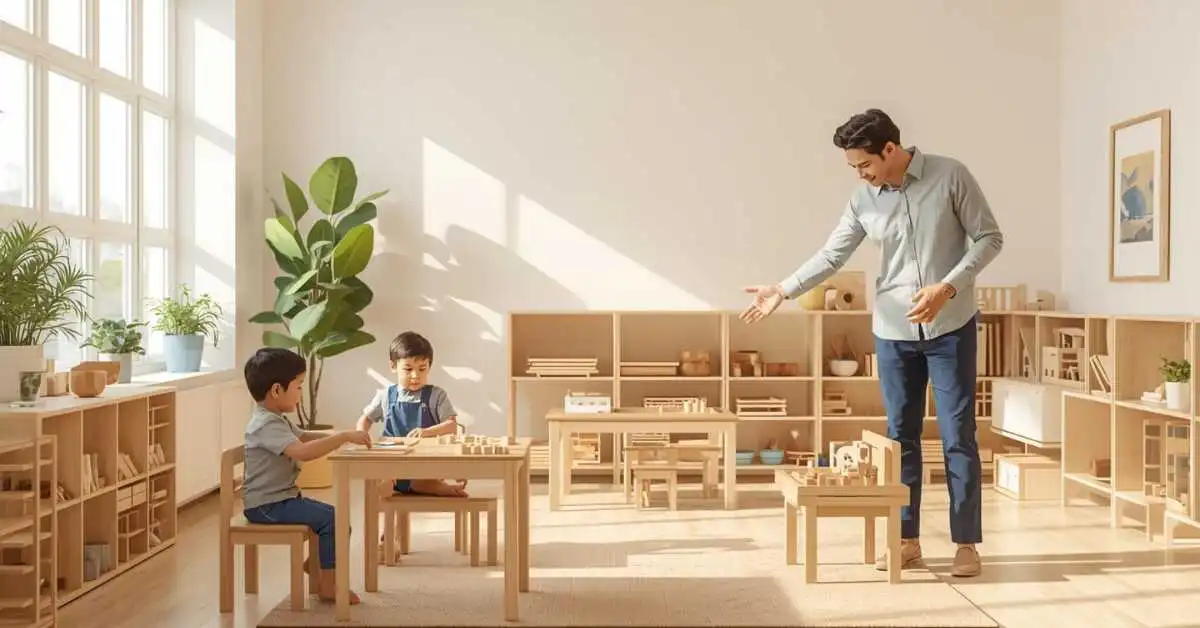
A Montessori classroom is a prepared environment. That means it is intentionally designed for the child, not just for adult convenience. Furniture is child-sized. Materials are visible and reachable.
The room is orderly, calm, and built to support independence. Children can choose work, carry it out, return it, and move on with minimal adult interruption.
2. The absorbent mind and sensitive periods
AMI’s glossary describes the absorbent mind as the young child’s ability to take in knowledge quickly and effortlessly, especially from birth to age six.
Montessori also identified sensitive periods, which are times when children are especially ready to develop certain skills, such as language, order, movement, and social behavior. A good Montessori environment matches lessons and materials to those developmental windows.
3. Freedom within limits
One of the most misunderstood Montessori ideas is freedom within limits. Children are not left to do anything they want. They are given meaningful choice inside clear classroom ground rules.
They may choose work, repeat activities, move carefully, and work independently, but they are also expected to respect others, the materials, and the environment.
4. Auto-education and control of error
Montessori believed children learn deeply when they can discover and correct things for themselves.
AMI describes control of error as built-in feedback in the materials that helps a child notice mistakes without depending on constant adult correction. That supports auto-education, confidence, self-motivation, and real understanding.
5. Repetition, concentration, and normalization
Montessori classrooms give children time to repeat work. That repetition is not wasted time. It helps build coordination, will, concentration, and mastery. AMS describes uninterrupted work periods as essential because they allow children to choose, engage, clean up, and continue without constant breaks.
Montessori linked this kind of deep, self-chosen engagement to normalization, a state marked by love of work, concentration, self-discipline, and joy in accomplishment.
What does a Montessori classroom actually look like?
A real Montessori classroom is active, but it does not feel chaotic. You may see one child washing a table, another working with Knobbed Cylinders, another building the Pink Tower, and another using Sandpaper Letters or the Movable Alphabet.
The teacher, often called a guide or historically a directress, moves carefully, observes closely, and gives short lessons when the child is ready.
The five main curriculum areas
In an Early Childhood Montessori classroom, AMS says children typically work across five core areas:
- Practical Life
- Sensorial
- Language
- Math
- Cultural Studies
Practical Life includes dressing, pouring, cleaning, preparing snacks, setting the table, flower arranging, and caring for the classroom. It also includes social routines such as saying please and thank you, waiting a turn, and offering help. These activities build independence, movement, coordination, and what Montessori calls grace and courtesy.
Sensorial work helps children refine the senses and classify the world. Materials such as the Pink Tower, Red Rods, and sound, touch, or smell activities help children notice differences in size, length, texture, sound, and pattern. This work prepares the mind for later math, language, and scientific thinking.
Language materials support vocabulary, sound awareness, writing, and reading. Montessori classrooms often introduce writing before fluent reading through tactile and hands-on materials like Sandpaper Letters, the Sand Tray, Metal Insets, and the Movable Alphabet.
Math materials help children move from concrete to abstract understanding. Children first handle real quantities and patterns, then connect them to symbols and operations. AMS notes that Montessori math materials support number sense, place value, and the base-10 system through hands-on exploration rather than memorization alone.
Cultural Studies includes geography, history, science, art, music, and the study of the wider world. In later Montessori levels, this expands into broader ideas such as cosmic education, which helps children see how knowledge connects across nature, history, geography, science, and human life.
Montessori vs traditional school
A quick comparison makes the meaning of Montessori easier to see.
| Aspect | Montessori | Traditional classroom |
|---|---|---|
| Teacher role | Guide, observer, lesson giver | Main instructor leading whole group |
| Classroom ages | Mixed-age, often 3-year span | Same-age grade levels |
| Learning pace | Individualized | More group-paced |
| Materials | Hands-on, sequenced, self-correcting | Often books, worksheets, shared instruction |
| Work flow | Long uninterrupted work periods | Frequent transitions and teacher-led blocks |
| Student choice | Freedom within limits | Usually less choice |
| Learning style | Concrete to abstract, movement-based | Often more seat-based and abstract earlier |
These differences reflect major Montessori characteristics recognized by AMS, including trained teachers, multi-age classrooms, specially designed materials, student-directed work, and uninterrupted work periods.
How to tell if a school is truly Montessori
This is one of the most useful questions for parents because not every school using the word Montessori follows the method closely. AMS states clearly that any school can call itself Montessori, even if it does not fully reflect Montessori philosophy and practice.
A stronger way to judge a school is to look for these signs:
Trained Montessori teachers
Teachers should have Montessori credentials for the level they teach. AMS recognizes credentials from AMS, AMI, and accredited Montessori teacher education programs.
Mixed-age classrooms
A true Montessori class usually groups children across a three-year age span, such as 2.5 to 6, 6 to 9, or 9 to 12. This supports observation, mentorship, leadership, and less comparison between same-age peers.
Authentic Montessori materials
Look for materials designed for hands-on, sequenced, self-correcting learning. One clue is that there is often just one of each material, which helps children practice patience and self-control.
Long work periods
A Montessori classroom should not feel chopped into short, adult-controlled segments. Uninterrupted work periods are a core part of the method because they support concentration and independence.
Observation-led teaching
In Montessori, the guide observes the child carefully, then introduces the right lesson at the right time. That is very different from teaching the same lesson to the entire class at once all day long.
Common myths about Montessori
Myth 1: Montessori means no rules
False. Montessori offers freedom, but inside clear limits. Children are expected to follow ground rules, use materials respectfully, and act with care toward others and the environment.
Myth 2: Montessori is just wooden toys and pretty shelves
False. Montessori materials matter, but the deeper meaning is developmental. The method depends on observation, independence, sequence, movement, concentration, and a prepared environment. The look of the room is not the whole method.
Myth 3: Montessori is only for preschool
False. AMS lists Montessori program levels from Infant and Toddler through Early Childhood, Elementary, and Secondary. The method grows with the child and connects to larger developmental ideas such as the planes of development.
Myth 4: Montessori is not academic
False. Montessori is hands-on, but that does not mean it lacks rigor. The method builds toward strong academic understanding through concrete materials, repetition, self-correction, and increasingly abstract thinking.
What does Montessori mean for parents?
For parents, Montessori usually means choosing an education model that values independence, order, movement, respect, and active learning.
It often appeals to families who want children to do real tasks, make age-appropriate choices, and develop confidence through meaningful work instead of constant rewards, pressure, or passive instruction.
This is not a promise that Montessori is perfect for every child or every school. The quality of implementation matters. But the core idea is consistent: help the child become capable, focused, and responsible.
A simple way to use Montessori ideas at home is to make daily life more child-accessible. Put items where children can reach them. Offer real tasks. Slow down demonstrations. Let children practice. Keep routines clear.
Support independence without turning every moment into a lesson. Those small changes reflect the deeper meaning of Montessori better than buying a set of themed toys.
FAQ
What does Montessori mean in education?
It means an educational method developed by Dr. Maria Montessori that uses child development, hands-on materials, prepared environments, and guided independence as the basis for learning.
Is Montessori a curriculum or a teaching method?
It is best understood as a teaching method and educational philosophy, not just a curriculum. It includes classroom design, teacher role, materials, work periods, and developmental theory.
Why do Montessori classrooms mix ages?
Mixed-age classrooms help younger children learn through observation and help older children strengthen knowledge through leadership and mentoring.
What are Montessori materials?
They are specially designed hands-on materials that isolate skills, move from concrete to abstract learning, and often include self-correction so children can learn independently.
What is the role of the Montessori teacher?
The Montessori teacher, often called a guide, observes the child, prepares the environment, introduces lessons at the right time, and supports independent growth rather than dominating the classroom.
Does Montessori mean children can do whatever they want?
No. Montessori gives children freedom within limits. They have choice, but they also follow clear expectations and use materials and space respectfully.
Can Montessori be used at home?
Yes. Parents can use Montessori ideas at home by making spaces accessible, teaching practical life skills, offering limited choices, and encouraging independence through daily routines.
Conclusion
So, what does Montessori mean? It means far more than a school label. Montessori is an educational method created by Maria Montessori that centers on child development, hands-on learning, mixed-age community, trained guides, and prepared environments that support independence and concentration.
For parents, the best next step is not just learning the definition. It is learning how to spot authentic Montessori practice in real classrooms. From here, a smart next read would be [Montessori vs Traditional School] or [How to Choose a Montessori School].
Read Also About: What Does Misogyny Mean? Simple Definition and Examples

Hi, I’m Clara Lexis from Meanvia.com. I break down words and expressions so they’re easy to understand and enjoyable to learn. My mission is simple: make language approachable and fun, one word at a time.