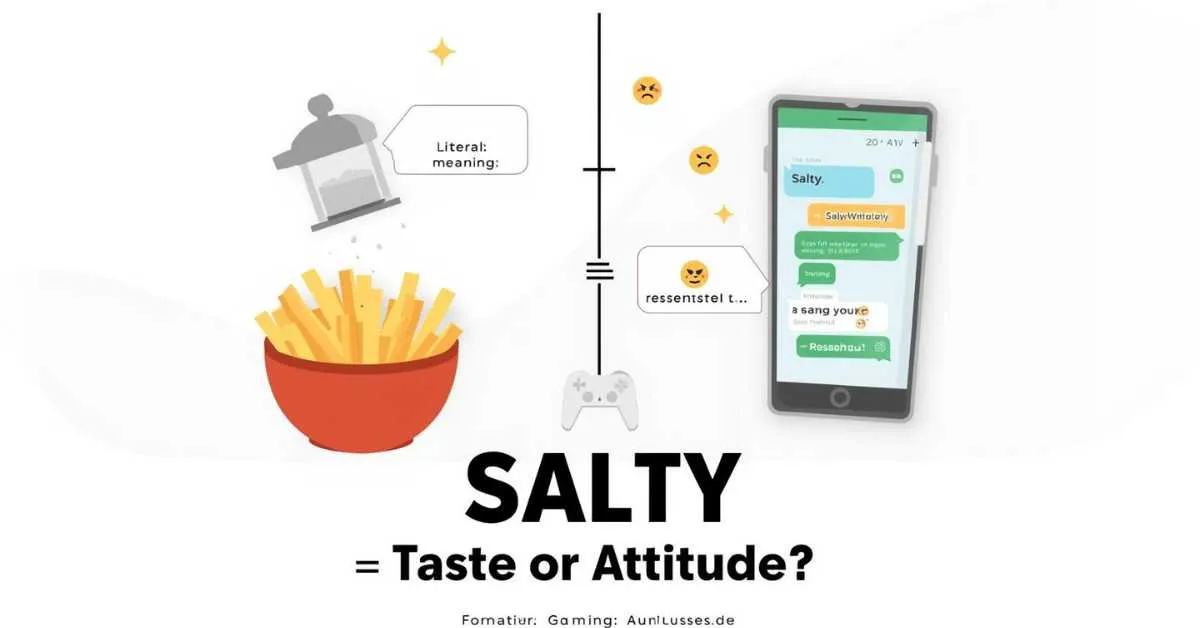
Salty means someone is upset or annoyed and shows it with attitude; or it can mean something tastes like salt. You’ve probably seen it in a TikTok comment, an Instagram reply, or a heated chat where one person can’t let a small thing go.
Maybe they lost a game, got teased, or felt ignored. Instead of moving on, they answer with sarcasm, short messages, or complaints. That’s when people say, “Why are you so salty?”
In this guide, you’ll learn the full meaning of salty in simple words. We’ll cover salty in slang, salty in text/chat, and salty in gaming.
You’ll also see clear examples of salty behavior, plus the literal meaning for food and the ocean. By the end, you’ll know when “salty” is just a joke, and when it’s crossing the line
Definition Box (Fast Answer)
Salty (slang) means annoyed or resentful, often after losing or being teased.
- Slang: upset + attitude (sarcasm, complaints, cold replies)
- Text/Chat: messages sound offended or passive-aggressive
- Gaming: bad sportsmanship after a loss (blaming, arguing, raging)
- Literal: tastes like salt / sea-like (ocean water, salty air)
Salty meaning in slang
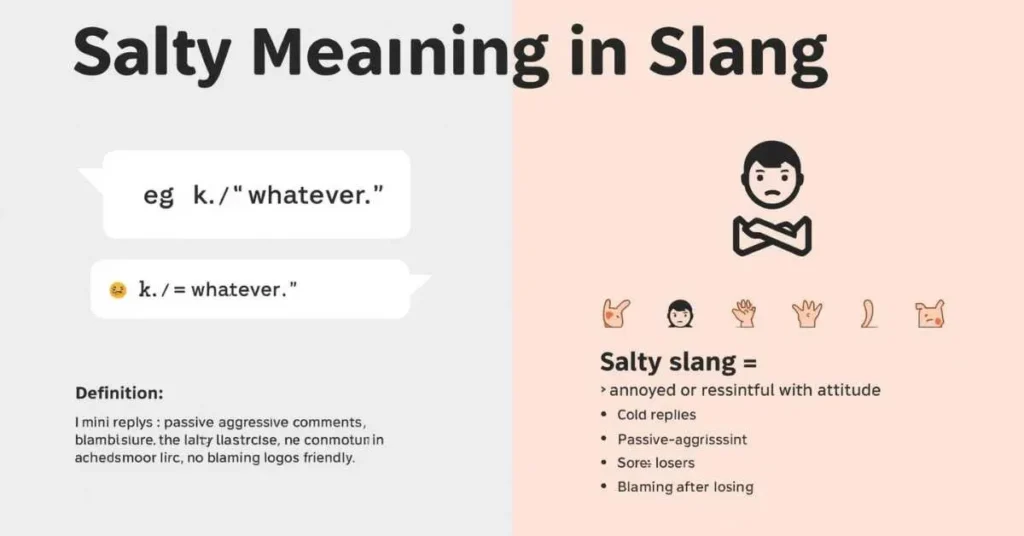
In modern slang, salty describes someone who is bothered and shows it. It’s usually not calm disappointment. It’s frustration with attitude, often sarcasm, complaining, or a “sore loser” vibe.
You might hear it after:
- a loss (game, sports, argument)
- rejection (“no” or getting ignored)
- embarrassment (getting called out)
- being left out (not invited, not chosen)
- feeling something was unfair
A simple memory trick:
Salty = emotional response + frustration + attitude.
Cambridge Dictionary supports this idea by defining the informal sense as “annoyed or upset.”
Examples of salty behavior
Here are clear, real-life signs that someone is being salty:
- Excuses after losing: “You got lucky.” “Lag.” “That didn’t count.”
- Cold replies: “k.” “whatever.” “sure.”
- Passive-aggressive comments: “Must be nice.”
- Refusing to give credit: “You’re not even good.”
- Dragging it out: bringing up the same moment again and again
- Mood-killing negativity: turning a fun chat into an argument
These behaviors are why “salty” is such a useful word online. It describes the vibe in one punchy label.
Salty meaning in text/chat
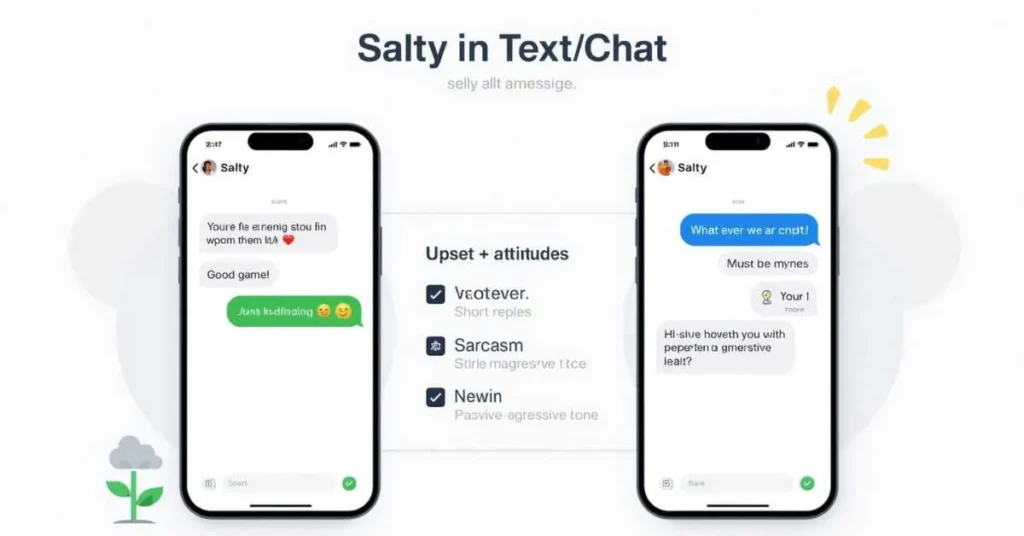
In text/chat, “salty” means the message tone feels offended, bitter, or passive-aggressive. It’s often used when someone’s reply looks sharp or resentful.
Common phrases:
- “Why are you salty?”
- “Don’t be salty.”
- “That was a salty reply.”
- “He’s salty about it.”
Text/chat examples:
- “Why are you salty? I was joking.”
- “That reply is salty for no reason.”
- “Don’t be salty, we can try again.”
- “She’s salty because I didn’t agree.”
This is also where people confuse salty with triggered. “Triggered” is usually a stronger reaction. It means someone gets upset very fast. “Salty” is often less intense, but it can last longer.
A salty person may stay annoyed and show attitude, like sarcasm or rude replies. We will compare both more clearly below.
Why people say salty online (TikTok, Instagram, X, Reddit)
People say “salty” online because it fits what happens in comments. People share fast opinions. They start fast fights. And they react fast with feelings.
On TikTok and Instagram, people often say “salty” in the comments. It happens a lot under posts that start arguments. For example, it can be a new trend, a sports video, relationship advice, or a strong opinion (“hot take”).
On X, it often describes angry quote-posts or bitter replies. On Reddit, it can describe an entire thread that turns into complaints and resentment.
Online examples you’ll see:
- “The comments are salty today.”
- “Why are people so salty about this?”
- “That’s a salty take.”
- “He posted a salty caption after the results.”
This slang meaning is widely recognized in modern usage. Dictionary.com says “salty” (slang) means irritated, angry, or upset. It is often used when someone loses or feels treated badly. Dictionary.com also says this slang word came from Black English.
Salty meaning in gaming (League of Legends, Fortnite, Call of Duty)
In gaming culture, “salty” usually means someone can’t take the loss well. That’s why it’s common in competitive communities like League of Legends, Fortnite, and Call of Duty.
A player may be called salty if they:
- blame teammates nonstop
- argue about rules and fairness
- spam angry chat messages
- accuse others of cheating without proof
- refuse to move on after the match
Gaming examples:
- “He got salty after that League of Legends match.
- “In Call of Duty, some players get salty and start blaming everyone.”
In short: salty in gaming = frustration after an outcome, shown with negativity.
Literal meanings: food, ocean, and “salty language”
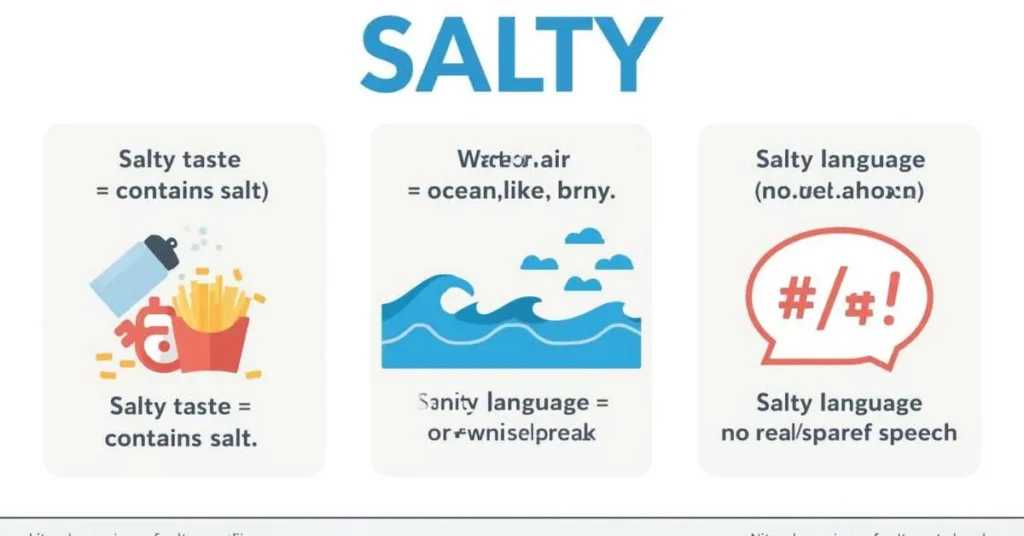
Not all uses are slang. Merriam-Webster says salty means made with salt or tasting like salt. It also uses salty to talk about the sea, like salty water and salty air.
1.Salty taste (food)
- “These fries are too salty.”
- “I like salty snacks like chips and nuts.”
2.Salty water and salty air
- “The ocean is salty.”
- “The salty air at the beach feels fresh.”
3. Salty language”
“Salty language” means earthy, crude, or profane speech, a recognized sense in Merriam-Webster.
Example: “He used salty language during the argument.”
Origin of salty (slang)
The slang meaning of salty comes from older uses of the word and how people used it in communities over time. Merriam-Webster links “salty” to sailors and rough talk. It also shares an early phrase, “jumping salty,” which meant getting angry easily. This phrase showed up in Black newspaper writing in the 1930s.
Dictionary.com also says that “salty” as slang, meaning irritated or resentful. (often after losing or being disrespected), started in and became popular through Black English.
Some people explain “salty” with the idea of “salty tears.” When someone is upset, they might cry, and tears are salty. So people use the word to describe an upset mood and sharp replies. Later, the internet helped the slang spread fast, especially in gaming chats and on social media.
The Oxford English Dictionary says the word “salty” is very old. It goes back to Middle English, with early examples from around the 1400s.
Salty vs triggered vs petty
| Word | What it usually means | Quick example |
|---|---|---|
| Salty | annoyed/resentful with attitude | “He’s salty about losing.” |
| Triggered | strong emotional response; easily set off | “That topic triggered him.” |
| Petty | small, immature actions for payback | “He unfollowed her to be petty.” |
Key point: salty is a mood + vibe, petty is an action,is a style, and triggered is usually a stronger reaction than salty.
Is “salty” playful or rude?
Use this quick guide:
It’s usually playful when:
- it’s between friends
- the issue is small (a joke, a game)
- your tone is light (smile, emojis, friendly vibe)
It can be rude when:
- you use it to dismiss real feelings
- you say it publicly to embarrass someone
- you repeat it to provoke them
- the person is already hurt or stressed
If you want a safer word in serious settings, use: upset, frustrated, irritated, disappointed.
Copy-paste replies to salty comments (10–15 options)
Calm (ends drama)
- “All good, no hard feelings.”
- “I hear you. Let’s move on.”
- “I didn’t mean it that way.”
- “Fair point. Let’s reset.”
- “No stress, next time.”
Light humor (only if the vibe is friendly)
- “Okay okay, no salt today 😄”
- “Truce? 🤝”
- “My bad, didn’t mean to poke you.”
- “Let’s not turn this into a salt festival 😂”
- “Alright, I’ll chill.”
Boundaries (when it’s getting disrespectful)
- “Let’s keep it respectful.”
- “I’m not arguing. We can talk when calm.”
- “Please don’t speak to me like that.”
- “If you want to discuss it, I’m here; but not like this.”
- “I’m stepping away from this chat.”
Salty meaning in Urdu & Hindi
Urdu
For the literal meaning (taste), Cambridge translates salty as نمکین and also “زیادہ نمک آمیز.”
Examples:
- “یہ سوپ بہت نمکین ہے۔” (This soup is very salty.)
For the slang meaning (attitude), people often explain it with Urdu phrases like:
- چِڑا ہوا (irritated), خفا (upset), نالاں (complaining), جلن (resentful/jealous feeling)
Hindi
Cambridge lists salty as खारा / नमकीन / समुद्री for the literal sense.
Examples:
- “यह सूप बहुत नमकीन है।” This soup is too salty.
For the slang meaning, common Hindi expressions include:
- चिढ़ा हुआ, खिन्न, नाराज़, or जलन में (resentful/jealous)
Quick rule: Urdu/Hindi “namkeen/نمکین” is the taste. The slang meaning is usually explained with words for irritation or resentment.
FAQs
What does salty mean about a person?
It means they’re annoyed or resentful and showing it with attitude.
What does salty mean in text/chat?
It means the messages sound bothered, offended, or passive-aggressive.
What does salty mean in gaming?
It means someone reacts badly to losing; blaming, arguing, or complaining.
Is “salty” an insult?
Sometimes. It can be playful with friends, but dismissive in serious moments.
Conclusion:
“Salty” isn’t just about food; it’s also a quick way to describe someone who feels upset and shows it with attitude.
If it’s about fries, soup, or the ocean, it’s the literal meaning. If it’s about a person’s mood, sarcasm, or cold replies, it’s slang.
Now you can spot salty behavior in texts, comments, and games, and respond in a calm way without making the drama bigger.
Read Also This Post: What does the name Moses mean? Complete Guide (2026)

Hi, I’m Evan Lexor, the voice behind Meanvia.com. I break down English words, slang, and phrases into clear, simple meanings that actually make sense. From modern internet terms to everyday expressions, my goal is straightforward: help you understand English better, faster, and with confidence, one word at a time.