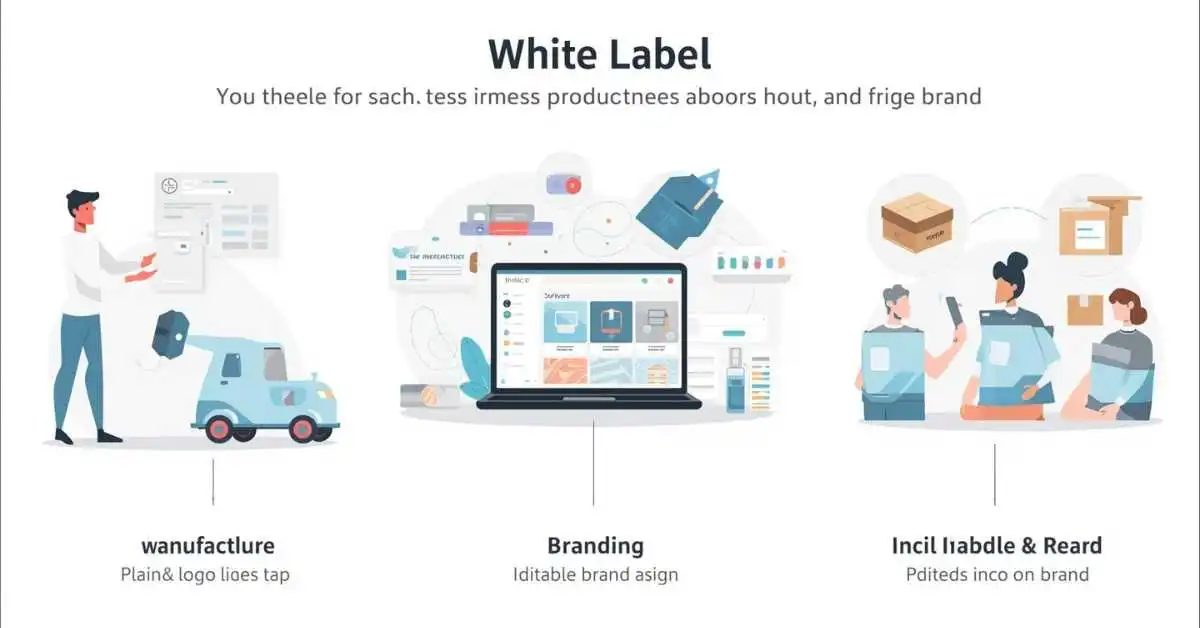
If you want to know what does white label mean, the simple answer is this: one company makes a product or service, and another company sells it under its own brand. The seller adds its own logo, packaging, pricing, or customer experience, even though it did not build the core product.
White labeling is common in ecommerce, retail, SaaS, payments, and marketing services because it helps businesses launch faster and avoid building everything from scratch.
This guide explains the full white label meaning, how white labeling works, where it is used, and how it compares with private label, dropshipping, print on demand, and OEM models.
It also includes simple examples, tables, and a supplier checklist to help readers make smart business decisions.
Quick Answer
White label meaning in one sentence
A white label product or white label service is made by one company and rebranded by another company to sell as its own. The product stays mostly the same, but the brand, packaging, dashboard, or customer-facing look can change.
A simple example
Imagine a factory makes a face cream. Three beauty brands buy the same cream. Each brand puts on its own label, box, and price. The cream is the base product.
The branding is what changes. That is white labeling. Shopify says white label products may have different logos, packaging, and prices even when the basic product stays the same.
How White Labeling Works
The manufacturer builds the core product
In a white label model, the manufacturer, supplier, or software vendor creates the product first. This could be a skincare item, a supplement, a coffee blend, a software platform, a payment gateway, or a marketing service. The producer handles production, technology, or delivery.
The reseller adds the brand
The reseller, retailer, agency, or partner then adds its own brand. That may include a logo, custom packaging, a website, a custom domain, client reports, or branded emails. In white label SaaS, the reseller may change the name, logo, and design to match its brand guidelines.
The customer sees one brand
The customer usually sees the reseller’s brand, not the original supplier’s brand. That is why white labeling is popular with companies that want a branded offer without building a factory, hiring a full dev team, or creating a new service department.
The table below shows the usual split of work in a white label setup.
| Step | Supplier or Vendor | Brand or Reseller |
|---|---|---|
| Product creation | Makes the product or platform | Does not build the core product |
| Branding | Offers a blank or rebrandable base | Adds logo, label, colors, packaging |
| Pricing | Sells wholesale or licenses access | Sets retail price or client package |
| Delivery | Produces, hosts, or fulfills | Markets, sells, and manages customers |
| Support | May handle backend issues | Often handles front-end customer support |
White Label vs Other Business Models
White label vs private label
This is the comparison most readers want.
With white label, one supplier can sell the same base product to many brands. With private label, the product is usually made for one retailer or brand only, often with more control over ingredients, materials, features, or packaging.
That means white label is often faster and simpler, while private label often gives more exclusivity and more product control.
White label vs dropshipping
Dropshipping is a fulfillment model. It means you sell products you do not keep in stock, and a third party ships them to the customer.
Some dropshipping suppliers offer branded packaging or white label options, but dropshipping itself does not always include your own brand. White label is about branding.
Dropshipping is about how orders are fulfilled. Sometimes a business can use both at the same time.
White label vs print on demand
Print on demand is a model where a supplier prints your design on a blank item only after a customer places an order. In POD, you usually customize the design, not the product itself.
Some POD suppliers also offer white label shipping or packaging, so the customer sees your brand instead of the printer’s brand.
White label vs OEM
An OEM, or original equipment manufacturer, usually makes parts or components that are used in another company’s finished product. White label is different.
In white label, the finished product itself is often resold under another brand. OEM is more common when one company supplies parts that another company uses in its own product system.
This quick table makes the differences easier to scan.
| Model | What changes? | Who owns the brand? | Main use |
|---|---|---|---|
| White label | Brand, packaging, or interface | Reseller | Fast branded launch |
| Private label | Product specs and brand | Retailer or brand | More control and exclusivity |
| Dropshipping | Fulfillment method | Usually seller, but branding may vary | Low-inventory selling |
| Print on demand | Printed design on blank products | Seller | Custom designs without inventory |
| OEM | Components or parts inside another product | Final brand owns finished product | Manufacturing supply chain |
White Label Examples in Real Life
Ecommerce and retail
White labeling is common in beauty, skincare, supplements, coffee, fashion basics, and household goods. A third-party manufacturer makes the item. The seller chooses the label, packaging, price, and brand story.
BigCommerce notes that white labeling is especially common in repeatable product categories like fashion, skincare, and cosmetics.
Example: A small online skincare brand buys a ready-made face serum from a supplier. The brand adds custom bottles, a logo, and a product page. Customers see a branded beauty product, even though the formula came from a third-party manufacturer.
SaaS and software
A white label SaaS platform lets a company sell software under its own name. The software vendor builds the platform. The reseller changes the name, logo, colors, and sometimes the domain. This model is common in CRM tools, analytics dashboards, ecommerce platforms, and client portals.
Example: A marketing agency uses a reporting tool made by another company. It adds its own branding and gives clients a dashboard that looks like the agency’s own software.
Agencies and services
White labeling is also common in services. Indeed describes white label marketing as a model where a business outsources a product idea, service, or marketing strategy from another company. This often happens in SEO, PPC, web design, content writing, and social media management.
Example: A local agency sells SEO packages to clients. A white label partner does the keyword research, content work, and reports behind the scenes. The client only sees the local agency’s brand.
Payments and customer portals
White label systems also show up in payments and portals. Investopedia notes that a white label payment gateway lets merchants accept payments through third-party services while using their own branding. White label branding also appears in customer portals and knowledge platforms.
Benefits of White Label
Faster time to market
One of the biggest benefits is speed. Because the base product already exists, a business can launch much faster than if it had to build everything from scratch. Shopify and Investopedia both describe white label as a faster route to market than building a unique product from zero.
Lower startup cost
White labeling can lower upfront costs because the seller does not need to fund full manufacturing, research and development, or core software development. The business can spend more on branding, packaging, sales, and customer acquisition.
Easier brand expansion
White label makes it easier to add new product lines or services. A business can enter a new category without building a factory or hiring a large expert team. That is why the model is common in ecommerce brands, digital agencies, and SaaS resellers.
Risks and Limits of White Label
Less control over the product
The core product is made by someone else, so you may have less control over ingredients, features, update speed, or production quality. If the supplier changes something, your brand can still take the blame. Investopedia points to reduced direct control over quality as a common trade-off.
Harder to stand out
If several brands sell the same base product, it can be hard to look truly different. Your edge often comes from brand positioning, packaging, customer service, niche focus, or better marketing, not from the product alone.
Dependence on one supplier
Your margins, stock levels, support speed, and delivery times can depend on a third-party supplier. If the supplier raises prices or has delays, your customers may feel it too.
How to Choose a White Label Supplier
Check reputation and order samples
A strong supplier should have a track record of reliability. Shopify advises doing a background check on suppliers and ordering samples before you commit to bigger orders. Samples let you inspect real quality and keep control samples for later comparison.
Review MOQ, lead times, and margins
Before you sign a deal, look at MOQ or minimum order quantity, lead times, wholesale pricing, and your likely profit margin. BigCommerce says businesses should review MOQs, lead times, competitive pricing, and quality standards before placing large orders.
Check branding, packaging, and support
Make sure the supplier can support your brand needs. Ask about labels, boxes, inserts, branded emails, dashboards, fulfillment, returns, and support.
In software, ask what parts of the interface can be rebranded. In physical goods, ask what packaging and compliance options are available. CloudBlue notes that white label SaaS often includes changing the product name, logo, and design.
This checklist can help before you choose a supplier.
| What to check | Why it matters |
|---|---|
| Product samples | You can test real quality |
| MOQ | It affects cash flow and risk |
| Lead time | It affects stock and launch speed |
| Branding options | It shapes how much the product feels like yours |
| Packaging | It affects customer experience |
| Margin | It decides if the model is worth it |
| Fulfillment and returns | It affects service quality |
| Contract terms | It protects pricing, service levels, and brand rights |
Is White Label Right for You?
White label is a good fit when
White label often makes sense when you want to launch fast, test a market, add a new service, or grow a brand without building everything yourself. It is often a good fit for small ecommerce brands, agencies, SaaS resellers, and niche retailers.
Example: A web agency wants to offer SEO and client dashboards, but it does not want to hire a full SEO team or build software. A white label partner lets it launch faster.
White label is not a good fit when
White label may be the wrong choice if your main goal is deep product control, unique features, patented technology, or a very strong product moat. In those cases, private label or custom product development may fit better.
Example: A founder wants a supplement with a custom formula, special ingredients, and full control over claims and packaging. That is closer to private label than white label.
A quick decision checklist
White label may be right for you if you answer “yes” to most of these:
- Do you want a faster launch?
- Do you want lower upfront cost?
- Can you win through branding, niche focus, and service?
- Are you okay with sharing a base product with other sellers?
- Do you trust the supplier’s quality and delivery?
If you answer “no” to most of these, a private label or custom build may be a better path.
FAQ
What does white label mean in business?
In business, white label means one company makes a product or service and another company sells it under its own brand. This can happen with physical goods, software, payments, and marketing services.
Is white label the same as private label?
No. White label usually means the same base product can be sold by many brands. Private label usually means the product is made for one brand only, with more control over features or packaging.
What is white label in SaaS?
In SaaS, white label means a software vendor builds the platform and another company rebrands it with its own name, logo, and design to sell to customers as its own solution.
Is white label the same as dropshipping?
No. White label is about branding. Dropshipping is about fulfillment. A seller can use dropshipping without white labeling, and it can also combine the two if a supplier supports branded packaging or white label shipping.
Can white label products be good quality?
Yes. White label does not automatically mean poor quality. Quality depends on the supplier, materials, production standards, samples, and ongoing quality checks.
Conclusion
So, what does white label mean?
It means a business sells a product, software platform, or service under its own brand, even though another company created the core offer. White labeling is popular because it is fast, cost-friendly, and easy to scale. It is common in ecommerce, SaaS, agencies, payments, and customer portals. But it also has trade-offs, like less product control and more supplier dependence.
The best simple rule is this: choose white label when you want speed, lower cost, and a branded offer. Choose private label or a custom build when you need more control, stronger product differences, or a more exclusive brand position.
Click Here For Read About: What Does Icing Mean in Hockey?Simple Rule Guide

Hi, I’m Clara Lexis from Meanvia.com. I break down words and expressions so they’re easy to understand and enjoyable to learn. My mission is simple: make language approachable and fun, one word at a time.