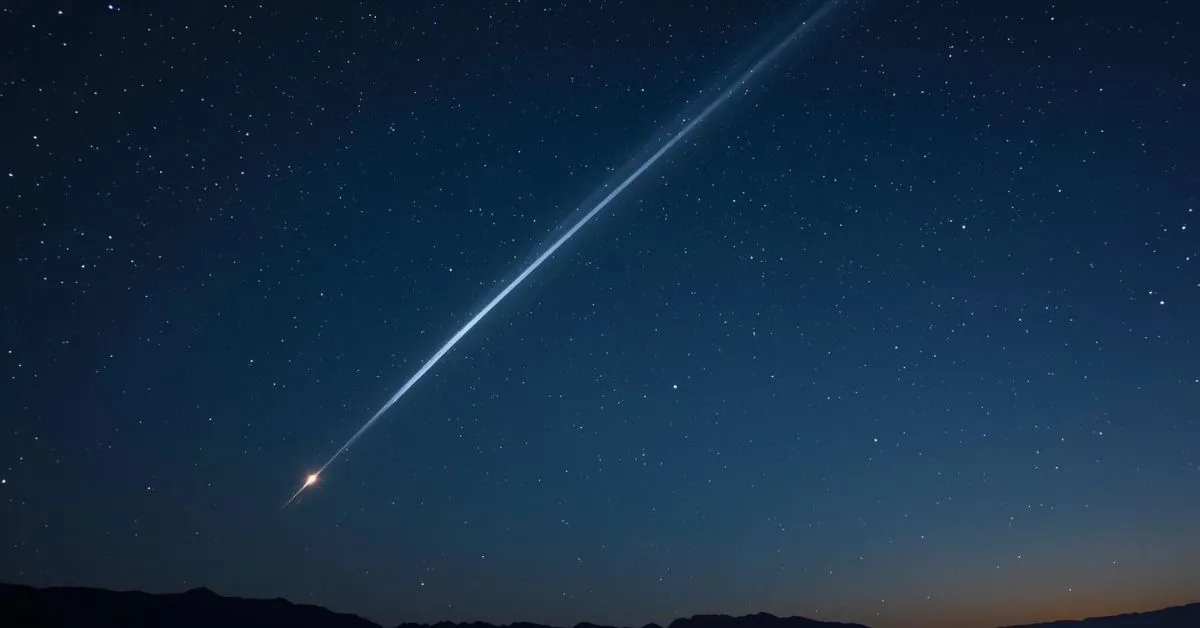
Seeing a shooting star usually means you saw a meteor streak through Earth’s atmosphere, not an actual star.
Symbolically, many people take it as a sign of luck, hope, change, or a perfect moment to make a wish, but those meanings come from folklore and personal belief rather than astronomy.
A lot of articles answer this question too narrowly. Some go fully spiritual and skip the science. Others explain meteors but ignore the real reason people search this phrase in the first place: they want to know whether the moment meant something.
The clearest answer is that a shooting star can have a scientific meaning, a symbolic meaning, and a personal meaning at the same time.
Meaning at a glance
| Perspective | What it means |
|---|---|
| Scientific | You most likely saw a meteor, which is the bright streak caused when a meteoroid enters the atmosphere. |
| Spiritual | Many people see it as a sign of hope, guidance, or a fresh start. |
| Symbolic | It is often linked with luck, wishes, rare opportunities, and meaningful timing. |
| Personal | It may feel significant because of what was happening in your life when you saw it. |
That is the most useful way to understand the experience. A shooting star is real in astronomy, meaningful in culture, and sometimes powerful on a personal level because rare sky events naturally stand out in human memory.
Is seeing a shooting star good luck?
Many people believe it is. In popular superstition and folklore, seeing a shooting star is often associated with good luck, a wish being heard, or the beginning of something positive. That belief is widespread enough that it shows up repeatedly in modern spiritual content, older superstition collections, and general explainer pages.
But there is no single universal rule. Some traditions treat shooting stars positively, while others connect them with warnings, souls, or omens. That is why online answers vary so much. The “good luck” interpretation is common, but it is still a belief-based meaning, not a scientific one.
A practical way to interpret it is this: if seeing one feels encouraging, inspiring, or lucky to you, that response is valid as a personal interpretation. Just do not confuse symbolism with proof that a specific outcome is guaranteed.
What does a shooting star mean spiritually?
Spiritually, people often interpret a shooting star as a sign of:
- hope
- change
- guidance
- alignment
- a moment to set an intention
- a reminder to make a wish
Those meanings are common because the event is sudden, beautiful, and brief. A bright streak across a dark sky feels unusual, so many people naturally attach emotional or spiritual significance to it. That is one reason shooting stars are often linked with new beginnings, romance, manifestation, or the feeling that life is trying to get your attention.
Still, the strongest interpretation is usually the most grounded one.
A shooting star does not automatically mean the universe is confirming a relationship, predicting a life event, or sending a fixed message. Spiritual meaning is usually personal, not objective. What matters most is the context: what you were thinking, feeling, or facing when you saw it.
Is a shooting star a sign or just a meteor?
It is definitely a meteor in scientific terms, and it may also feel like a sign in personal or spiritual terms. Those two ideas are not mutually exclusive. The problem starts when articles treat symbolic meaning as fact instead of belief.
If you want the most balanced answer, use this simple framework:
- Literal meaning: a meteor crossed the atmosphere
- Symbolic meaning: many traditions connect it with luck, wishes, and change
- Personal meaning: the moment may feel important because of where you are in life
That framework is more useful than extreme answers like “it is only a rock” or “it is definitely a cosmic message.” Most readers are really looking for the middle ground.
What is a shooting star in science?
A shooting star is the everyday name for a meteor. NASA explains the difference clearly:
| Term | Meaning |
|---|---|
| Meteoroid | A small rocky or metallic object still in space |
| Meteor | The streak of light seen when that object enters the atmosphere |
| Meteorite | What remains if part of the object survives and reaches the ground |
| Fireball | An unusually bright meteor |
NASA and NASA Space Place both explain that the “shooting star” effect is not an actual star falling.
It is the visible streak created when a meteoroid enters Earth’s atmosphere at high speed. NASA also notes that the bright streak is associated with heating and glowing effects as the object rushes through the atmosphere.
So when people ask what it means to see a shooting star, the literal answer is simple: you saw a small bit of space material interacting with Earth’s atmosphere.
Why do people make wishes on shooting stars?
Because the moment feels rare, fast, and emotionally charged. Across many traditions, unusual sky events have been treated as meaningful, and the idea of making a wish on a shooting star became one of the most recognizable versions of that.
HowStuffWorks notes that wishing on a falling star is a widely shared belief in parts of North America and Eurasia, while cultural and lifestyle pages continue to repeat the tradition today.
The tradition also makes emotional sense. A shooting star appears suddenly and disappears almost instantly. That creates a natural feeling of urgency, which is exactly the kind of moment people turn into ritual: make a wish now, before the chance is gone.
Different meanings people attach to shooting stars
A sign of hope
Because the event is brief but bright, many people see it as a reminder that good moments can arrive suddenly.
A symbol of change
Its fast movement across the sky often makes people connect it with transitions, turning points, or fresh starts.
A wish moment
This is the most familiar interpretation. The sighting becomes a trigger to focus on what you want most.
A feeling of guidance
Some people take it as a nudge to pay attention to their intuition or the timing of something in their life.
These interpretations are common because people do not experience sky events only as science. They also experience them emotionally. That is why a shooting star can feel meaningful even when you understand exactly what it is.
Are shooting stars rare?
They can feel rare, but they are not as rare as many people think. NASA says large amounts of meteoric material enter Earth’s atmosphere every day, and on clear dark nights you may be able to see several meteors. Visibility depends heavily on weather, moonlight, and light pollution.
Meteor showers make them easier to spot. NASA notes that when Earth passes through streams of debris, the number of visible meteors rises and we call the event a meteor shower.
Some of the best-known examples are the Perseids, linked to comet Swift-Tuttle, and other annual showers associated with comet debris.
That matters for search intent because many people see one meteor, assume it is extremely rare, and then attach even more meaning to it. The truth is more interesting: the event is real and special to witness, but it is also part of a repeating natural process.
What most people get wrong
The biggest misunderstanding is thinking a shooting star is an actual star. It is not. It is a meteor.
The second misunderstanding is assuming that if you see one, something major is definitely about to happen. That is not something astronomy supports. Symbolic meaning can be meaningful to you, but it is still interpretation, not evidence.
The third misunderstanding is assuming they almost never happen. In reality, meteors are part of normal sky activity, and meteor showers happen regularly throughout the year.
How to interpret a shooting star without overthinking it
If you want a healthy, useful interpretation, this is the best one:
- enjoy the moment
- appreciate the science
- let it inspire reflection if it feels meaningful
- do not force it to become a prediction
That approach keeps the wonder without turning the experience into anxiety or superstition. If you want to make a wish, do it.
If you want to see it as a sign of hope, that is fine too. Just remember that the event itself is a meteor, and the deeper meaning comes from human belief and personal reflection, not from astronomy alone.
FAQ
Is a shooting star actually a star?
No. A shooting star is the common name for a meteor, which is the bright streak seen when a meteoroid enters Earth’s atmosphere.
Does seeing a shooting star mean good luck?
Many people believe it does, but that idea comes from superstition and folklore rather than science.
What does a shooting star mean spiritually?
Spiritually, it is often interpreted as hope, change, guidance, or a chance to make a wish. That meaning depends on belief and personal context.
Are shooting stars and meteor showers related?
Yes. A meteor shower happens when Earth moves through a stream of debris, causing many meteors to appear over a short period.
Can a shooting star land on Earth?
Usually the object burns up before reaching the ground. If part survives and lands, it is called a meteorite.
Why do people wish on shooting stars?
Because many traditions treat them as special or lucky moments, and the brief nature of the event makes the ritual feel meaningful.
Conclusion
When you see a shooting star, the most accurate answer is that you saw a meteor. The broader answer is that people have long treated these moments as symbols of luck, wishes, hope, and change.
The best interpretation is the balanced one: know what it is, enjoy what it feels like, and let the moment mean something to you without pretending it guarantees anything.
Click Below To Read About These Posts:
What Does “Top of the Morning” Mean? Irish Phrase Explained
What Does Maintenance Required Mean? Dashboard Light Explained
What Does Ay Caramba Mean in English?

Hi, I’m Evan Lexor, the voice behind Meanvia.com. I break down English words, slang, and phrases into clear, simple meanings that actually make sense. From modern internet terms to everyday expressions, my goal is straightforward: help you understand English better, faster, and with confidence, one word at a time.