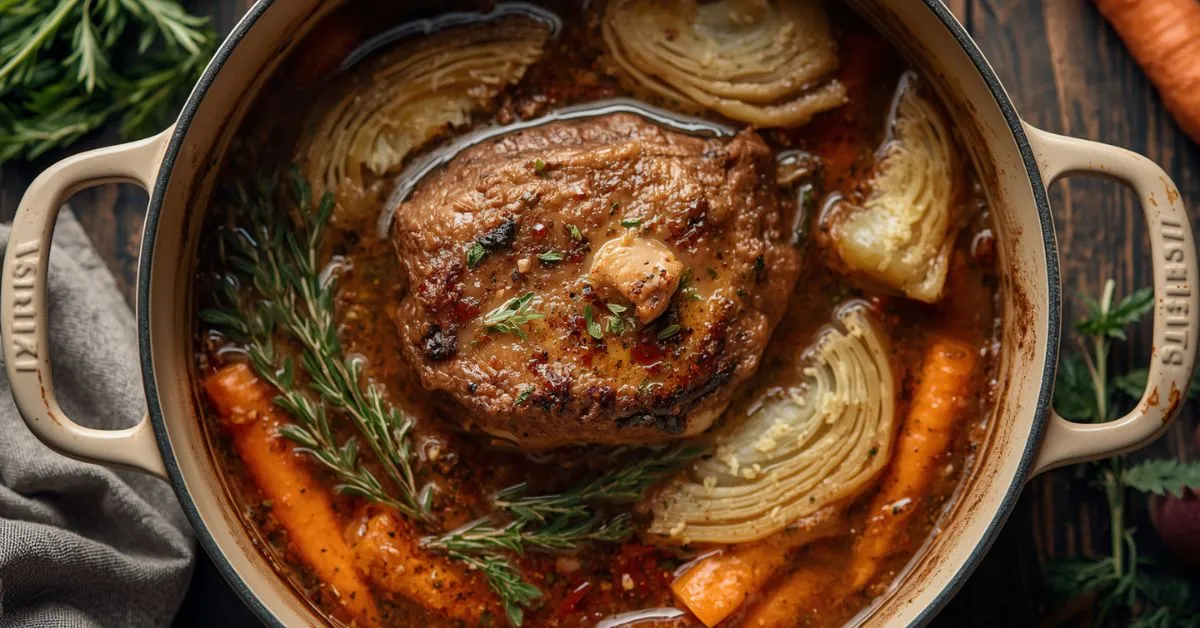
Braised means food is first browned, then cooked slowly in a covered pot with a small amount of fat and liquid until it becomes tender.
Culinary and dictionary references consistently describe braising as slow cooking in a closed vessel with limited liquid, not full immersion like stewing or boiling.
If you saw braised on a menu or in a recipe, the word is telling you how the food was cooked and also hinting at what it will be like to eat: usually soft, moist, rich, and deeply flavored.
In most cases, braised foods are gently cooked after browning, often with broth, stock, wine, or another flavorful liquid in the pot.
Braise vs. Braised vs. Braising
These word forms confuse a lot of readers, so it helps to separate them clearly.
- Braise = the verb, or action
- Braised = the adjective or past form describing the finished food
- Braising = the cooking method or process
That matches standard dictionary usage, where braise is the cooking action and braised describes food that has been cooked that way.
What Braised Means in Simple Terms
In plain English, braised usually means:
- the food was browned first
- a little liquid was added
- the pot was covered
- the food cooked slowly until tender
That is why braised dishes are often associated with comfort food, restaurant mains, and recipes that produce both tender food and a rich pan sauce.
How Braising Works
Braising is a combination cooking method that uses both dry heat and moist heat. The food is usually seared first at a higher temperature, then finished at a low simmer in a covered pot with some liquid.
Strong references on braising describe this as the key feature that separates it from simpler one-step methods.
A classic braise usually does not fully cover the food. Instead, the liquid often comes partway up the ingredient, which is one of the clearest differences between braising and stewing.
Many braises are done with larger cuts of meat, but the method is also used for vegetables, mushrooms, fish, tofu, tempeh, and even some fruits.
The leftover liquid is often reduced or finished into a sauce, which is one reason braised dishes tend to taste deeper and more developed than foods that are simply simmered.
What Does Braised Mean on a Menu?
On a menu, braised usually signals more than just technique. It often tells you to expect:
- tender texture
- slow-cooked flavor
- a moist result rather than a crisp one
- some kind of juices, glaze, or sauce
So if you see braised short ribs, braised lamb shank, or braised cabbage, the dish will usually be softer, richer, and more savory than something grilled, roasted, or fried. That expectation lines up with how braising is commonly defined and described in culinary references.
Braised vs. Stewed vs. Roasted vs. Simmered
This is where many articles stay too vague. Here is the quick practical difference:
| Method | Liquid level | Covered? | Typical food size | Usual result |
|---|---|---|---|---|
| Braised | Small to moderate amount | Usually covered | Larger cuts or whole pieces | Tender food with concentrated sauce |
| Stewed | More liquid, often surrounding ingredients | Usually covered | Smaller cut pieces | Spoonable dish with more broth or gravy |
| Roasted | Little or no added liquid | Often uncovered | Whole cuts or vegetables | Browner, drier exterior |
| Simmered | Food cooks in liquid | Can be either | Varies | Gentle liquid-based cooking |
Britannica notes that braising differs from stewing because stewed food is immersed in liquid, while braising also differs from covered roasting because braising uses added liquid. Wikipedia likewise describes braising as similar to stewing but done with less liquid and usually used for larger cuts.
A simple way to remember it is this:
- braised = browned first, then slowly cooked with some liquid
- stewed = smaller pieces cooked in more liquid
- roasted = mostly dry heat
- simmered = gentle cooking in liquid, but not necessarily braising
What Foods Are Commonly Braised?
Braising is especially useful for foods that benefit from slow, gentle cooking.
Common braised meats
- beef short ribs
- chuck roast
- brisket
- lamb shank
- pork shoulder
- pot roast
- osso buco
- coq au vin
Common braised vegetables
- cabbage
- fennel
- leeks
- carrots
- celery
- mushrooms
- artichokes
Other foods that may be braised
- fish
- tofu
- tempeh
- some fruits
Why Braising Makes Food Tender
One point many weak articles miss is that braising does not simply “pour moisture into meat.”
A well-known explanation in culinary references is that the tender, moist feeling comes largely from slow cooking breaking down connective tissue and collagen, while the covered cooking environment helps keep the dish from drying out too aggressively.
That is why braising is so often associated with tougher cuts. These cuts can become especially tender when cooked slowly over time, while the browning step helps develop richer flavor before the liquid stage begins.
What Most Articles Miss About This Topic
Most articles give a thin definition like “braised means cooked slowly in liquid,” but that skips the details that actually matter.
What usually gets missed is:
- braising uses two stages: browning first, then slow covered cooking
- the liquid is usually limited, not enough to fully submerge the food
- the method often works best for larger cuts and sturdy vegetables
- the finished liquid often becomes part of the sauce
- braised on a menu signals both the method and the likely texture of the dish
These details make the term much easier to understand in real life, especially when you are deciding what to order or trying to follow a recipe correctly.
Common Mistakes People Make With the Word Braised
Mistake 1: Thinking braised means boiled
It does not. Boiling means cooking in a lot of liquid at a stronger temperature. Braising uses less liquid and gentler, slower cooking.
Mistake 2: Thinking braised and stewed are identical
They are close, but not the same. Stews usually involve smaller pieces and more liquid, while braises more often focus on larger cuts and less liquid.
Mistake 3: Thinking braised only applies to meat
Not true. Standard culinary references include vegetables, fish, tofu, tempeh, and fruits among foods that can be braised.
Mistake 4: Thinking braised means crispy
Usually the opposite. Braised dishes are generally associated with tenderness, moisture, and concentrated flavor rather than crispness.
Quick Answer for Readers in a Hurry
If you only want the shortest useful answer:
Braised means browned first, then cooked slowly in a covered pot with a small amount of liquid until tender. That is what the word usually means in recipes, restaurant menus, and food writing.
FAQ
What does braised mean in cooking?
It means the food is first browned, then slowly cooked in a covered pot with a small amount of liquid and fat until tender.
What does braised mean on a menu?
It usually means the dish was slow-cooked after browning, so you can expect a softer texture and richer flavor, often with juices or sauce.
Is braised the same as stewed?
No. Braising usually uses less liquid and larger pieces, while stewing usually uses more liquid and smaller cut pieces.
Does braised mean fully covered in liquid?
Usually no. In a classic braise, the food is only partly covered by liquid rather than fully submerged.
Can vegetables be braised?
Yes. Vegetables such as cabbage, fennel, celery, and carrots are commonly braised, and some vegetables can braise largely in their own juices.
What is the difference between braised and roasted?
Roasting relies mainly on dry heat, while braising adds liquid and cooks the food covered at low heat after browning.
Conclusion
Braised is a cooking term that means food was browned first and then cooked slowly in a covered pot with a small amount of liquid until tender. If you see it on a menu, think slow-cooked, rich, soft, and flavorful rather than crisp or dry.
The clearest way to understand the word is to remember that braising combines browning + a little liquid + slow covered cooking.
Click Here and Read More Posts:
What Does DRL Mean in a Car? Daytime Running Lights Explained
What Does Marketing Mean? Purpose, Types, Real Examples

Hi, I’m Evan Lexor, the voice behind Meanvia.com. I break down English words, slang, and phrases into clear, simple meanings that actually make sense. From modern internet terms to everyday expressions, my goal is straightforward: help you understand English better, faster, and with confidence, one word at a time.