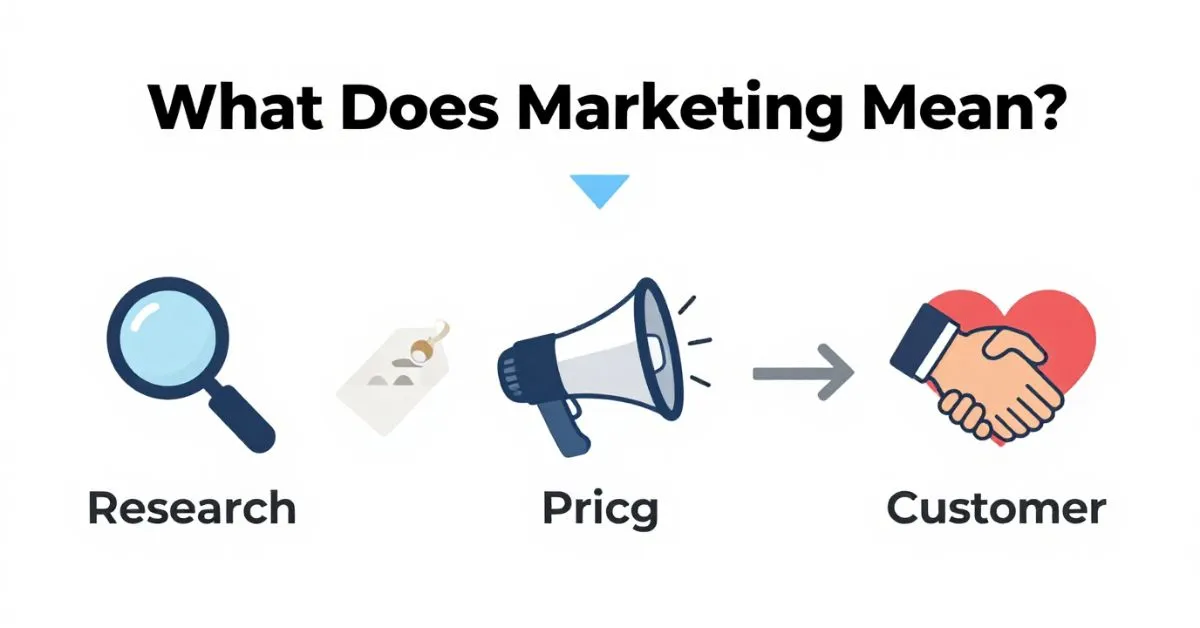
Marketing means understanding customer needs, creating and positioning a valuable offer, communicating it clearly, and building relationships that lead to sales and loyalty. It includes research, pricing, branding, promotion, distribution, and retention, not just advertising.
Many people hear the word marketing and think of ads, social media posts, or catchy slogans. That is only part of the picture. In business, marketing is much broader.
Professional bodies such as the American Marketing Association and the Chartered Institute of Marketing describe marketing as a process centered on creating, communicating, delivering, and exchanging value while identifying and satisfying customer requirements.
So if you are asking, “What does marketing mean?”, the simplest useful answer is this:
Marketing is the system a business uses to understand demand, shape value, communicate it well, and keep customers over time.
That definition is easier to use in real life because it explains what marketing actually does, not just what it sounds like in theory.
What Marketing Means in Simple Words
In simple words, marketing is how a business connects what it offers with the people most likely to want it.
That includes questions like:
- Who is this product or service for?
- What problem does it solve?
- Why should anyone choose it?
- How much should it cost?
- Where should people find it?
- What message will make it easy to understand?
- How do we keep customers happy after they buy?
This is why marketing is not the same as “promotion.” Promotion is one piece of marketing, but marketing also includes customer research, positioning, pricing, distribution, and retention. AMA, CIM, Coursera, and Investopedia all frame marketing as broader than advertising alone.
The Formal Business Meaning of Marketing
In business language, marketing is usually treated as a management process, not just a creative activity. AMA defines marketing around creating, communicating, delivering, and exchanging offerings that have value, while CIM describes it as identifying, anticipating, and satisfying customer requirements profitably. Those two definitions differ in wording, but they point to the same core idea: marketing is about value, customers, and coordinated business decisions.
That matters because businesses do not grow simply by “getting attention.” They grow when the right people understand the offer, trust it, and see why it fits their needs better than alternatives.
Why Marketing Matters
Marketing matters because even a strong product can fail if the wrong audience sees it, the pricing is off, the message is unclear, or the offer is poorly positioned. Strong marketing helps companies define a target market, understand competitors, communicate value clearly, and guide people from awareness to purchase and beyond.
In practice, marketing helps a business:
- understand customer needs
- identify a target audience
- stand out from competitors
- build brand awareness and trust
- support sales
- improve retention and loyalty
- measure what is working and what is not through analytics
Without marketing, many businesses end up relying on guesswork. They may have a useful product but no clear position, no strong message, and no repeatable system for growth.
What Marketing Actually Includes
A lot of articles define marketing in one sentence and stop there. That leaves beginners with the answer but not the understanding. Real marketing includes several connected parts.
1) Market research
Marketing starts with learning, not posting. Businesses study customer needs, preferences, pain points, and buying behavior. They also examine the market, competitors, and changes in technology or culture. Coursera and CIM both emphasize target market understanding and ongoing market investigation as the foundation of marketing strategy.
2) Target audience and segmentation
Not every offer is for everyone. Marketing involves deciding which group of people a product is best for. That is where target market and segmentation come in. A company may speak differently to students, parents, small businesses, or enterprise buyers even when the product is similar.
3) Positioning and value proposition
Positioning is about how a business wants to be understood in the market. Is the offer premium, affordable, fast, beginner-friendly, luxury, or eco-conscious? A value proposition explains why the offer is worth choosing. Good marketing makes that answer obvious.
4) Product, price, place, and promotion
Marketing includes decisions about the offer itself, how much it costs, where it is available, and how it is promoted. Those elements are commonly explained through the 4 Ps of marketing.
5) Customer experience and retention
Marketing does not end at the sale. Follow-up emails, onboarding, packaging, service quality, loyalty efforts, and customer support all influence how people feel about a brand. Modern marketing increasingly overlaps with customer experience, retention, and long-term brand trust.
The 4 Ps of Marketing, Explained Simply
The 4 Ps are one of the best-known marketing frameworks: Product, Price, Place, and Promotion. They are widely used to shape marketing decisions and strategy. Some service-oriented models later expand this into 7 Ps by adding People, Process, and Physical Evidence.
| Element | What it means | Simple example |
|---|---|---|
| Product | What you are offering and the value it provides | A beginner-friendly budgeting app |
| Price | What customers pay and how the offer is positioned | Free trial, monthly plan, premium tier |
| Place | Where and how people get it | App store, website, retail shelf |
| Promotion | How people learn about it | SEO, email, social media, paid ads |
For service businesses, the extra 7 Ps additions help explain why staff, process, and trust signals matter so much:
- People: the staff or support experience
- Process: how smoothly the service works
- Physical evidence: the visible cues that help people trust the service, such as a clean website, office, packaging, or reviews
What is Marketing
Marketing is the strategic process of understanding customer needs, creating valuable products or services, and communicating their benefits to the right audience. It goes beyond advertising and focuses on building lasting relationships that drive sales and brand loyalty. Effective marketing researches markets, positions offerings uniquely, and delivers messages through channels customers trust. Businesses use it to grow revenue, attract new buyers, and keep existing ones engaged. In today’s digital world, marketing blends creativity with data to deliver personalized experiences that truly resonate.
Examples:
- A coffee shop surveys local preferences and launches a loyalty app with personalized offers to increase repeat visits.
- An online clothing brand uses social media stories and targeted ads to showcase sustainable fabrics and convert browsers into buyers.
[Context and how people use it]
People search this phrase when they want a clear, simple explanation of the concept for study, business planning, or career exploration.
Students, entrepreneurs, and professionals use the information to grasp fundamentals before diving into strategies or campaigns.
Reason Why Marketing Definition
Understanding the definition of marketing matters because it sets the foundation for every business decision related to customers. A clear definition helps teams align on goals, measure success accurately, and avoid wasting resources on ineffective tactics. It explains why companies invest in research, branding, and communication instead of just producing goods. Without a solid definition, efforts become random and fail to create real value. Knowing the “why” behind the definition empowers smarter planning and stronger results across industries.
Examples:
- A startup founder studies the definition to decide whether to focus first on product features or customer discovery.
- A marketing manager uses the definition to justify budget requests by showing how activities create measurable customer value.
[Context and how people use it]
Searchers look for the reason behind the definition when writing essays, preparing presentations, or training new team members.
Educators and business owners rely on this insight to teach why marketing is essential rather than optional.
What Does Marketing Mean
Marketing means identifying what people want, creating solutions that meet those wants, and sharing the value in a way that inspires action. It is the bridge between a company and its customers, turning ideas into desirable offerings and messages into purchases. At its core, marketing is about exchange—giving customers something useful in return for their attention, trust, and money. Modern marketing also includes listening, adapting, and nurturing relationships long after the first sale.
Examples:
- A fitness app company researches busy professionals and designs short home workouts, then promotes them through targeted Instagram ads.
- A local bakery learns customers love seasonal flavors and launches limited-edition cakes promoted via email and community events.
[Context and how people use it]
People type this query when they need a straightforward explanation for personal learning or workplace discussions.
Job seekers and small business owners use the answer to understand the daily role of marketing in real organizations.
Marketing Definition
Marketing is defined as the activity, set of institutions, and processes for creating, communicating, delivering, and exchanging offerings that have value for customers, clients, partners, and society at large. This widely accepted definition highlights that marketing is not limited to selling; it includes research, product development, pricing, distribution, and ongoing customer care. It positions marketing as a customer-focused discipline that creates mutual benefit. Businesses that follow this definition build stronger brands and sustainable growth.
Examples:
- A software company follows the definition by surveying users, improving features based on feedback, and promoting the updates through webinars.
- A grocery chain applies the definition by creating private-label products that solve everyday problems and communicating their quality through in-store displays.
[Context and how people use it]
This exact phrase is popular among students writing assignments and professionals refreshing core concepts.
Teachers and trainers frequently reference the formal definition to establish a shared understanding in classrooms and workshops.
Marketing Meaning
The meaning of marketing centers on creating and delivering value that satisfies customer needs while achieving business goals. It involves understanding markets, crafting compelling offers, choosing the right channels, and measuring results. Marketing meaning extends beyond promotion to include every touchpoint that shapes how people perceive and interact with a brand. When done well, it builds trust, encourages loyalty, and turns customers into advocates who willingly share their positive experiences.
Examples:
- An eco-friendly cleaning brand researches family safety concerns and creates plant-based products marketed through educational blog content.
- A travel agency studies adventure seekers and designs unique itineraries promoted via personalized email sequences and influencer partnerships.
[Context and how people use it]
Users search for marketing meaning when they want both a simple explanation and deeper insight into its practical role.
New entrepreneurs and career changers use this information to decide whether marketing is a field they want to enter.
What Does Marketing Mean in Business
In business, marketing means the systematic effort to attract, convert, and retain customers profitably. It connects product development with customer demand, guides pricing decisions, selects distribution methods, and crafts messages that differentiate the company from competitors. Marketing in a business context drives revenue, shapes brand reputation, and provides data that improves future offerings. Companies that treat marketing as a core function rather than a support activity usually achieve stronger market positions and long-term success.
Examples:
- A B2B software firm uses marketing to identify pain points of mid-sized companies and runs LinkedIn campaigns that generate qualified leads.
- A restaurant chain studies local dining trends and launches a new menu with targeted promotions that increase weekday traffic.
[Context and how people use it]
Business owners, managers, and students search this phrase to understand marketing’s specific role inside companies.
Consultants and executives use the explanation when aligning teams or explaining marketing’s contribution to overall strategy.
What’s Marketing
What’s marketing? It is the practical art and science of making sure the right people know about your product or service and feel motivated to choose it. Marketing discovers customer problems, designs solutions, sets prices people will pay, places products where buyers can find them, and communicates benefits clearly. It also tracks results so strategies can improve over time. In short, marketing turns potential interest into actual customers and keeps those customers coming back.
Examples:
- A handmade jewelry seller discovers customers want unique gifts and markets custom pieces through Etsy ads and Instagram reels.
- A mobile phone accessory brand identifies common frustrations and promotes durable cases with clear before-and-after videos online.
[Context and how people use it]
This casual phrasing is used by beginners who want a quick, friendly explanation without heavy jargon.
High school students, hobbyists starting side hustles, and curious professionals often search this way for an accessible overview.
Marketing Means
Marketing means putting the customer at the center of every business decision related to products, prices, places, and promotion. It means researching needs, creating value, communicating that value effectively, and building relationships that last. Marketing means listening as much as talking, adapting to feedback, and measuring what works. When a company truly understands what marketing means, it stops pushing products and starts solving real problems for real people.
Examples:
- A pet food company learns owners want healthier options and develops grain-free recipes promoted through veterinarian partnerships.
- An online course creator surveys learners’ skill gaps and markets practical modules with free sample lessons to build trust.
[Context and how people use it]
People use this search when they want a concise yet meaningful explanation they can apply immediately.
Freelancers and small teams often look up “marketing means” while planning their first campaigns or client pitches.
Marketing What Is
Marketing—what is it really? It is the coordinated effort to research markets, develop offerings people want, price them attractively, distribute them conveniently, and promote them persuasively. Marketing also involves analyzing results and refining approaches for better performance. Far from being only about flashy ads, it is a continuous cycle of understanding, creating, delivering, and improving value. Businesses that master this cycle grow faster and build stronger customer connections.
Examples:
- A sustainable fashion brand researches ethical concerns and markets clothing made from recycled materials through transparent storytelling.
- A meal-kit service studies busy parents and promotes easy recipes with time-saving benefits via social media and referral programs.
[Context and how people use it]
This inverted phrasing appears in searches by non-native speakers and people looking for quick definitions.
Content creators and educators use the clear answer to produce helpful videos, articles, or training materials.
What Is Marketing About
Marketing is about creating meaningful connections between businesses and the people they serve. It focuses on discovering customer desires, designing solutions that fulfill those desires, and communicating benefits in ways that feel helpful rather than pushy. Marketing is about building trust, delivering consistent experiences, and measuring impact so improvements never stop. Ultimately, it is about helping customers make better choices while helping companies achieve sustainable growth through genuine value exchange.
Examples:
- A financial app researches young adults’ money worries and markets budgeting tools with simple educational content and free trials.
- A home décor store studies interior trends and markets curated collections through inspiring mood boards and limited-time offers.
[Context and how people use it]
Searchers use this phrase when they want to understand the purpose and focus of marketing beyond basic definitions.
Aspiring marketers and business students rely on the explanation to see the bigger picture of why marketing exists and how it serves both sides.
Marketing vs Advertising vs Branding vs Sales
This is one of the biggest confusion points, so it needs to be crystal clear.
| Term | Main meaning | Main goal |
|---|---|---|
| Marketing | The full system for understanding, attracting, converting, and retaining customers | Create demand and long-term growth |
| Advertising | Paid promotion used to reach or persuade people | Gain attention and action |
| Branding | How a business is perceived and remembered | Build recognition and trust |
| Sales | The direct process of turning interest into a purchase | Close deals and generate revenue |
Advertising is part of marketing. Branding supports marketing. Sales works closely with marketing. But none of them means exactly the same thing. Investopedia and CIM both support the broader view that marketing is much bigger than promotion alone.
Traditional Marketing vs Digital Marketing
Marketing can happen through offline and online channels.
Traditional marketing includes:
- print ads
- brochures
- direct mail
- TV and radio
- billboards
- events
Digital marketing includes:
- websites
- search engines
- social media
- apps
- online ads
- content marketing
Investopedia describes digital marketing as using websites, apps, mobile devices, social media, search engines, and other digital means to promote and sell products and services.
The key point is that digital marketing is a type of marketing, not a separate concept from marketing itself.
Real Examples of Marketing
Example 1: A local bakery
A bakery notices that nearby office workers want quick, fresh breakfast options. It creates a morning combo, prices it competitively, promotes it on local social media, improves takeaway packaging, and offers a loyalty card.
That is marketing because it combines:
- customer insight
- offer design
- pricing
- promotion
- retention
Example 2: A software company
A project-management app targets small remote teams. It positions itself as easy to use, offers a free trial, publishes SEO content, sends onboarding emails, and compares its features against better-known competitors.
That is marketing because it connects product value to a specific audience through positioning, content, pricing, and conversion strategy.
Example 3: A skincare brand
A skincare brand focuses on sensitive skin. It builds trust with simple packaging, educational content, ingredient transparency, reviews, and email follow-up.
That is marketing because it shapes customer perception before and after the sale.
What Most Articles Miss About This Topic
Most articles miss the fact that marketing is partly interpretation.
The same product can be marketed in very different ways depending on:
- the audience
- the price point
- the competition
- the buying situation
- the desired brand image
A notebook can be marketed as:
- an affordable school supply
- a premium productivity tool
- a stylish gift item
- an eco-friendly purchase
The physical product barely changes, but the marketing changes because the meaning of value changes for different customers.
Another thing many articles miss is that marketing starts before promotion and continues after purchase. That is why research, positioning, onboarding, support, reviews, loyalty, and analytics all matter. Coursera highlights target market, competitors, strategy, and analytics as central to marketing, which is much broader than campaign creation alone.
Common Mistakes People Make When Defining Marketing
Mistake 1: Thinking marketing is just advertising
It is not. Ads are one tactic within a much bigger system.
Mistake 2: Thinking marketing only matters for large companies
Small businesses, creators, consultants, and local service providers all use marketing, whether formally or informally. CIM explicitly notes that organizations are often already marketing without realizing it.
Mistake 3: Thinking marketing begins after the product is finished
In reality, marketing should help shape the product, message, pricing, and target audience from the start.
Mistake 4: Thinking marketing ends when someone buys
Strong marketing also supports retention, repeat purchases, referrals, and long-term brand trust.
What Marketers Actually Do Day to Day
Depending on the role, marketers may work on:
- audience research
- customer interviews
- content planning
- SEO and search visibility
- campaign creation
- email automation
- social media
- paid ads
- analytics and reporting
- competitor analysis
- pricing and offer testing
- brand messaging
- conversion optimization
That mix changes by industry, but the core job stays similar: understand the market, communicate value, and improve results over time.
FAQs
Q: What is the best definition of marketing
A: Marketing is the process of promoting, selling, and delivering products or services to meet customer needs and achieve business goals.
Q: What is marketing mean in business studies
A: Marketing in business studies means identifying customer needs and creating, promoting, and selling products or services to satisfy them.
Q: What is marketing mean in business
A: Marketing in business means attracting customers and encouraging them to buy a company’s products or services.
Q: Types of marketing
A: Common types of marketing include digital marketing, social media marketing, content marketing, email marketing, and traditional marketing.
Q: Importance of marketing
A: Marketing helps businesses attract customers, increase sales, build brand awareness, and compete effectively in the market.
Q: 5 definition of marketing
A: Five simple definitions of marketing describe it as promoting products, satisfying customer needs, creating value, building relationships, and increasing sales.
Q: Nature of marketing
A: The nature of marketing is customer-focused, goal-oriented, continuous, dynamic, and centered on creating and delivering value.
Q: Example of marketing
A: A company promoting a new product through social media advertisements, emails, and special offers is an example of marketing.
Conclusion
Marketing means far more than promotion. It is the business process of understanding people, creating value for them, presenting that value clearly, and building a relationship that lasts beyond the first transaction. Professional definitions from AMA and CIM, along with educational overviews from Coursera and Investopedia, all point to the same truth: marketing is a system, not a single tactic.
If you want to explain marketing correctly, the best shortcut is this:
Marketing is how a business finds the right audience, offers the right value, communicates it clearly, and keeps customers over time.
Read Also These Posts:
What Does Withholding Tax Mean? Explanation & Examples
What Does DEFCON 3 Mean? Definition, Alert Level, Examples

Hi, I’m Clara Lexis from Meanvia.com. I break down words and expressions so they’re easy to understand and enjoyable to learn. My mission is simple: make language approachable and fun, one word at a time.