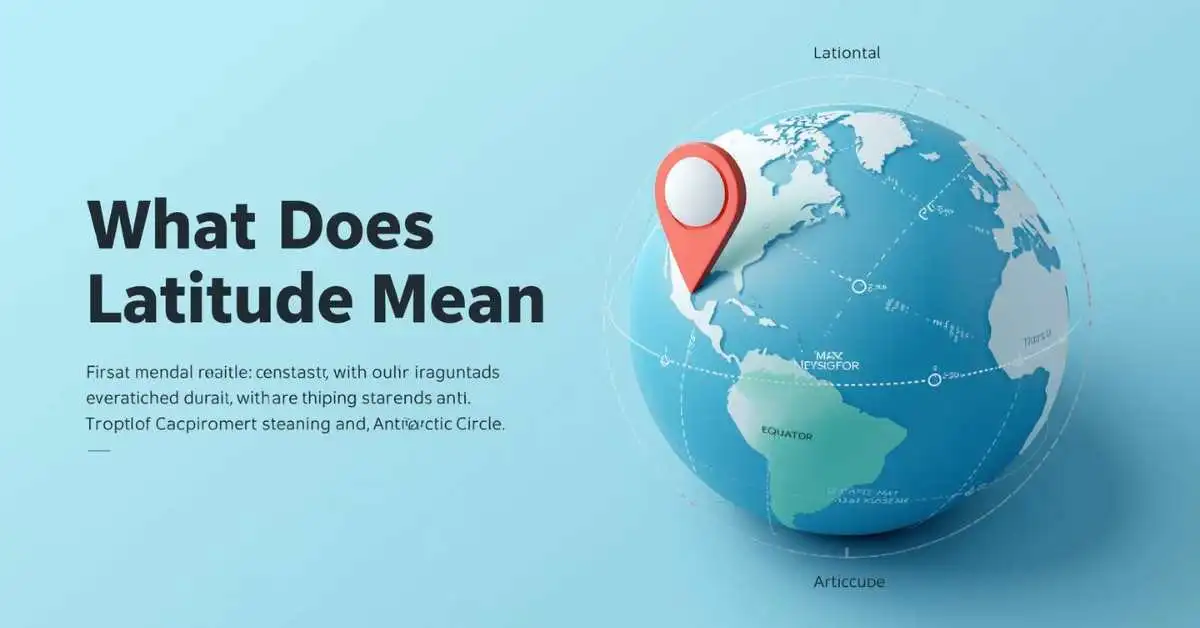
What does latitude mean? Latitude means how far a place is north or south of the Equator, measured in degrees. It helps us find places on Earth. It also helps explain maps, GPS, climate zones, and world geography.
Many people ask, what is the meaning of latitude, or what is latitude in geography. The answer is simple. Latitude is part of the system used to show the location of a place on a globe or map. It works with longitude to form coordinates.
This guide explains latitude in very simple words. You will learn what it means, how it works, how to read it on a map, and why it matters in real life.
Quick Answer: What Does Latitude Mean?
Simple Definition
Latitude is the distance of a place north or south of the Equator.
Easy Example
- 0° latitude = Equator
- 20° N = 20 degrees north of the Equator
- 45° S = 45 degrees south of the Equator
Why It Matters
Latitude helps with:
- maps
- GPS
- navigation
- climate zones
- geography lessons
This is the fastest answer to the question what does latitude mean.
What Is Latitude in Geography?
What Is the Meaning of Latitude?
In geography, latitude shows the north-south position of a place on Earth.
The Equator is the starting line. It is 0 degrees latitude. From there:
- places north of the Equator have north latitude
- places south of the Equator have south latitude
So, when someone asks what is latitude in geography, the answer is this: it tells how far a place is from the Equator.
Latitude Definition for Kids
A simple latitude definition for kids is:
Latitude tells how far up or down a place is from the middle of Earth.
The middle line is the Equator. Children often understand latitude faster when they think of the Equator as a belt around the Earth.
Example of Latitude in Geography
Here are easy examples:
- Quito, Ecuador is close to 0° latitude
- Cairo, Egypt is around 30° N
- Sydney, Australia is around 34° S
These numbers help us know where each place is on Earth.
How Does Latitude Work on a Map?
What Do Lines of Latitude Mean?
Many people ask, what do lines of latitude mean. These are imaginary lines that circle Earth from east to west.
They are also called parallels because they stay parallel to the Equator.
These lines help us measure distance north or south.
Example of Lines of Latitude
Imagine a globe with stripes going around it.
- the middle stripe is the Equator
- the stripes above it are north latitude
- the stripes below it are south latitude
That is how latitude lines help us locate places.
Table: Latitude Basics
| Term | Meaning |
|---|---|
| Latitude | Distance north or south of the Equator |
| Equator | 0° latitude |
| North Latitude | Above the Equator |
| South Latitude | Below the Equator |
| Parallels | Another name for lines of latitude |
How to Read Latitude on a Map
To read latitude on a map:
- Find the Equator
- Look at the horizontal lines
- Check the number of degrees
- See whether it is N or S
Example:
- 15° N means 15 degrees north of the Equator
- 22° S means 22 degrees south of the Equator
This makes the idea of what does latitude mean much easier to understand.
Latitude vs Longitude
Latitude vs Longitude: What Is the Difference?
A very common search is latitude vs longitude.
Here is the simple difference:
- Latitude shows north-south position
- Longitude shows east-west position
Latitude starts at the Equator.
Longitude starts at the Prime Meridian.
Example of Latitude vs Longitude
Take this coordinate:
40° N, 74° W
- 40° N is the latitude
- 74° W is the longitude
Together, these numbers help find an exact place on Earth.
Table: Latitude vs Longitude
| Feature | Latitude | Longitude |
|---|---|---|
| Shows | North-south position | East-west position |
| Starting Line | Equator | Prime Meridian |
| Direction | North or South | East or West |
| Line Shape | Horizontal on maps | Vertical on maps |
| Example | 25° N | 80° W |
Easy Memory Trick
A simple memory trick:
- Latitude is flat
- Longitude is long
This is not a perfect rule, but it helps beginners remember the basic idea.
What Is 0 Degrees Latitude?
What Is 0 Degrees Latitude Called?
Another common question is what is 0 degrees latitude.
The answer is simple:
0 degrees latitude is called the Equator.
The Equator is the line that divides Earth into two halves:
- Northern Hemisphere
- Southern Hemisphere
Why the Equator Matters
The Equator matters because it is the starting point for latitude.
Every latitude number is measured from this line.
Example of 0 Degrees Latitude
Places near the Equator often stay warm through most of the year.
Examples of places near the Equator include parts of:
- Ecuador
- Brazil
- Kenya
- Indonesia
That is one reason the Equator is important in both geography and climate studies.
Why Is Latitude Important?
Why Is Latitude Important in Geography?
Many people ask, why is latitude important.
Latitude is important because it helps us:
- find places on Earth
- read maps
- use GPS
- study climate
- understand world regions
Without latitude, it would be much harder to describe exact locations.
Why Is Latitude Important for Maps and GPS?
Latitude is used in:
- smartphone maps
- GPS devices
- navigation systems
- shipping routes
- air travel
- geographic coordinate systems
When you share a location pin, latitude is often part of the data.
Example from Real Life
A pilot, sailor, or map app uses latitude and longitude to find the right place.
This is why geographic coordinates matter so much.
How Does Latitude Affect Climate?
How Does Latitude Affect Climate?
A very helpful related question is how does latitude affect climate.
Latitude affects climate because sunlight hits Earth at different angles.
- places near the Equator get more direct sunlight
- places far from the Equator get less direct sunlight
That is why low latitudes are often warmer, while high latitudes are often cooler.
Example of Latitude and Climate
Compare these two places:
- a city near the Equator usually has warm weather most of the year
- a city near the Arctic Circle usually has colder weather and bigger seasonal changes
So, latitude helps explain temperature, seasons, and climate zones.
Table: Latitude and Climate Zones
| Latitude Zone | General Climate |
|---|---|
| Near 0° | Tropical and warm |
| Around 23.5° to 40° | Warm to mild |
| Mid-latitudes | Temperate |
| Near 66.5° and beyond | Polar and very cold |
Why Sunlight Changes by Latitude
This happens because Earth is curved.
Sunlight is more direct near the Equator. It spreads out more near the poles.
That simple fact explains a lot about world climate.
Major Lines of Latitude You Should Know
Important Latitude Lines
Some lines of latitude are very important in geography.
Here are the main ones:
| Line | Latitude |
|---|---|
| Equator | 0° |
| Tropic of Cancer | 23.5° N |
| Tropic of Capricorn | 23.5° S |
| Arctic Circle | 66.5° N |
| Antarctic Circle | 66.5° S |
| North Pole | 90° N |
| South Pole | 90° S |
Example of Why These Lines Matter
These lines help us understand:
- tropical zones
- temperate zones
- polar regions
- daylight patterns
- Earth’s climate system
For example, the Tropic of Cancer and Tropic of Capricorn help mark the tropical region. The Arctic Circle and Antarctic Circle help mark the polar zones.
Related Geography Entities
These terms are closely linked to latitude:
- Earth
- globe
- map
- Equator
- hemispheres
- poles
- Prime Meridian
- coordinates
- GPS
- cartography
- navigation
- climate zones
- parallels
- degrees
These related entities help strengthen topical relevance and semantic SEO.
Real Examples of Latitude
Example 1: A Place Near the Equator
A city near 0° latitude is close to the Equator.
That usually means:
- strong sunlight
- warm temperatures
- small seasonal changes
Example 2: A Mid-Latitude Place
A place around 40° N or 40° S is in the mid-latitudes.
That often means:
- four seasons
- milder sunlight than the tropics
- bigger weather changes during the year
Example 3: A High-Latitude Place
A place near 70° N is in a high-latitude area.
That often means:
- cold climate
- short winter days
- long summer days
These examples make the meaning of latitude easier to see in real life.
Common Mistakes About Latitude
Mistake 1: Thinking Latitude Means East and West
That is wrong.
Latitude means north and south.
Longitude means east and west.
Mistake 2: Thinking Latitude Lines Go Up and Down
They do not.
Lines of latitude go around Earth from east to west.
But they measure how far north or south a place is.
Mistake 3: Forgetting the Equator
Latitude always starts from the Equator.
That is why the Equator is so important in geography.
Example of a Common Error
- 30° N is not the same as 30° S
- one is north of the Equator
- the other is south of the Equator
The degree number may be the same, but the location is different.
How to Understand Latitude Fast
One-Sentence Answer
Here is the simplest answer again:
Latitude means how far a place is north or south of the Equator, measured in degrees.
Three Easy Words to Remember
Think of latitude like this:
- location
- lines
- degrees
Example for Quick Recall
If someone asks you, what does latitude mean, you can say:
“It tells where a place is above or below the Equator.”
That is short, correct, and easy to remember.
FAQ About Latitude
What does latitude mean in simple words?
Latitude means how far a place is north or south of the Equator.
What is the meaning of latitude in geography?
In geography, latitude shows the north-south position of a place on Earth.
What is 0 degrees latitude?
0 degrees latitude is the Equator.
What do lines of latitude mean?
They are imaginary lines that circle Earth and help show distance north or south of the Equator.
How does latitude affect climate?
Latitude affects climate because sunlight hits places at different angles. Places near the Equator are usually warmer than places near the poles.
Why is latitude important?
Latitude is important because it helps with maps, GPS, navigation, geography, and climate understanding.
What is the difference between latitude and longitude?
Latitude measures north-south position. Longitude measures east-west position.
Conclusion
So, what does latitude mean?
Latitude means the distance of a place north or south of the Equator, measured in degrees. It is a basic part of geography, maps, and GPS. It also helps explain climate, hemispheres, and how Earth is divided into regions.
Click Here For Read About: What Does Permanent Press Mean? Easy Laundry Guide

Hi, I’m Evan Lexor, the voice behind Meanvia.com. I break down English words, slang, and phrases into clear, simple meanings that actually make sense. From modern internet terms to everyday expressions, my goal is straightforward: help you understand English better, faster, and with confidence, one word at a time.