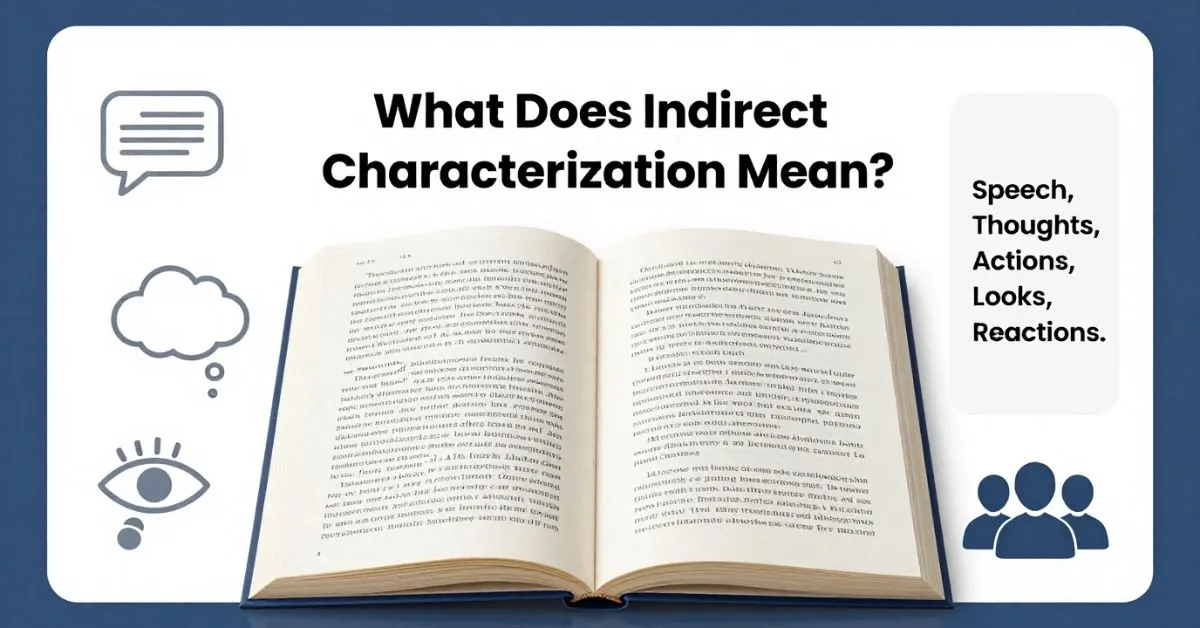
Indirect characterization means an author shows what a character is like through clues such as speech, thoughts, actions, appearance, and other characters’ reactions instead of stating the character’s traits directly. The reader has to infer the personality from the evidence in the story.
If a story says, “Nina was brave,” that is direct characterization. If the story shows Nina stepping in front of danger to protect someone else, that is indirect characterization.
This literary term appears often in English class, reading passages, novels, and character analysis assignments because it helps readers move beyond simple labels.
Instead of being told what a character is like, you gather clues and interpret them. That makes the character feel more real and the reading experience more active.
What indirect characterization means in simple words
In simple words, indirect characterization is when a writer shows a character’s personality instead of telling it.
The writer may reveal that personality through:
- what the character says
- what the character thinks
- what the character does
- how the character looks
- how other people react to the character
So when people search “what does indirect characterization mean,” they usually want this basic answer:
It is a way of revealing character traits indirectly through evidence rather than direct description.
That evidence can suggest that a character is kind, jealous, nervous, dishonest, thoughtful, arrogant, loyal, insecure, determined, or something more complex.
The key point is that the story gives you clues, and you draw the conclusion.
Why indirect characterization matters
Indirect characterization matters because it adds depth.
When a writer simply tells you a trait, you get the information quickly. When a writer shows the trait through dialogue, behavior, body language, motives, and reactions, the character feels fuller and more believable.
It also matters because this is one of the most common skills teachers test in literary analysis and reading comprehension.
Many students know the definition but struggle to identify it in a passage. That usually happens because they are looking for a direct label instead of looking for evidence.
Indirect vs. direct characterization
This is the first distinction most readers need to understand clearly.
| Type | What it does | Example |
|---|---|---|
| Direct characterization | Tells the reader the trait directly | “Hassan was generous.” |
| Indirect characterization | Shows clues so the reader infers the trait | “Hassan gave his lunch away and laughed when someone tried to thank him.” |
Direct characterization is faster and more explicit.
Indirect characterization is more interpretive. It asks the reader to notice details and infer what those details mean.
Both methods can appear in the same story. A writer may directly describe a character in one sentence and then deepen that impression through actions, speech, and reactions from others. Good writing often uses both.
How to identify indirect characterization in a passage
This is where many articles stay too vague. The easiest way to identify indirect characterization is to use a simple three-step process.
Step 1: Find the clue
Look for a detail that reveals something about the character.
That clue might appear in:
- dialogue
- internal thoughts
- actions
- mannerisms
- body language
- clothing or appearance
- reactions from other characters
- choices under pressure
Step 2: Infer the trait
Ask yourself what that clue suggests.
For example:
- interrupting others may suggest impatience
- avoiding eye contact may suggest guilt, nervousness, or insecurity
- staying calm during a crisis may suggest confidence or leadership
- quietly helping someone may suggest kindness or loyalty
Step 3: Check the context
Do not jump to a trait too quickly.
One clue does not always prove a personality trait. Context matters. A character who is quiet in one scene may be shy, angry, tired, cautious, respectful, or simply distracted. Strong analysis looks at repeated patterns and surrounding details.
A simple formula for answering school questions
Use this pattern:
clue + trait + explanation
Example:
“Maria keeps rereading her notes and rubbing her hands before speaking, which indirectly characterizes her as nervous because her actions show clear anxiety before the presentation.”
This makes your answer much stronger than simply writing, “Maria is nervous.”
The STEAL method explained
A common way to understand indirect characterization is the STEAL method. This gives you five main clue types to look for.
S = Speech
What does the character say, and how do they say it?
A character’s speech can reveal confidence, arrogance, humor, insecurity, kindness, anger, or dishonesty.
Example:
“I’ve already fixed your mistake,” Adrian said before anyone asked for help.
This may suggest confidence, impatience, or a need to feel superior.
T = Thoughts
What does the character think privately?
Thoughts often reveal fears, motives, jealousy, guilt, or hopes that are not obvious in public behavior.
Example:
Layla congratulated her friend, but secretly wondered why success never seemed to find her first.
This suggests envy, frustration, or insecurity.
E = Effect on others
How do other characters respond?
Sometimes the clearest clue about a character comes from the way others behave around them.
Example:
As soon as the coach walked in, the room went silent and everyone sat straighter.
That reaction suggests authority, strictness, or intimidation.
A = Actions
What does the character do?
Actions are often the strongest form of indirect characterization because behavior reveals priorities and values.
Example:
Even after losing the debate, Jonah stayed behind to help his teammate practice for the next round.
This suggests maturity, resilience, or loyalty.
L = Looks
What does the character’s appearance suggest?
Appearance only counts when it adds meaningful insight, not when it only gives a neutral fact.
Example:
Her uniform was neatly pressed, but the shoes were badly worn and carefully polished.
This may suggest pride, discipline, or an effort to maintain dignity despite limited resources.
Indirect characterization examples
Examples are where this concept usually becomes clear.
Example 1: Kindness through action
“The new student stood alone in the cafeteria, and Amina moved over without announcing her kindness to anyone.”
The text never says Amina is kind, but her action suggests it.
Example 2: Nervousness through body language
“Rafi kept tapping his pen against the desk and swallowed before every sentence.”
The text does not say he is nervous, but his body language strongly suggests it.
Example 3: Arrogance through speech
“I knew you’d all need me eventually,” Marcus said, smiling before anyone responded.
This indirectly characterizes Marcus as arrogant or overly self-important.
Example 4: Loyalty through repeated choices
Although she knew helping him might get her in trouble too, Sana returned after school every day until he understood the work.
This suggests loyalty, patience, and commitment.
Example 5: A short passage analysis
Read this sentence:
“Eva folded the letter twice, slipped it into her pocket, and answered her mother with a smile that disappeared the moment she turned away.”
What does that suggest?
- Clue: hiding the letter, forced smile, change in expression
- Possible trait or state: secrecy, worry, emotional conflict
- Better interpretation: Eva is likely hiding something important and feels uneasy about it
Notice that strong analysis does not always jump to a permanent personality label. Sometimes indirect characterization reveals a temporary emotional state, motive, or inner conflict.
A quick-reference table: clue, inference, and caution
| Story clue | Likely inference | What to be careful about |
|---|---|---|
| Interrupts people often | Impatient, arrogant | Could also be excitement or anxiety |
| Refuses help, insists on doing everything alone | Independent, proud, stubborn | Context decides which trait fits best |
| Keeps promises even when inconvenient | Loyal, responsible | Look for repeated behavior |
| Smiles while clenching fists | Angry, tense, hiding emotion | Body language can show conflict |
| Other characters trust them quickly | Reliable, calm, respected | Ask why they trust them |
| Dresses neatly despite hardship | Disciplined, self-respecting | Appearance needs context to mean more |
This is important: indirect characterization often works through patterns, not just isolated details.
Is indirect characterization the same as “show, don’t tell”?
They are closely related, but not exactly identical.
“Show, don’t tell” is a broader writing principle. It encourages writers to reveal information through scenes, details, and action instead of flat explanation.
Indirect characterization is one specific way that “show, don’t tell” works. It focuses on showing what a character is like rather than directly labeling the character.
So if you are wondering whether they are the same, the simplest answer is this:
Indirect characterization is a form of showing.
Why writers use indirect characterization
Writers use indirect characterization because it creates depth, realism, and subtext.
Instead of giving the reader a label like “kind,” “jealous,” or “brave,” the writer lets the audience notice patterns and draw conclusions.
This often feels more natural because real people are not understood through labels alone. We understand them through behavior, speech, attitude, and how they treat others.
Indirect characterization also helps with:
- character development
- tension and suspense
- subtle storytelling
- emotional complexity
- stronger reader engagement
It is especially useful when a writer wants a character to seem contradictory, layered, or difficult to read at first.
What most articles miss about this topic
Most articles explain the definition correctly, but they often miss the deeper reading skill behind it.
1. Indirect characterization is really about inference
This term is not just a writing label. It is a reading skill. You are being asked to move from textual evidence to meaning.
That is why it appears so often in school assignments, test passages, and literary analysis.
2. One clue is not always enough
A lot of weak explanations make it sound like every small detail has one fixed meaning. That is not true.
A character who avoids eye contact may be shy, guilty, respectful, embarrassed, or frightened. Strong interpretation depends on context, repetition, narration, and surrounding details.
3. Indirect characterization can reveal emotion, motive, or personality
Not every clue points to a permanent trait. Sometimes it reveals a temporary emotional state, hidden motive, or internal conflict.
That distinction helps readers avoid shallow analysis.
4. Contradictory clues can be intentional
A writer may present a character who sounds polite but acts selfishly, or looks confident but thinks fearfully. That is not bad writing. It is often how writers create subtext and layered characterization.
5. Appearance only matters when it means something
Many students assume any physical description counts as indirect characterization. It does not.
“Tall,” “brown hair,” or “blue coat” are usually just details.
But “perfectly ironed sleeves with fraying cuffs” may suggest discipline, pride, or financial strain. The description matters when it points beyond surface appearance.
Common mistakes students make
Treating one detail as final proof
Do not overread one small clue. Look for patterns.
Confusing direct and indirect characterization
If the text directly says “he was rude,” that is direct characterization.
If the text shows him mocking people and rolling his eyes, that is indirect characterization.
Ignoring the narrator or point of view
Sometimes what you know about a character depends on who is telling the story. Narration can shape how a character appears.
Giving a trait without evidence
In essays and classwork, naming a trait is not enough. You need the clue that supports it.
How to write about indirect characterization in an essay
If you are analyzing a story, here is a clean way to write about it:
- identify the clue
- name the likely trait or emotion
- explain how the clue supports that interpretation
- connect it to the character’s role, conflict, or development if needed
Example analysis sentence
“The author indirectly characterizes Daniel as stubborn through his refusal to ask for help, even when his solution is clearly failing.”
Stronger extended version
“The author indirectly characterizes Daniel as stubborn through both action and dialogue. He ignores repeated advice, insists he can solve the problem alone, and becomes defensive when questioned. These details suggest that his pride is shaping his decisions.”
That kind of sentence is much stronger because it uses evidence and interpretation together.
Indirect characterization in stories, novels, and even film
Indirect characterization is not limited to novels.
You can see it in:
- short stories
- plays
- films
- television
- classroom reading passages
- narrative essays
In film, for example, a character may be indirectly characterized through costume, silence, facial expression, movement, and the reactions of others. The medium changes, but the principle stays the same: the audience infers who the character is from what is shown.
FAQ
What is indirect characterization in simple words?
It means a writer shows what a character is like through clues instead of directly stating the trait.
What is a short example of indirect characterization?
“Zoya checked the lock twice and looked over her shoulder before entering.” This suggests caution, fear, or anxiety without directly saying it.
What is the difference between direct and indirect characterization?
Direct characterization tells the trait clearly. Indirect characterization shows evidence so the reader infers the trait.
What does STEAL stand for?
Speech, Thoughts, Effect on others, Actions, and Looks.
Is dialogue indirect characterization?
Yes. Dialogue can indirectly reveal confidence, dishonesty, kindness, arrogance, fear, or many other traits.
Can appearance count as indirect characterization?
Yes, but only when the appearance suggests something meaningful beyond a neutral physical description.
Why do teachers ask about indirect characterization so often?
Because it tests whether you can use textual evidence and inference instead of only repeating what the text says directly.
Conclusion
Indirect characterization means an author reveals a character through clues rather than direct labels. Once you understand that it works through speech, thoughts, actions, looks, and other characters’ reactions, the term becomes much easier to identify.
The simplest way to remember it is this: direct characterization tells, indirect characterization shows.
Click Here To Read About:
What Does Mhm Mean in Text?
What Does Marketing Mean? Purpose, Types, Real Examples
What Does DRL Mean in a Car? Daytime Running Lights Explained

Hi, I’m Clara Lexis from Meanvia.com. I break down words and expressions so they’re easy to understand and enjoyable to learn. My mission is simple: make language approachable and fun, one word at a time.