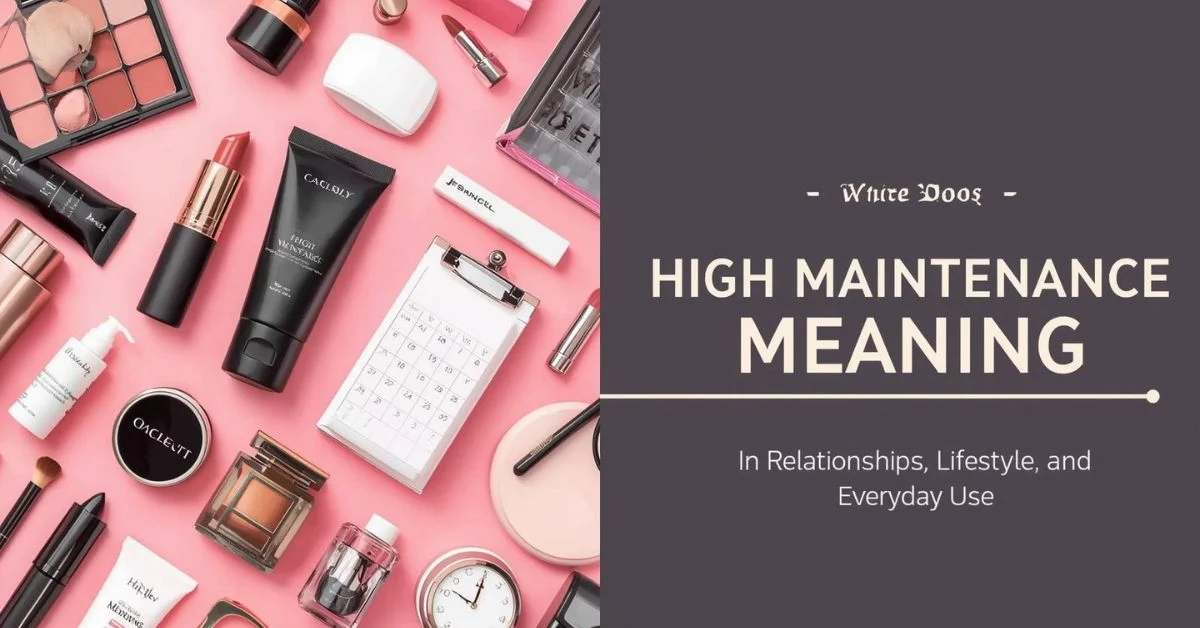
High maintenance usually means needing a lot of care, attention, time, money, effort, or upkeep. It can describe a person, a relationship dynamic, a lifestyle, or even a thing like a car, garden, hairstyle, or pet.
Major dictionaries consistently split the meaning this way: something that needs a lot of maintenance, or a person who needs a high level of care and attention.
If you heard someone call a person “high maintenance,” they usually mean that being around them takes more emotional energy, attention, reassurance, planning, or accommodation than usual.
If they are talking about an object or routine, they usually mean it takes more upkeep, work, or money to maintain.
What does high maintenance mean in simple words?
In simple words, high maintenance means hard to keep up with.
That could mean:
- more attention
- more effort
- more money
- more emotional energy
- more upkeep
So if something is high maintenance, it usually takes more work than average to keep it going smoothly.
Quick meaning at a glance
| Context | What high maintenance usually means |
|---|---|
| Person | Needs a lot of attention, care, reassurance, or accommodation |
| Relationship | Requires a lot of effort, emotional energy, or constant input |
| Appearance or lifestyle | Takes a lot of time, money, or upkeep |
| Object or possession | Needs frequent maintenance, repairs, or care |
| Pet, plant, or home | Requires regular attention to stay in good condition |
What does high maintenance mean when describing a person?
When used for a person, high maintenance usually means they require a high level of care, attention, or effort from other people.
Collins and Dictionary.com explicitly mark this person-focused sense as informal, and Merriam-Webster adds that it can imply being demanding, sensitive, or temperamental.
In everyday conversation, people often use it for someone who:
- wants constant reassurance
- needs frequent attention
- has strong or very specific preferences
- becomes upset when things are not done a certain way
- expects a lot of emotional labor, time, or special treatment
That does not always mean the person is wrong, spoiled, or unreasonable. It usually means that dealing with their needs feels more demanding than average.
What does high maintenance mean in a relationship?
In relationships, high maintenance usually means one partner seems to need a lot of attention, communication, reassurance, effort, planning, or emotional energy.
People may use the phrase when someone expects:
- constant texting or check-ins
- repeated reassurance
- expensive dates, gifts, or gestures
- lots of validation
- a very specific kind of treatment
- emotional support at a level the other person finds exhausting
This is where the phrase becomes tricky.
Sometimes it is a fair description of genuinely demanding behavior. But sometimes people use high maintenance too casually when they really mean:
- “This person has standards.”
- “This person communicates their needs clearly.”
- “This person expects consistency.”
- “This person wants more effort than I want to give.”
That is why context matters. The label is common, but it is not always neutral.
Is high maintenance always negative?
No. But it is often used critically.
The phrase can be:
- neutral, when talking about upkeep
- playful, when used lightly
- negative, when used to criticize a person
For example:
- “That car is high maintenance.”
- “Her hair color is high maintenance.”
- “He is high maintenance in relationships.”
The first two are often practical. The third usually carries judgment.
So the phrase does not automatically mean bad, but when used about a person, it often suggests that the person is difficult to please, demanding, or tiring to manage.
That negative shade is reflected in dictionary synonym groupings such as demanding, difficult, or troublesome.
What can be high maintenance besides a person?
A lot of things.
Dictionaries also use high maintenance in the literal sense of something that requires a lot of care, regular maintenance, repair, or effort to keep in working order.
Common examples include:
Beauty and appearance
- bleached hair
- long acrylic nails
- elaborate skincare routines
- clothes that need special care
- styles that require daily upkeep
Homes and possessions
- sports cars
- large gardens
- delicate fabrics
- old houses
- luxury items
Pets, plants, and hobbies
- pets that need frequent grooming
- plants with strict light or watering needs
- hobbies that require costly gear and regular attention
In all of these cases, the meaning is simple: it takes work to maintain.
High maintenance vs needy vs demanding vs high standards
These terms overlap, but they are not the same.
| Term | What it usually means | Key difference |
|---|---|---|
| High maintenance | Requires a lot of time, effort, attention, money, or upkeep | Broad term; can describe people, relationships, routines, or things |
| Needy | Wants frequent emotional reassurance or support | More specifically emotional |
| Demanding | Expects a lot and may pressure others to meet those expectations | Stronger and more critical |
| High standards | Has clear preferences or expectations | Not automatically excessive or difficult |
This distinction matters because people often misuse the phrase.
Someone may be called high maintenance when they are actually:
- emotionally needy
- demanding
- perfectionistic
- expensive to keep up with
- or simply clear about what they want
Those are not identical.
What is the opposite of high maintenance?
The usual opposite is low maintenance.
Cambridge defines low-maintenance as not needing much attention, effort, help, or money.
So:
- a low-maintenance person is often seen as easygoing or not demanding
- a low-maintenance lifestyle is simpler and easier to keep up with
- a low-maintenance object needs less repair, care, or upkeep
Example sentences using high maintenance
These examples show how the meaning changes by context:
- She can be high maintenance in relationships because she needs constant reassurance.
- That hairstyle looks great, but it is too high maintenance for my routine.
- Imported sports cars are often seen as high maintenance because repairs can be expensive.
- This plant is beautiful, but it is high maintenance and easy to get wrong.
- He is not rude, but he is high maintenance at work and needs a lot of follow-up.
- Their lifestyle looks glamorous, but it is extremely high maintenance.
Is high maintenance an insult?
Often, yes.
When someone says a person is high maintenance, they are usually not giving neutral praise. They are often implying that the person is:
- hard to please
- emotionally draining
- expensive
- demanding
- tiring to deal with
But the phrase is still subjective.
What one person calls high maintenance, another person may call:
- normal care
- basic effort
- clear standards
- healthy communication
- personal preference
That is why the phrase should be interpreted carefully instead of automatically accepted as fact.
When the label is fair and when it is unfair
It may be fair when:
- someone constantly demands more than others can reasonably give
- they create unnecessary stress around ordinary situations
- they are rarely satisfied
- they expect ongoing special treatment without balance or reciprocity
It may be unfair when:
- someone simply has boundaries
- they communicate their needs clearly
- they want consistency, respect, or effort
- their preferences are treated as a problem just because they are not passive
This is one of the biggest points most short definition pages miss.
The phrase high maintenance can describe real behavior, but it can also be used as a lazy label when someone does not want to meet another person’s expectations.
Common mistakes people make with this phrase
1. Treating it as only a relationship term
It is often used in dating, but it also applies to routines, beauty, homes, cars, pets, products, and lifestyles.
2. Assuming it only means expensive
Money is one part of it, but time, effort, attention, and emotional energy also count. Collins explicitly includes attention, time, money, and effort in its definition.
3. Assuming it only applies to women
It does not. Dictionaries define the term broadly, and the person-focused sense is not limited to one gender.
4. Confusing standards with excessive demands
Having preferences or boundaries does not automatically make someone high maintenance.
5. Ignoring tone and context
The same phrase can sound practical, playful, rude, or dismissive depending on how it is used.
What Most Articles Miss About This Topic
Most articles stop at “high maintenance means demanding,” but that is too shallow.
Here is what actually helps readers understand the phrase:
The term has two core meanings
The strongest dictionary entries split it into:
- something that needs upkeep
- a person who needs a lot of care, attention, or effort
The person meaning often carries judgment
When used for people, the phrase is rarely purely descriptive. It often suggests frustration, criticism, or emotional burden.
It is partly subjective
There is no exact universal line where someone officially becomes high maintenance. The label depends on expectations, personality, and context.
It is broader than “needy”
A person can be emotionally needy without being expensive or hard to manage in every way. High maintenance is the wider label.
The opposite is not always morally better
Low maintenance is often praised, but being easier to deal with is not always the same as being healthier, clearer, or more emotionally honest.
Practical takeaway
If you want the plainest possible answer, here it is:
High maintenance means requiring more care, attention, effort, money, or upkeep than usual.
If the phrase is about a person, it usually means they seem more demanding or harder to keep happy. If it is about a thing, routine, or lifestyle, it usually means it takes more work to maintain.
The smartest way to interpret it is to ask:
- What kind of effort is being talked about?
- Is the speaker being practical or judgmental?
- Is the label actually fair?
FAQs
Q: High maintenance meaning girl
A: A high-maintenance girl is someone who may expect extra attention, effort, care, or comfort from others.
Q: High maintenance meaning in relationship
A: In a relationship, high maintenance describes someone who needs a lot of attention, reassurance, effort, or specific treatment.
Q: Low-maintenance meaning
A: Low-maintenance means someone or something that needs little attention, effort, care, or upkeep.
Q: High maintenance girl meaning in relationship
A: A high-maintenance girl in a relationship may expect frequent attention, reassurance, affection, and extra effort from her partner.
Q: High-maintenance synonym
A: Common synonyms for high-maintenance include demanding, needy, particular, demanding of attention, and difficult to please.
Q: Is high maintenance a compliment
A: High maintenance is usually not a compliment, although it can sometimes describe someone positively as having high standards.
Q: High maintenance in a sentence
A: She is considered high maintenance because she expects constant attention and carefully planned dates.
Q: High maintenance friend meaning
A: A high-maintenance friend is someone who may require frequent attention, support, reassurance, or effort to maintain the friendship.
Conclusion
High maintenance means needing more care, attention, effort, money, or upkeep than usual. The phrase can describe a person, a relationship dynamic, a beauty routine, a lifestyle, or a physical thing that takes work to maintain. That broad, two-part definition is the one reflected across major dictionaries, even though everyday use often adds a more judgmental tone when the phrase is aimed at people.
The most useful way to understand the phrase is not just to memorize the definition, but to read the context. That is what tells you whether it means expensive, demanding, emotionally draining, or simply hard to maintain.
Click Below To Read About These Posts:
What Does Exposition Mean in a Story? Complete Guide
What Does Bop Mean on TikTok? Complete Guide & Explanation
What Does Bon Appétit Mean? Complete Meaning & Explanation
Hi, I’m Clara Lexis from Meanvia.com. I break down words and expressions so they’re easy to understand and enjoyable to learn. My mission is simple: make language approachable and fun, one word at a time.