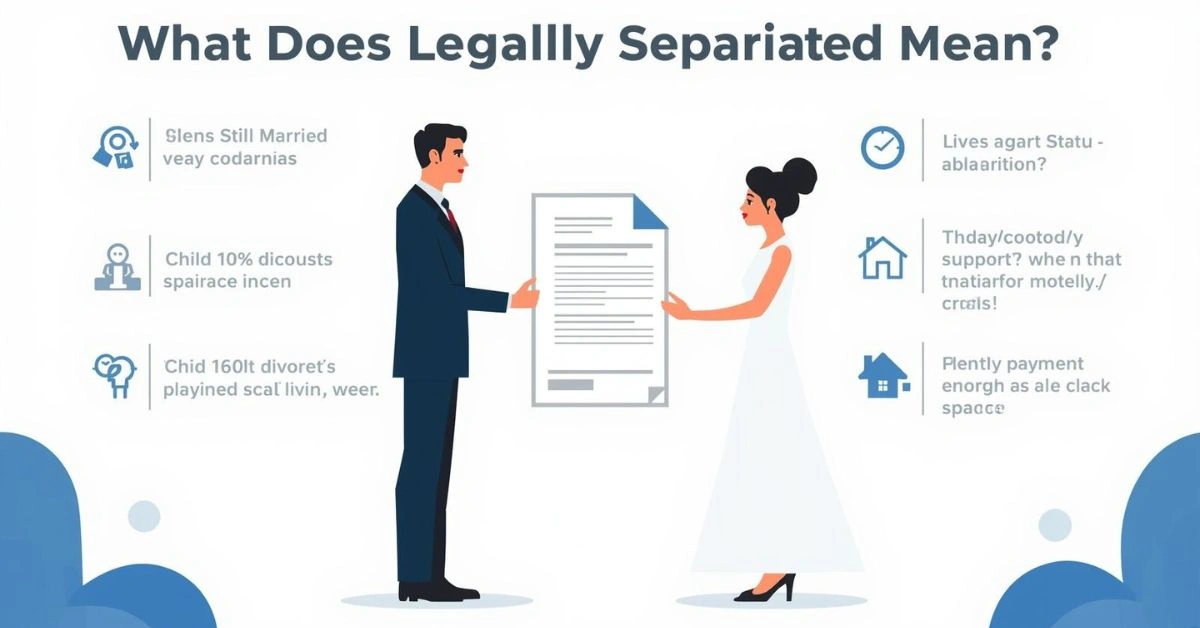
Legally separated usually means a married couple is living apart under a recognized legal arrangement while still remaining legally married.
In many places, a court can make orders about property, debts, child custody, child support, or spousal support, but the marriage itself is not ended. The exact meaning and process can vary by state or country.
If you came here for the simple answer, that is it: legal separation is not the same as divorce. It often creates real legal consequences, but it does not automatically make you unmarried or free to remarry.
Important note: this article gives general educational information, not legal advice. Legal separation rules differ by jurisdiction, and some places handle separation very differently from others.
Quick answer: separated vs legally separated vs divorced
| Status | Are you still legally married? | Is court involvement usually required? | Can you remarry? | What usually changes? |
|---|---|---|---|---|
| Just separated | Usually yes | Not always | No | You may be living apart, but without the same formal legal status |
| Legally separated | Yes | Often yes, depending on local law | No | The court or a formal legal arrangement may address money, parenting, property, and support |
| Divorced | No | Yes | Yes | The marriage is legally ended |
This is the distinction most readers want first: legal separation can change rights and responsibilities, but divorce ends the marriage itself.
What legally separated means in simple terms
In simple words, being legally separated usually means this:
- you and your spouse are no longer living together as a married couple
- you are still legally married
- some legal rules may now govern your finances, parenting, property, or support
- the legal effect depends on where you live and how the separation was created
Cornell describes legal separation as an arrangement where a married couple lives apart but remains legally married, and notes that rights can differ depending on the form of separation and the jurisdiction.
California Courts explains that in a legal separation, the court can divide property and debts and make orders about support and children, while the marriage remains intact.
That is why the phrase matters. It is not just an emotional label like “we’re taking a break.” In many contexts, it points to a legal status or formal arrangement with real consequences.
Are you still married if you are legally separated?
Yes, in general, you are still married if you are legally separated. That is one of the most important things people misunderstand.
California Courts says plainly that legal separation does not end the marriage, and Cornell’s definition makes the same point.
That means legal separation usually does not let you remarry. If you want the marriage to end, you usually need a divorce rather than a legal separation.
Legally separated vs just separated
Many couples say they are “separated” simply because they live apart. But that does not always mean they are legally separated.
A plain separation can be informal. It may mean the relationship has broken down and the spouses no longer live together, but there may be no court order and no formal legal arrangement.
Legal separation, by contrast, usually involves either a court-recognized process or a legally meaningful agreement, depending on the jurisdiction.
This distinction also matters for taxes. The IRS says that if you are separated but not legally separated or divorced at the end of the year, you are generally treated as married for filing purposes until there is a final decree of divorce or separate maintenance.
If you are legally separated or divorced at year-end, you generally must file as single unless you qualify for another status such as head of household or remarry by year-end.
Legally separated vs divorced
This is the second big question readers usually have.
Legal separation
- keeps the marriage legally in place
- can still deal with property, debts, support, custody, and parenting issues
- usually does not allow remarriage
Divorce
- legally ends the marriage
- also addresses property, debts, support, and children
- usually allows remarriage after the divorce is final
California Courts explains that legal separation and divorce can both involve court orders on finances and children, but only divorce ends the marriage.
Cornell also notes that some states allow a later “conversion divorce,” meaning a legal separation may eventually be converted into a divorce after a required period or additional steps.
How do you become legally separated?
This is where many articles stay too vague.
There is not one universal process. In some places, legal separation is created through a court filing and judgment. In some places, a written separation agreement plays a central role. And in some places, the term is handled differently or is not formally recognized in the same way.
For example:
1. Court-ordered legal separation
California Courts treats legal separation as a court case. The court can make orders about property, debts, support, and children, much like in divorce, except the marriage stays intact.
California also notes that legal separation does not have the same residency requirement as divorce, and a case can later be changed to divorce before it is final.
2. Separation agreement model
LawHelpNY explains legal separation as living apart while following a written separation agreement, and notes that if a spouse does not follow the agreement, family court may enforce it.
3. Different or limited recognition depending on the state
Investopedia notes that not all states officially recognize legal separation and that some offer alternatives instead. That is why a person should never assume the exact same process applies everywhere.
What can legal separation change?
Legal separation can be serious because it may settle many of the practical issues that matter most in day-to-day life.
Depending on local law, legal separation can affect:
- property division
- who pays which debts
- spousal support or maintenance
- child custody
- visitation or parenting time
- child support
- tax filing status
- some benefits, depending on law and plan terms
California Courts specifically lists property, debts, spousal support, child custody, visitation, and child support as issues the court can address in a legal separation case.
Cornell’s entry on separation agreements also notes that such agreements may govern property division, alimony or maintenance, child support, and child custody.
This is why legal separation is not just a softer word for “relationship problems.” It can shape how money, parenting, and legal responsibilities work while the spouses remain married.
What legal separation usually does not change
Legal separation may change many practical rights, but it usually does not change the core fact that the marriage still exists. That means:
- you usually remain legally married
- you usually cannot remarry
- your rights may still depend on marital status in some settings
- the final legal consequences still depend on local law and the terms of any order or agreement
Cornell notes that because the parties remain married, the continuing marital status can still affect certain legal rights. California Courts also makes clear that legal separation does not end the marriage.
Why some couples choose legal separation instead of divorce
People do not choose legal separation for only one reason.
Common reasons include:
- religious or personal objections to divorce
- needing time before deciding whether to end the marriage
- wanting formal orders for money or parenting without ending the marriage
- possible insurance or benefit concerns, depending on the situation
- residency or procedural reasons in places where divorce rules are different
California Courts says some people choose legal separation for religious reasons, financial reasons, or because they do not meet divorce residency requirements yet.
LawHelpNY also notes that some people choose it because they are not ready for divorce or want to preserve health insurance.
A careful caution matters here: possible benefit continuation is not guaranteed just because a couple is legally separated. Whether a benefit continues depends on the specific policy, plan, employer, and law involved.
What varies by state or country
This is one of the most important clarifications, and many articles do not explain it strongly enough.
The phrase “legally separated” does not mean exactly the same thing everywhere. Cornell explicitly notes that the rights of legally separated parties may differ depending on the form of separation and the laws of the jurisdiction where they live.
LawHelpNY describes a written-agreement model. California Courts treats legal separation as a court action. Investopedia notes that not all states officially recognize legal separation at all.
So if you see “legally separated” on:
- a court form
- a tax return
- an insurance form
- a benefits application
- an immigration or government document
you should not assume the phrase works the same way in every setting. The form may rely on a legal definition that depends on your jurisdiction or the rules of that agency. The IRS, for example, uses year-end marital status rules for filing.
How to know what “legally separated” means in your situation
A practical way to think about it is this:
You may be legally separated if:
- there is a court order or judgment recognizing the separation
- you signed a valid separation agreement in a place where that carries legal effect
- the relevant form or law specifically treats your status as legally separated
You may not be legally separated if:
- you only moved out
- you are living apart but filed nothing
- you call yourselves separated, but there is no legal document or recognized status behind it
- your jurisdiction does not treat your situation as legal separation
That is why the safest reading is not “we live apart, so we must be legally separated.” The safer reading is: living apart and legal separation are not automatically the same thing.
Real-life examples
Example 1: Living apart, no paperwork
A couple stops living together and tells friends they are separated. They have no court order and no written separation agreement.
In many situations, that may mean they are simply separated, not legally separated. Tax treatment may still follow married rules unless there is a final decree or another qualifying status.
Example 2: Formal separation without divorce
A spouse files for legal separation in a state that recognizes it. The court decides who stays in the home, how debts are handled, how parenting time works, and whether support is owed. The couple is still married, but many practical issues are now legally structured.
Example 3: Written agreement instead of immediate divorce
A couple signs a written separation agreement that covers property, maintenance, and parenting arrangements, and that agreement has legal significance where they live. They remain married, but their responsibilities are more clearly defined.
Common misconceptions
“Legal separation is just another word for divorce.”
No. Divorce ends the marriage. Legal separation usually does not.
“If we moved out, we are legally separated.”
Not necessarily. Moving out may mean you are separated in an everyday sense, but legal separation usually requires more than that.
“All states handle legal separation the same way.”
No. The meaning and process can differ substantially by jurisdiction, and some states use alternatives or do not formally recognize legal separation in the same way.
“If I’m legally separated, I can remarry.”
Usually no. Legal separation typically leaves you still married.
“A separation agreement is always the same as legal separation.”
Not always. A separation agreement is a contract between spouses, but whether it creates or proves legal separation depends on local law.
FAQ
Is legally separated the same as divorced?
No. Legal separation usually means you are still married but living apart under a recognized legal arrangement. Divorce legally ends the marriage.
Are you still legally married if you are legally separated?
Yes, generally. That is one of the core differences between legal separation and divorce.
Can you remarry if you are legally separated?
Usually no, because the marriage has not been dissolved.
Does living apart automatically make you legally separated?
No. Living apart may be informal separation, but legal separation usually depends on a court order, agreement, or another recognized legal basis, depending on the jurisdiction.
Does legal separation affect taxes?
It can. The IRS says filing status generally depends on marital status on the last day of the year and treats being legally separated differently from merely living apart.
Do all states recognize legal separation?
No. Recognition and process vary, and some states use alternatives instead of formally recognizing legal separation in the same way.
Can legal separation later become divorce?
In some places, yes. Cornell notes that some states allow a later conversion divorce, and California says a legal separation case can be changed to a divorce before it becomes final.
Conclusion
If you want the clearest possible takeaway, here it is: “legally separated” usually means living apart while still legally married under a recognized legal arrangement. It can affect money, parenting, property, support, and taxes, but it does not automatically end the marriage.
Because the exact legal effect varies by jurisdiction, the safest next step is to check your local court rules or get family-law advice if the term affects your rights, filings, benefits, or future plans.
Click Below To Read About These Psots:
What Does “Hot and Mean” Mean in Slang and Dating?
What Does Bon Appétit Mean? Complete Meaning & Explanation

Hi, I’m Evan Lexor, the voice behind Meanvia.com. I break down English words, slang, and phrases into clear, simple meanings that actually make sense. From modern internet terms to everyday expressions, my goal is straightforward: help you understand English better, faster, and with confidence, one word at a time.