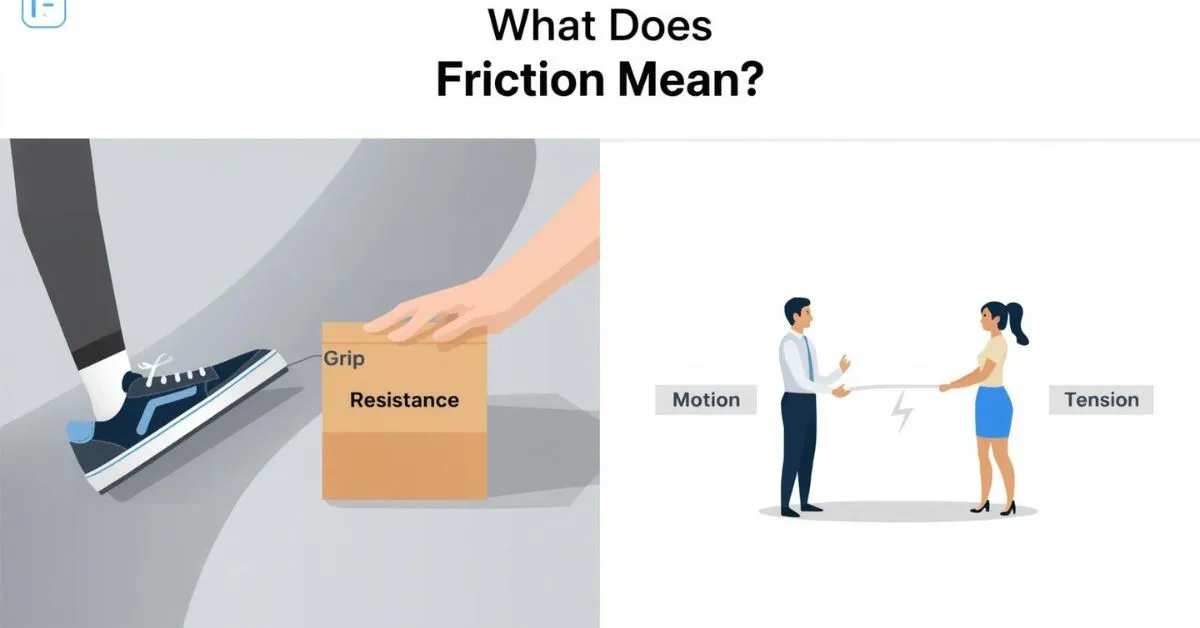
Friction means a force that resists motion when two surfaces touch, or when something moves through a fluid such as air or water.
In everyday language, friction can also mean tension or disagreement between people. In physics, friction is not just a slowdown force. It is also what gives you grip, traction, and control.
If you walk without slipping, stop a car with brakes, rub your hands together, or hear someone talk about “friction” in a team, you are seeing the same core idea in different forms: resistance.
The strongest version of this topic is not a dictionary-style definition alone. It explains what friction is, why it happens, when it helps, when it hurts, and how to use the word correctly in both science and everyday life.
What does bashful mean
“Bashful” means shy, nervous, or easily embarrassed, especially when someone receives attention or praise. A bashful person may smile quietly, look away, blush, or avoid being the center of attention. The word often has a sweet and gentle feeling, so it does not always mean someone lacks confidence. It is commonly used when describing a person’s behavior in social or romantic situations. For example, someone may become bashful when their crush compliments them. In simple words, bashful means feeling shy or embarrassed in a cute or modest way.
Context and how people use it:
People use “bashful” when someone reacts shyly to attention, praise, flirting, or compliments.
It can describe a quiet, modest, or slightly embarrassed reaction in everyday conversations.
Examples:
- “She became bashful when everyone praised her new dress.”
- “He gave a bashful smile when his friends mentioned his crush.”
Friction at a glance
- Simple meaning: friction is resistance to motion
- In physics: it opposes sliding, rolling, or motion through fluids
- In daily life: it helps you walk, grip, brake, and control movement
- In figurative use: it means tension or disagreement between people
- Main types: static, kinetic or sliding, rolling, and fluid friction
What friction means in physics
In physics, friction is the force that resists the sliding or rolling of one solid object over another. It acts opposite the motion, or opposite the motion that is about to start.
That is why a box is harder to push, a bike slows down if you stop pedaling, and your shoes can grip the ground instead of sliding across it. Friction is one of the most practical forces in everyday life because it both opposes motion and makes controlled motion possible.
A lot of pages explain friction only as something that slows things down. That is incomplete. Friction does slow movement, but it also gives you traction.
Without it, walking, turning a steering wheel, using brakes, writing with a pencil, or holding a phone would all become much harder. Britannica specifically notes that frictional forces can be beneficial, such as the traction needed to walk without slipping, even while they also oppose motion.
What friction means outside physics
The word friction also has a standard figurative meaning. It can mean tension, clashing views, or disagreement between people, groups, or organizations.
So if someone says there is friction between coworkers, departments, or neighbors, they do not mean literal rubbing. They mean the relationship is not running smoothly.
That double meaning matters because real readers often meet the word in both places. A student may see friction in science class, while a manager may hear about customer friction, process friction, or friction between teams.
The shared idea is still resistance. The context tells you whether the resistance is physical or social.
What causes friction?
At a simple level, friction happens because surfaces are not perfectly smooth and because the tiny contact points between them can stick to each other.
Britannica explains that the major cause of friction between metals appears to be attractive forces called adhesion between contact regions, and that the surfaces involved are microscopically irregular.
In other words, friction is not just “rubbing.” It comes from what happens at the tiny contact points where materials meet.
Another important factor is the normal force, which is the force pressing surfaces together. In the standard school-level model, more load pressing the surfaces together usually means more friction.
Britannica describes friction as proportional to the load pressing the surfaces together, and educational explainers commonly connect friction force to the normal force in formulas.
The main types of friction
Static friction
Static friction acts when surfaces are touching but not sliding past each other yet. It resists the start of motion.
If you push a heavy couch and it does not move at first, static friction is what is resisting that first movement. Britannica notes that static friction acts between surfaces at rest relative to each other.
Kinetic or sliding friction
Kinetic friction, also called sliding friction, acts when one surface is already moving across another.
If you slide a book across a desk, kinetic friction is resisting that motion. Britannica describes kinetic friction as the force that opposes the motion of an object already moving across a surface.
Rolling friction
Rolling friction occurs when a wheel, ball, or cylinder rolls over a surface. It is usually much lower than sliding friction, which is one reason wheels make movement easier than dragging.
Britannica explains that rolling friction involves energy dissipation linked to deformation of the objects in contact.
Fluid friction
Fluid friction is resistance involving liquids or gases. When an object moves through air or water, the resistive force is commonly called drag.
Britannica defines drag as a force exerted by a fluid stream on an obstacle or felt by an object moving through a fluid, and NASA explains it in beginner terms as aerodynamic friction, including skin friction between air and the surface of an object.
Quick comparison table
| Type | What it does | Simple example |
|---|---|---|
| Static friction | Resists motion before sliding starts | Pushing a box that does not move |
| Kinetic or sliding friction | Resists motion once sliding begins | A book sliding across a table |
| Rolling friction | Resists rolling motion | Bicycle tires on a road |
| Fluid friction / drag | Resists motion through air or water | A swimmer moving through water |
This classification matches the standard breakdown used by educational friction explainers.
The simple friction formula
If you are learning friction in school, you will often see the simplified model:
Friction force = μN
Here:
- Friction force is the resistive force
- μ is the coefficient of friction
- N is the normal force pressing the surfaces together
Britannica explains that the ratio of friction force to load is the coefficient of friction, symbolized by μ. Educational explainers also commonly write the friction force as the coefficient of friction multiplied by the normal force.
For static friction, the force adjusts up to a maximum value before motion starts. That is why a box can stay still even when you push gently.
Byju’s expresses this as static friction being less than or equal to a maximum value based on the coefficient of static friction and the normal force.
Why static friction is usually greater than kinetic friction
One of the most useful distinctions is this: it usually takes more force to start motion than to keep motion going.
Britannica states that the smallest force required to start motion, or overcome static friction, is greater than the force required to continue motion, or overcome kinetic friction. That is why a heavy object may feel stubborn at first but easier to keep moving once it has started sliding.
How friction helps and how it hurts
| How friction helps | How friction hurts |
|---|---|
| Gives shoes traction on the ground | Wastes energy in moving parts |
| Lets brakes slow vehicles | Creates heat |
| Helps tires grip the road | Causes wear and tear |
| Allows you to hold, write, and grip objects | Makes motion less efficient |
This is one of the biggest practical takeaways. Friction is not purely good or purely bad. It is useful when you need control, and costly when you want smooth, efficient movement. Britannica explicitly notes both sides of this trade-off.
How to increase or reduce friction
You increase friction when you want more grip. You reduce friction when you want smoother movement.
Ways to increase friction
- Use rougher surfaces or tread patterns
- Increase the force pressing surfaces together
- Use materials with better grip, such as rubber on pavement
Ways to reduce friction
- Add lubrication, such as oil in an engine
- Use wheels or bearings instead of sliding surfaces
- Smooth the surfaces
- Reduce fluid drag with streamlined shapes and smoother finishes
Merriam-Webster’s examples note that oil in a car engine reduces friction, and NASA explains that smoother, waxed surfaces can reduce skin-friction drag compared with roughened surfaces.
What does friction mean in physics
In physics, friction means a force that resists motion when two surfaces touch each other. It can slow an object down or stop it from moving. For example, when you push a box across the floor, friction between the box and floor works against your push. Friction is not always bad. It helps us walk without slipping, hold objects, and stop cars with brakes. The amount of friction can change based on the surfaces and how strongly they press together. Rough surfaces usually create more friction, while smooth surfaces often create less.
Context and how people use it:
People use this meaning when discussing forces, motion, experiments, and physical objects.
It is common in physics lessons when explaining why objects slow down or stay in place.
Examples:
- “Friction between the tires and road helps the car stop.”
- “The rough surface creates more friction than the smooth one.”
What does friction mean in science
In science, friction is a force that opposes movement between surfaces that touch. It can happen when two solid objects move against each other or when an object moves through a fluid, such as air or water. Scientists study friction because it affects motion, energy, machines, and everyday activities. Friction can be useful because it gives us grip and helps objects stop. However, it can also cause heat, wear, and energy loss. The exact effect depends on the materials, surfaces, and type of movement involved.
Context and how people use it:
People use this meaning when learning about forces, energy, motion, and physical changes.
It often appears in science classes, textbooks, experiments, and educational websites.
Examples:
- “Scientists study friction to understand how objects move.”
- “Friction can produce heat when two surfaces rub together.”
What does friction mean for kids
For kids, friction can be explained as a force that makes moving objects slow down or stop when surfaces rub together. Think about sliding a toy across the floor. After you stop pushing, the toy does not keep moving forever because friction works against its motion. Friction also helps you walk. Your shoes grip the ground instead of sliding away with every step. A rough surface usually gives more grip, while a very smooth surface may make things slide more easily. So, friction is a simple force we experience almost every day.
Context and how people use it:
Teachers and parents use this simple meaning to help children understand forces and movement.
Kids may learn about friction through toys, shoes, bicycles, playgrounds, and classroom experiments.
Examples:
- “Friction helps your shoes grip the ground when you walk.”
- “A toy car slows down because friction acts against its movement.”
What does friction mean in books
In books, friction often means conflict, tension, or disagreement between people or groups. It does not always refer to the scientific force. Authors may use the word to show that characters have different opinions, goals, feelings, or interests. This tension can make a story more interesting and create problems that characters must solve. For example, two friends may experience friction after an argument, or two groups may have friction because they want different things. The exact meaning depends on the sentence and the type of book.
Context and how people use it:
Writers use “friction” to describe tension between characters, families, teams, or groups.
Readers often see it in novels, stories, essays, and books about human behavior.
Examples:
- “There was growing friction between the two characters.”
- “Their different opinions created friction throughout the story.”
What does friction mean in a relationship
In a relationship, friction means tension, disagreement, or small conflicts between two people. It can happen when partners have different opinions, habits, needs, or expectations. Friction does not always mean that a relationship is failing. Some disagreements are normal, especially when two people spend a lot of time together. However, repeated or serious friction can create stress if the problems are not handled well. Open communication, patience, and understanding can help people work through these differences and build a stronger relationship.
Context and how people use it:
People use “friction” when talking about disagreements between partners, friends, family members, or coworkers.
It usually describes ongoing tension rather than one quick argument.
Examples:
- “Their different spending habits caused some friction in the relationship.”
- “They had friction at first but solved their problems by talking openly.”
What does friction mean in business
In business, friction means something that makes a process harder, slower, or less convenient. It can describe problems between employees, customers, teams, or companies. For example, a complicated checkout process can create friction for customers and make them leave before buying something. Internal friction may happen when departments disagree or communication breaks down. Businesses often try to reduce unnecessary friction because smoother processes can save time and improve the customer experience. The meaning is usually about obstacles, tension, or anything that makes business activities less efficient.
Context and how people use it:
Businesses use “friction” when discussing customer experience, teamwork, sales, communication, and workplace problems.
It often describes an obstacle that prevents people from completing a task easily.
Examples:
- “The long signup form creates friction for new customers.”
- “Poor communication caused friction between the two departments.”
What does friction mean in simple words
In simple words, friction means something that pushes against movement or creates difficulty. In science, it is a force that slows things down when surfaces rub together. In everyday language, friction can mean tension or disagreement between people. The meaning changes with the context. If someone says, “Friction stopped the box,” they are talking about a physical force. If they say, “There is friction between the teams,” they mean the teams are having problems or disagreements. So, friction can describe either physical resistance or social tension.
Context and how people use it:
People use the word for both physical resistance and disagreements between people.
The surrounding words usually make it clear which meaning the speaker intends.
Examples:
- “Friction makes the moving wheel slow down.”
- “There is some friction between the two teams.”
What does friction mean in english
In English, friction can have both a physical and a figurative meaning. In science, it refers to the force that resists motion between touching surfaces. In everyday English, it can mean tension, conflict, or disagreement between people or groups. The word comes from the idea of things rubbing against each other, which connects both meanings. You might see “friction” in a physics lesson, a news article, a novel, or a workplace discussion. To understand the intended meaning, always look at the words and situation around it.
Context and how people use it:
In everyday English, “friction” often describes tension or disagreement between people.
In scientific English, it usually refers to resistance that affects physical movement.
Examples:
- “Friction between the shoes and floor helps people walk safely.”
- “There was friction between the workers and their manager.”
Real-life examples of friction
Friction shows up in everyday life more often than most people realize:
- walking without slipping
- using car brakes
- writing with a pencil
- striking a match
- holding a glass without dropping it
- a ball slowing down on the floor
- swimming through water
- air resistance acting on a cyclist or car
These examples matter because they make the concept easier to remember. Friction is not just a textbook word. It is part of how movement, control, safety, and efficiency work in the real world.
Friction vs drag vs resistance
These terms are related, but they are not identical.
- Friction is the broad idea of a force resisting motion, especially between contacting surfaces
- Drag is resistive force in a fluid such as air or water
- Resistance is the broadest general word and can apply in physics and outside it
In beginner explanations, drag is often described as a kind of aerodynamic friction, but in physics and engineering it is usually treated more specifically as fluid resistance.
What most articles miss about friction
Most articles stop at “friction is a force that opposes motion.” That is true, but it is not enough.
The better way to understand friction is as a trade-off between control and energy loss. You need friction for traction, braking, grip, and stability.
But too much friction creates heat, wear, and wasted energy. That is why engineers do not try to remove friction everywhere. They try to manage it. They increase it where control matters and reduce it where smooth motion matters.
Another thing many pages miss is that the word has a real, standard figurative meaning. In modern usage, people talk about friction in teams, workflow friction, customer friction, and political friction.
The same core logic still applies: something is creating resistance and making smooth movement or agreement harder.
FAQs
What does friction mean in simple words?
It means resistance to motion. In physics, it resists sliding, rolling, or motion through fluids. In everyday language, it can also mean tension or disagreement.
What is friction in physics?
It is the force that resists the sliding or rolling of one object over another, or more broadly, motion through a fluid such as air or water.
What are the four main types of friction?
The main types are static friction, kinetic or sliding friction, rolling friction, and fluid friction.
Why is friction useful?
It gives you traction, grip, and control. Without friction, you would struggle to walk, hold objects, or stop vehicles safely.
Why does friction create heat?
Because friction resists motion and some energy is transferred as heat during that interaction. This is why rubbing surfaces together can make them warmer.
What does friction mean between people?
It means tension, clashing views, or disagreement between people or groups.
Is air resistance a type of friction?
In beginner explanations, it is often treated as fluid friction. More specifically, it is usually called drag.
Conclusion
Friction means resistance, but that simple definition becomes much more useful when you understand the full picture. In physics, friction resists motion while also making traction, grip, and control possible.
In everyday language, it can mean tension between people. Once you see friction as the force or condition that makes smooth movement harder, the term becomes easier to understand, explain, and use correctly in almost any context.
Click Below To Read About:
What Does High Maintenance Mean? Complete Guide
What Does Bop Mean on TikTok? Complete Guide & Explanation

Hi, I’m Evan Lexor, the voice behind Meanvia.com. I break down English words, slang, and phrases into clear, simple meanings that actually make sense. From modern internet terms to everyday expressions, my goal is straightforward: help you understand English better, faster, and with confidence, one word at a time.