
Quick Definition:
Tuition means the money paid for instruction, courses, and classes in an academic program.
Think of it like a menu price: tuition is the main item, but extras can raise the final bill. Once you learn what the word covers, you can compare schools faster and avoid surprise costs.
Tuition is money paid for learning. It is a fee. It is an education cost and it is a charge you pay so you can study in a program.
You may see this word in two ways:
- On a school bill (the cost of teaching)
- In daily talk (extra tutoring, like “tuition classes”)
This guide explains both meanings in very simple words. It also shows what is included, what is not, and how to plan your budget.
Tuition as a School Cost

When schools use this word, they mean the main cost for teaching.
Who pays it?
The payer can be:
- the student
- parents/guardian
- a sponsor
- an employer
- the government
Who receives it?
The provider can be:
- a school
- a college
- a university
- a training institute
Why do you pay it?
You pay for a service:
- instruction
- courses
- classes
- an academic program
On bills, you will often see it written as a tuition fee.
Tuition as Tutoring (Tuition Classes)

In many places (including Pakistan/India and some UK-style English), “tuition” can mean private tutoring.
Examples:
- “I take tuition classes after school.”
- “I go to a tuition center for math.”
- “My tuition teacher helps me with English.”
So in daily speech:
- Tuition classes = extra coaching / tutoring
- Tuition center = coaching center
- Tuition teacher = tutor
Both meanings are correct. The sentence tells you which one is best.
What This Cost Usually Covers Tuition
Most of the time, this charge pays for the core teaching part of education.
It often covers:
- your place in classes
- lessons and lectures
- teacher time for teaching and checking work
- grading and exams
- the basic structure of your program (the planned subjects you must finish)
Many schools also include basic access to learning tools, like:
- a student portal for results and schedules
- an online system to submit homework
Still, each institution is different. Always check what your school includes.
What It Usually Does Not Cover Tuition
This is where many students get surprised.
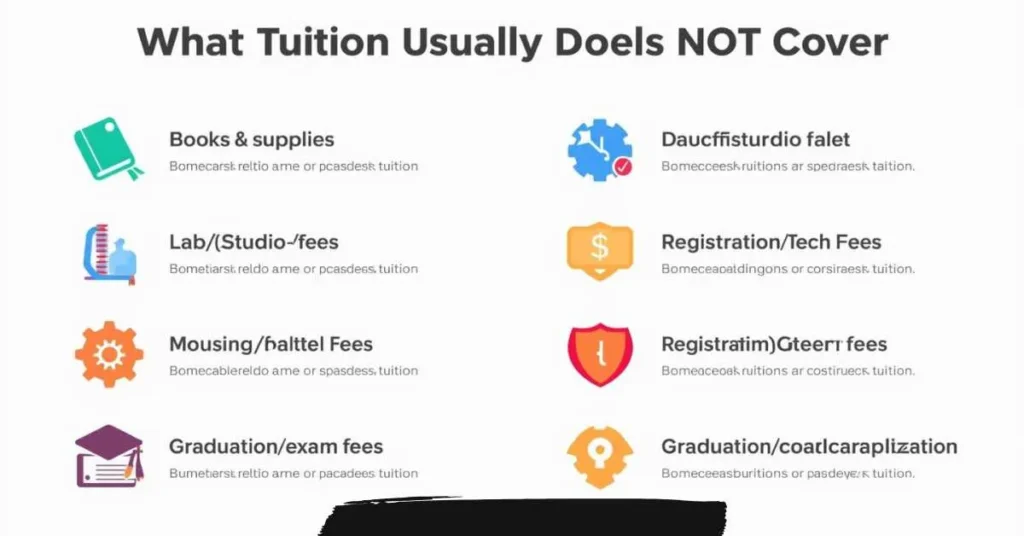
Many costs are separate, such as:
- books and supplies (textbooks, notebooks, tools, software)
- course add-ons (lab, studio, clinical, fieldwork)
- living costs (hostel/dorm, rent, meals)
- transport (bus, fuel, parking)
- extra fees (registration, technology, student services)
- insurance (required in some places)
A simple rule helps:
This charge pays for teaching. Other charges pay for services, materials, and living.
Tuition vs Fees vs Total Cost (Simple Table)
| Item | What it means | Common examples |
|---|---|---|
| Tuition | Main cost for teaching | classes, instruction |
| Fees | Extra required charges | registration, tech, services |
| Total cost | All costs to study and live | tuition + fees + books + housing + transport |
If you only look at the first number, you may under-plan your budget.
How Schools Set the Tuition Price (Billing Styles + Examples)
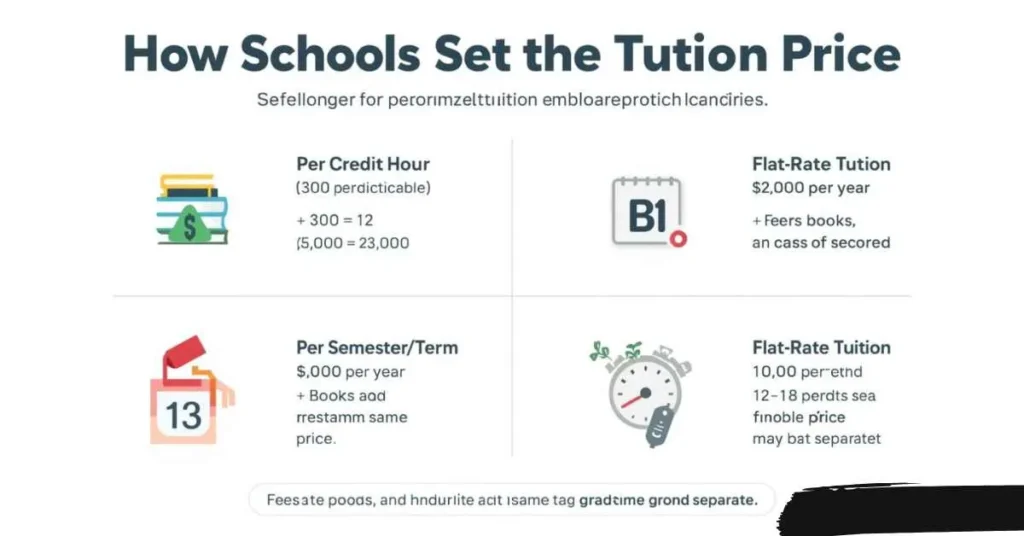
Schools use different billing styles. Here are the most common ones.
1) Per credit hour
You pay based on how many credits you take.
Example:
Cost per credit: 300
Credits this term: 12
Total class cost = 300 × 12 = 3,600
This style is common for part-time study and flexible programs.
2) Per semester/term
You pay one set amount for the term.
Example:
Cost for the term: 5,000
You pay that amount for the semester.
3) Annual tuition
Some schools show a yearly amount to help families plan.
Example:
Yearly amount: 12,000
This is the yearly teaching cost (before other items).
4) Flat-rate tuition
You pay one price if you stay in a credit range (often full-time).
Example:
Flat rate covers 12–18 credits
You take 12 credits or 18 credits → you pay the same base amount
This can be a good deal if you take more credits.
Why One Person Pays More Tuition Than Another
Prices can change based on rules and categories.
Common categories include:
- In-state vs out-of-state tuition (common in the US)
- Domestic vs international tuition
- Undergraduate vs graduate tuition
Other factors also matter:
- public vs private school
- program type (some programs need costly labs or training)
- location (big cities often have higher overall costs)
Always check the exact category used for your offer letter or bill.
Common Terms About Tuition You Will See And What Its Mean
These words show up on admission letters and invoices.
Tuition deposit
A tuition deposit is money paid to hold your seat after you accept an offer.
Sometimes it is used later as part of your first bill. Refund rules can differ.
Tuition waiver
A tuition waiver lowers or removes the teaching charge for eligible students.
It may not cover other fees.
Tuition assistance
Tuition assistance is support that helps pay the teaching cost.
It can come from an employer, a sponsor, or the government.
Tuition reimbursement
Tuition reimbursement usually means you pay first, then get paid back later.
Many employers do this after you finish a term.
Tuition grant/scholarship (covers tuition)
A tuition grant/scholarship can cover part or all of the teaching cost.
Important: some awards cover only tuition, not fees or living costs.
How to Read a Student Tuition Bill (Step-by-Step)
A bill can look scary. Use this simple order:
- Base teaching charge
- often based on credits or a flat rate
- Required fees
- registration, technology, student services
- Course fees
- labs, studios, training placements
- Credits and discounts
- scholarship, grant, waiver, sponsor payment
- Deposit line (if you paid one)
- may show as “deposit received”
- Due date and late rules
- late fees, account holds, blocked services
If a line is not clear, ask the accounts office for an itemized explanation.
Ways People Pay Tuition (Real-Life Options)
Many students use more than one source.
Common sources:
- student payment
- parents/guardian help
- sponsor support
- employer support
- government support
Common payment methods:
- bank transfer
- card payment (if allowed)
- installment plan (monthly payments for one term)
Tip: Ask if your school offers a payment plan. It can reduce stress.
Refunds, Drops, and Withdrawals (Very Important)
Most schools have rules about refunds. These rules are often strict.
Key points:
- There is often an add/drop time at the start of a term.
- Refunds often get smaller each week after classes begin.
- Some fees and deposits may be non-refundable.
- Dropping one class may lower your bill only if you pay per credit.
- With a flat rate, dropping one class may not change the base amount.
Also, aid can change if you withdraw. Some scholarships and government aid require full-time study.
Always check the dates before you drop or withdraw.
Simple Budget Planner (Copy and Use)
Use this checklist to estimate your real cost.
Step 1: School charges
- teaching cost (tuition)
- required fees
- course fees (lab/studio/training)
2: Study items
- books
- supplies
- software or equipment
3: Living costs
- hostel/dorm or rent
- meals
- transport
- personal costs
4: Subtract support
- scholarships and grants
- waiver (if any)
- sponsor payments
- employer help
- government support
Final estimate = (Step 1 + Step 2 + Step 3) − Step 4
This keeps you safe from surprise bills.
Mini Glossary (Easy Words)
- Credit hour: a unit that shows course load
- Full-time: enough credits for full-time status
- Part-time: fewer credits than full-time
- Add/drop period: early days to change classes
- Total cost: all study + living costs
- Student accounts/bursar: the office that makes bills
- Sticker price: the listed cost before aid
- Net cost: what you pay after aid
FAQ (Short Answers)
Is tuition the same as fees?
No. Tuition is the main teaching cost. Fees are extra charges.
Does tuition include books?
Usually not. Books and supplies are often separate.
Does tuition include hostel or dorm?
Usually not. Housing and meals are separate in most cases.
Is it paid monthly or per term?
Many schools bill per term. Some offer monthly plans.
Why did my cost go up this term?
Common reasons are more credits, program changes, or extra course fees.
Can I ask for a discount?
You can ask about scholarships, grants, waivers, and payment plans.
What does “tuition classes” mean?
It means tutoring or extra coaching outside school.
Conclusion:
Tuition is an education cost paid for instruction, courses, and classes in a program. It is paid to a school, college, university, or training institute. The payer might be the student, parents/guardian, a sponsor, an employer, or the government.
To plan well, do this:
- check what the base teaching cost includes
- list all fees, books, and living costs
- subtract scholarships and other support
- read refund rules before making changes
That is the safest way to avoid surprises.
Read Also This Post: What Does EOW Mean? Full Guide to Its Full Form, Usage

Hi, I’m Evan Lexor, the voice behind Meanvia.com. I break down English words, slang, and phrases into clear, simple meanings that actually make sense. From modern internet terms to everyday expressions, my goal is straightforward: help you understand English better, faster, and with confidence, one word at a time.