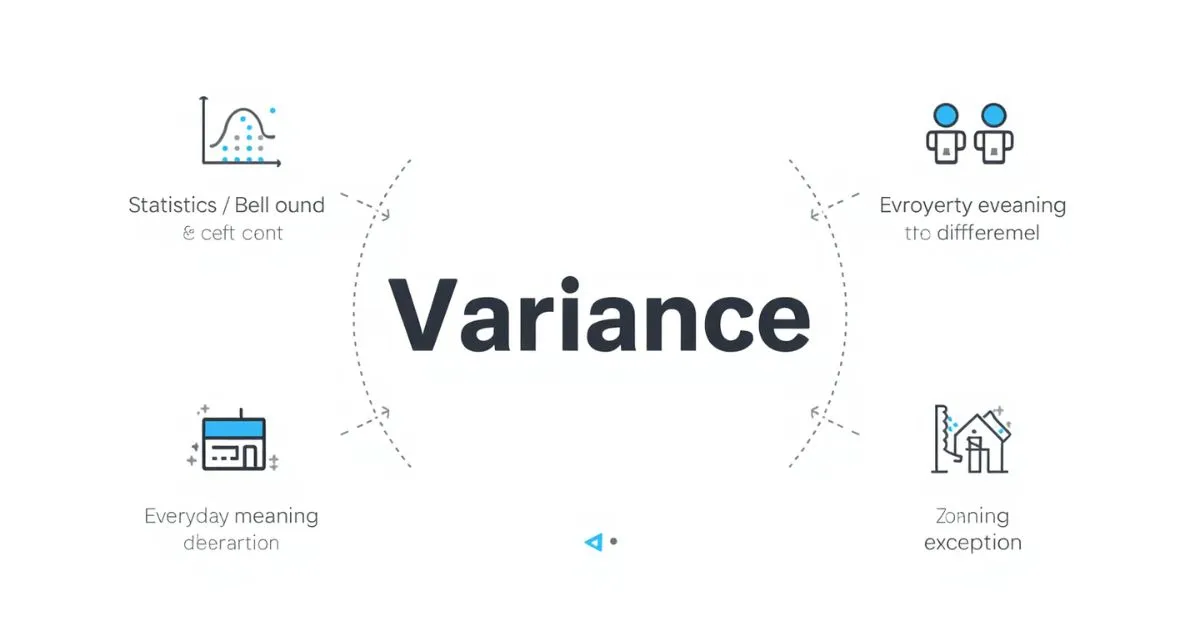
Variance usually means a difference, a change, or the amount something varies. In statistics, it has a more specific meaning: it measures how spread out values are around the mean.
In accounting, it often means the gap between expected and actual results. And In zoning, it can mean official permission to depart from a rule.
The reason this word confuses people is simple: variance has one core idea, but several context-specific meanings. The core idea is “not exactly the same.” Depending on where you see it, that can mean difference, disagreement, spread, or an approved exception.
This guide explains the meaning in plain English first, then shows what variance means in statistics, how it differs from standard deviation, and where else the word appears in real life.
Variance Meaning at a Glance
| Context | What variance means | Simple example |
|---|---|---|
| Everyday English | A difference or amount of change | There was little variance in price |
| Statistics | How spread out numbers are around the mean | Scores with a wider spread have higher variance |
| Accounting / budgeting | The difference between expected and actual figures | Actual costs were higher than budgeted costs |
| Zoning / property law | Permission to depart from a usual zoning rule | A homeowner gets a variance for a setback issue |
| Phrase: at variance | In disagreement or not matching | His statement was at variance with the report |
The broad meaning “difference or variation,” the disagreement meaning, the zoning meaning, and the statistical meaning are all recognized in major dictionary and legal references.
Variance in plain English
In ordinary English, variance means difference, variation, or a lack of exact sameness. If two things are not identical, you might say there is some variance between them. Merriam-Webster defines variance first as the state of being variable or variant, meaning difference or variation.
Simple examples
- There was a slight variance in the two prices.
- We noticed some variance in the quality of the samples.
- Rainfall showed wide variance from one month to the next.
In these examples, variance is not a math term. It simply means difference or change.
What does variance mean in statistics?
In statistics, variance measures how far numbers in a data set are spread out from the mean. Investopedia describes it as a measurement of dispersion across a data set, and Merriam-Webster notes that variance is the square of the standard deviation.
A quick way to understand it:
- Low variance means the values are fairly close together.
- High variance means the values are more spread out.
- Zero variance means every value is the same.
StatPearls notes that variance cannot be less than zero and is only zero when all the numbers in the set are equal.
Why statisticians use it
Variance helps show how consistent or inconsistent a set of numbers is. Two groups can have the same average but very different spreads.
For example:
- Class A scores: 74, 75, 75, 76
- Class B scores: 40, 60, 90, 110
The average can be similar, but Class B is much more spread out. That means Class B has higher variance.
A simple variance formula
For a population, variance is:
σ² = Σ(x − μ)² / N
For a sample, variance is:
s² = Σ(x − x̄)² / (n − 1)
Where:
- x = each value
- μ = population mean
- x̄ = sample mean
- N = total number of values in the population
- n = number of values in the sample
Investopedia explains that population variance divides by N, while sample variance uses n − 1 when estimating population variance from a sample.
What the formula means in simple words
You:
- Find the mean
- Subtract the mean from each value
- Square each difference
- Add those squared differences
- Divide by the number of values, or by n − 1 for a sample
That is why variance is often described as the average squared distance from the mean.
A quick worked example
Let’s use the numbers:
4, 6, 8, 10
Step 1: Find the mean
(4 + 6 + 8 + 10) / 4 = 7
2. Step : Find each difference from the mean
- 4 − 7 = −3
- 6 − 7 = −1
- 8 − 7 = 1
- 10 − 7 = 3
3. Step : Square each difference
- (−3)² = 9
- (−1)² = 1
- 1² = 1
- 3² = 9
4. Step : Add the squared differences
9 + 1 + 1 + 9 = 20
Step 5: Divide
- Population variance = 20 / 4 = 5
- Sample variance = 20 / 3 = 6.67 (rounded)
So for the same numbers:
- population variance = 5
- sample variance = 6.67
This example is useful because it shows that sample variance is usually a little larger when you are estimating variance from sample data.
Sample variance vs population variance
This is one of the most important distinctions many basic articles skip.
Population variance
Use this when you have every value in the full population.
Sample variance
Use this when you have only a sample from a larger population and want to estimate the population’s variance.
Investopedia notes that sample variance uses n − 1 rather than N so the estimate does not systematically understate the population variance.
For beginners, the simplest takeaway is:
- population variance = complete group
- sample variance = smaller group used to estimate the complete group
Variance vs standard deviation
This is where many readers get stuck.
Variance
Variance tells you how spread out the data is, but it does so in squared units.
Standard deviation
Standard deviation is the square root of variance, which brings the value back into the original units of the data. Investopedia and Statistics By Jim both explain that standard deviation is usually easier to interpret for that reason.
Why that matters
If your data is measured in minutes, then:
- variance is in minutes squared
- standard deviation is in minutes
That is why people often understand standard deviation more easily in practice, even though variance is still essential in formulas and statistical analysis.
Variance vs related terms
| Term | What it means | Best used for |
|---|---|---|
| Variance | Spread around the mean using squared differences | Statistical analysis |
| Standard deviation | Square root of variance, in original units | Easier interpretation |
| Variation | General difference or change | Everyday language |
| Deviation | Distance from a reference point or mean | Individual differences |
| Dispersion | Overall spread in data | General statistics language |
This comparison reflects the way current reference and statistics sources distinguish general lexical meaning from technical statistical use.
Why variance matters
Variance matters because averages alone can hide important differences.
Two stores could have the same average daily sales, but one store might be very consistent while the other swings sharply from day to day.
Two investments could have similar average returns, but one might be much more volatile than the other. Investopedia specifically notes that in finance, higher variance is associated with greater variability and risk.
In short, variance helps answer a question the average cannot answer:
How spread out are the results?
Other common meanings of variance
Because this keyword has mixed intent, it helps to cover the other real-world meanings briefly and clearly.
Variance in accounting and budgeting
In accounting or budgeting, variance often means the difference between what was planned and what actually happened.
Examples:
- budgeted cost vs actual cost
- forecast sales vs actual sales
- expected labor hours vs real labor hours
If a company expected $10,000 in costs but actually spent $11,500, the cost variance is $1,500.
Variance in zoning and property law
In zoning law, a variance is an officially granted exception to a zoning ordinance or rule. Cornell’s Legal Information Institute defines it that way directly.
For example, a homeowner may need a variance to:
- build closer to a property line than normally allowed
- exceed a setback rule
- make a change that does not fully meet local dimensional requirements
A land-use training resource from the University of Wisconsin notes that two common types are area variances and use variances.
Area variances deal with dimensional requirements such as height or setback, while use variances deal with uses not normally allowed in a zoning district. Rules and availability can vary by jurisdiction, so this meaning is always context-specific.
What “at variance” means
The phrase at variance means in disagreement or not in harmony.
Example:
- His version of events was at variance with the official report.
That means his version did not match the report. Merriam-Webster includes disagreement and dispute among the core meanings of variance.
Common mistakes people make
1. Thinking variance always means the same thing
It does not. Context matters. In general English it can mean difference, in statistics it means spread, and in zoning it can mean an exception to a rule.
2. Assuming variance in statistics just means “difference”
That is too vague. Statistical variance is a formal measure of how far values spread around the mean.
3. Mixing up variance and standard deviation
They are related, but they are not interchangeable. Standard deviation is the square root of variance.
4. Forgetting that variance uses squared units
This is why variance can feel abstract. Standard deviation is often easier to interpret because it returns to the original units.
5. Ignoring the effect of outliers
Investopedia notes that squaring deviations gives extra weight to values far from the mean, so outliers can have a strong effect on variance.
What Most Articles Miss About This Topic
Most articles make one of two mistakes:
They either treat variance as only a dictionary word, or they treat it as only a statistics term.
The better way to explain it is this:
- the core idea of variance is difference from what is central, expected, or usual
- in statistics, that becomes spread around the mean
- in budgeting, that becomes expected vs actual
- in zoning, that becomes permission to depart from a rule
- in the phrase at variance, that becomes disagreement
That mental model helps readers understand the word much faster than memorizing disconnected definitions. It is a synthesis of the main current definitions and use cases reflected across dictionary, statistics, and legal references.
Another point many pages skip: variance is important, but it is often not the easiest measure to read directly. Because it uses squared units, standard deviation is usually more intuitive for interpretation, even though variance remains central in statistical work.
FAQs
What does variance mean in simple words?
In simple words, variance means a difference, change, or amount of spread. In statistics, it specifically means how spread out data is around the mean.
What does variance mean in statistics?
It means the spread of values around the mean, measured using squared differences.
Is variance the same as standard deviation?
No. Standard deviation is the square root of variance, and it is usually easier to interpret because it uses the original units.
Can variance be negative?
No. Variance cannot be less than zero because it is based on squared differences. It is zero only when all values are identical.
Why is variance squared?
Variance squares each difference from the mean so negative and positive deviations do not cancel each other out. That makes it useful mathematically, but it also makes the result less intuitive to read directly.
What is the difference between sample variance and population variance?
Population variance uses the full population and divides by N. Sample variance estimates population variance from a sample and divides by n − 1.
What does a zoning variance mean?
It means official permission to do something that would normally break a zoning rule, such as a setback or use restriction.
Is higher variance always bad?
Not always. Higher variance simply means more spread or variability. Whether that is bad depends on context. In finance it can suggest more volatility and risk, but in other settings it may just mean results are less consistent.
Conclusion
If you are asking what does variance mean, the best short answer is this: it means difference or spread, but the exact meaning depends on context. In general English, it means variation or difference. And In statistics, it measures how spread out values are around the mean. In accounting, it often means expected versus actual results. In zoning, it means an approved exception to a rule.
Once you know which context you are in, the word becomes much easier to understand and use correctly.

Hi, I’m Clara Lexis from Meanvia.com. I break down words and expressions so they’re easy to understand and enjoyable to learn. My mission is simple: make language approachable and fun, one word at a time.



