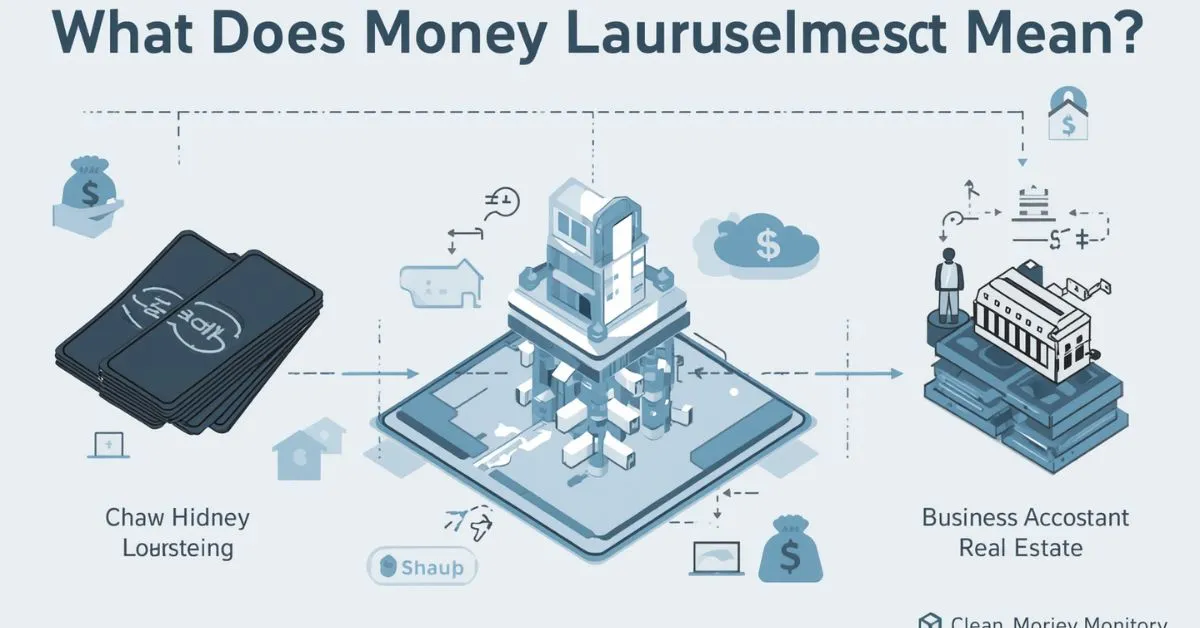
Money laundering means hiding or disguising the source of money or assets that came from crime so they appear legitimate. Official definitions from FinCEN and UNODC describe it as making criminal proceeds usable without exposing the illegal activity that produced them.
If you have seen this term in news stories, banking, fraud cases, corruption coverage, or compliance discussions, the basic idea is this: a crime creates profits, and laundering is the process used to make those profits look clean enough to spend, move, invest, or store with less suspicion.
The exact legal rules can vary by country, but the core meaning is widely consistent across major official sources and global AML standards.
Money Laundering at a Glance
| Question | Quick answer |
|---|---|
| What does money laundering mean? | Making criminal proceeds look legitimate |
| Why is it done? | To hide illegal origin and use the money more safely |
| Classic stages | Placement, layering, integration |
| Is it only about cash? | No. It can involve bank transfers, businesses, real estate, shell companies, and virtual assets |
| What is AML? | Anti-money laundering: the rules and controls used to detect and prevent laundering |
This summary reflects FinCEN’s description of laundering, the classic three-stage framework, and FATF’s broader AML standards, which also cover areas such as beneficial ownership, real estate risk, and virtual assets.
Money laundering meaning in simple words
In simple words, money laundering means taking “dirty” money and making it look “clean.” The money is called dirty because it came from illegal activity.
The laundering part is the attempt to disguise where it came from so it can pass through the financial system, a business, or an asset purchase without drawing attention to its criminal source.
FinCEN explains the idea as disguising financial assets so they can be used without revealing the illegal activity that produced them, while UNODC describes it as processing criminal proceeds to hide their illegal origin.
One important point many short definition pages miss is that this is not only about physical cash. Official and regulatory discussions often refer to proceeds, assets, funds, property, companies, ownership structures, real estate, and virtual assets, which shows that money laundering can take many forms.
Why money laundering matters
Money laundering matters because it helps criminals keep the profits of crime. If illegal proceeds could not be hidden or reintroduced into the economy, many criminal schemes would be much harder to sustain.
FinCEN says laundering allows criminal proceeds to be transformed into funds with an apparently legal source, while UNODC explains that the process lets criminals enjoy profits without jeopardizing the source.
It also matters because AML systems exist across banking, payments, money services businesses, brokerage, real estate risk controls, and cross-border enforcement. FATF’s standards explicitly frame money laundering as part of a broader international effort that countries implement through their own legal systems.
Where people usually hear this term
Many readers first hear “money laundering” in one of these settings:
- crime or corruption news
- scam or fraud stories
- bank account reviews or frozen transactions
- real estate risk reporting
- cryptocurrency compliance discussions
- articles about shell companies, secrecy, or beneficial ownership
That wider context matches how official and financial-information sources discuss the topic today, especially around suspicious activity, opaque ownership, real estate, and digital finance.
How money laundering works
The classic explanation breaks laundering into three stages: placement, layering, and integration.
FinCEN uses this framework in its AML history materials, and it remains the simplest way for beginners to understand the process.
1) Placement
Placement is the first move. Illicit funds are introduced into the financial system or moved away from the immediate crime. This is often described as the point where illegal proceeds first become mixed with apparently nnormal financial activity.
2) Layering
Layering is the concealment stage. The money is moved through multiple transactions, transfers, accounts, companies, invoices, or jurisdictions to make the trail harder to follow. FinCEN’s real-estate guidance and its AML history explanation both describe layering as separating illegal funds from their source through transactions that obscure origin.
3) Integration
Integration is when the funds return in a form that appears legitimate, such as business revenue, investment proceeds, asset holdings, or other apparently lawful wealth. At that point, the proceeds are easier to use with less immediate suspicion.
A simple example
Imagine someone gets illegal money from fraud. They move it through several accounts, use false business paperwork to explain part of it, and then use it to buy an asset or present it as business income.
The important point is not the exact method. The important point is that the original criminal source is being disguised. That basic logic is consistent across FinCEN, FBI, and UNODC explanations.
Important clarification: the 3 stages are a model, not a strict script
This is one of the biggest things generic articles often oversimplify.
The three-stage model is useful, but real cases do not always happen in one neat order. Modern AML work often focuses less on whether a case follows a textbook sequence and more on whether there are suspicious patterns, unusual transactions, opaque structures, or behavior that does not make business sense.
Investopedia’s current explainer makes this point clearly, noting that modern AML detection looks for suspicious patterns rather than relying on rigid stage sequencing.
That makes the topic easier to understand correctly: money laundering is not a formula people follow step by step every time. It is a broader process of concealment.
Common ways money laundering can happen
Money laundering methods evolve, but several patterns appear repeatedly in current regulatory and financial explanations.
Cash-heavy businesses
Cash-intensive businesses can be used to mix illicit funds with legitimate-looking revenue because it may be harder to distinguish real customer income from inserted criminal proceeds. Investopedia’s current article still highlights cash-intensive businesses as a classic risk area.
Complex ownership structures and shell companies
Opaque companies and layered ownership structures can make it difficult to identify who really controls or benefits from assets. FATF’s beneficial ownership work specifically focuses on stopping shell companies and other complex structures from being misused by money launderers and related offenders.
Real estate transactions
Real estate is often treated as a higher-risk area because property deals are high value, can involve intermediaries, and may hide ownership or pricing irregularities. FinCEN and Investopedia both point to real estate as an area where regulators monitor for signs of laundering.
Virtual assets and digital payment channels
Digital financial systems can increase speed, transaction volume, and cross-border complexity. Investopedia notes that online banking, digital platforms, and virtual assets create new detection challenges, while FATF maintains guidance specifically for virtual assets and red-flag indicators. FinCEN has also warned that some convertible virtual currency activity can increase AML/CFT challenges.
Rapid movement through multiple accounts or jurisdictions
Moving funds quickly through different accounts, countries, or third parties without a clear business reason is a widely recognized red flag. Diligent’s current overview highlights rapid movement across accounts or jurisdictions and unusual third-party payments as warning signs.
Red flags of money laundering
A beginner-friendly page should not just define the term. It should also explain what suspicious behavior can look like.
Here are common warning signs mentioned across current explainers and regulatory guidance:
| Red flag | Why it can be suspicious |
|---|---|
| Large or unusual cash activity | May be an attempt to place illicit proceeds into the financial system |
| Multiple complex transfers with no clear purpose | Can be a layering tactic |
| Payments through unrelated third parties | Can create distance between the source and destination |
| Opaque ownership or no clear business purpose | Can hide who really controls assets |
| Transactions just under reporting thresholds | Can suggest structuring or threshold avoidance |
| Real estate deals with unusual pricing or rapid ownership changes | Can be used to conceal source of funds |
| High-speed digital or cross-border movement | Can make tracing harder |
These indicators reflect current material from Investopedia, Diligent, FinCEN, and FATF around suspicious activity, complex ownership, real estate risk, and threshold-avoidance patterns.
What is structuring, and why does it come up so often?
Structuring means breaking transactions into smaller amounts to reduce scrutiny or avoid reporting triggers. Even if a page is focused on the meaning of money laundering, readers often encounter structuring in the same conversations because it can be one tactic used during placement or concealment.
Investopedia’s current explainer specifically lists several transactions just under the reporting threshold as a money laundering sign, and it notes the Bank Secrecy Act reporting framework around large cash transactions and suspicious activity.
What AML means in banking and compliance
AML stands for anti-money laundering. It refers to the rules, systems, monitoring, due-diligence procedures, and reporting obligations used to detect and prevent money laundering.
FinCEN describes the Bank Secrecy Act as an AML law, and FATF’s recommendations set the international framework countries adapt to their own systems.
In practice, AML often involves things like:
- customer due diligence
- beneficial ownership checks
- transaction monitoring
- suspicious activity reporting
- recordkeeping
- risk-based controls
FinCEN’s CDD Rule says it strengthens customer due diligence requirements and aims to improve transparency and stop criminals from misusing companies to disguise illicit activity and launder gains.
Why banks ask questions about source of funds
This is one of the most useful real-world explanations for ordinary readers.
Banks and other regulated institutions do not ask questions about source of funds or ownership just to be difficult. They do it because AML rules require risk-based controls, customer due diligence, recordkeeping, and suspicious activity detection.
FinCEN’s CDD framework and the Bank Secrecy Act are built around improving transparency and identifying suspicious patterns, including who ultimately owns or benefits from legal entities.
So when a bank asks for documents, clarifies a transaction, or reviews beneficial ownership information, that often sits within an AML and compliance process rather than a random customer-service decision.
Money laundering vs related terms
A lot of readers mix up money laundering with fraud, tax evasion, or money mules. These are related, but they are not the same thing.
| Term | What it means | How it differs from money laundering |
|---|---|---|
| Money laundering | Hiding the criminal origin of money or assets | Focuses on disguising illicit proceeds |
| Fraud | Deceiving someone for financial gain | Fraud may create the proceeds that are later laundered |
| Tax evasion | Illegally avoiding taxes owed | It is a separate offense, though illicit funds may overlap with laundering issues |
| Money mule | A person who transfers illegally acquired money for someone else | A mule may be used as part of a laundering chain |
| AML | Anti-money laundering controls and enforcement | AML is the system used to detect and prevent laundering |
The FBI defines money mules as people who move illegally acquired money on behalf of others, and says some know what they are doing while others do not. That makes “money mule” one of the most practical related terms to explain alongside money laundering.
Can ordinary people get caught up in it?
Yes, sometimes.
The FBI warns that criminals recruit money mules to move illicit funds and create layers of distance between victims and criminals. Some mules are fully aware; others are recruited through fake jobs, online relationships, or scam payment requests and may not realize the legal seriousness of what they are doing.
That does not mean normall people should panic every time they send or receive money. It means people should be careful with requests to move funds for strangers, accept payments on behalf of others, or forward money through their own accounts for a commission.
The red flag is not ordinary banking. The red flag is unexplained movement of money on someone else’s behalf under suspicious circumstances.
Is money laundering only about cash?
No.
Cash is still important in AML discussions, especially in placement and threshold-based reporting, but modern money laundering can involve companies, transfers, invoices, intermediaries, real estate, beneficial ownership structures, and virtual assets. That broader view is reflected across FinCEN, FATF, and current finance explainers.
What Most Articles Miss About This Topic
Most basic pages say “dirty money made to look clean” and stop there. That leaves out the parts readers actually need.
First, money laundering is not just about piles of cash. In current AML practice, it is often about patterns, ownership, movement, opacity, and explanation gaps. Regulators increasingly focus on suspicious behavior, hidden control, and inconsistent transaction logic, not just obvious cash deposits.
Second, real-world laundering risk often shows up through intermediaries and structures rather than dramatic movie-style bags of money. That is why beneficial ownership, due diligence, shell-company misuse, and unusual third-party payments matter so much.
FATF’s beneficial ownership work and FinCEN’s CDD framework both reflect that shift toward transparency and control over legal entities.
Third, modern laundering discussions increasingly include real estate and digital finance, because those areas can combine speed, complexity, value, and opacity. That does not make those sectors automatically criminal. It means they receive more AML attention because they can be misused.
Fourth, the exact law varies by jurisdiction. FATF provides international standards, but countries implement those standards through their own laws and systems. That is why a good explainer should stay accurate at the concept level without pretending every legal detail is identical everywhere.
FAQ
What does money laundering mean in simple words?
It means making money or assets from crime look like they came from a legal source so they can be used more easily and with less suspicion.
What are the 3 stages of money laundering?
The classic stages are placement, layering, and integration. They are a useful teaching model, but modern AML detection often focuses more on suspicious patterns than on a perfect three-step sequence.
Is money laundering only about cash?
No. Current guidance and explainers cover cash, bank transfers, shell companies, beneficial ownership structures, real estate, and virtual assets.
What does AML mean?
AML means anti-money laundering. It refers to the laws, procedures, controls, and monitoring used to detect and prevent money laundering.
Why do banks ask where money came from?
Because AML and customer due-diligence rules require institutions to understand customers, assess risk, identify beneficial owners in relevant cases, and detect suspicious activity.
What is a money mule?
A money mule is someone who transfers illegally acquired money for another person. The FBI says some mules know what they are doing, while others are tricked into helping criminals.
Can crypto be used in money laundering?
Yes, virtual assets can be misused, which is why FATF and FinCEN have issued guidance and warnings around virtual assets, transparency, and AML/CFT controls. But that does not mean every crypto transaction is suspicious.
Is money laundering the same as fraud?
No. Fraud is often the underlying crime that generates illicit proceeds. Money laundering is the act of disguising those proceeds so they appear legitimate.
Conclusion
Money laundering means disguising criminal proceeds so they appear legitimate. Once you understand that basic idea, plus the roles of placement, layering, integration, AML controls, beneficial ownership checks, and suspicious-activity monitoring, the term becomes much easier to understand in news, banking, fraud, real estate, and digital-finance contexts.
Click Below To Read About:
What Does “Bye Felicia” Mean? Complete Explanation
What Does the Name Peyton Mean? Origin, Pronunciation, Popularity & More
What Does Despair Mean? Complete Guide And Explanation

Hi, I’m Evan Lexor, the voice behind Meanvia.com. I break down English words, slang, and phrases into clear, simple meanings that actually make sense. From modern internet terms to everyday expressions, my goal is straightforward: help you understand English better, faster, and with confidence, one word at a time.