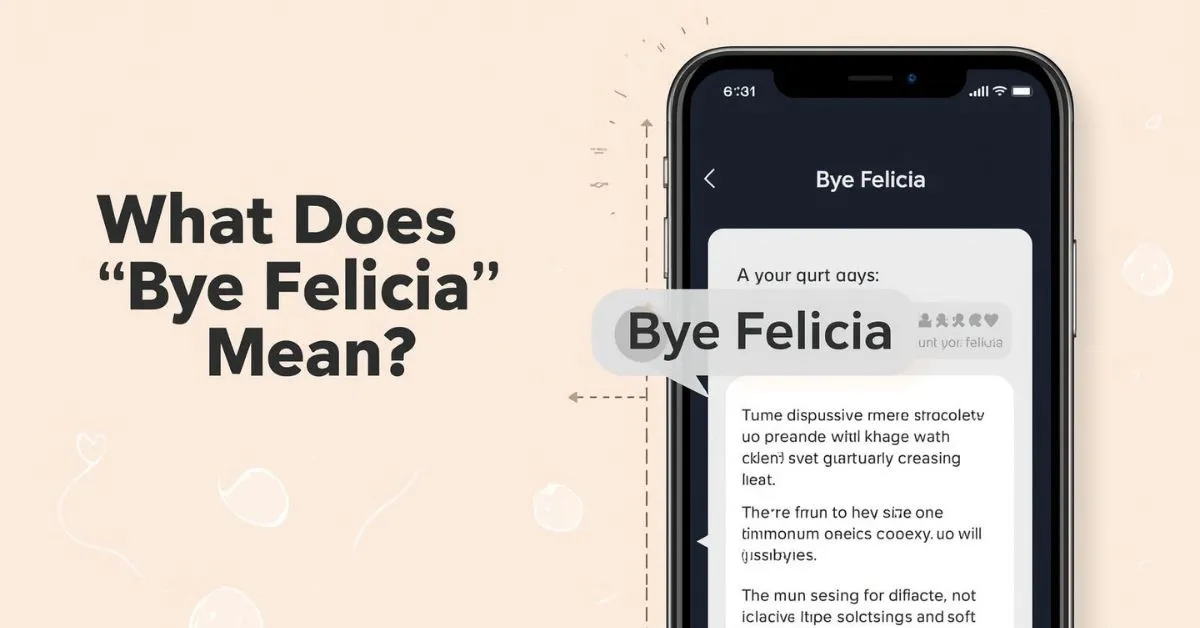
“Bye Felicia” is a dismissive goodbye. People use it to brush someone off, shut down an annoying comment, or show they do not care about a person, opinion, or bit of drama.
The phrase comes from the 1995 film Friday and later became a widely recognized internet meme and pop-culture catchphrase.
If you saw it in a text, meme, GIF, or comment section, the meaning is usually simple: “I’m done with this” or “Go away, I’m not taking this seriously.” It is not a warm or neutral goodbye. It is a send-off with attitude.
Meaning at a glance
| Question | Quick answer |
|---|---|
| What does “Bye Felicia” mean? | A dismissive goodbye |
| Is it friendly? | Usually no |
| Is it rude? | Often, yes |
| Where did it come from? | The 1995 movie Friday |
| Is it still used? | Yes, mostly as a meme or pop-culture phrase |
| Is it “Felicia” or “Felisha”? | Both appear, but the movie character is credited as Felisha |
The short version is this: the phrase is used when someone or something feels annoying, irrelevant, tiring, or not worth more attention.
What “Bye Felicia” means in simple terms
“Bye Felicia” means dismissal.
It is what people say when they want to:
- brush someone off
- end a pointless exchange
- react with sarcasm
- show indifference
- signal that a person, opinion, or excuse is not worth more energy
That is why the phrase works differently from a normal “bye.” A normal goodbye ends a conversation. “Bye Felicia” ends it with contempt, shade, or annoyance.
Where did “Bye Felicia” come from?
The phrase comes from Friday (1995), the comedy film starring Ice Cube and Chris Tucker. In the scene most people reference, Craig dismisses a neighborhood character named Felisha after she annoys him and Smokey by asking to borrow things. That quick brush-off became the line people remembered.
A detail many pages skip: the movie character is Felisha, played by Angela Means. That is why some people write “Bye Felisha” instead of “Bye Felicia.” Online, though, “Felicia” became the dominant spelling that most readers now recognize.
Bye Felicia
“Bye Felicia” is a casual slang phrase used when someone wants to dismiss a person, end a conversation, or show that they are not interested in continuing an interaction. It can sound funny, sarcastic, playful, or slightly rude depending on the situation. The phrase became famous from the 1995 comedy movie Friday, where Ice Cube’s character dismisses a bothersome woman named Felisha. Today, people often use the spelling “Felicia” in texts, memes, captions, and social media posts.
Example 1: “You keep complaining, so bye Felicia!”
Example 2: “He left the group chat. Bye Felicia!”
What Does Bye Felicia Mean?
“Bye Felicia” means something like “goodbye, I’m done with this conversation” or “you can leave now.” It is usually said in a humorous or dismissive way when someone is being annoying, unwanted, or irrelevant. The expression does not normally mean a serious goodbye. Instead, it adds attitude to the way someone ends an interaction. Its meaning became widely recognized through the movie Friday and later internet culture. Depending on your tone, it can be playful between friends or sound disrespectful when directed at someone seriously.
Example 1: “You changed your mind again? Bye Felicia!”
Example 2: “Nobody asked for another argument. Bye Felicia.”
Bye Felicia Meaning
The meaning of “Bye Felicia” is a sarcastic or dismissive goodbye. People often say it when they want to make it clear that someone’s comments, behavior, or presence no longer matters to them. The phrase can be used in everyday conversations, texts, memes, and social media comments. Although it contains the word “bye,” it is usually more expressive than an ordinary farewell. It can communicate annoyance, confidence, humor, or playful rejection. The exact feeling depends heavily on the relationship between the people and the tone used.
Example 1: “You don’t want to join us? Bye Felicia!”
Example 2: “She kept making excuses, so I said, ‘Bye Felicia.’”
By Felicia Meaning
“By Felicia” is usually a misspelling or typing variation of “Bye Felicia.” The intended phrase is normally written as “Bye Felicia.” People may accidentally type “by” instead of “bye” because the two words sound similar when spoken. If you see “by Felicia” in a text, meme, comment, or caption, the person probably means the popular slang expression rather than talking about something being “by” a person named Felicia. The meaning remains a dismissive or joking goodbye in most online conversations.
Example 1: “By Felicia, I’m done arguing.”
Example 2: “He wrote ‘by Felicia’ instead of ‘bye Felicia.’”
Goodbye Felicia
“Goodbye Felicia” is a variation of the better-known phrase “Bye Felicia.” It carries the same basic idea: dismissing someone or ending an interaction in a humorous, sarcastic, or slightly rude way. Adding “goodbye” makes the phrase sound more like a direct farewell, while “Bye Felicia” has the stronger slang and meme connection. It can appear in social media posts, jokes, captions, and casual messages. Whether it sounds funny or offensive depends on the situation, so it is best used with people who understand the playful meaning.
Example 1: “You don’t want to help? Goodbye Felicia!”
Example 2: “He walked away after the argument. Goodbye, Felicia!”
Where Did Bye Felicia Come From?
“Bye Felicia” comes from the 1995 American comedy movie Friday, directed by F. Gary Gray and starring Ice Cube and Chris Tucker. In the movie, a character named Felisha repeatedly bothers Craig and Smokey. When she asks for favors, Craig dismisses her with the famous line “Bye, Felisha.” The original character’s name was spelled Felisha, although “Felicia” became the more common spelling online. Angela Means, who played Felisha, has also described the line as coming from Ice Cube’s performance in the scene.
Example 1: “Did you know ‘Bye Felicia’ came from Friday?”
Example 2: “The phrase started as a movie line before becoming internet slang.”
Bye Felicia GIF Meaning
A “Bye Felicia” GIF usually communicates a humorous or dramatic dismissal. Someone may send one after ending an argument, rejecting an unwanted comment, or jokingly telling another person to leave. GIFs make the phrase more expressive because facial expressions, gestures, or movie clips can add attitude to the message. The meaning is generally similar to saying, “I’m done with you,” “Go away,” or “This conversation is over.” Because GIFs can feel playful, friends often use them online without intending genuine hostility.
Example 1: Friend: “I’m leaving the group.” You: “Bye Felicia!” sends GIF
Example 2: “He sent a Bye Felicia GIF after winning the argument.”
When Was Bye Felicia Popular?
“Bye Felicia” originated in 1995, but its biggest mainstream rise happened much later. The phrase remained connected to Friday and Black popular culture for years before gaining major attention through social media and internet memes. Searches and online use increased strongly during the 2010s. In 2014, the phrase appeared in mainstream conversations and even inspired a VH1 reality show titled Bye Felicia. Its visibility increased again in 2015 when the phrase appeared in Straight Outta Compton.
Example 1: “Bye Felicia became especially recognizable online during the 2010s.”
Example 2: “Many people discovered the phrase through memes and social media.”
Bye Bye Felicia
“Bye Bye Felicia” is an extended version of “Bye Felicia.” Repeating “bye” makes the expression sound more playful, dramatic, or intentionally dismissive. People may use it when they want to jokingly emphasize that someone should leave or that a conversation is finished. The phrase can appear in texts, captions, comments, memes, and casual conversations. It is not usually a formal way to say goodbye. Instead, it works as humorous slang, especially when someone wants to add a little attitude to an ordinary farewell.
Example 1: “You’re still complaining? Bye bye Felicia!”
Example 2: “The party is over, so bye bye Felicia!”
Bye Felicia Origin
The origin of “Bye Felicia” traces back to the 1995 movie Friday. The original character was named Felisha, played by Angela Means, and the famous dismissal was directed at her by Ice Cube’s character, Craig. The line was originally a small moment in the movie, but it eventually developed into a widely recognized catchphrase. Its spelling later shifted from “Felisha” to the now-common “Felicia.” Social media, memes, and later appearances in popular culture helped transform the movie line into everyday internet slang.
Example 1: “The Bye Felicia origin can be traced to Friday in 1995.”
Example 2: “The original movie character was actually spelled Felisha.”
Is it “Bye Felicia” or “Bye Felisha”?
Both spellings point to the same phrase, but they come from different layers of its history.
- Felisha connects more directly to the movie credit and character spelling.
- Felicia is the spelling that spread most widely online and in everyday use.
For SEO and modern recognition, “Bye Felicia” is the main version people search. For accuracy to the film, “Felisha” matters too.
Is “Bye Felicia” rude, funny, or both?
Usually, it is both dismissive and funny; but the funny part depends on context.
With close friends, it can sound playful and meme-like. In an argument, workplace conversation, or tense personal moment, it can sound openly rude. The phrase is commonly used to dismiss someone who is being annoying or saying something foolish, which is why it often carries sarcasm even when said as a joke.
A useful rule: if you would not say “go away” or “I’m over this” to someone directly, “Bye Felicia” is probably the wrong choice too.
What does “Bye Felicia” mean in text and on social media?
In texting and online spaces, “Bye Felicia” usually means one of these:
- “I’m not entertaining that.”
- “That’s irrelevant.”
- “This is embarrassing, annoying, or tired.”
- “I’m done with this conversation.”
Online, the phrase expanded beyond dismissing a literal person. It can also be aimed at a bad opinion, an excuse, a rumor, a trend, or even an app, plan, or idea someone wants to reject. Fast Company described it as a freeform kiss-off aimed at the person, place, or thing of your choosing.
That broader use is one reason the phrase survived. It became flexible enough to work as a reaction, caption, GIF, tweet, or meme response.
Why the phrase spread so fast online
“Bye Felicia” worked online because it did three things at once:
- It was short.
- It carried attitude immediately.
- It was reusable in many situations.
Know Your Meme documents how the phrase moved from a movie quote into internet meme culture, and other pop-culture coverage from the 2010s helped keep it visible. Later references, including its use in Straight Outta Compton, gave it another boost and helped introduce it to people who had never seen Friday.
That matters because many people now know the phrase as a meme first and a movie quote second.
How “Bye Felicia” sounds in real life
The phrase changes based on tone more than many articles admit.
Playful
Used with a friend during obvious joking.
Example:
“You said pineapple belongs on every pizza? Bye Felicia.”
Sarcastic
Used to reject a weak opinion or dramatic comment.
Example:
“You’re late again and somehow it’s everyone else’s fault? Bye Felicia.”
Mean
Used to humiliate or belittle someone.
Example:
Saying it to someone who is upset and trying to explain themselves.
That last version is why this phrase can go from funny to nasty very quickly. The line itself is short, but the message behind it is: you are not worth my time. That is why it can land harder than people expect.
Quick comparison table
| Phrase | Meaning | Tone | Best used when | Avoid when |
|---|---|---|---|---|
| Bye Felicia | Dismissive send-off | Snarky, sarcastic, rude | Light joking, meme-style reactions | Work, conflict, serious conversations |
| Goodbye | Neutral farewell | Polite | Everyday use | Rarely a problem |
| Talk to the hand | Stop talking / I’m not listening | Dated, rude, playful | Jokes or throwback references | Formal settings |
| I’m done with this | Clear exit | Direct | Setting a boundary | Can sound blunt, but less mocking |
“Bye Felicia” stands out because it is not just blunt. It is culturally loaded, meme-coded, and intentionally dismissive.
When not to use “Bye Felicia”
Do not use it when:
- you want to sound respectful
- you are talking to a coworker, customer, teacher, or manager
- someone is already hurt, embarrassed, or emotional
- you want to disagree without escalating
- the other person may not understand the pop-culture reference
In those situations, it is usually better to say:
- “I’m not continuing this conversation.”
- “Let’s leave it there.”
- “I disagree, but I’m moving on.”
- “That’s not something I want to debate.”
Those alternatives still set a boundary without the extra mockery.
Common misconceptions
It does not mean a normal goodbye
This is the biggest misunderstanding. It is not just “bye” it is “bye, and I am dismissing you.”
It is not only for a person named Felicia
Most modern uses are not literal. “Felicia” functions more like a placeholder for whatever the speaker wants to reject.
It did not start as a meme
It became a meme later, but it started as a line from Friday.
The spelling confusion is not a mistake people invented randomly
The movie ties back to Felisha, while internet culture normalized Felicia.
What Most Articles Miss About This Topic
Most articles stop at: “It means a rude goodbye.” That is not enough.
1. The real point is dismissal, not departure
The phrase is powerful because it strips importance away from the person or thing being addressed. It says: this does not deserve more attention.
2. It became bigger than the original scene
Once it spread online, “Bye Felicia” stopped being only a movie quote. It became a flexible reaction phrase people used across memes, comment sections, captions, and pop-culture callbacks.
3. Tone matters more than definition
Two people can say the same phrase and mean very different things. One may be joking. The other may be trying to humiliate someone.
4. The cultural context matters
The phrase came out of Friday and broader Black pop-culture recognition before it was flattened into mainstream meme language. Some later discussions of the term note that once a phrase like this spreads widely, people often use it with little awareness of the original context that gave it meaning and edge.
5. It can feel dated
People still know it, but today it often reads as a recognizable meme-era comeback rather than fresh everyday slang. That does not make it useless. It just affects how natural or current it sounds.
FAQs
Q: Why is Bye Felicia offensive
A: “Bye Felicia” can sound dismissive or disrespectful when used to mock or abruptly dismiss someone.
Q: What to say when someone says Bye Felicia
A: You can calmly say “Okay, take care” or respond with a lighthearted “Bye!”
Q: What does bye felicia mean in english
A: “Bye Felicia” is a slang phrase used to dismiss someone or indicate that their presence is not important.
Q: What does bye felicia mean urban dictionary
A: Urban Dictionary commonly describes “Bye Felicia” as a humorous way to dismiss someone or tell them to leave.
Q: What does Felicia Mean
A: Felicia is a female name derived from Latin and means “lucky,” “fortunate,” or “happy.”
Q: Bye Felicia meme
A: The “Bye Felicia” meme is commonly used online to humorously dismiss someone or end an unwanted conversation.
Q: Bye Felicia movie
A: “Bye Felicia” became popular from the 1995 comedy movie Friday, where the phrase is used to dismiss Felicia.
Q: Bye felicia gif
A: A “Bye Felicia” GIF is a short animated clip used online to humorously dismiss someone or end a conversation.
Conclusion
“Bye Felicia” means a dismissive goodbye. People use it to brush off someone or something they find annoying, irrelevant, or unworthy of more attention. It started in Friday, spread through memes and pop culture, and now works as a sarcastic reaction phrase in text, social media, and casual conversation.
The practical takeaway is simple: understand it as shade, not politeness. If you use it, make sure the tone fits the moment.
Click Below To Read About These Posts:
What Does Git Mean? Complete Guide And Explanation
Blue Rose Meaning: Blue Roses Symbolize in Love, Gifts, and Life
What Does Friction Mean? Complete Guide & Explanation

Hi, I’m Evan Lexor, the voice behind Meanvia.com. I break down English words, slang, and phrases into clear, simple meanings that actually make sense. From modern internet terms to everyday expressions, my goal is straightforward: help you understand English better, faster, and with confidence, one word at a time.