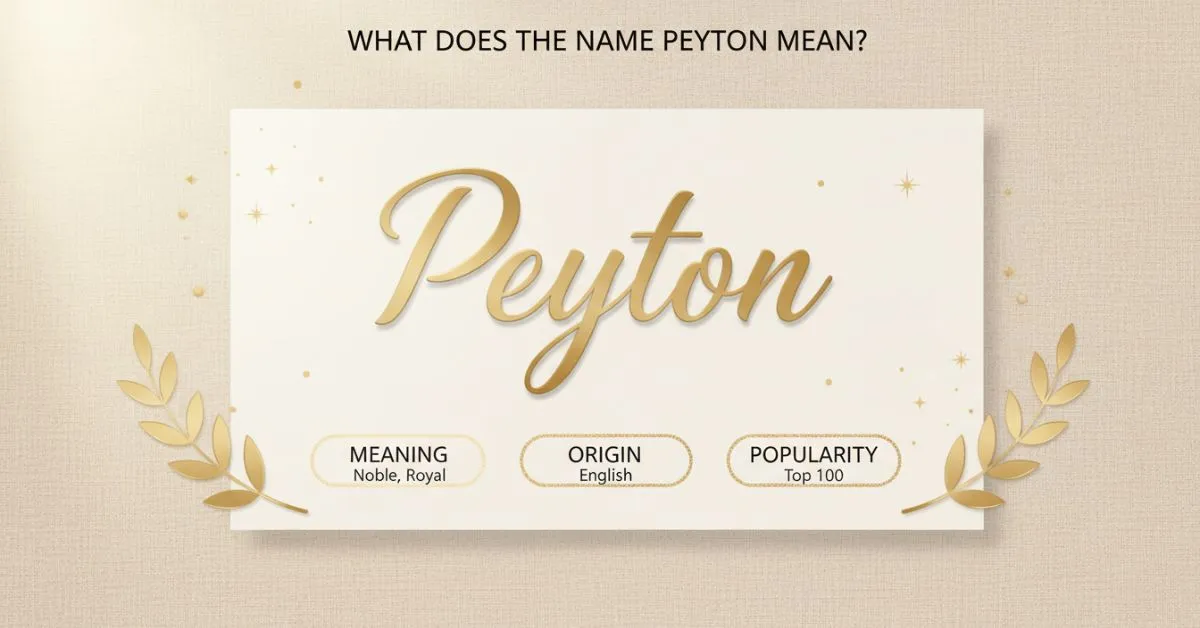
Peyton is usually explained as a name of English surname origin meaning “Pæga’s town” or “Pæga’s settlement.” Some baby-name sources also give an Irish-linked explanation and summarize it as “fighting-man’s estate,” which is why the meaning can look different from one site to another.
If you are considering Peyton for a baby name, the simplest way to understand it is this: it is a modern-feeling, gender-neutral first name with older surname roots, a clear pronunciation, and strong real-world familiarity.
The exact wording of the meaning varies by source, but the name’s overall identity is consistent.
Peyton at a glance
| Detail | Answer |
|---|---|
| Main meaning | Usually explained as “Pæga’s town” or “Pæga’s settlement” |
| Alternate meaning often shown online | “Fighting-man’s estate” |
| Main origin | English surname and place-name origin |
| Other origin notes | Some sources also connect it to Irish usage |
| Pronunciation | PAY-tən |
| Gender use | Used for both girls and boys |
| Current U.S. ranking | #168 for girls, #658 for boys in 2024 |
| Common variant | Payton |
The quick facts above are drawn from major baby-name references that currently list Peyton as an English surname-based given name, note its gender-neutral use, and show current U.S. rankings for both girls and boys.
What the name Peyton means in plain English
In plain language, Peyton is a place-rooted surname name that later became a first name. That is why many sources explain it through an older settlement or estate meaning rather than through a symbolic meaning like “joy,” “light,” or “wisdom.”
For most readers, the practical takeaway is simple: Peyton is a strong, modern, surname-style name whose meaning is usually tied to an old place name.
If you see slightly different definitions online, that usually reflects different ways of summarizing the same naming history rather than completely different names.
Where does the name Peyton come from?
Behind the Name traces Peyton to an English surname that originally came from a place name meaning “Pæga’s town.” The Bump also describes Peyton as a gender-neutral name with English roots, while noting an Irish connection in some naming traditions.
That dual explanation is the main reason the name can look inconsistent from one baby-name site to another.
One source may focus on the English place-name origin, while another emphasizes the Irish-linked explanation and gives “fighting-man’s estate” as the meaning.
How do you pronounce Peyton?
Peyton is usually pronounced PAY-tən. It is a simple two-syllable name, which is one reason it has stayed usable and familiar for modern parents.
Is Peyton a boy’s name or a girl’s name?
Peyton is a true gender-neutral name. Major baby-name references list it for both girls and boys, not just one or the other.
At the moment, it is more common for girls than boys in the United States. Behind the Name lists Peyton at #168 for girls and #658 for boys in 2024, and Nameberry shows the same split on its current U.S. ranking pages.
That means Peyton still works for either gender, but many readers today will hear it slightly more often as a girl’s name than as a boy’s name.
How popular is the name Peyton?
Peyton is not rare, but it is also not at peak popularity anymore. Behind the Name’s U.S. popularity data shows that Peyton peaked at #42 for girls in 2009 and has since declined to #168 in 2024. For boys, it reached #125 in 2007 and stands at #658 in 2024.
That popularity pattern matters because it tells you something useful about the name’s current feel: Peyton is still familiar and mainstream, but it is not as trend-heavy as it was during its highest-growth years.
Why Peyton became more common for girls
Behind the Name notes that Peyton was a rare masculine name until the 1990s and says its rise for girls was boosted after the 1992 film The Hand That Rocks the Cradle used Peyton for a female character.
That helps explain why many people now experience Peyton as balanced or girl-leaning, even though it has roots in surname use and earlier masculine use.
Peyton vs. Payton: what’s the difference?
The biggest difference between Peyton and Payton is spelling, not core identity. Both are used as first names, both are pronounced the same way, and both are generally explained through the same surname-style naming tradition.
Nameberry’s current rankings suggest that Peyton is the more established spelling right now. It lists Peyton at #168 for girls and #658 for boys, while Payton is lower at #381 for girls and #914 for boys.
| Comparison | Peyton | Payton |
|---|---|---|
| Pronunciation | PAY-tən | PAY-tən |
| Style feel | More standard, more established | Familiar variant |
| Current U.S. ranking for girls | #168 | #381 |
| Current U.S. ranking for boys | #658 | #914 |
| Meaning | Same general naming family | Same general naming family |
The table above reflects the current rankings shown by Nameberry and the shared surname-style origin described by major baby-name references.
Famous people named Peyton
One reason the name feels familiar is that it has several recognizable namesakes. Behind the Name lists Peyton Manning, Peyton List, and Peyton Meyer among notable bearers of the name.
Namesakes do not change the meaning of the name, but they do shape how people experience it. Peyton Manning, in particular, has helped keep the name visible in American culture for years.
Nicknames for Peyton
Peyton is already short and easy to say, so it does not require a nickname. Still, people often use casual short forms such as:
- Pey
- Peyt
- P
- Toni/Ton in more playful family use
Nicknames are personal rather than official, so the best choice usually depends more on family style than on name rules.
Names similar to Peyton
If you like Peyton, you may also like names that share its modern, surname-style, gender-flexible feel:
- Payton
- Parker
- Riley
- Avery
- Rowan
- Sawyer
- Hayden
- Leighton
These names are not identical in origin, but they often appeal to the same reader because they sound current, polished, and easy to live with.
Why parents choose the name Peyton
Peyton appeals to many parents because it checks several boxes at once:
- easy to pronounce
- familiar without being overly plain
- modern without feeling invented
- gender-neutral but still well-defined
- strong sound without feeling harsh
That balance is a major reason the name has held attention for years even after its peak ranking period.
Common mistakes people make about the name Peyton
1. Assuming there is only one correct meaning
There is a most common explanation, but not every source phrases it the same way. Peyton is one of those names where a good article should explain the variation honestly.
2. Thinking gender-neutral means confusing
Peyton is unisex, but it is not unclear. Most people recognize it immediately, and current baby-name references consistently list it for both genderss.
3. Treating popularity as the same thing as quality
A name can be excellent whether it is rising, peaking, or cooling off. Popularity tells you how common a name is, not whether it is a good fit for your child.
4. Assuming Peyton and Payton are completely different names
They are better understood as close spelling variants in the same naming family, not unrelated names.
What Most Articles Miss About This Topic
Most articles answer “What does Peyton mean?” with one sentence and move on. That misses the most useful clarification: the meaning varies online because different sources emphasize different parts of the name’s history.
Some focus on the English place-name root, while others foreground the Irish-linked explanation.
Another thing many articles miss is that readers are usually asking more than a dictionary question.
They want to know whether Peyton is easy to say, whether it works for a girl or a boy, whether the spelling matters, and whether the name still feels current. Those are the practical questions that help someone actually use the information.
The strongest answer, then, is not just “Peyton means X.” It is: Peyton is a modern, familiar, gender-neutral name with English surname roots, a few common meaning glosses, and a stronger current presence for girls than boys.
FAQ About the Name Peyton
Is Peyton a biblical name?
Peyton is not mainly known as a biblical name. It is usually traced to English surname and place-name roots instead.
Is Peyton an Irish name?
Some sources describe Peyton as having an Irish connection or variant pathway, but major references also trace it to English surname origin. That is why both explanations appear online.
What does Peyton mean for a girl?
The meaning is generally explained the same way whether Peyton is used for a girl or a boy. The gender changes usage, not the core origin explanation.
Is Peyton more popular for girls or boys?
Peyton is currently more popular for girls in the United States. Current 2024 ranking data shows it at #168 for girls and #658 for boys.
What is the difference between Peyton and Payton?
Mostly spelling and current popularity. Peyton is the more established spelling in current U.S. rankings, but both names share the same general style and pronunciation.
Is Peyton still a good baby name?
For many parents, yes. It remains recognizable, easy to pronounce, flexible across genderrs, and familiar without feeling stale. That makes it a practical choice for readers who like modern surname-style names.
Final takeaway
If you want the clearest answer, Peyton is best understood as a gender-neutral first name with English surname roots, usually explained as “Pæga’s town” or “Pæga’s settlement,” though some sources also give the alternate gloss “fighting-man’s estate.” It is easy to pronounce, still familiar in current use, and more common for girls than boys right now.
Click Below To Read About These Posts:
What Does Capricorn Mean? Personality, Traits, Hidden Secrets
What Does Git Mean? Complete Guide And Explanation
What Does Rushing Mean in College?

Hi, I’m Evan Lexor, the voice behind Meanvia.com. I break down English words, slang, and phrases into clear, simple meanings that actually make sense. From modern internet terms to everyday expressions, my goal is straightforward: help you understand English better, faster, and with confidence, one word at a time.



