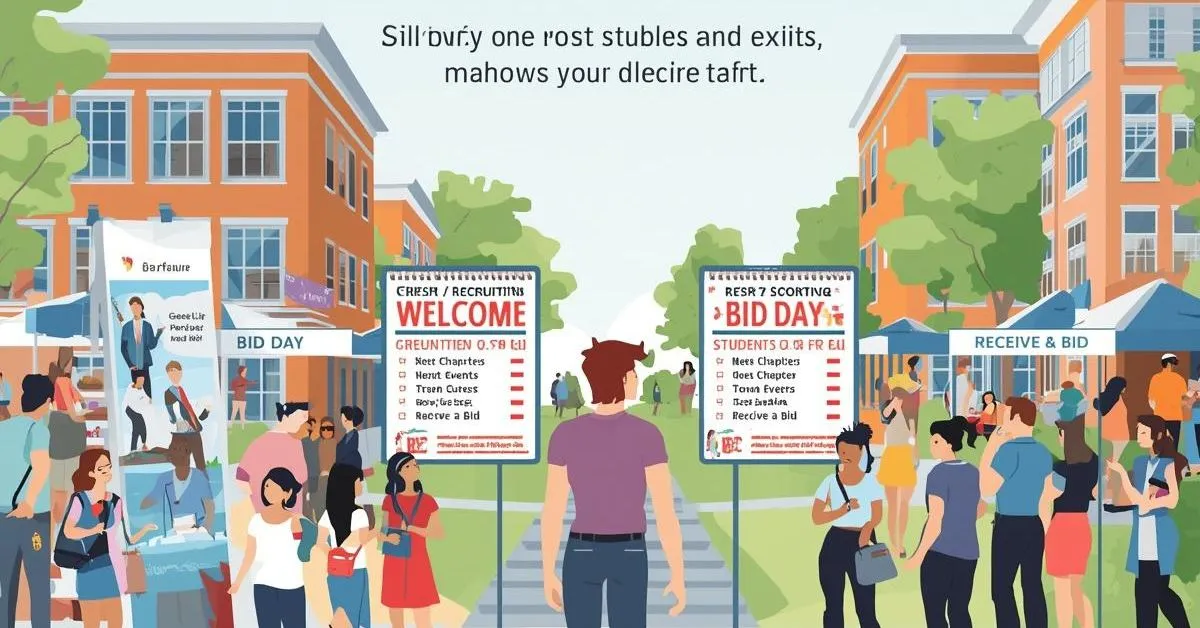
Rushing in college usually means taking part in the process of meeting and being evaluated by fraternities or sororities before joining. It is commonly called Greek life recruitment, and at some schools it may also be called membership intake. Rushing does not usually mean you are already a member. It means you are exploring organizations, attending events, and possibly working toward a bid, which is an invitation to join.
If you have heard students say they are “rushing,” they are usually talking about Greek life. In plain English, they are going through the first stage of deciding whether a fraternity or sorority is the right fit and whether that organization wants to invite them in.
The process is not identical everywhere. Some schools use the word rush all the time. Others prefer recruitment. Some organizations, especially outside traditional Panhellenic or Interfraternity systems, may use terms like intake or membership intake instead. But the core idea is usually the same: students meet organizations, organizations meet students, and both sides decide whether to move forward.
The simplest meaning of rushing in college
Rushing means participating in the joining process for a fraternity or sorority.
That usually includes:
- attending recruitment events
- meeting members
- learning about different chapters
- asking questions
- being considered by organizations
- deciding where you feel comfortable
- possibly receiving a bid
The key point is this:
Rushing is the process before membership, not the same thing as membership itself.
A student can rush and decide not to join. A chapter can also decide not to invite a student. That is why rushing, joining, and becoming a full member are related but different steps.
Rush vs recruitment vs intake
This is one of the biggest areas of confusion, especially for first-year students.
Rush
Rush is the term many students use casually. It is widely understood and often appears in everyday conversation, online posts, and pop culture.
Recruitment
Recruitment is often the more official campus term, especially for sororities and fraternities in formal systems. Many schools use this word in university materials even when students still say rush.
Intake or membership intake
Some organizations, especially some multicultural or historically Black Greek-letter organizations, may use membership intake rather than rush. The joining process, expectations, and structure can also differ.
So if you are asking what rushing means in college, the safest answer is:
It usually means participating in Greek life recruitment, although the exact terminology may vary by campus and organization type.
What happens during rush?
The exact process changes by school, but it often follows a recognizable pattern.
1. You sign up or show interest
At some schools, students register through the campus fraternity and sorority office. At others, they connect directly with chapters or attend interest events.
2. You meet different organizations
This may happen through:
- open houses
- meet-and-greet events
- formal recruitment rounds
- information sessions
- interviews or conversations
- smaller informal gatherings
3. Both sides evaluate fit
Students are figuring out where they feel comfortable, supported, and interested. At the same time, chapters are deciding which students they want to continue meeting.
4. The options narrow
In a more formal system, students may return to fewer organizations over time. In a more informal system, they may simply build stronger contact with one or two chapters.
5. A bid may be offered
A bid is usually an invitation to join a specific fraternity or sorority.
6. A new member period may begin
If the student accepts the bid, the next stage often begins. Depending on the school and organization, this may be called:
- new member period
- new member education
- pledge process
- intake process
That still is not always the same as being a fully initiated member.
Does rushing mean you already joined?
No. Usually, it does not.
This is the most common misunderstanding.
Rushing means you are going through the selection and exploration process. You are learning about organizations, and they are learning about you. Full membership usually comes later, after a bid and after any required new member period or initiation steps.
Formal rush vs informal rush
Not all rush looks the same.
Formal rush
Formal rush, often called formal recruitment, is a structured process with a set schedule. Students often meet multiple chapters over a defined period, such as a week or several days.
Formal rush often includes:
- official registration
- scheduled rounds
- campus-wide coordination
- multiple chapter visits
- a clearer timeline
This is common in many sorority systems and some fraternity systems.
Informal rush
Informal rush is more flexible. A student may connect with one chapter outside the main recruitment period and attend smaller events or conversations.
Informal rush often includes:
- fewer formal steps
- direct chapter contact
- smaller events
- more flexible timing
Some schools and organizations also use terms like COB, which stands for Continuous Open Bidding. That usually refers to a less formal opportunity to join outside the main formal recruitment period.
Common Greek life terms you may hear during rush
If you are new to college, the vocabulary can feel confusing fast. This is where many articles fall short.
| Term | Simple meaning | When you may hear it | Common confusion |
|---|---|---|---|
| Rush | The joining process for a fraternity or sorority | Casual student conversations | Many think it means you already joined |
| Recruitment | The official or formal name for rush on many campuses | University materials, sorority systems | Some think it is totally different from rush |
| PNM | Potential New Member | During sorority or formal recruitment | Beginners may not know it means a student who is rushing |
| Bid | An invitation to join a chapter | Near the end of recruitment | A bid is not always the same as full membership |
| Bid Day | The day students receive or celebrate bids | Formal sorority recruitment especially | Some think this is the same as initiation |
| Chapter | A local branch of a fraternity or sorority | Greek life discussions | People often assume all chapters are alike |
| COB | Continuous Open Bidding, a less formal joining option | Outside formal recruitment | Many students have never heard the term |
| Pledge / new member | A student who has accepted a bid and entered the next stage | After recruitment | Often confused with rushing itself |
| Panhellenic | A governing system often connected to sorority recruitment | School Greek life pages | Students may not realize different councils exist |
| IFC | Interfraternity Council | Fraternity recruitment context | Often unfamiliar to first-year students |
| NPHC / intake | Terms linked to historically Black Greek-letter organizations and their joining process | Council-specific recruitment context | Students may wrongly assume all organizations use rush |
What is a PNM?
PNM means Potential New Member.
This term is especially common in sorority recruitment. It refers to a student who is going through recruitment but has not joined yet.
If you see PNM on a school Greek life page, it usually just means “student participating in recruitment.”
What is Bid Day?
Bid Day is the day students receive, accept, or celebrate bids in a more formal recruitment system.
This term is especially common in sorority recruitment. It can be one of the most visible parts of the process, but it is only one step. It usually does not mean the person has already completed every stage of membership.
What happens after you get a bid?
Getting a bid is important, but it is not always the final step.
After a bid, a student usually has to decide whether to accept it. If they do, they often enter a new member period. That stage may involve orientation, relationship-building, learning the organization’s values, and preparing for initiation or full membership.
This part varies a lot by campus and organization.
That is why it is more accurate to think of the process like this:
rush or recruitment → bid → new member period → full membership
Why students rush in college
Students rush for many different reasons.
Some are looking for:
- friendship
- belonging
- social connection
- leadership opportunities
- service and philanthropy
- alumni networking
- campus involvement
- a smaller community within a large school
Others are simply curious. They may want to understand Greek life better before deciding whether it fits their college experience.
That matters because rushing is not always a sign that someone is fully committed. Sometimes it simply means they are exploring.
Why is it called rushing?
Many students ask this because the word sounds strange if you have never heard it before.
Historically, the term rush has long been tied to fraternity and sorority recruiting periods, when organizations moved quickly to meet and attract students at the beginning of a term. Today, the word still survives in everyday college language, even though many schools prefer the more official word recruitment.
In modern use, the important thing is not the history of the word. It is the practical meaning: students are going through the process of exploring and possibly joining Greek life.
How much time and money does rushing usually involve?
This is something many students want to know but many basic articles skip.
Time commitment
The time commitment during rush can vary a lot. Formal recruitment may involve multiple days of scheduled events. Informal recruitment may feel more flexible, but it still takes time to attend events and conversations.
If you accept a bid, the time commitment often increases during the new member period.
Cost and dues
Students should also know that joining a fraternity or sorority can involve dues or fees. These costs vary by school and chapter. Some organizations also have added expectations tied to events, apparel, housing, or participation.
That does not mean Greek life is automatically too expensive, but it does mean students should ask direct questions early.
Good questions include:
- What are the dues?
- Are there one-time fees?
- What does the cost actually cover?
- Are payment plans available?
- What weekly time commitment is expected?
What rushing does not mean
Rushing does not always mean:
- you are definitely joining
- you must accept a bid
- all fraternities and sororities are the same
- the experience is only about parties
- every campus runs the same system
- every organization uses the word rush
- every student should want Greek life
This matters because Greek life is not one single category. There are social, professional, service-based, multicultural, and council-specific organizations, and they may differ a lot in tone, values, structure, and expectations.
Real-life examples of what rushing can look like
Example 1: Formal sorority recruitment
A first-year student signs up through the campus Panhellenic office. She attends a series of scheduled events, talks with members from different sororities, narrows down her choices, and eventually receives a bid from one chapter.
That is rushing.
Example 2: Informal fraternity recruitment
A student meets fraternity members during the semester and gets invited to smaller events over the next two weeks. He is not in a large campus-wide process, but he is still being recruited by that chapter.
That is also rushing.
Example 3: Exploring without joining
A student goes through recruitment, learns more about the time commitment and cost, and decides it is not the right fit.
That still counts as rushing. Participation in rush does not lock someone into membership.
Common misconceptions about rushing
“Rushing means you are already in.”
Usually false. Rushing usually means you are still in the process.
“Rush and pledging are the same thing.”
Not usually. Rush comes first. Pledging or the new member stage usually happens later.
“Every school uses the same Greek life language.”
No. Some schools say rush, some say recruitment, and some organizations use intake.
“Every chapter offers the same experience.”
No. Chapters can differ a lot in culture, expectations, cost, and values.
“Rushing is only for freshmen.”
Not always. Many first-year students rush, but some campuses allow sophomores or other upperclass students to participate too.
Questions to ask before rushing
Students often focus so much on getting accepted that they forget to evaluate the organization too.
These questions can help:
- What is this chapter known for on campus?
- What are the dues and other expected costs?
- How much time is required each week?
- What does the new member process look like?
- What values matter most in this organization?
- How does the chapter handle academics, conduct, and member support?
- Do I actually feel comfortable around these people?
- Am I interested in the real community, or just the image of it?
The best choice is not always the most popular group. It is usually the one that fits your goals, comfort level, and budget.
What if you rush and decide Greek life is not for you?
That is completely normal.
Some students go through rush and realize:
- the time commitment is too high
- the cost does not work for them
- the chapter culture does not feel right
- they would rather invest in clubs, sports, work, faith groups, volunteering, or other communities
Rushing can still be useful even if you do not join. It helps you understand campus culture and make a more informed decision.
Safety and trust: one important thing students should know
A good recruitment process should feel respectful, organized, and safe.
If any part of the process feels coercive, secretive in a harmful way, or unsafe, students should step back and check with their campus fraternity and sorority life office or student affairs office. It is also smart to look at the school’s policies on conduct, hazing, and chapter standing before joining any organization.
This is one of the most practical trust checks a student can make.
What Most Articles Miss About This Topic
Most articles explain that rushing means trying to join a fraternity or sorority, but they miss the details that actually reduce confusion.
The term is not universal
Many articles act as if every campus uses the same vocabulary. They do not. Some schools say rush, some prefer recruitment, and some organizations use intake or membership intake.
Students need vocabulary help, not just a definition
Beginners often do not just search “what does rushing mean in college.” They also get confused by terms like PNM, Bid Day, COB, chapter, and new member period. A useful article should explain those terms too.
The process is a two-way decision
Too many articles make rush sound like a one-sided audition. In reality, students should also be asking whether the organization fits their time, values, finances, and comfort level.
Membership does not begin the moment rush begins
This sounds obvious once you understand it, but it is one of the biggest sources of confusion. Rush usually happens before the bid, and the bid usually comes before full membership.
Greek life is not one single experience
A social sorority, an IFC fraternity, an NPHC organization, a service fraternity, and a professional Greek-letter organization may all handle joining differently. Treating them as identical makes the topic less accurate and less useful.
Quick comparison: rush, bid, and pledging
| Stage | What it usually means | What it does not mean |
|---|---|---|
| Rush / recruitment | You are exploring and being considered by organizations | You are already a member |
| Bid | You have received an invitation to join | You have completed every membership step |
| Pledge / new member period | You have accepted the invitation and entered the next stage | You necessarily have full initiated status already |
FAQs
Q: What does rushing mean in college reddit
A: In college, rushing usually means going through the recruitment process for a fraternity or sorority.
Q: What does rushing mean in college sorority
A: In a sorority, rushing means participating in recruitment events to meet members and potentially receive an invitation to join.
Q: What does rushing mean in college fraternity
A: In a fraternity, rushing means attending recruitment events to meet members and learn about joining the fraternity.
Q: What does rushing mean in college frats
A: Rushing a frat means taking part in fraternity recruitment activities to see if you want to join.
Q: What is rush week in college
A: Rush week is a period when fraternities and sororities hold recruitment events for potential new members.
Q: What does rushing a frat mean
A: Rushing a frat means participating in its recruitment process to potentially become a member.
Q: How does rushing a sorority work
A: Rushing a sorority usually involves attending recruitment events, meeting members, and going through several selection rounds.
Q: What does rushing in the fall mean for college
A: Rushing in the fall means participating in fraternity or sorority recruitment during the fall semester.
Conclusion
If you are wondering what rushing means in college, the clearest answer is this: it usually means going through the process of exploring and possibly joining a fraternity or sorority.
It is not the same as full membership, and it can look different depending on the campus, council, and organization. Once you understand the difference between rush, recruitment, PNM, bid, Bid Day, and the new member process, the whole topic becomes much easier to follow.
Click Below To Read About These Posts:
What Does Git Mean? Complete Guide And Explanation
What Does La Dolce Vita Mean? Translation, Real Meaning
What Does the Ninth Amendment Mean? Plain-English Guide

Hi, I’m Clara Lexis from Meanvia.com. I break down words and expressions so they’re easy to understand and enjoyable to learn. My mission is simple: make language approachable and fun, one word at a time.