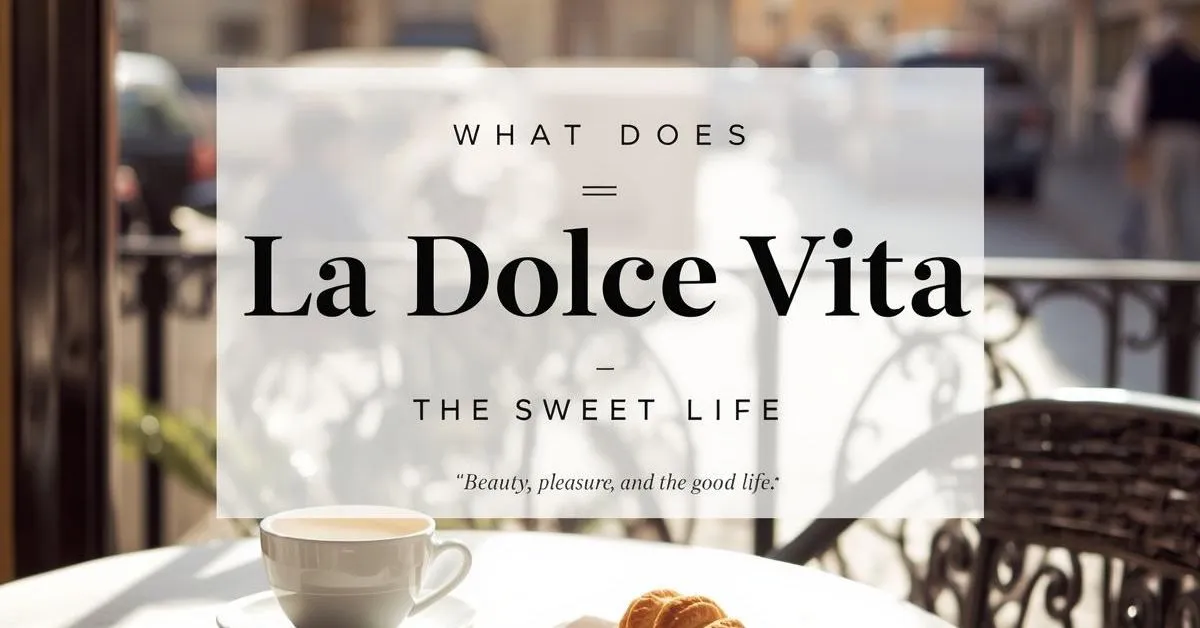
La dolce vita literally means “the sweet life” in Italian. In natural English, it usually means the good life: a life associated with pleasure, beauty, leisure, style, and enjoyment.
Depending on context, it can suggest luxury and self-indulgence, or a slower, richer enjoyment of everyday pleasures.
If you have seen this phrase in a travel caption, a movie discussion, a fashion campaign, or a lifestyle article, the core idea is simple: living well and enjoying life.
But the phrase has more depth than many short definition pages explain.
La Dolce Vita Meaning at a Glance
Pronunciation: lah DOL-chay VEE-tah in Italian; English dictionaries also show anglicized pronunciations.
Literal translation: “the sweet life”
Natural English meaning: “the good life” or a life of pleasure, luxury, ease, and enjoyment
Tone: Usually positive, but sometimes slightly ironic in film or cultural discussion because of the phrase’s connection to Fellini’s La Dolce Vita.
What La Dolce Vita Means in Plain English
At the simplest level, la dolce vita means a life that feels enjoyable, attractive, and full of pleasure. Dictionaries commonly define it as a life of luxury, pleasure, or self-indulgence, while broader cultural usage often expands it to include beauty, leisure, and everyday enjoyment.
So when someone says, “They’re living la dolce vita,” they usually mean one of these things:
- They seem to be enjoying the good life
- They are surrounded by beauty, comfort, style, or excellent food
- They are taking time to enjoy life instead of rushing through it
- They are living in a way that feels elegant, indulgent, or effortlessly pleasurable
what does dolce vita mean
Dolce vita is an Italian phrase that means “sweet life.” It describes a way of living that focuses on enjoying life’s simple pleasures, such as good food, relaxing moments, friendship, beauty, travel, and meaningful experiences. The phrase became widely known through the Italian film La Dolce Vita, which helped make it popular around the world. Today, people often use dolce vita to describe a relaxed and enjoyable lifestyle rather than a specific place or activity. It can suggest slowing down, appreciating the present, and finding happiness in everyday moments.
Context and how people use it:
People use dolce vita when talking about an enjoyable, relaxed, or beautiful lifestyle.
It often appears in travel, fashion, food, photography, and social media captions.
Example 1: “We spent the afternoon enjoying the dolce vita by the sea.”
Example 2: “Fresh pasta, good friends, and sunshine—that’s the dolce vita.”
dolce vita definition
The definition of dolce vita is “sweet life” in Italian. It refers to a pleasant lifestyle filled with enjoyment, comfort, beauty, and memorable experiences. The idea is not simply about having expensive things or living without problems. Instead, it can mean taking time to appreciate what makes life feel special. A long dinner with friends, a peaceful walk, a beautiful sunset, or a relaxing vacation can all represent the idea of dolce vita. In modern English, the phrase is often used to describe an attractive and carefree way of living.
Context and how people use it:
The phrase is commonly used when describing pleasure, relaxation, travel, and beautiful everyday experiences.
People may also use it to express a desire to enjoy life more slowly and fully.
Example 1: “Her weekend in the countryside was the perfect dolce vita.”
Example 2: “He dreams of a dolce vita filled with travel and great food.”
what does la dolce vita mean
La dolce vita literally means “the sweet life” in Italian. It expresses the idea of enjoying life’s pleasures and appreciating beautiful experiences. The word “la” means “the,” while “dolce” means “sweet” and “vita” means “life.” Together, they create a phrase associated with pleasure, leisure, culture, food, beauty, and a relaxed lifestyle. The expression is also strongly connected with Federico Fellini’s famous 1960 film La Dolce Vita. Because of this cultural connection, the phrase can carry both a lifestyle meaning and a reference to Italian culture.
Context and how people use it:
People use la dolce vita to describe a joyful lifestyle or the pleasure of living well.
It is especially common in conversations about Italy, vacations, food, fashion, and luxury.
Example 1: “Our Italian vacation gave us a taste of la dolce vita.”
Example 2: “She loves the idea of la dolce vita—slow mornings and long dinners.”
dolce vita”: meaning
Dolce vita means “sweet life” and is used to describe a life centered on pleasure, beauty, relaxation, and enjoyment. It is an Italian expression that has become familiar in English because of its strong connection with Italian culture. The phrase can suggest enjoying delicious food, spending time with loved ones, traveling, or simply taking a break from a busy routine. Its meaning can change slightly depending on context. Someone might use it seriously to describe a lifestyle, while another person may use it playfully as a caption for a relaxing day or vacation.
Context and how people use it:
In casual use, dolce vita often describes a moment that feels peaceful, fun, or luxurious.
It can appear in captions, travel posts, restaurant descriptions, fashion writing, and everyday conversations.
Example 1: “Coffee on the balcony with that view—dolce vita!”
Example 2: “This little coastal town makes me feel like I’m living the dolce vita.”
la dolce vita in english
In English, la dolce vita translates most directly to “the sweet life.” It describes an enjoyable way of living that includes pleasure, relaxation, beauty, and appreciation for life. The phrase is Italian, but it is also commonly used in English without translation because it has become a familiar cultural expression. Depending on the situation, it may refer to an easygoing vacation, good food, stylish living, or simply enjoying a special moment. It does not always mean a wealthy or perfect life; it can also mean finding joy in ordinary experiences.
Context and how people use it:
English speakers often keep the Italian phrase when they want to give an idea an Italian or elegant feeling.
It is frequently used when discussing travel, food, fashion, leisure, and enjoying life.
Example 1: “After a busy month, she wanted a little taste of la dolce vita.”
Example 2: “The sunny café and fresh pastries felt like la dolce vita.”
dolce vita meaning in english
The dolce vita meaning in English is “sweet life.” It describes the enjoyment of life through pleasant experiences, relaxation, beauty, food, friendship, and leisure. The expression does not necessarily mean having a perfect or luxurious life. Instead, it often suggests making time for things that bring happiness and appreciating the present. In English, dolce vita can be used as a noun phrase to describe a lifestyle or a particular moment that feels enjoyable and carefree. It is especially popular in travel, lifestyle, fashion, restaurant, and social media content.
Context and how people use it:
People use dolce vita when they want to express the pleasure of living well and enjoying special moments.
It can describe anything from an Italian holiday to a simple evening spent with people you love.
Example 1: “Good food and great company are part of the dolce vita.”
Example 2: “Their weekend getaway was all about enjoying the dolce vita.”
definition of dolce vita
The definition of dolce vita is “sweet life,” an Italian expression for a pleasurable and enjoyable way of living. It is often linked with relaxation, good food, social connection, beauty, travel, and taking pleasure in everyday experiences. The phrase became internationally famous through Federico Fellini’s 1960 movie La Dolce Vita, but its everyday use today is broader. Someone can use it to describe a peaceful vacation, an elegant lifestyle, or even a simple dinner enjoyed without rushing. At its heart, dolce vita is about appreciating life rather than constantly hurrying through it.
Context and how people use it:
The expression is often used positively to describe moments filled with comfort, pleasure, and enjoyment.
People commonly use it in travel, lifestyle, food, fashion, and social media contexts.
Example 1: “Sitting beside the lake with a good book was pure dolce vita.”
Example 2: “Their restaurant promotes the dolce vita with relaxed dining and fresh Italian dishes.”
la dolce vita definition
The la dolce vita definition is “the sweet life.” It refers to a lifestyle or experience that emphasizes pleasure, relaxation, beauty, and enjoyment. In Italian, la means “the,” dolce means “sweet,” and vita means “life.” The expression became famous internationally through Federico Fellini’s film La Dolce Vita, released in 1960. Today, people often use it more generally to talk about enjoying life’s pleasures, especially food, travel, culture, friendship, and leisure. It can describe both an overall lifestyle and a single moment that feels especially enjoyable.
Context and how people use it:
People use la dolce vita to express the idea of enjoying life instead of always focusing on work or stress.
It is often used in travel writing, captions, fashion, restaurants, and conversations about Italian culture.
Example 1: “They spent their honeymoon embracing la dolce vita in Italy.”
Example 2: “A sunset dinner with friends is my idea of la dolce vita.”
Literal Translation vs. Real Meaning
This is where many articles stop too early.
The literal translation is easy:
- la = the
- dolce = sweet
- vita = life
So yes, la dolce vita means “the sweet life.” But in real use, the phrase often means more than a word-for-word translation. In English, it usually works more like “the good life” or a beautiful, pleasure-filled way of living.
That difference matters because readers often want the real-world meaning, not just the translation.
Does La Dolce Vita Mean Luxury or Simple Pleasure?
It can mean both.
Some dictionary-style definitions stress luxury, ease, self-indulgence, or even indolence. But in modern lifestyle writing, the phrase is often used more softly to suggest:
- long lunches
- beautiful surroundings
- good conversation
- stylish simplicity
- enjoying small daily pleasures
- living at a slower, more intentional pace
That broader interpretation is now common in travel, design, hospitality, and social media contexts.
So the best reading depends on context:
| Context | What it usually means |
|---|---|
| Dictionary / formal definition | a life of pleasure, luxury, or self-indulgence |
| Travel or lifestyle writing | the good life, beauty, leisure, and enjoyment |
| Film or cultural discussion | glamour mixed with irony, excess, or critique |
| Social captions / branding | elegance, pleasure, romance, style, and ease |
How People Use La Dolce Vita Today
Today, people use la dolce vita in a few common ways.
1. To describe a beautiful lifestyle
Example:
“They moved to the coast and now they’re living la dolce vita.”
This suggests a life that feels pleasant, relaxed, and attractive.
2. To create an Italian or Mediterranean mood
Example:
“The hotel campaign leans into a la dolce vita aesthetic.”
Here the phrase signals elegance, sunshine, café culture, charm, and visual pleasure.
3. To talk about pleasure without sounding too direct
Example:
“For her, la dolce vita means coffee, slow mornings, and dinner with friends.”
This use is less about money and more about quality of life.
4. To reference glamour with a knowing edge
Example:
“The scene felt straight out of La Dolce Vita.”
In this kind of use, the phrase may hint at spectacle, nightlife, image, celebrity culture, or even emptiness beneath glamour.
dolce vita meaning
Dolce vita is an Italian expression that means “sweet life” or “the good life.” It describes a pleasant way of living filled with happiness, beauty, comfort, enjoyment, and memorable experiences. The phrase can suggest enjoying simple pleasures, such as good food, travel, friendship, relaxation, art, or time with loved ones. It became especially famous through the Italian film La Dolce Vita, which helped make the expression popular around the world. Today, people often use dolce vita when talking about a relaxed, joyful, stylish, or enjoyable lifestyle. It can describe both everyday happiness and a dream of living life to the fullest.
Context and how people use it:
It is often used when discussing an enjoyable, beautiful, or carefree lifestyle.
People may use it in captions, travel posts, conversations, and descriptions of relaxing experiences.
Example 1: “Sitting by the sea with fresh Italian food feels like dolce vita.”
Example 2: “She moved to the countryside to enjoy a slower dolce vita.”
la dolce vita meaning
La dolce vita is an Italian phrase that literally means “the sweet life.” In natural English, it is often understood as “the good life,” meaning a life filled with pleasure, beauty, comfort, and enjoyable experiences. The expression can refer to appreciating life’s special moments rather than constantly worrying about work or responsibilities. It is also strongly connected with Italian culture and the famous 1960 film La Dolce Vita directed by Federico Fellini. Because of this cultural connection, the phrase can carry ideas of glamour, nightlife, romance, travel, and luxury. However, it can also simply mean enjoying ordinary moments that make life feel happy and meaningful.
Context and how people use it:
The phrase is commonly used to describe a beautiful, enjoyable, or satisfying lifestyle.
People often use it in travel writing, social media captions, fashion, food, and lifestyle conversations.
Example 1: “A long lunch with friends was our little taste of la dolce vita.”
Example 2: “The hotel captures the relaxed spirit of la dolce vita.”
la dolce meaning
La dolce comes from Italian, where dolce means “sweet,” “gentle,” or “pleasant,” depending on the context. The word la is the feminine singular form of “the,” so la dolce can literally suggest “the sweet” or “the gentle one,” but its exact meaning depends on what follows it. By itself, it is usually incomplete because Italian adjectives normally describe a noun. For example, la dolce vita means “the sweet life,” while la dolce ragazza can mean “the sweet girl.” When people search for la dolce meaning, they are often referring to the phrase la dolce vita rather than using la dolce as a complete expression.
Context and how people use it:
Its meaning changes according to the Italian noun or phrase it belongs to.
People most commonly recognize it from expressions such as la dolce vita.
Example 1: “In la dolce vita, dolce describes the quality of life.”
Example 2: “The phrase la dolce ragazza can describe a sweet or kind girl.”
dolce vita translation
The most direct English translation of dolce vita is “sweet life.” However, a more natural English translation can be “the good life” depending on the sentence and intended meaning. Dolce means “sweet,” while vita means “life” in Italian. The phrase does not only describe sweetness in a literal sense. It can express the idea of enjoying happiness, beauty, comfort, relaxation, and life’s pleasures. In English, someone might use “the good life” when talking about a comfortable and enjoyable lifestyle. Therefore, both “sweet life” and “the good life” can work, but the best choice depends on the context.
Context and how people use it:
The literal translation helps explain the Italian words, while “the good life” sounds more natural in many English sentences.
People use the expression when discussing happiness, pleasure, travel, food, luxury, or relaxation.
Example 1: “Dolce vita translates literally as ‘sweet life.’”
Example 2: “In this context, ‘the good life’ is a natural translation of dolce vita.”
la dolce vita meaning in english
In English, la dolce vita means “the sweet life” and is commonly understood as “the good life.” It describes a lifestyle centered on enjoyment, beauty, pleasure, relaxation, and appreciating life’s experiences. The phrase can bring to mind sunny streets, delicious food, travel, stylish living, friendship, romance, and time spent enjoying the moment. It does not necessarily mean being rich or living extravagantly. Someone can experience la dolce vita through simple pleasures, such as having coffee with a friend or watching a sunset. The expression became internationally famous through Federico Fellini’s 1960 film La Dolce Vita, which gave it an important cultural meaning.
Context and how people use it:
In English, the phrase is often used to describe an enjoyable or attractive way of life.
People commonly use it in travel, lifestyle, food, fashion, and social media content.
Example 1: “For me, fresh pasta and a sunset are part of la dolce vita.”
Example 2: “Their Italian vacation gave them a chance to experience la dolce vita.”
la dolce vita pronunciation
The Italian phrase la dolce vita is pronounced with three clear words and natural Italian rhythm. English speakers may be tempted to pronounce it exactly as written in English, but Italian pronunciation is generally more consistent than English spelling. The c in dolce has a soft sound because it comes before e, similar to the sound in “church” at the start of the word. The phrase is usually spoken smoothly rather than with heavy emphasis on every word. Learning the natural rhythm can make it sound more authentic. The pronunciation is useful when ordering Italian food, discussing Italian culture, or using the phrase in conversation.
Context and how people use it:
People pronounce the phrase when talking about Italian culture, travel, movies, food, or lifestyle.
It is also commonly spoken when describing an enjoyable or relaxed experience.
Example 1: “She learned the Italian pronunciation before visiting Rome.”
Example 2: “He used the phrase while talking about his relaxing Italian vacation.”
la dolce vita”: meaning
La dolce vita means “the sweet life” in a literal translation and “the good life” in natural English. The quotation marks or extra punctuation in the search phrase do not change the meaning of the Italian expression. It describes a life that includes happiness, pleasure, beauty, relaxation, and appreciation of enjoyable moments. The phrase can be used for a luxurious lifestyle, but it can also describe simple joys. Its popularity comes partly from the famous Italian film La Dolce Vita, which explored glamour, entertainment, relationships, and modern life. Today, the phrase is widely understood as an invitation to enjoy life’s pleasures and memorable experiences.
Context and how people use it:
The expression is often used when people want to describe an attractive, joyful, or pleasure-filled lifestyle.
It appears frequently in captions, travel content, restaurant descriptions, fashion, and cultural discussions.
Example 1: “Weekend breakfasts in the garden feel like la dolce vita.”
Example 2: “The magazine used la dolce vita to describe the city’s elegant lifestyle.”
la vita dolce meaning
La vita dolce literally means “the sweet life” in Italian. The words are understandable individually, but the more famous and established Italian expression is la dolce vita. In la dolce vita, the adjective dolce comes before vita, creating the well-known phrase associated with “the good life.” La vita dolce places the adjective after the noun, which gives it a different word order and is not the standard famous expression. Someone searching for la vita dolce meaning may therefore be looking for the same general idea of a pleasant or enjoyable life. For the classic expression, la dolce vita is the form to use.
Context and how people use it:
It can be understood as describing a sweet or pleasant life, but it is less common than la dolce vita.
People often encounter it while comparing Italian word order or searching for the famous expression.
Example 1: “The phrase suggests a life filled with pleasant experiences.”
Example 2: “For the well-known Italian expression, use la dolce vita rather than la vita dolce.”
la dolce vita translation
The standard translation of la dolce vita is “the sweet life.” In everyday English, “the good life” often communicates the idea more naturally. La means “the,” dolce means “sweet,” and vita means “life.” Together, the phrase describes an enjoyable and fulfilling way of living. Depending on the context, it can suggest relaxation, pleasure, beauty, comfort, travel, food, romance, or simply appreciating the present moment. The phrase is also deeply connected to Italian popular culture because of Federico Fellini’s famous 1960 film. Today, it is commonly used beyond Italy as a stylish way to describe an enjoyable lifestyle.
Context and how people use it:
The literal translation is “the sweet life,” while “the good life” often works better in natural English.
People use it to talk about enjoyable experiences, beautiful surroundings, relaxation, and life’s pleasures.
Example 1: “The literal translation of la dolce vita is ‘the sweet life.’”
Example 2: “The travel blogger described her vacation as living the good life.”
definition of la dolce vita
The definition of la dolce vita is a pleasurable, beautiful, and enjoyable way of living. Literally translated from Italian, it means “the sweet life.” The expression is often used to describe enjoying good food, travel, friendship, romance, comfort, art, relaxation, and other pleasures. It can suggest luxury, but luxury is not required. A person may experience la dolce vita by enjoying a peaceful morning, sharing a meal with loved ones, or taking time away from a busy routine. The phrase became famous internationally through Federico Fellini’s 1960 film and is now widely used in English-language culture.
Context and how people use it:
The phrase is used to describe a lifestyle or moment that feels especially enjoyable, beautiful, or satisfying.
People commonly use it in conversations, travel stories, lifestyle writing, captions, and descriptions of Italian culture.
Example 1: “A peaceful afternoon by the coast was her idea of la dolce vita.”
Example 2: “The restaurant’s atmosphere reflects the relaxed feeling of la dolce vita.”
Where the Phrase Became Famous
The phrase became globally famous through Federico Fellini’s 1960 film La Dolce Vita, starring Marcello Mastroianni and featuring one of cinema’s most famous images: Anita Ekberg in Rome’s Trevi Fountain. Britannica describes the film as a major work and notes that it presents an ironic, critical view of modern decadence, mass consumerism, and shallow high society.
This matters because the phrase did not spread in English as just a neutral Italian expression. It spread with a strong cultural mood attached to it: glamour, nightlife, spectacle, temptation, and unease.
Why the Film Connection Still Matters
Many people use la dolce vita in a purely positive way now, especially in travel and lifestyle content. But the film behind the phrase was not simply celebrating glamour. It also questioned it.
Britannica describes the movie as an indictment of decadence, mass consumerism, and the emptiness of modern social life. It also notes that the film helped contribute paparazzi to English through the character Paparazzo.
That gives the phrase a subtle dual meaning:
- aspirational in lifestyle use
- critical or ironic in film and culture use
That tension is one of the most important things readers miss when they only get the translation.
Word History and English Usage
Merriam-Webster lists 1961 as the first known use of dolce vita in English and gives its etymology as Italian, literally “sweet life.” Merriam-Webster defines it as “a life of indolence and self-indulgence.”
That is useful because it shows two things at once:
- English treats it as a borrowed Italian expression
- The older dictionary sense leans more toward indulgence than the softer lifestyle meaning many people use today
When La Dolce Vita Works Best
The phrase works best when there is a sense of:
- pleasure
- elegance
- leisure
- beauty
- indulgence
- atmosphere
- romance
- stylish enjoyment
It fits naturally in writing about:
- travel
- fashion
- film
- food
- hospitality
- interiors
- culture
- luxury lifestyles
- slower living
When Not to Use It
Using la dolce vita for any pleasant moment can make the phrase feel forced.
It usually does not fit well when:
- the mood is purely casual with no sense of beauty, style, or pleasure
- the context is serious, technical, or formal
- you are describing hardship, stress, or everyday routine with no emotional contrast
- you want a plain translation only and do not need the cultural tone
For example, saying “I finished my inbox, la dolce vita” usually sounds unnatural unless you are being playful.
Common Misconceptions
It always means luxury
Not always. It can mean luxury, but it can also mean enjoying simple pleasures and a slower pace of life.
It only means “the sweet life”
That is the literal translation, but not the full explanation. In natural English, “the good life” is often closer to how people actually understand it.
It is just a travel phrase
No. People also use it in film, design, branding, fashion, and cultural writing.
It is always positive
Usually, yes. But in cultural or cinematic discussion, it can carry irony because of the Fellini connection.
La Dolce Vita vs. Dolce Far Niente
These phrases are related, but they are not the same.
La dolce vita is the broader idea of the sweet or good life.
Dolce far niente means the sweetness or pleasure of doing nothing.
A simple way to remember the difference:
- la dolce vita = living well
- dolce far niente = enjoying idleness or rest
If your goal is to describe a whole lifestyle, la dolce vita is the better phrase. If your goal is to describe the joy of slowing down and doing nothing, dolce far niente is more precise.
What Most Articles Miss About This Topic
Most articles either reduce la dolce vita to a flat translation or turn it into a vague lifestyle cliché.
What they miss is the balance between three real layers of meaning:
1. The dictionary layer
It can mean a life of luxury, ease, pleasure, or self-indulgence.
2. The cultural layer
The phrase became globally famous through Fellini’s film, which is not simply glamorous but also critical of decadence and consumerism.
3. The modern lifestyle layer
Today, many people use it more softly to mean savoring beauty, small pleasures, and a slower, richer way of living.
That combination is what makes the phrase so appealing. It sounds elegant and simple, but it carries more cultural texture than a basic translation suggests.
FAQs
Q: What does la dolce vita mean in english
A: “La dolce vita” means “the sweet life” or “the good life” in English.
Q: What does la dolce vita mean urban dictionary
A: On Urban Dictionary, “la dolce vita” generally refers to enjoying a pleasurable, relaxed, and luxurious lifestyle.
Q: La dolce meaning
A: “La dolce” literally means “the sweet” in Italian, though its meaning depends on the phrase.
Q: La Dolce Vita pronunciation
A: La Dolce Vita is pronounced with Italian pronunciation, with clear emphasis on the first syllable of “Dolce.”
Q: What language is La Dolce Vita
A: “La Dolce Vita” is an Italian phrase.
Q: Dolce vita meaning in Spanish
A: In Spanish, “dolce vita” can be understood as “la dulce vida,” meaning a sweet or enjoyable life.
Q: La Dolce Vita movie meaning
A: The movie explores pleasure, fame, relationships, and the emptiness that can exist behind a glamorous lifestyle.
Q: La Dolce Vita dress code
A: A La Dolce Vita dress code usually suggests elegant Italian-inspired clothing with a stylish, relaxed, and sophisticated look.
Conclusion
La dolce vita means “the sweet life,” but the best real-world explanation is broader: a life of pleasure, beauty, leisure, and enjoyment. Sometimes it suggests luxury and indulgence. Sometimes it points to the art of enjoying small daily pleasures well. And because of its connection to Fellini’s film, it can also carry a slightly ironic cultural edge.
That fuller explanation is what helps readers understand the phrase correctly, use it naturally, and avoid the shallow “just a translation” trap.
Click Below To Read About These Posts:
What Does High Maintenance Mean? Complete Guide
What Does Capricorn Mean? Personality, Traits, Hidden Secrets
What Does Git Mean? Complete Guide And Explanation

Hi, I’m Clara Lexis from Meanvia.com. I break down words and expressions so they’re easy to understand and enjoyable to learn. My mission is simple: make language approachable and fun, one word at a time.