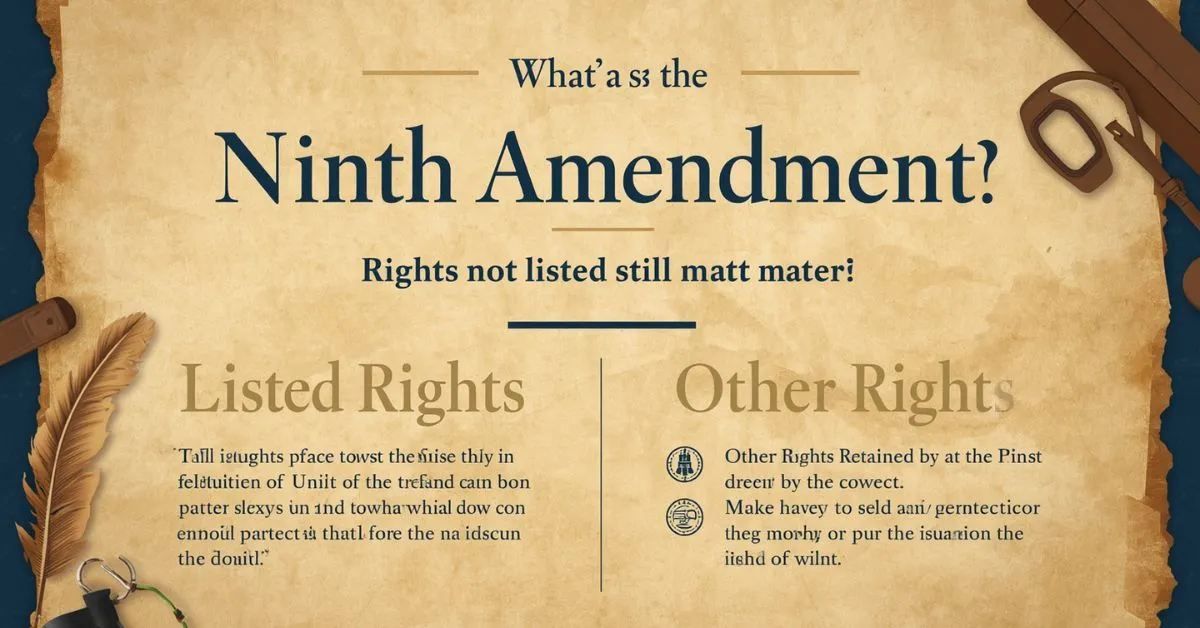
The Ninth Amendment means that the Constitution’s written list of rights is not necessarily the complete list of rights people have.
In simple terms, it warns that naming some rights in the Bill of Rights should not be used to deny or weaken other rights retained by the people.
If you want the shortest possible explanation, it is this: the Ninth Amendment tells readers not to assume that only written-down rights count.
That idea matters because the Bill of Rights names important freedoms, but the framers did not want anyone to argue that every unlisted liberty had been surrendered.
The Exact Text of the Ninth Amendment
“The enumeration in the Constitution, of certain rights, shall not be construed to deny or disparage others retained by the people.”
That sentence is short, but its warning is powerful: a list of rights should not be read as if it cancels every right left off the list.
9th amendment drawing
A 9th amendment drawing can show the main idea of the Ninth Amendment in a simple visual way. The amendment says that people may have other rights even if those rights are not specifically listed in the Constitution. A good school drawing could show a Constitution book with several written rights, while a person stands beside it holding a sign that says “Other Rights Are Protected Too.” You can add arrows from the Constitution to different symbols, such as privacy, choice, and personal freedom. Keep the design clean and easy to understand.
Context and how people use it:
Students often search for a 9th Amendment drawing for school projects, posters, or civics assignments.
The drawing usually uses simple symbols to explain that people have rights beyond those specifically written in the Constitution.
Examples:
- A Constitution book with a person standing beside a large “Other Rights” sign.
- A balance scale showing listed constitutional rights on one side and other individual rights on the other
What Is the Ninth Amendment in Simple Terms?
In plain English, the Ninth Amendment says this: just because the Constitution specifically names some rights, that does not mean those are the only rights people have.
A beginner-friendly way to understand it is to think of the Bill of Rights as a list of major protections, not necessarily a complete catalog of every liberty people retain.
The amendment pushes back against a narrow reading that would treat silence as surrender.
Why Was the Ninth Amendment Added?
The Ninth Amendment makes the most sense when you place it in the debate over the original Constitution. When the Constitution was first drafted, it did not include a bill of rights.
Federalists argued that the national government already had only limited, enumerated powers, so a separate list of rights was not strictly necessary. Antifederalists, however, strongly objected to ratification without clearer protections for individual liberty.
There was also a second concern. Some Federalists, including Alexander Hamilton in Federalist No. 84, argued that listing specific rights could be dangerous because people might later assume that any right not listed was unprotected. That is the problem the Ninth Amendment was designed to address.
James Madison acknowledged this exact problem when presenting amendments in Congress. He argued that enumerating some exceptions to government power could “disparage” rights left out of the list, and he said that concern could be guarded against by the language that became the Ninth Amendment.
Clause-by-Clause Breakdown
“The enumeration in the Constitution”
This means the Constitution names or lists certain rights. The clearest examples are the rights specifically protected in the Bill of Rights.
“of certain rights”
The key word here is certain. The Constitution protects some rights in express terms, but the text does not say those are the only rights that exist.
“shall not be construed”
This is interpretive language. It tells judges, lawmakers, and readers how not to read the Constitution. That is why many legal sources describe the Ninth Amendment as a rule of construction.
“to deny or disparage”
This means listed rights should not be used as a reason to reject, downgrade, or belittle other rights. The amendment is aimed at a bad inference: “If it is not listed, it does not count.”
“others retained by the people”
This is where the idea of unenumerated rights comes in. The amendment assumes that people may retain rights even when those rights are not specifically spelled out in constitutional text.
What Rights Does the Ninth Amendment Protect?
The careful answer is: the Ninth Amendment recognizes that unenumerated rights can exist, but it does not itself provide a tidy list of those rights.
That distinction matters. The amendment does not say, “Here are ten more hidden rights.” Instead, it blocks the argument that the written Constitution exhausts the universe of liberty. In that sense, it preserves room for rights that are retained by the people even if they are not expressly named.
This is why the Ninth Amendment is often discussed alongside ideas like natural rights, fundamental rights, and personal liberty. But readers should be careful: recognizing that unlisted rights may exist is not the same thing as proving that any claimed liberty is automatically protected as a constitutional right.
What the Ninth Amendment Does Not Mean
A common mistake is to assume that the Ninth Amendment turns every personal preference into a constitutional right. That is not how courts have generally treated it.
Congress’s Constitution Annotated explains that the amendment is better understood as a rule against reading the Bill of Rights too narrowly, rather than a blank check for judges to invent any right they prefer.
Another mistake is to assume the amendment has no real meaning at all. That goes too far in the other direction. The Ninth Amendment clearly reflects the framers’ belief that rights exist beyond those expressly listed in the first eight amendments, even if courts have often been cautious about how to enforce that idea.
Ninth Amendment vs. Tenth Amendment
These two amendments are often confused, but they do different jobs. Congress’s Constitution Annotated explains that the Ninth addresses fears that listing rights might imply the loss of other rights, while the Tenth addresses fears that listing rights might imply extra federal powers beyond those actually delegated.
| Amendment | Main focus | Plain-English meaning | Biggest confusion |
|---|---|---|---|
| Ninth Amendment | Rights | Listing some rights does not erase other rights retained by the people | People confuse it with states’ rights |
| Tenth Amendment | Powers | Powers not delegated to the federal government are reserved to the states or the people | People mix up rights and powers |
That is the easiest way to remember the difference: the Ninth is about rights; the Tenth is about powers.
9th amendment
The 9th Amendment is part of the United States Constitution and protects rights that are not specifically listed in the Constitution. It says that people have other rights beyond those written in the Constitution. This amendment helps make clear that the Bill of Rights should not be read as if it contains every right held by the people. It was added in 1791 as part of the Bill of Rights. In simple terms, the 9th Amendment recognizes that citizens can have important rights even when those rights are not directly named in the Constitution.
Context and how people use it:
It is mainly discussed when explaining unlisted rights and the meaning of the Bill of Rights.
People often mention it in constitutional discussions about whether a right must be specifically written down to exist.
Example 1: A student learns that the Constitution protects some rights without listing every possible individual right.
Example 2: A legal discussion may refer to the 9th Amendment when considering rights not specifically named in the Constitution.
ninth amendment
The Ninth Amendment, also called the 9th Amendment, is a constitutional protection found in the Bill of Rights. It explains that listing certain rights in the Constitution does not mean people have no other rights. This idea is important because the Constitution does not provide a complete list of every freedom or right a person may have. The amendment was designed to prevent the written list of rights from being treated as the only rights belonging to the people. It is therefore closely connected to broader discussions about individual liberty and constitutional interpretation in the United States.
Context and how people use it:
The term is commonly used in history, government, law, and constitutional studies.
People use it when discussing rights that are not expressly named in the Constitution.
Example 1: “Our government class covered the Ninth Amendment during a lesson about the Bill of Rights.”
Example 2: “The lawyer mentioned the Ninth Amendment while discussing unlisted constitutional rights.”
9th amendment simplified
The 9th Amendment simplified means that people have rights beyond the ones specifically written in the Constitution. The amendment was added because the founders understood that it would be impossible to list every right people could have. Its purpose is not to provide a detailed list of additional rights. Instead, it warns against assuming that a right disappears simply because it is not written in the Constitution. In everyday language, you can think of the Ninth Amendment as saying: “The Constitution lists some rights, but that list does not mean those are the only rights people have.”
Context and how people use it:
It is useful when explaining the amendment to students or readers who want a plain-English meaning.
People often use simplified explanations to understand the basic idea before studying its legal history.
Example 1: “The Ninth Amendment simplified means that people can have rights that are not specifically listed.”
Example 2: “My teacher gave us a 9th Amendment simplified explanation before discussing constitutional law.”
the 9th amendment
The 9th Amendment is the ninth amendment in the Bill of Rights and concerns rights that are not specifically written in the Constitution. Its main idea is that the Constitution’s written list of rights should not be interpreted as denying other rights held by the people. This makes the amendment different from provisions that name a particular freedom, such as freedom of speech or religion. Instead, it addresses the broader question of how to understand the rights of the people. The amendment remains an important part of discussions about constitutional interpretation and individual liberty.
Context and how people use it:
The phrase appears often in discussions about American constitutional rights and the Bill of Rights.
People use it when talking about rights that are not directly named in the Constitution.
Example 1: “We studied the 9th Amendment during our lesson on constitutional rights.”
Example 2: “The article explains how the 9th Amendment relates to unlisted rights.”
what is the 9th amendment
The 9th Amendment is a provision in the United States Bill of Rights that recognizes that people have rights beyond those specifically listed in the Constitution. It was ratified in 1791 along with the other amendments in the Bill of Rights. The amendment does not give a specific list of these additional rights. Instead, it prevents the written enumeration of certain rights from being understood as denying other rights retained by the people. In simple terms, the Constitution’s list of rights is not necessarily a complete list of every right that people may possess.
Context and how people use it:
This question is common among students and readers learning about the U.S. Constitution.
People usually ask it when they want a basic explanation of the amendment’s purpose and meaning.
Example 1: “What is the 9th Amendment? It protects the idea that people have rights beyond those specifically listed.”
Example 2: “I searched what is the 9th Amendment because I wanted to understand the Bill of Rights better.”
what does the 9th amendment mean
What does the 9th Amendment mean? It means that the rights specifically listed in the Constitution should not be treated as the only rights belonging to the people. The amendment recognizes that people may retain other rights even when those rights are not expressly named. This principle is important because the founders knew that no written document could realistically identify every right people might have. However, the amendment itself does not provide a complete catalog of those unlisted rights. Its basic purpose is to prevent the written enumeration of certain rights from being used to deny other rights.
Context and how people use it:
This phrase is often searched by people who want the amendment explained in straightforward language.
It is commonly used in schoolwork, constitutional discussions, and questions about individual rights.
Example 1: “What does the 9th Amendment mean? It means the Constitution’s listed rights are not necessarily the only rights people have.”
Example 2: “My professor explained what does the 9th Amendment mean during our constitutional law class.”
what is the ninth amendment
The Ninth Amendment is part of the U.S. Bill of Rights and addresses rights that are not specifically listed in the Constitution. It states that naming certain rights in the Constitution should not be understood as denying or taking away other rights retained by the people. The amendment was ratified in 1791 and is closely connected to the broader principle of individual liberty. Unlike some amendments that identify a particular freedom, the Ninth Amendment focuses on how the written list of rights should be interpreted. It therefore has an important place in constitutional history and legal discussions.
Context and how people use it:
People commonly use this question when learning about the Constitution or preparing for a government class.
It is also used when discussing the difference between listed constitutional rights and other rights.
Example 1: “What is the Ninth Amendment? It addresses rights that are not specifically listed in the Constitution.”
Example 2: “The textbook answers what is the Ninth Amendment in a short section about the Bill of Rights.”
the ninth amendment
The Ninth Amendment is the ninth provision in the U.S. Bill of Rights. Its purpose is to make clear that the Constitution’s decision to list certain rights does not mean people have no other rights. This matters because the Bill of Rights identifies several important freedoms, but it was never intended to suggest that every possible right had been written down. The Ninth Amendment therefore supports a broader understanding of individual rights. Its language is short, but its meaning has been part of continuing constitutional discussions about liberty, interpretation, and the relationship between written protections and other rights.
Context and how people use it:
The phrase is common in American history, civics, and constitutional law discussions.
People use it when referring to the amendment’s role in recognizing rights beyond the written list.
Example 1: “The ninth amendment is an important part of the Bill of Rights.”
Example 2: “Our class discussed the ninth amendment while studying individual freedoms.”
9th amendment meaning
The 9th Amendment meaning centers on the idea that people have rights beyond those expressly listed in the Constitution. It was included in the Bill of Rights to prevent the written enumeration of certain rights from being interpreted as denying other rights retained by the people. In simple terms, the amendment says that the Constitution’s list should not automatically be treated as a complete list of every individual right. It does not, by itself, name all of these additional rights. Instead, it establishes an important principle about how the Constitution’s written rights should be understood.
Context and how people use it:
This phrase is often used by students and online readers searching for a quick explanation of the amendment.
People also use it when discussing constitutional interpretation and rights that are not specifically named.
Example 1: “The 9th Amendment meaning is connected to rights that are not expressly listed.”
Example 2: “I looked up the 9th Amendment meaning before starting my government assignment.”
amendment ix
Amendment IX, written with Roman numerals, is another way of referring to the Ninth Amendment of the United States Constitution. It is part of the Bill of Rights and addresses rights that are not specifically enumerated in the Constitution. The amendment says that the listing of certain rights should not be interpreted as denying or disparaging other rights retained by the people. This makes Amendment IX especially relevant when people study the scope of constitutional rights. While its wording is brief, its principle raises an important question: Does the Constitution’s written list contain every right people possess? The Ninth Amendment says the answer is no.
Context and how people use it:
“Amendment IX” is often used in formal legal, academic, and constitutional writing.
People may also search this term when they see the Ninth Amendment written using Roman numerals.
Example 1: “Amendment IX is part of the Bill of Rights.”
Example 2: “The legal textbook refers to Amendment IX when discussing unenumerated rights.”
How the Supreme Court Has Interpreted the Ninth Amendment
The Ninth Amendment has been cited far less often than many other constitutional provisions. Congress’s Constitution Annotated notes that it appeared infrequently in Supreme Court decisions and has generally not been the main basis for broad rights rulings.
One early example is United Public Workers v. Mitchell in 1947, where the Court acknowledged arguments involving political rights under the Ninth and Tenth Amendments while upholding the Hatch Act.
The case is often mentioned to show that the amendment existed in constitutional argument, but it did not turn the Ninth Amendment into a broad standalone engine of rights enforcement.
The best-known Ninth Amendment discussion came in Griswold v. Connecticut in 1965. The Court struck down a law banning contraceptive use by married couples, and Justice Arthur Goldberg argued in concurrence that the Ninth Amendment supported protection for unenumerated rights such as aspects of privacy. At the same time, he also said the amendment was not an independent source of rights by itself, but evidence that the Constitution’s listed rights were not exhaustive.
That point is important because modern liberty cases have often been analyzed through substantive due process under the Fifth and especially the Fourteenth Amendment, rather than through the Ninth Amendment alone.
Cornell’s legal explainer notes that substantive due process has been used to protect certain fundamental rights from government interference, including rights related to marriage, parenting, and privacy.
Does the Ninth Amendment Protect Privacy?
The careful answer is: it has been part of privacy debates, but it is usually not the only or main constitutional basis courts rely on. Justice Goldberg’s concurrence in Griswold used the Ninth Amendment to reinforce the idea that fundamental rights can exist even if they are not specifically listed.
But other justices and later doctrine have often leaned more heavily on the Fourteenth Amendment’s liberty protections.
So if someone says, “The Ninth Amendment is the privacy amendment,” that is too simplistic. A more accurate statement is that the Ninth Amendment has influenced arguments about privacy and unenumerated rights, while the Court has often built modern doctrine elsewhere.
A Simple Real-Life Analogy
Imagine a school handbook that lists three student protections:
- the right to appeal a suspension
- the right to see grading rules
- the right to meet with an advisor
Now imagine the school says that because the handbook does not specifically mention fair notice before a serious disciplinary hearing, students do not deserve it. The Ninth Amendment pushes against that style of reasoning. A written list can be important without pretending to be complete.
This analogy is not constitutional law, but it captures the amendment’s basic logic: do not use a partial list to wipe out what was not listed.
Common Misconceptions
“The Ninth Amendment creates any right a judge wants.”
No. The amendment supports the idea that unenumerated rights may exist, but Congress’s Constitution Annotated emphasizes that it is generally understood as a rule of construction, not a free-floating license for judges to constitutionalize every claimed liberty.
“The Ninth Amendment is basically the Tenth Amendment.”
No. The Ninth deals with rights retained by the people. The Tenth deals with powers reserved to the states or the people when those powers were not delegated to the federal government.
“If a right is not listed, it cannot be constitutional.”
That is exactly the assumption the Ninth Amendment warns against. Its whole purpose is to prevent the Bill of Rights from being read as if it were an exhaustive inventory of liberty.
What Most Articles Miss About This Topic
Most articles stop at “the Ninth Amendment means there are rights not listed in the Constitution.” That is true, but incomplete. The deeper point is that the Ninth Amendment is also a rule about how to interpret the Constitution. It tells readers not to treat enumeration as exhaustion.
Another subtle point many pages miss is that the amendment sits between two different constitutional concerns from the founding era. One concern was liberty: people wanted clearer protection for individual rights.
The other was structure: people worried that listing some rights could distort how the Constitution would later be read. The Ninth Amendment addresses that second problem directly.
A third overlooked point is that the amendment still matters even when courts do not rely on it as the lead doctrinal tool. It remains important because it rejects an overly cramped understanding of liberty and preserves the constitutional idea that written rights are not the whole story.
Quick Summary
If you need to explain the Ninth Amendment in one sentence, say this:
The Ninth Amendment means that the Constitution’s list of rights is not necessarily complete, so unlisted rights should not be denied just because they were not specifically written down.
FAQs
Q: 10th Amendment
A: The 10th Amendment reserves powers not given to the federal government to the states or the people.
Q: 9th Amendment examples
A: Examples include rights to privacy and other individual rights that are not specifically listed in the Constitution.
Q: 10th Amendment simplified
A: The 10th Amendment means that powers not given to the federal government belong to the states or the people.
Q: Why is the 9th Amendment important
A: The 9th Amendment is important because it recognizes that people have rights beyond those specifically listed in the Constitution.
Q: What does the 9th Amendment protect
A: The 9th Amendment protects unlisted rights held by the people, even when those rights are not specifically named in the Constitution.
Q: 9th Amendment drawing
A: A 9th Amendment drawing can illustrate the idea that people have rights beyond those specifically written in the Constitution.
Q: When was the 9th Amendment ratified
A: The 9th Amendment was ratified on December 15, 1791, as part of the Bill of Rights.
Q: 9th Amendment name
A: The 9th Amendment is commonly called the Ninth Amendment to the United States Constitution.
Conclusion
The Ninth Amendment means the Constitution’s written list of rights is not automatically the full list. That is its core message, and it remains a powerful one. It reminds readers that liberty cannot be reduced to only the rights that happened to be spelled out line by line in the Bill of Rights.
It also helps explain why the amendment still matters today. Even when modern cases are argued through other constitutional provisions, the Ninth Amendment preserves an important constitutional principle: a partial list of rights should not be used to deny the existence or value of other rights retained by the people.
Click Below To Read About:
What Does LLM Mean? Large Language Model Explained Simply
What Does Friction Mean? Complete Guide & Explanation
What Does Legally Separated Mean? Still Married, Not Divorced

Hi, I’m Evan Lexor, the voice behind Meanvia.com. I break down English words, slang, and phrases into clear, simple meanings that actually make sense. From modern internet terms to everyday expressions, my goal is straightforward: help you understand English better, faster, and with confidence, one word at a time.